

SUMMARY:
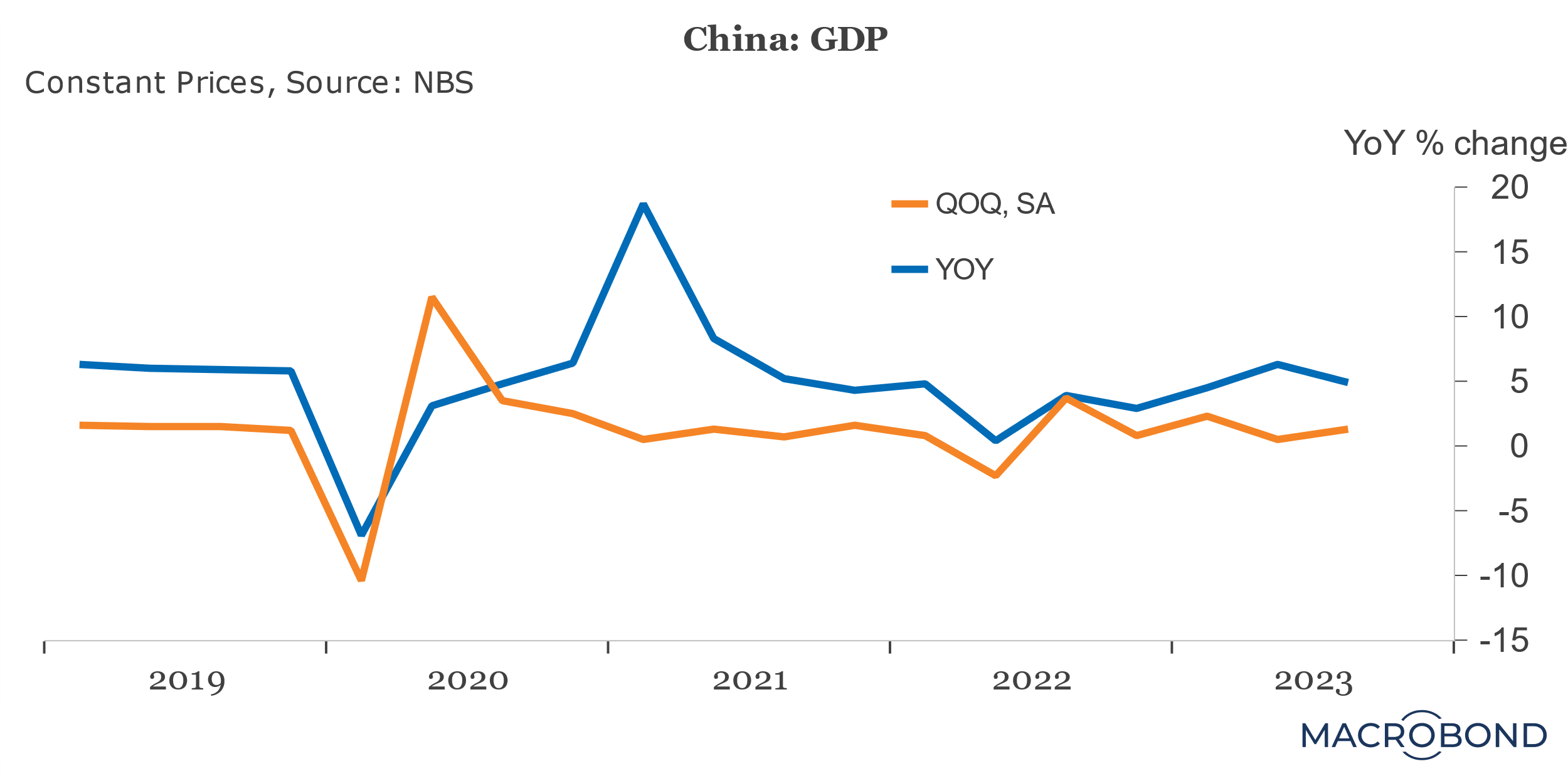
- China’s Q3 growth (4.9% y/y) puts GDP on track to meet Beijing’s annual target of “around 5%”; this further lowers the probability of new fiscal stimulus measures this year.
- While the economic recovery is strengthening it is not yet on solid ground; property remains a heavy drag on growth and the recovery in consumption is still subdued.
- Investor attention will now shift to end-year policy meetings that preview the outlook for 2024; continued support for growth will be important to sustain the recovery and avoid a potential double-dip next year.
China’s Q3 GDP solidly beat estimates, growing 4.9% year-on-year compared to the consensus forecast of 4.5%. On a sequential basis, GDP grew 1.3% quarter-on-quarter, compared to the consensus of 0.9% and Q2 growth of 0.5%. Monthly activity for September was broadly in line with forecasts, with a positive surprise from retail sales.
In our preview note yesterday (link HERE) we laid out two main ways to parse the data release: what it means for the stimulus outlook, and what it means for the strength of China’s broader recovery. Let’s take each in turn.
Additional stimulus is now even less likely in Q4
The strong Q3 print virtually guarantees that 2023 GDP growth will meet Beijing’s official target of “about 5%.” Year-over-year growth rates will be flattered in Q4 by the comparison to 2022, when China was in the throes of its chaotic pivot out of zero-Covid. Given these base effects, China can hit the 5% target even with flat sequential growth in Q4.
The easy path to hitting 5% rules out major additional fiscal stimulus this year. Beijing will see little need to expand spending other than a likely move to allow local governments to tap some of their 2024 quota for bond issuance early (rather than in March 2024) to avoid a drop off in infrastructure spending in Q1. Monetary policy will stay relatively supportive with the possibility of a rate cut or RRR cut in Q4.
An improving recovery but not yet a strong one
We have stressed the risk that China’s recovery stays anemic. The latest data show an improvement but do not eliminate those concerns. The recovery is gradually gaining strength but remains dependent on stimulus and is not yet on solid footing.
Consumption demand is recovering slowly
Consumption remained the key growth driver for China’s recovery, contributing 83% of GDP growth over the first three quarters. Among the positives:
- The quarterly household survey showed per capita consumption increasing 11% in real terms y/y in Q3, roughly even with Q2. That implies a decrease in the household saving rate given that real disposable income grew by roughly 6% in the quarter (down from 8% in Q2).
- The surveyed unemployment rate fell from 5.2% in August to 5% in September, the lowest level since 2021. Continued labor market strength will be key to accelerating income growth and supporting household consumption and – eventually – property investment.
However, given that consumption was hit hard by Covid containment measures in 2022, year-over-year growth numbers overstate the degree of current strength, particularly in retail sales. Nominal retail sales picked up by 5.5% y/y in September, compared to 4.6% y/y in August and the consensus forecast of 4.9%. But when viewed as a two-year compound growth rate (to reduce base effects from 2022), retail sales expanded by 4% in September, slower than the 5% rate in August; retail sales of goods (excluding services) slowed to 3.8% from 4.4% in August. The two main takeaways from stripping out base effects are: (1) the overall improvement in household spending remains modest; and (2) most of the recent improvement came in August, with momentum fading a bit in September.

Property looks only slightly “less bad”
Housing support measures accelerated in late August so it remains early to assess their effectiveness. Thus far, however, they are only having only a modest impact in stabilizing real estate sentiment and activity:
- The fall in property investment widened to -9.1% y/y ytd in September from -8.8% in August.
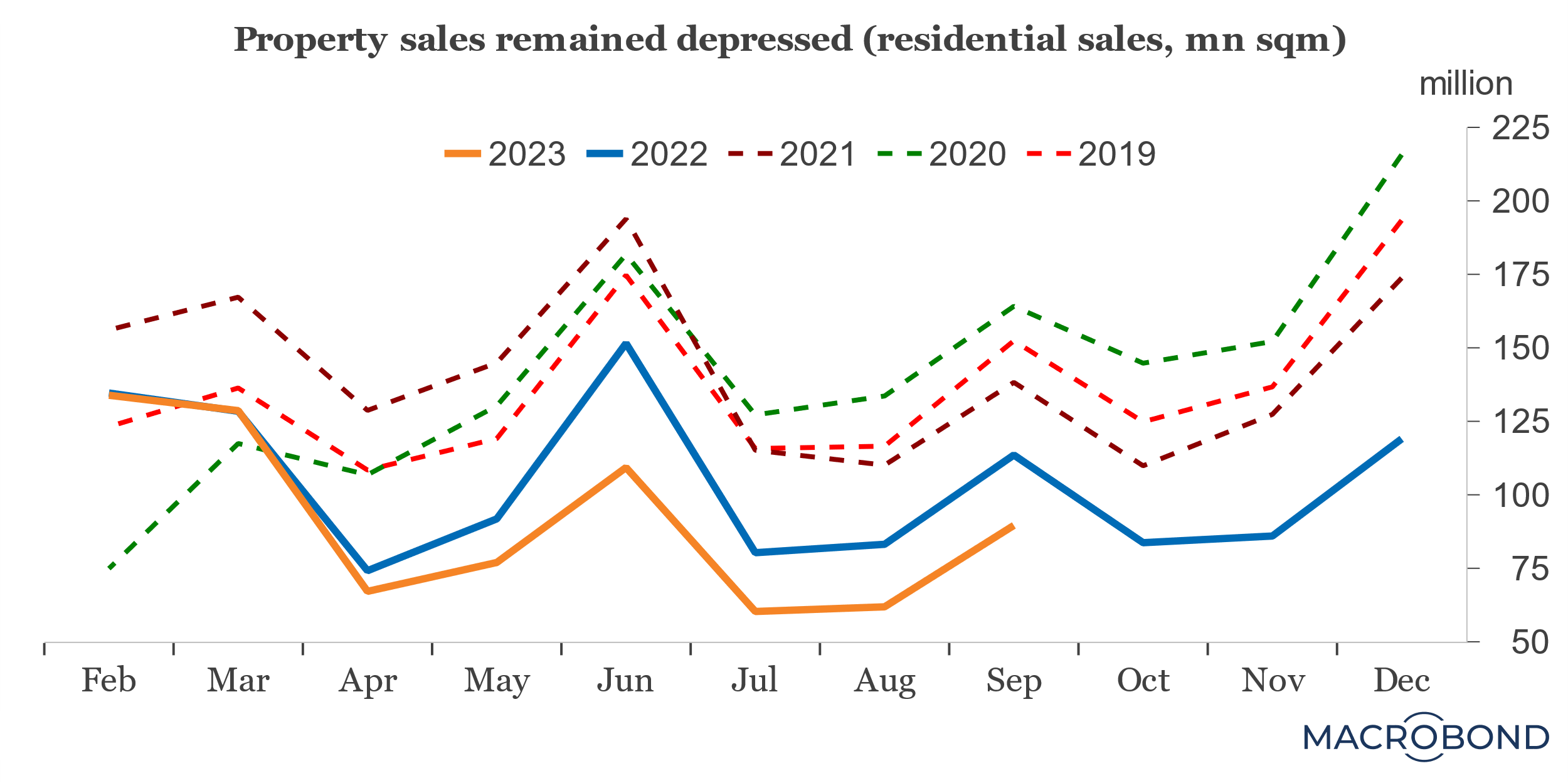
- Housing sales by area (chart below) fell by -21.1% in September, a narrowing contraction from August (-25.6%).
- With policymakers focusing on ensuring that developers finish stalled housing projects, completions remained strong (19.3% y/y, from 18.8% y/y in August). But with private developers’ scant resources tied up in completion, housing starts remained very weak at -24.4% y/y from -25.3% in August.
The two key stumbling blocks for a rebound in property remain: (1) subdued household confidence in income prospects; and (2) the ongoing financial troubles of private developers, which undermine confidence of would-be buyers and are only getting worse as Evergrande and Country Garden experience deepening distress.
Manufacturing investment is resilient
Weakness in property dragged down overall fixed asset investment (FAI) growth to 3.1% y/y ytd, from 3.2% y/y ytd in August. The other engines of FAI, manufacturing and infrastructure, provided significant support.
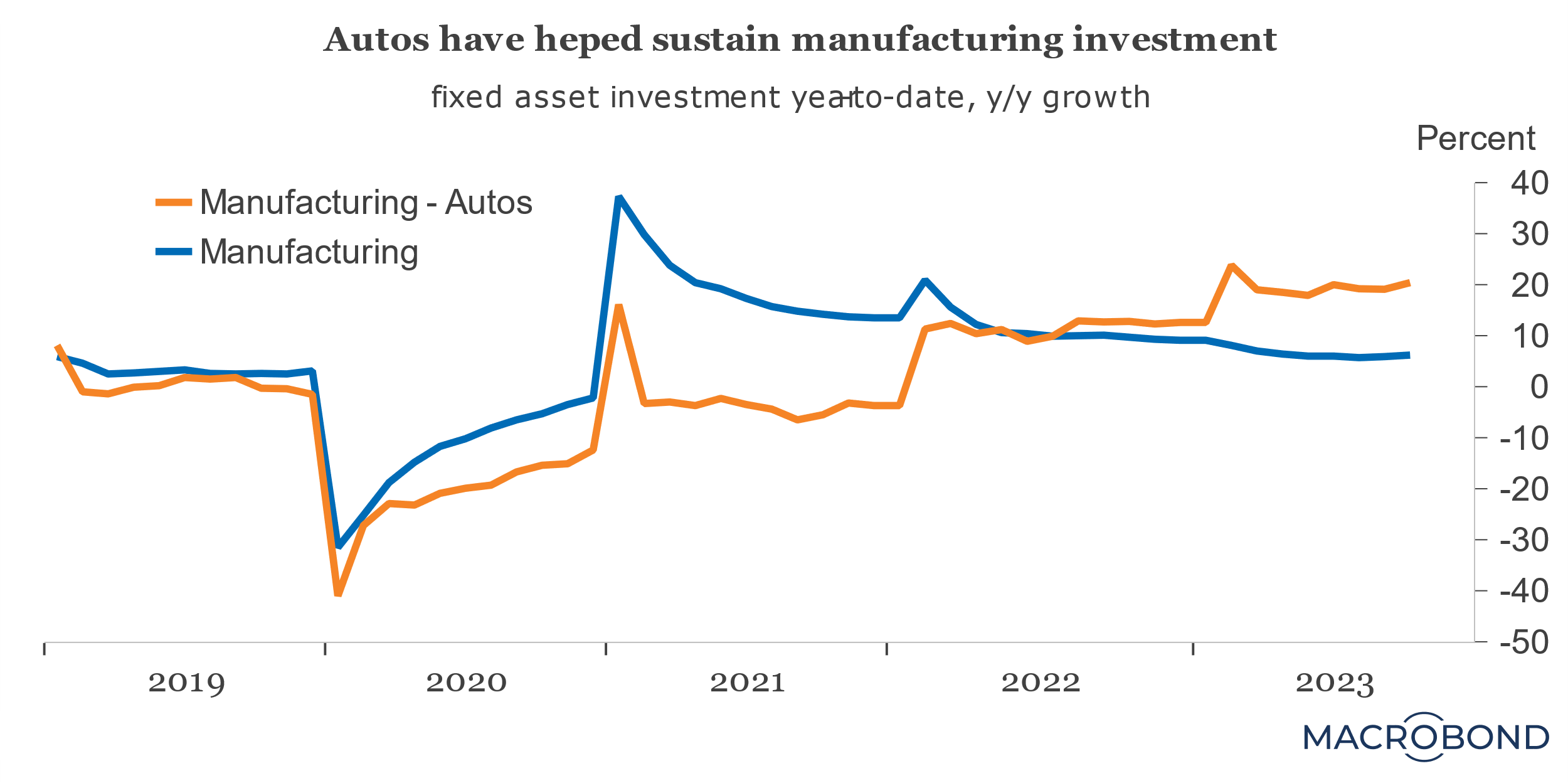
Manufacturing investment stayed surprisingly resilient, growing 6.2% y/y ytd from 5.9% in August; this translates to 7.9% growth y/y in September from 7.1% in August. The strength this year has helped support China’s commodity demand amid the collapse in property investment. Such resilience in manufacturing is notable given that export demand has been relatively weak and domestic demand fairly subdued. One driver is the auto sector, where investment was up 20% y/y ytd in September, reflecting China’s remarkable emergence as the world’s largest auto exporter (see our recent discussion HERE). While positive, such strength also raises questions about whether the expansion in manufacturing capacity is sustainable at this rate: some of the key areas of growth, including EVs, solar, and batteries, show signs of overcapacity.
Infrastructure investment picked up to 5% y/y in September, from 3.9% in August. Infrastructure spending will likely remain fairly strong for the remainder of Q4 as local governments make use of the proceeds of a recent surge in bond issuance to support construction projects.
Overall momentum slowed a bit in September
The final caveat to note with the latest data is that month-over-month growth slowed across the three major activity indicators: industrial production (.36% vs 5% in August), retail sales (.02% vs. .22% in August) and fixed asset investment (0.15% vs 0.2% in August). This is not a flashing red sign but is another marker that the recovery does not yet have strong momentum and remains dependent on stimulus.
Watchpoints
The gradual improvement in growth conditions removes most of the recent suspense about the near-term outlook as well as the prospect of new stimulus measures. Investor attention will increasingly shift to the following themes:
- The policy outlook for 2024: In December, China will hold the annual Central Economic Work Conference (CEWC) to preview policies for the following year. Given that private sector demand remains somewhat fragile, a key watchpoint is the degree of support that Beijing provides to growth, signaled in part by how high Beijing sets the GDP growth target (this will be officially announced in March 2024 but with clues provided at the CEWC). One risk for H1 2024 is that policymakers become complacent about the need to support growth, focusing on risk reduction instead, with the possibility of a double dip as current momentum fades. Recent signals have been somewhat reassuring, for example with PBOC governor Pan Gongsheng striking a dovish tone in comments at the IMF/World Bank meetings. Beijing has likely learned a lesson from insufficient support for growth this year, but we will be closely parsing signals as the CEWC approaches.
- Firefighting in real estate. While we don’t expect Beijing to provide sizeable new support to Evegrande or Country Garden, how regulators and local officials handle the (ongoing) collapses of these firms will be important for property sentiment and potential spillovers to growth and financial stability.
- US-China and geopolitics. Our note yesterday (link HERE) explained that while updated US export controls are a big deal – both for US semiconductor firms and for China – we do not expect the new measures to scuttle a likely meeting between President Biden and General Secretary Xi Jinping at the APEC summit in mid-November. It will be important to monitor the ongoing fallout from the new restrictions, including China’s potential retaliation, amid preparations for that meeting.

