In recent reports we have noted that China’s economic activity has stabilized but still at relatively low levels (see our take on August activity data HERE). The main risk for the economy and markets is that this remains an anemic recovery and possibly a long-term malaise, with targeted stimulus not delivering a forceful enough counter-cyclical push to offset the drag from the property sector and from a vicious cycle of weak private sector demand and muted expectations.
China’s recent PMI data for September are consistent with the “stabilizing at low levels” dynamic. In the chart below I have combined the official composite PMI produced by China’s statistical bureau with the composite PMI produced by Caixin and S&P Global. Over the last three months, this “composite of the composite” has held steady at 51.5, still in the expansionary zone but commensurate with a subdued recovery.

Among the caveats is that the PMI, as a diffusion index, does not report on actual levels of economic activity. And I am sure my composite of the two different composite PMIs breaks all manner of sound data practices. But if one isn’t being too literal, the point still stands that PMIs show activity firming but not at a robust clip.
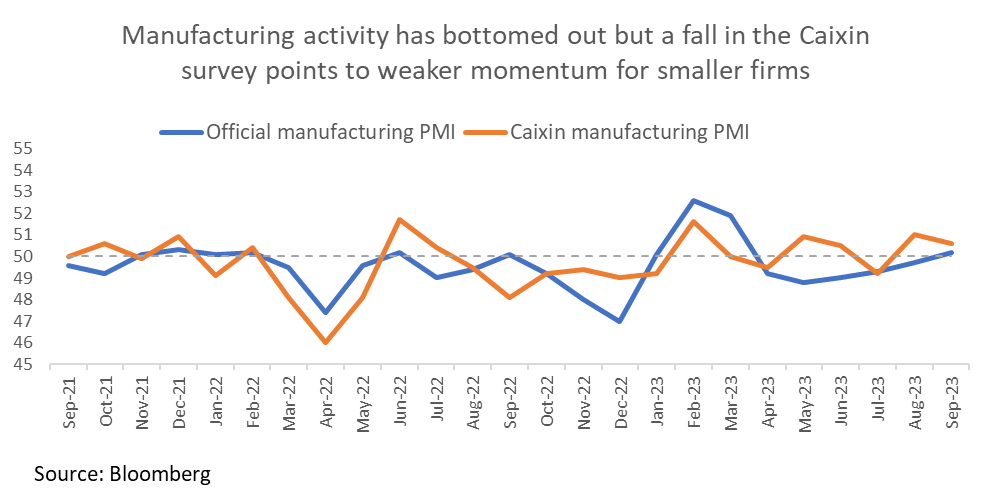
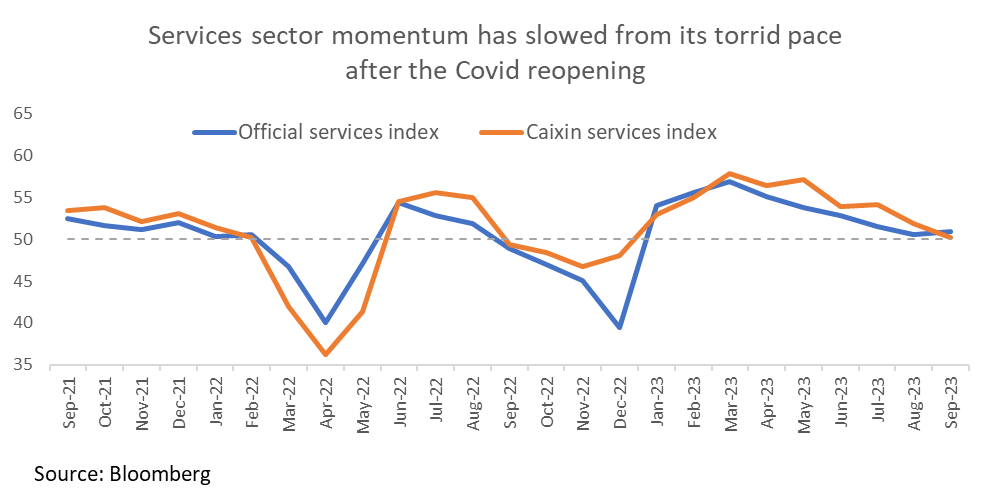
There is of course a lot happening in the details, and some of the signals are mixed. The official and Caixin series tell somewhat different stories regarding economic momentum in September. The official series, which is tilted towards larger firms, showed an improvement both in the manufacturing PMI (50.2 in September, up from 49.7 in August) and the services PMI (50.9, up from 50.2 in September). The Caixin survey, tilted towards smaller, private, and export-oriented firms, showed a dip in momentum: manufacturing stayed in expansion but slowed to 50.6 from 51 in August, while services dipped to 50.2, the lowest level this year and down from 51.8 in August.
My overall take on the PMI readings is as follows:
- Manufacturing, which had been the weakest part of China’s recovery, is stabilizing under the influence of incremental stimulus policies. New orders in the official series (50.5) have improved for four straight months and should see some additional support from infrastructure spending in coming months (see further below). However, the divergence between the official and Caixin series is among the indications that momentum is improving the most for larger firms, who are more likely to be state-owned and to benefit from infrastructure-focused stimulus. Private firms and smaller firms (there is a large overlap between the two categories) do not benefit as much from infrastructure stimulus spending and face weak export orders and soft domestic private sector demand. A sustained improvement in their outlook is important for employment, as the private sector and SME sector are the China’s main engines of job growth.
- The service sector, which has powered the recovery since the Covid pivot late last year, is slowing from its torrid pace. This is another potential drag on employment and income growth, with services larger than manufacturing as a share of the economy and more labor-intensive by nature.
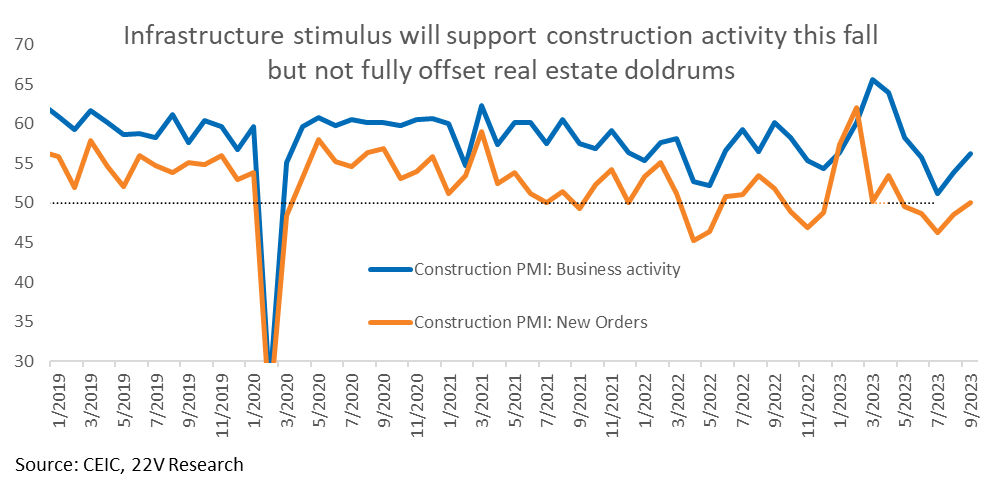
- Construction activity remains anemic overall due to the collapse of housing investment but is picking up incrementally due to an acceleration of infrastructure projects. This impulse from infrastructure investment should continue for at least the next several months. In September, local governments completed their issuance of special bonds allotted at the start of the year to finance infrastructure projects, and that fund-raising will translate to real construction activity this fall. However, the strength and durability of this impulse is likely to be limited due to the weak overall state of local government finances and Beijing’s determination to prevent further growth in local debt.
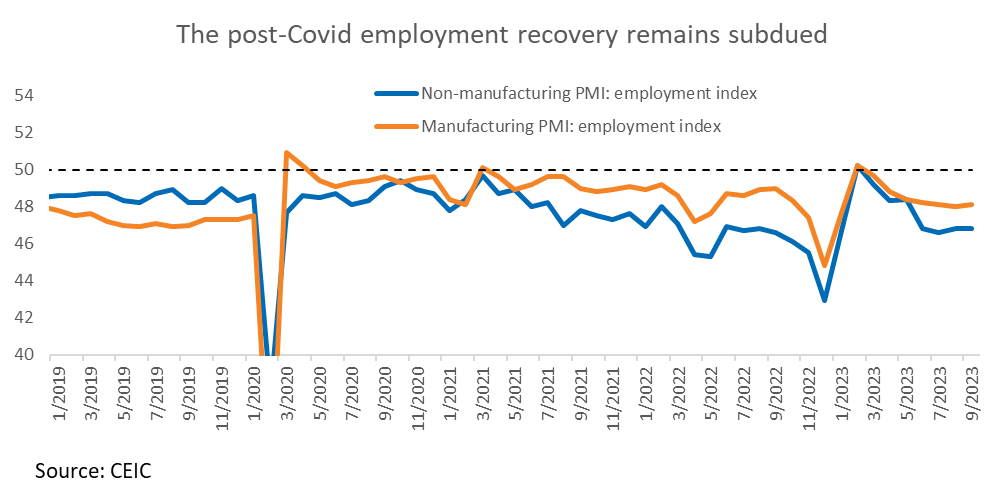
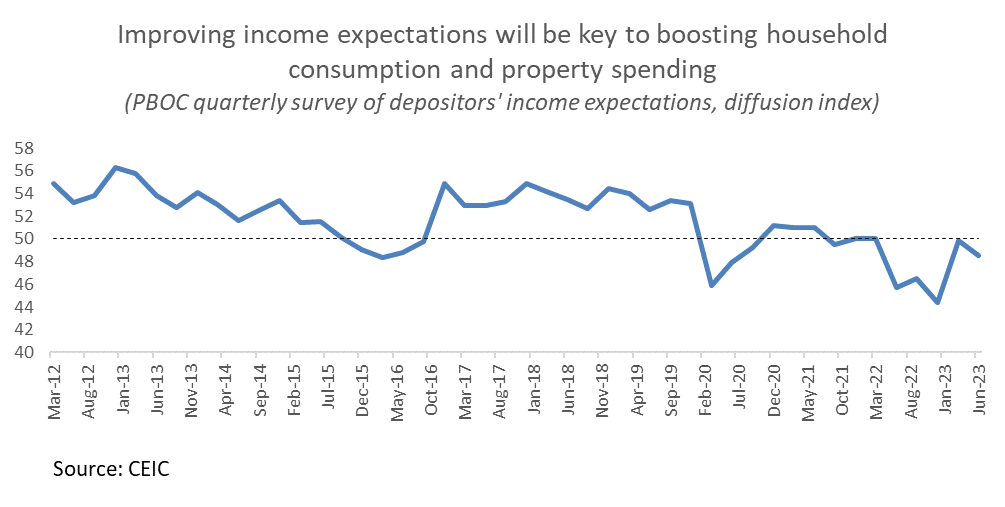
- Slowing momentum in services, the weak overall state of property construction, and subdued expansion for smaller and private firms are all contributing to a slow employment recovery (see charts below). Stronger employment growth would help boost household income expectations and wiliness to spend on property as well as big-ticket consumption items, but Beijing’s restrained stimulus policies are having a lagged and relatively indirect effect on job creation.
Implications:
Forthcoming data, in particular the report on monthly economic activity and 3Q GDP to be released on 17 October, will be critical for filling in the very partial picture that the PMI readings provide. For now, however, the PMI suggest that China is not yet out of danger from an anemic recovery. Infrastructure stimulus will provide at least modest support in coming months to heavy industry and demand for construction materials. But lackluster employment growth will constrain growth in household consumption and property investment, key requirements for a recovery in end-demand and a broader and more durable economic rebound.