SUMMARY
- The financial woes of property developer Country Garden highlight the vicious cycle continuing to play out in the real estate sector between weak housing sales, fragile household confidence, and debt repayment pressures. Beijing’s recent easing moves will not arrest these dynamics.
- Missed payments by a leading trust company, Zhongrong Trust, increase potential financial stability concerns though the probability of a systemic crisis remains low. It will be important to watch for signs of contagion to companies not affiliated with Zhongrong and its parent company.
- Our basecase remains that China will achieve its 5% GDP growth target this year, though the risk of missing that target is rising. Growth in 2024 will be even more challenging than this year.
- Whether in terms of growth or financial stability risks, Beijing remains reticent to employ the central government’s balance sheet to mitigate downside pressures. Policy is still behind the curve.
China will release activity data for July at 10pm EST on Monday. Further below we discuss some of the key watchpoints for that data release, but we start with thoughts on more recent developments that speak to persistent downside pressures on China’s economy.
In mid-June, as anticipation of stimulus measures was building, we noted that Beijing was signaling stepped up support but still in danger of falling behind the curve. Our concerns in this regard deepened after meetings in China in mid-July. The prevailing sense among interlocutors was that policy had to be much bolder and aggressively counter-cyclical to offset the downward pressures on the economy, particularly from the real estate sector (please see: Not yet meeting the moment: Key takeaways from a China trip, 28 July 2023). The stream of targeted stimulus measures since the 24 July Politburo meeting has continued to be underwhelming relative to the scale of the challenges, and the politics of stimulus play are playing a key role in this lackluster response (see: Can a thousand Band-Aids stop the bleeding?, 4 August 2023).
In recent days, financial stress at China’s largest property developer (Country Garden) and a major trust company (Zhongrong Trust) show that downside pressures on the economy are increasing – underscoring the risks of Beijing’s restrained policy settings.
- Both Country Garden and Zhongrong present significant risks of contagion spilling over into financial stability concerns and increasing downside pressures on growth. In the coming days it will be important to monitor ripple effects in the economy and financial system and the evolving policy response.
- We view the probability of a systemic financial crisis in China as still quite low given that regulators have been careful in recent years to insulate the impact of property and the trust sector on the banking system.
- While our basecase remains that China will be able to hit its 5% growth target for this year – a very low bar given slow growth last year – the probability of a miss in the growth target is increasing, perhaps from 20% last week to 30% today. We refer here to growth in terms of what official statistics will show, with actual growth lower though hard to measure. Property woes will also worsen the outlook for next year, which was already looking challenging. China may struggle to produce GDP growth above 4.5% in 2024.
Country Garden: Property’s vicious cycle continues
Country Garden, China’s largest developer by revenue and number of projects, missed interest payments last week on two offshore bonds and earlier today announced it will seek to extend maturities on a domestic note as well. The company’s woes show that the vicious cycle in China’s property sector is continuing to play out:
- Weak property sales are increasing cash flow pressures on private developers, who face large financial liabilities (debt payments) and physical liabilities (unfinished apartments).
- Financial distress at developers is undermining the confidence of prospective homebuyers that pre-sold apartments will be delivered, thus worsening sales.
- With property developers lacking capability and demand to invest in new housing projects, acquisition of land continues to fall, depriving local governments of a key source of revenue. This is adding to the financial stability risks involving local government financing vehicles and constraining fiscal stimulus.
How about the policy response? While China’s leadership has recently signaled an easing of property sector policies, this support will mainly impact tier-1 cities where fundamental demand for property is higher. Country Garden has long been regarded as one of China’s better managed and financial disciplined developers but its strategy centers on investing in tier-3 and tier-4 cities, where property sector fundamentals are weakest. Demand-side easing will thus be of limited help. Beijing’s efforts to extend financial support for developers have been largely ineffective, with investors and creditors balking at exposure to developers given their weak sales. Country Garden’s problems will only make the financial sector more risk averse.
What happens next? Short of a major financial rescue from Beijing, which is unlikely, Country Garden will default on onshore and offshore bonds and face a deepening liquidity crisis. The ripple effects would include:
- A further blow to confidence for homebuyers. Country Garden has four times the number of pending projects as Evergrande (3121 vs 778), which gives a sense of its scale in the nationwide property market – particularly smaller cities. Bloomberg estimates that the cash crunch at Country Garden could impact completion of up to 650K pre-sold housing units, thus adding to China’s stock of stalled projects and undermining homebuyers’ willingness to buy homes before delivery.
- A deepening financial predicament for other private property developers. This, in turn, will add to financial pressures on local governments from falling land sales, and to the risks of contagion in the financial sector, including to the trust sector.
A key near-term watchpoint is thus Beijing’s evolving financial response to Country Garden. It is unlikely that Beijing will provide a sufficient backstop to prevent default, but the degree of support offered to Country Garden as well as other private developers will be key to assessing the ripple effects.
Zhongrong Trust: Isolated case?
Last Friday, two companies announced that they did not receive payments on trust products sold by a unit of Zhongrong, one of China’s largest trust companies. It is not yet clear what precipitated the problems at Zhongrong, or how deep they are, but Zhongrong and other trust companies have substantial exposure to property developers as well as local government financing vehicles. The news is also not a complete surprise: the conglomerate that controls Zhongrong, Zhongzhi Group, has been under financial pressure and regulatory scrutiny for some time. Bloomberg reports that the National Financial Regulatory Commission established a task force at Zhongrong last month.
The key watchpoint with Zhongrong is how far the contagion spreads. If problems are confined mainly to Zhongrong and some of its affiliated entities, the authorities will likely favor a response that is close to a market-based solution, with most investors taking losses on their holdings. The fact that Zhongzhi Group is a conglomerate spanning trusts but also industrial holdings makes the situation more complicated, with potential for related party transactions and hidden exposures that add to financial risks. Most concerning for the authorities would be a run on trust products sponsored even by trust companies with no connection to Zhongrong. This would worsen credit availability for developers, LGFVs and private companies, hurting real demand and spreading financial risks. Thus, signs of broader contagion in coming days/weeks would increase the probability of an eventual government takeover of Zhongrong, similar to the Anbang Insurance case from 2017.
July activity data:
July data will be important to monitor but they represent a snapshot before two countervailing forces show their full impact:
- Ongoing stimulus measures, which have been gearing up since the July 24 Politburo meeting and not yet shown their full effect on activity. Indeed, one of the key stimulus measures in H2, an acceleration of infrastructure investment by local governments, is still getting underway. PBOC has yet to announce how much financing it will provide to local governments to support these projects, one of the key outstanding watchpoints for the stimulus response.
- The potential ripple effects from Country Garden and Zhongrong, as noted above.
The data that has come in for July thus far has been mixed but weak overall, including:
- Official PMI data showed overall growth momentum slowing but signs that the weakness in manufacturing is bottoming out.
- Trade data showed exports and imports slowing, but less dramatically when stripping out price effects and base effects (our write-up HERE). The key takeaway from the trade report was that with export demand weak, China will need to rely even further on domestic demand – highlighting the urgency of efforts to improve confidence, boost demand, and prevent a further deterioration in the property sector.
- Inflation data showed both consumer and producer prices in deflation. This is another manifestation of subdued domestic demand but also reflects shifts in international commodity prices. Fears of entrenched deflation are premature, in our view.
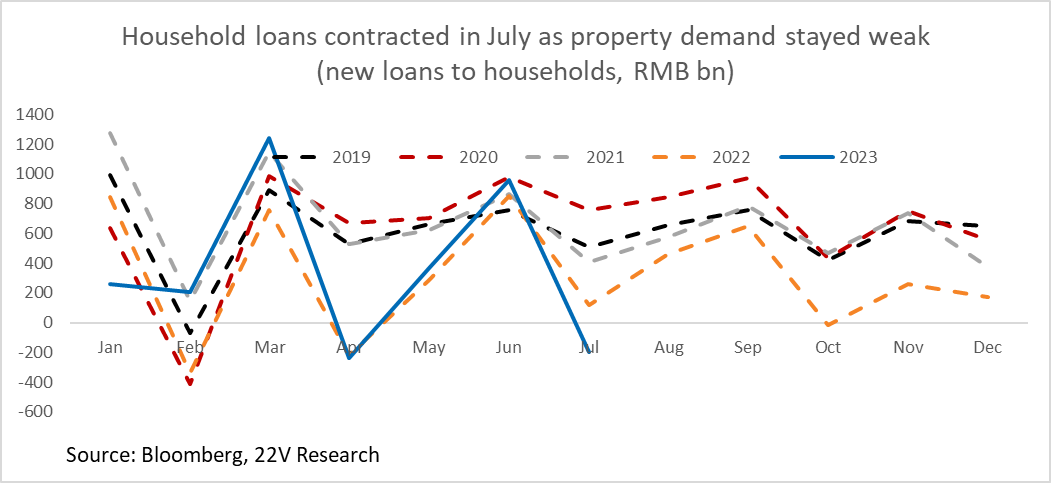
Credit data for July, released on Friday, were particularly concerning. New loans came in at their lowest level since 2019. New loans to households contracted, showing a continued trend of households repaying their mortgages as their yields on their other investments (including wealth management products) fall with reduced interest rates. Other areas of financing, including bank loans to the non-household sector as well as corporate and government bond issuance, were also weak.
The weak July data to some extent reflect a hangover from strong credit growth in June, a typical seasonal pattern. But that stop-and-start pattern to credit flows – surging at the end of each quarter, weak in between – has been particularly apparent this year and underscores the ineffectiveness of credit stimulus in boosting growth (see chart). Policymakers are pushing banks to lend, leading to a surge in credit at quarter-end as banks try to meet their policy targets, but with little impact on growth in an environment of weak demand and confidence.
A banker interviewed by Caixin (China’s leading financial outlet) described a very familiar pattern in China:
“…The money loaned by the bank may not be given to the companies that need it most…Because small and medium-sized enterprises’ have limited capacity to absorb loans, it takes loans to large enterprises to achieve rapid lending growth.”
Simply put, the credit starved firms – private firms, particularly smaller ones – are not getting new loans while large firms, particularly SOEs, already have enough credit but are getting more. The result is that new loans, rather than leading to investment, are sitting idle at banks in the form of deposits. In formal terms, the credit multiplier is low and likely to stay that way until demand and confidence improve.
These dynamics tie back to a central theme, which is the urgency of the central government deploying its balance sheet if the China’s recovery is to gain strength:
- On the growth side, more fiscal support is necessary to offset weak private sector demand and the limits of monetary/credit stimulus. PBOC will provide some such support through financing for infrastructure projects, though this will have only an indirect and lagged effect in spurring employment and consumption (even better would have been stimulus directed at households).
- On the financial risk side, the central government’s financial backstop would help arrest a further deterioration in property and in the trust sector. As noted above, such support thus far seems unlikely to be forthcoming until/unless conditions get worse.