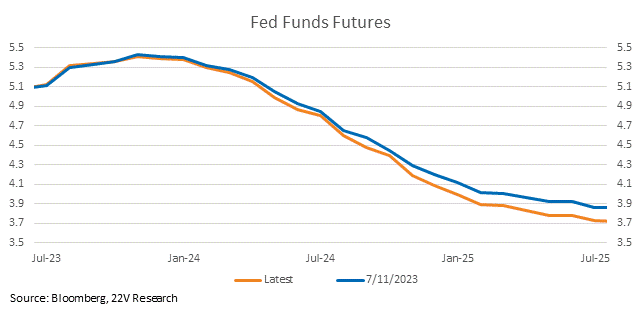
SUMMARY: A semi-hawkish macro theme has started to develop, which helps explain the fed fund futures retracing its post-CPI decline and the slight tightening of financial conditions yesterday. The hawkish theme, despite the lower-than-expected core service CPI reading, is driven by much stronger than expected economic growth. Housing data has stabilized and is now contributing to GDP growth (HERE), the labor market is firm (see claims) and core retail sales were better than expected, indicating ~2-2.5% real personal consumption expenditure growth.
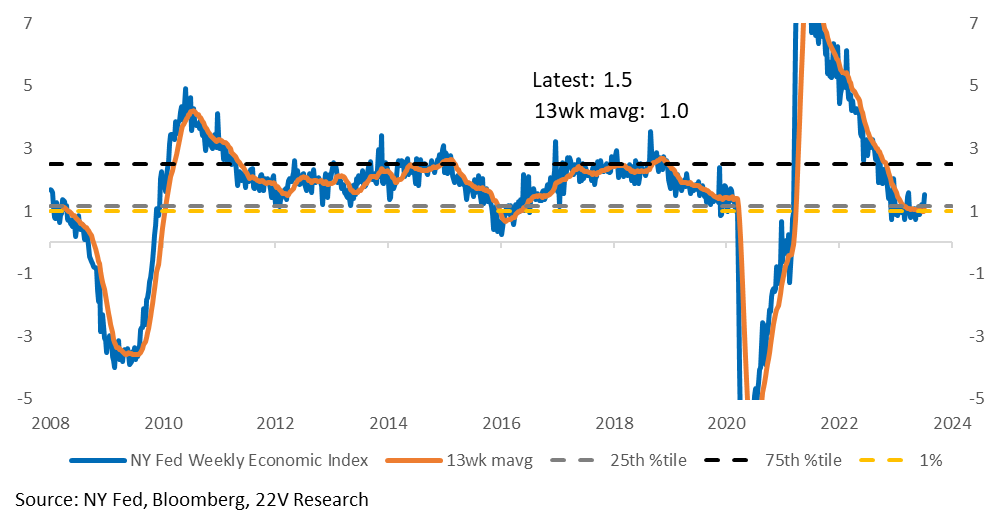
The New York Fed Weekly Economic Index (WEI), our favorite high-frequency indicator of underlying demand, increased again last week. That reading suggests GDP metrics, which ran above trend in 1H23 (trend is estimated to be about 2%), are likely to remain at or just slightly below trend in 2H23. GDP was 2% in 1Q23 and the Atlanta Fed’s GDP Now suggests 2.4% GDP growth for 2Q23. The “launch” into 2H23 is positive, which is reflected in high-frequency data and the improving NY fed WEI to start July.
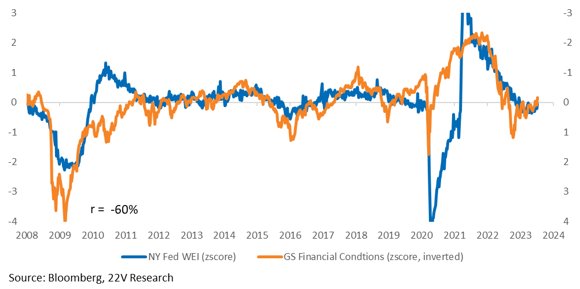
Improving demand growth combined with full employment and well above target core PCE increases the odds the recent deceleration in core service inflation stalls out at too high a level. That is why fed futures have adjusted higher and investors are concerned financial conditions have eased too quickly. FYI: As we show below, a continued easing in financial conditions suggests even stronger demand growth.
Bottom Line: Although some consolidation in markets makes sense given the increasing odds financial conditions have eased too much, we wouldn’t aggressively press that trade now. Don’t expect Powell to repeat the 2022 Jackson Hole moment, where he aggressively pushed back against the cuts implied in the Fed funds futures curve and FCI tightened sharply, next week (7/26). Core CPI has slowed materially and is biased to move lower over the next few months. The Fed has a chance at a soft landing, and they are likely to go for it. We remain long risk-on factors and small over large caps.
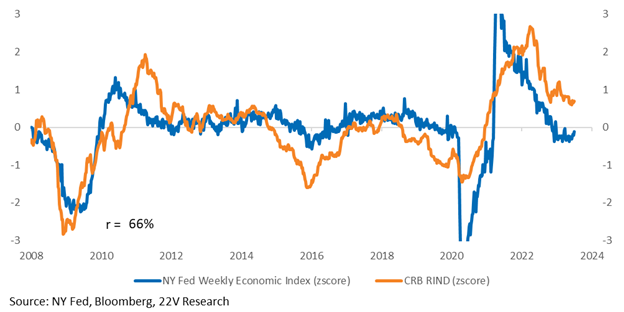
Commodities More Interesting Technically: The CRB RIND commodity index, which declined 30% from its peak, is up +2.6% since the end of May. That –30% decline is a 50% retracement of its 2020-2022 advance. John Roque thinks the RIND might be at an inflation point. The technical action in the CRB RIND is interesting, to us, in the context of VERY WELL KNOWN China headwinds. An improving NY fed weekly economic index has generally been associated with a higher CRB RIND.

Full report below…
MARKET VIEWS: Stock specific issues were a large driver of the decline in markets yesterday, but a hawkish macro theme is starting to develop, which helps explain the fed fund futures retracing its post CPI decline and the slight tightening of financial conditions yesterday. The hawkish theme, despite the lower-than-expected core service CPI number, has been driven by much stronger than expected economic growth. Improving demand growth at a time of full employment and well above target Core PCE increases the odds that the recent deceleration in core service inflation stalls out a too high a level. That is why fed futures have adjusted higher.
Housing data has stabilized and is now contributing to GDP growth (HERE), the labor market is firm (see claims yesterday) and core retail sales were better than expected and suggest roughly 2-2.5% real personal consumption expenditure growth. The New York Fed Weekly Economic Index (WEI), the best high-frequency indicator of underlying demand increased again last week, which suggests that GDP based metrics, which ran above trend in 1H23 (trend is estimated to be about 2%) are likely to continue to run at or just slightly below trend in 2H23.
Below is the New York Fed Weekly Economic Index relative to financial conditions. If financial conditions kept easing, from here, that would suggest stronger economic growth. At a time when the Fed wants to keep demand growth below trend. So, we get why fed fund futures have moved back up and risk assets consolidated yesterday. That being noted, don’t expect a 2022 Jackson Hole moment from Powell next week (7/26). Core CPI has slowed sharply and is biased to move lower over the next few months. Bottom line: Some consolidation in markets makes sense given the increasing odds that FCI has eased too much, but we wouldn’t be aggressively pressing that trade. We remain long risk on factors and small over large caps.
Value outperformed yesterday as oil prices held up and some deeper Cyclicals outperformed. China data is still a major headwind for commodity prices, but the CRB RIND, which declined –30% from its peak, is up +2.6% since the end of May. John Roque thinks the RIND might be at an inflation point. The technical action in the CRB RIND is interesting, to us, in the context of VERY WELL KNOWN China headwinds.
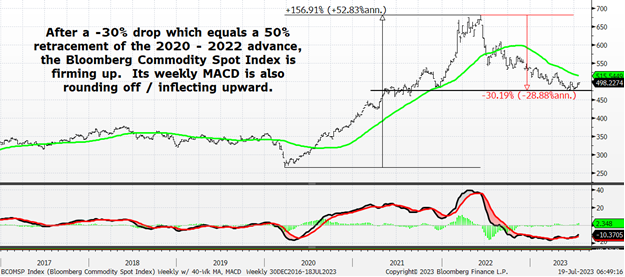
FYI: The RIND is tightly correlated with the NY Fed Weekly Economic Index (WEI), our favorite metric of high frequency demand growth. As noted above, the WEI has increased for a few weeks now (have we mentioned the WEI enough today?). Again, if growth reaccelerates, the second stage of disinflation could be much harder (and probably won’t be picked up by real-time models). Short-term though, the clear improving trend in economic activity is generally a positive for commodities.