

SUMMARY
- May PMI data show more evidence of fading momentum in China’s recovery, particularly in the industrial sector.
- Despite growing calls in China for policy support, we continue to expect Beijing to wait until July to rollout significant stimulus measures, which will focus on accelerating infrastructure spending.
- In the meantime, the policy response will likely consist mainly of targeted measures to incentivize hiring and support property demand.
China’s official PMI data for May add to the latest warning signs on the strength of the recovery. Demand in China remains driven by largely by services activity and infrastructure stimulus. There is still a huge “missing middle” of private sector investment and household spending on goods, which limits the breadth of the recovery and especially demand for commodities and manufactured goods (see our recent discussion of China’s April data and the growth predicament HERE).

The service sector PMI came in at 53.8, still strong by historical standards but down -1.3 ppts from April, the second consecutive month of fading momentum after a torrid first quarter. Sectors benefiting from reopening, such as tourism and entertainment, remained bright spots. The lift from services activity was enough to keep the composite PMI reasonably strong at 52.9, down -1.5 ppts from April.
Industry remained the weakest link in China’s recovery. The manufacturing PMI fell to 48.8, down from 49.2 in April and the second straight month of contraction (below 50). New export orders were weak (47.2, down by -.4 ppts from April), reflecting slowing global growth. Domestic orders were also soft (48.5, down -.5 ppts from April), pointing to the impact of continued weakness in property investment and some slowing of momentum in infrastructure investment. These trends are also reflected in the slowdown in the construction PMI, which declined 5.7 ppts from April to 58.2, and a slew of other recent data (including falling industrial profits in May, and low capacity utilization rates in materials sectors such as glass and cement). Another problem for manufacturing is weak end demand from households for goods such as autos and appliances.
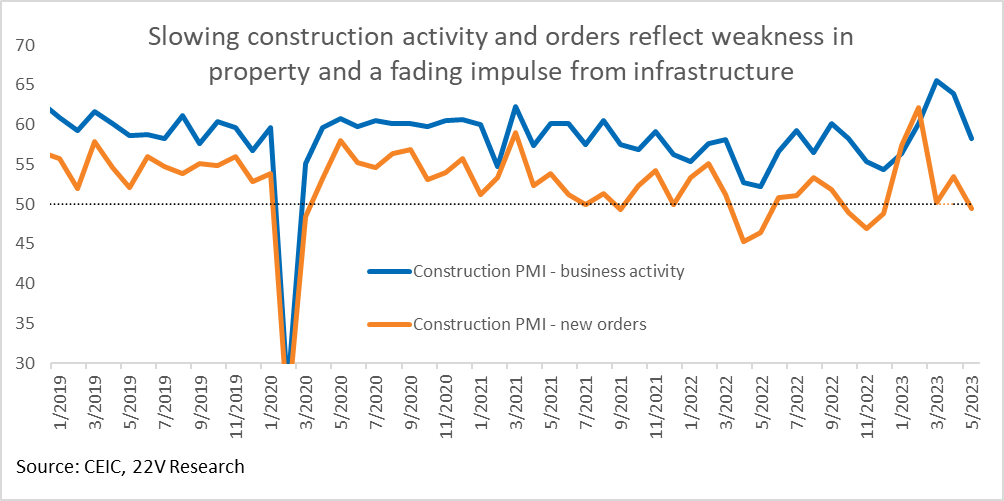
The critical question, of course, is what all this means for the policy outlook: will more signs of fading momentum, particularly in industry, prompt Beijing to loosen restraint and roll out new stimulus measures?
While it will be important to see how the rest of the data for May comes out over the next two weeks, we continue to think that Beijing will hold to a disciplined approach. We expect the main stimulus response to come in July, with an acceleration in infrastructure investment that will be relatively modest in scale. There will likely be only a marginal increase in the degree of policy easing in the meantime, though the authorities will be keen to show that they are aware of the headwinds to growth and confidence.
The disconnect between Beijing’s restrained policy stance and the views of the investment community is large and growing. Domestic economists have issued increasingly urgent calls in recent weeks for Beijing to do more to boost flagging demand and confidence, particularly through more powerful fiscal stimulus to spur consumption and employment. High rates of youth unemployment, which hit a new peak of 20.4% in April, add a particularly visible and socially sensitive aspect to the current economic malaise. Those employment challenges will grow as new graduates hit the job market this summer.
But there is a high bar for Beijing to drop its reticence towards broad-based stimulus measures. The key reasons are:
- Beijing’s concern over financial risks and a desire to conserve policy space for the future. Growing strains from local government debt burdens are a particular concern, which is weighing on infrastructure investment and other local-level spending (see our recent report on local government debt HERE).
- The leadership’s long-held reluctance to embrace strong and direct fiscal support for consumption. This stems in part from a lack of confidence in the effectiveness of such programs as well as the limited fiscal space available to local governments.
- A recognition that while there is still room for additional monetary easing, rate cuts will have limited marginal impact in an environment where the key issue is lack of confidence rather than high borrowing costs.
A patient approach to the recovery was a key theme of the Central Economic Work Conference in December, and high-level leadership statements have continually reaffirmed that policy stance. Less noticed in the Western media, but mentioned frequently domestically, were Xi’s instructions to local officials in March to “not have the urge to do things too quickly” and keep longer-term development goals in mind.
With that backdrop, economic conditions would likely need to get substantially worse to force stimulus ahead of the political calendar, which calls for the end-July Politburo meeting to lay out policies for H2. It is also worth noting that by July, the base effect from Shanghai’s lockdown in April-May 2022 will have largely faded, making year-over-year growth numbers less impressive. As superficial as it sounds, the fact that headline growth numbers remain solid for now – keeping China well on track to meet the 5% GDP growth target for the year – makes it harder for critics within and outside the system to argue for aggressive support measures. (This is a point recently made by WU Ge of Changjiang Securities, a former PBOC official and one of the most insightful economists working in the domestic financial sector).
A central question for H2 will be the extent to which Beijing is willing to utilize the central government’s balance sheet for stimulus, given that local government finances are tapped out and household and corporate balance sheets are under repair. Such support would come through “policy-based development tools” such as the PBOC’s Pledged Supplementary Lending (PSL) instrument, which can support infrastructure and real estate investment through PBOC financing via China Development Bank and the other policy banks. The PSL and similar tools were a key source of support for infrastructure in H2 2022 and we will be watching closely for signs as to their potential deployment.
In the meantime, we expect the State Council and agencies such as PBOC to respond to fading momentum in coming weeks mainly through targeted measures, such as additional programs to incentivize employment, further local-level policies to boost housing demand (including subsidies for households with multiple children) and modest efforts at consumer subsidies. We would not be surprised to see rate cuts or even an RRR cut in June, though continue to expect that monetary policy will mainly play a supporting role to fiscal policy and infrastructure spending (such as through the PSL and overall efforts to keep liquidity ample).

