

AT 10pm ET tonight (Monday), China will release its high frequency economic indicators for April. Below are some of the key watchpoints for investors.
Last month, China’s Q1 GDP and March activity data releases showed a recovery that is only gradually gaining strength. Growth has been led by the boost to services from reopening but otherwise overall demand has been quite subdued. At the same time, economic conditions have not been so bad as to force Beijing into intensifying stimulus measures. The result has been a “muddle through” that accords with our basecase expectations for the year but has been disappointing for investors.
The most recent indications point to April data continuing this “muddle through” pattern. The economic readings for April that have already been released (trade, inflation and credit) have broadly pointed to anemic demand outside of services. At the same time, we believe there is a high bar for Beijing to significantly loosen policy in the near-term. Even a ho-hum recovery, in which economic activity gradually returns to normal over the course of the year, is acceptable to the leadership, which deliberately set a conservative growth target this year of “around 5%” to avoid overdoing stimulus.
Recent policy meetings have reinforced a message of financial discipline, including the Politburo’s end-April quarterly meeting on the economy (see our write-up HERE), a meeting of the Central Commission on Finance and Economics on May 5 (see HERE), and PBOC’s Q1 2023 monetary policy report released earlier today (Monday). Beijing is saying that policy will remain broadly accommodative given weak demand (domestically as well as externally) but that there is little urgency now to aggressively boost stimulus given the “bottom-line” importance of avoiding systemic financial risks. We continue to think the authorities will wait until closer to the end-July Politburo meeting on the H2 outlook to introduce new stimulus measures, focused on a modest expansion in infrastructure spending.
What would need to change in the April data to shift China’s outlook? For signs that the recovery is strengthening, we will be looking at a few areas in particular:
- Are Chinese households becoming more confident? Weak growth in credit to households in March (see chart) suggested that they continue to deleverage, including through early payment of mortgages. It will be important to see if property sales show signs of a rebound after some signs of life earlier this year, and whether sales are leading to new property starts, which remain deeply depressed (see chart). We also will look closely at the retail sales data to see whether households are spending not only on services but also goods, particularly big-ticket items such as autos and appliances.
- Is private investment returning? Fixed asset investment by private firms increased only 0.6% y/y year-to-date in March, compared to 10% y/y for state firms. A strong recovery cannot be dependent on state-owned enterprises, which will increasingly come under pressure from Beijing to keep debt burdens under control.
- Is manufacturing activity gaining pace? The services production index rose by 9.1% y/y in March, compared to growth of only 4.2% y/y for industrial production. Stronger growth in manufacturing and investment activity is important for China’s recovery to pass through to global demand, particularly commodities, given that services-driven growth is less import- and commodity-intensive.

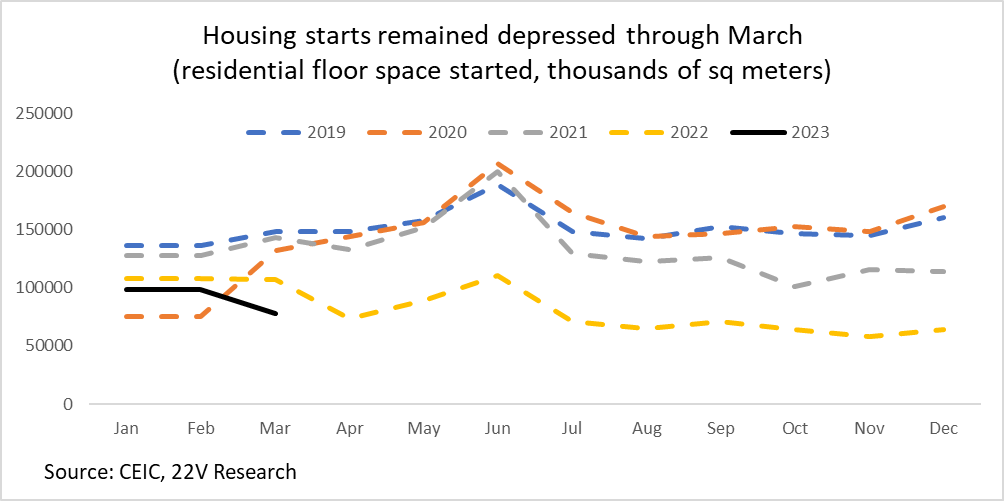
A word of warning: headline year-over-year growth numbers for April will be highly misleading (and confusing) due to base effects. Shanghai went into its Covid lockdown in April and created broad ripple effects throughout the national economy as key supply chains locked up. The base effect will flatter year-over-year comparisons for most data series. It will thus be important to look at month-over-month data where available and to use creative workarounds (such as comparing 2023 to 2021 levels) when necessary.
For signs that the recovery is slipping below Beijing’s comfort level – forcing stimulus sooner than Q3 – we would watch for dramatic misses in April data and a significant rise in unemployment. But again, we see the bar as quite high for Beijing to announce new stimulus measures in the short term.

