

Subdued imports show the recovery struggling to gain momentum
China’s April imports surprised to the downside, falling -7.9% y/y from -1.4% in March (USD terms). Exports were in line with analysts’ expectations, slowing to 8.5% y/y from 14.8% y/y in March.
The key takeaway, of course, is that China’s domestic demand remains subdued. This is consistent with the services-driven rebound that has long been our basecase, and which by nature means less demand for imports than an investment- and manufacturing-led recovery. There were some promising signs of a pickup of demand in the Q1 GDP data, but then April PMI releases showed manufacturing still in contraction and now come weak import data. A broad-based recovery is still struggling to take hold: firms, households and local governments all face balance sheet constraints in bouncing back from the pandemic and real estate downturn, and an uncertain global environment doesn’t help.
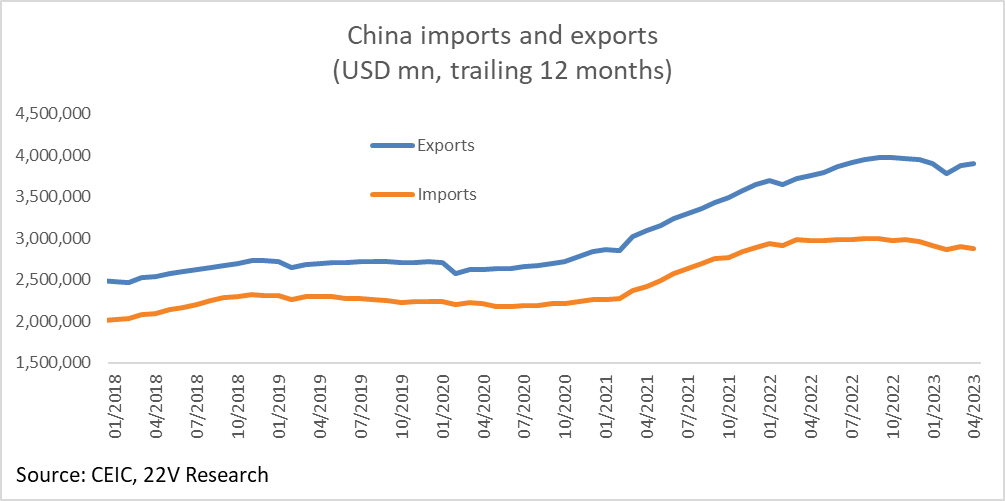
Note that two factors color interpretation of the data, with contradictory effects. First, April 2022 was when Shanghai went into full lockdown, depressing both imports and exports, which means a flattering base effect. If one looks at two-year growth (2023 over 2021), exports are up 12.3% in USD terms, while imports are down -7.8%% – another indication that domestic demand is recovering only slowly.
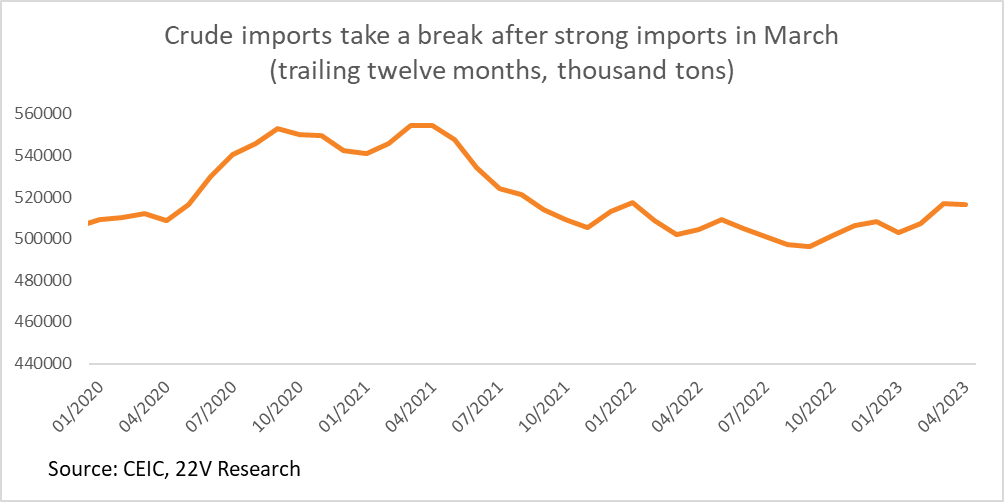
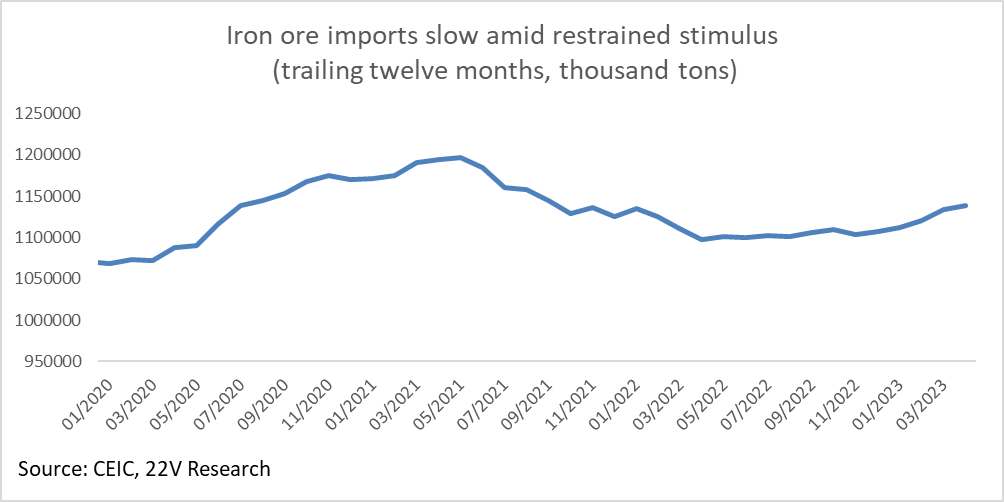
Second, falling global commodity prices exaggerate the apparent weakness in commodity imports. Crude imports fell -28.5% y/y in value but only -1.4% y/y in volume (but this was after 22% y/y growth in the volume of crude imports in March). Iron ore fell 5.8% y/y in value but grew 5.1% y/y in volume terms, compared to 14.8% y/y volume growth in March. As 22V’s head of commodities research, Colin Fenton, notes:
Commodity demand growth in China presently is neither booming nor falling off a cliff. It is all consistent with low single-digit GDP growth. Crude oil imports at 10.36 million b/d in April are more or less right on trend to balance domestic production and domestic crude runs. The April crude oil imports also follow a strongly above-trend import volume of 12.35 million b/d the month before. With Chinese refineries undergoing seasonal maintenance, there was no need to stock up beyond trend.
Beijing will keep stimulus targeted
The weak import data will not lead to new stimulus measures in the near-term, given that Beijing remains focused on keeping financial policy disciplined. The quarterly Politburo meeting on the economy, held last week, hammered this point very clearly (see our write-up HERE). And last Friday, Xi Jinping chaired the first meeting of the Central Commission on Finance and Economics since the 20th Party Congress. It focused on structural policies – strengthening industrial supply chains (more on that below) and addressing demographic challenges, with nothing at all to say on stimulus. One can contrast that with the meeting of the same body at this time last year, which focused on a surge in infrastructure spending.
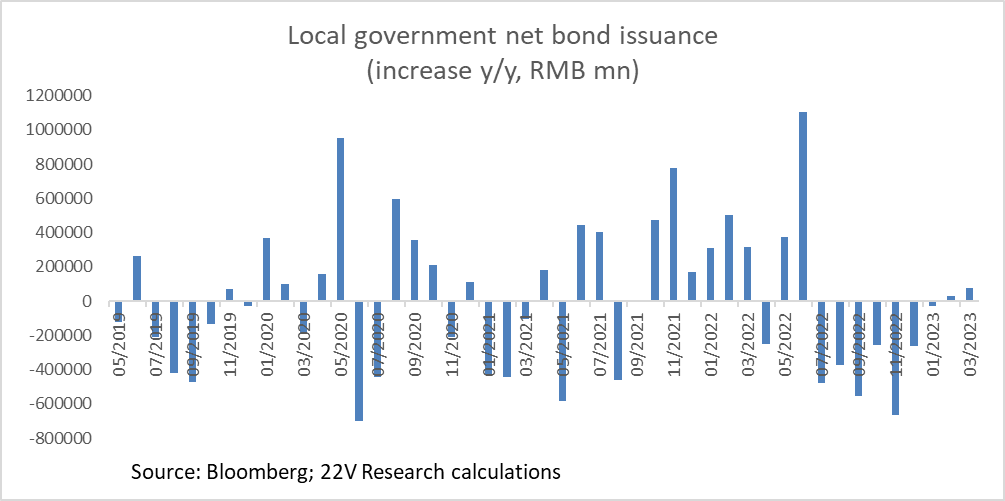
Indeed, government infrastructure stimulus thus far in 2023 remains modest. Net issuance of local government bonds is barely above the level of last year, and investment project starts are thus far below last year’s levels (see charts).
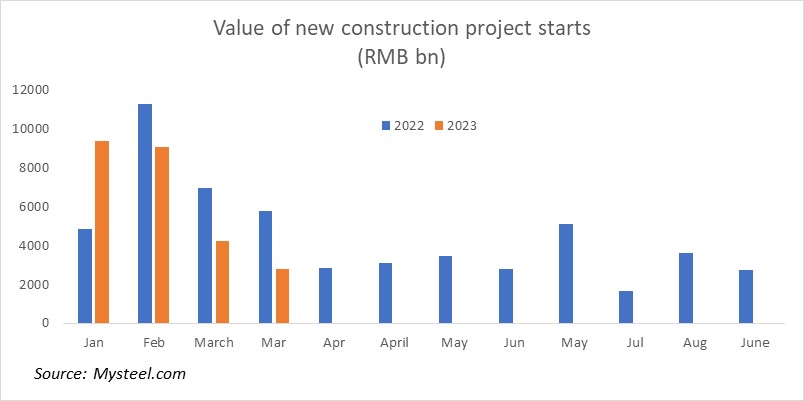
The upside of this restraint is that Beijing is leaving some bullets in the chamber for another round of stimulus, but probably not until July when the Politburo meets to discuss the second half outlook The authorities will decide how much additional spending is necessary to carry growth for the rest of the year. To be clear, this will not be a massive push, and aim instead to secure the conservative growth target of “around 5%” as well as employment goals.
Industrial policy, not growth, is Xi’s central priority
As noted, Friday’s meeting of Central Commission on Finance and Economics led with a discussion on “accelerating the construction of a modern industrial system.” Xi continues to focus on advanced manufacturing as China’s main economic and strategic thrust, necessary to reduce vulnerabilities (such as semiconductor imports) and extend strengths (such as dominance of clean energy supply chains).
Fruits of the industrial policy push are clear in the trade data – no more so than in China’s shocking growth in auto exports (and fall in auto imports). This is a “shock” in both senses of the word: a truly impressive performance and (as Brad Setser from the Council on Foreign Relation notes today) a looming economic shock for other auto exporting countries. The key driver here has been Chinese automakers’ leveraging the transition to electric vehicles, helped of course by years of industrial policy.

Brad and others have pointed out that this shift has happened so rapidly – literally since the start of the pandemic – that the trade politics haven’t caught up yet. German automakers are losing market share within China (as EVs take over), and along with other auto exporting countries will face stiffening pressure from China in third countries, particularly in the developing world. Yet European trade officials have thus far been more assertive in pushing back on the US’ green industrial policy in the Inflation Reduction Act (not without some justification, particularly among allies).
To Russia with love
It seems clear now that China’s very strong export numbers in March (14.8% y/y) were partly due to the release of orders that had accumulated in Jan-Feb (during the lunar new year and Covid disruptions). So, there was some give back last month. But China’s exports to Russia remain on a tear, up 153% y/y in April. This is a state of affairs that of course rankles not only Washington but Brussels, which is considering sanctions on eight Chinese companies suspected of shipping dual use items to Russia’s military (see WSJ report HERE). Robust Chinese trade with Russia – of which some portion is redirected goods from Western countries – will continue to be an issue that complicates Washington and Beijing’s ability to lower bilateral tensions, as well as Beijing’s modest charm offensive with the EU.
With thanks to Houze Song for contributions to the analysis.

