

SUMMARY
The President and the Speaker of the House agree cuts to Social Security and Medicare shouldn’t be part of a FY24 agreement. Both men also insist the US won’t default, although semantics might obscure that point. The Speaker yesterday invoked Reagan’s aura if not mantra in assuring no new taxes should be expected from fiscal discussions this year. Senator McConnell’s return to the Capitol after recovering from his fall is another reassuring fiscal policy development, as he too is on record against default. Public commitments of all four congressional leaders and the President mitigate concerns that process or narrow political preferences are roadblocks to FY24 negotiations failing to accommodate US debt payments.
OUTLOOK
The result is an improbable default or stimulus, and unambitious fiscal policy this year – despite an expected very loud process. This is a clear near-term positive that is nonetheless an intermediate-term disappointment that only feeds fiscal imbalances largely driven by demography. House Majority Leader Scalise yesterday said Republicans would release a blueprint today as an alternative to Biden’s March FY24 budget which serves as Democrats’ opening ante. That hasn’t happened as of 45 minutes before the market close; we’ll update our fiscal outlook once a plan is introduced.
McCarthy’s NYSE comments yesterday were also notable for his multiple assurances of no pre-conditions, despite specific ideas such as a return to discretionary spending caps. ‘Nothing is done until everything is done’ is a well-worn, if grammatically lacking, DC trope. It’s too early to know the timing and content of a deal. As we wrote in our fiscal note last week, credibly assessing tangible risk is impossible before the start of spring and summer months of negotiations. The X-date spread is mid-June to mid-August. Timing certainly will be an element of early talks. Some GOP lawmakers want to align the X-date with the October 1 start of FY24. Recent discussions reportedly indicate there might be more support for a late December suspension. Momentum suggests single or multiple 4Q23 X-dates triggered by specified suspension dates rather than debt ceiling dollar adjustment(s).
In our client survey last week less than 8% of respondents thought the US would default this year. Investors and other Americans are more focused on rates, inflation, war, and social issues. As such, they likely have little tolerance for contrived risks precisely because they’re occupied with these real daily challenges. This is one of the stronger factors meaningfully constricting odds of default. The data in the following table highlights the US debt problem, especially in a rising rates environment. It also shows the relative puniness of discretionary spending which includes most Pentagon and many domestic programs popular among voters. CBO interactive infographics offers cool visuals of major spending and tax categories. For reference, the 2022 US deficit is more than 5.5% of GDP.

The last serious fiscal rebalancing proposal of which we are aware was an 11-year fiscal rebalancing plan formulated and shopped in early 2011 to Capitol Hill leaders. The legislative core was a bundle of slow but steady restraints on entitlement spending and a gentle slope upwards of revenue from policy tweaks and anticipated growth.
That plan was designed to slow demography’s persistent fiscal balance pressure. Two important ‘money committee’ chairs of the then-newly elected House Republican embraced the plan, but an important one did not because it contained tax increases. Meetings with Senate money committee Democrats weren’t scheduled because an important House Democrat promised a very caustic fight if the plan was publicly released. Naming individuals isn’t important to the punchline as it wouldn’t change the outcome: the legislative proposal never moved beyond the draft phase.
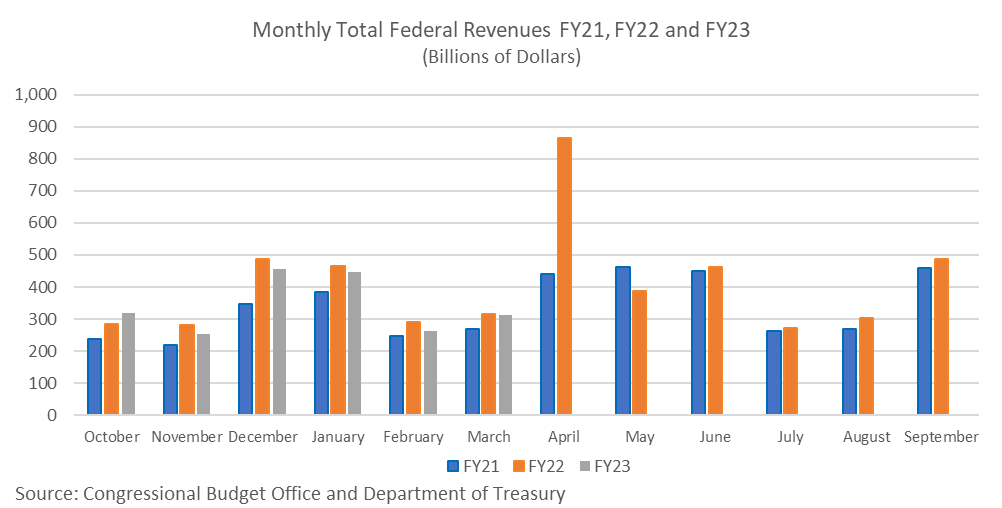
The following chart shows the last five months of FY23 revenues slowing compared to the recovery year of FY22.
Revenues measured against a backward-looking 30- or 50-year average miss the point about demography as our national costs haven’t ever been through this causal buildup of debt. Discretionary spending need not escape restructuring contribution, but the next fiscal rebalancing will necessarily recognize that mandatory spending on entitlements and net interest payments are the target. Adopting tough choices will benefit growth, generate more revenues, and enhance US international standing as the reserve currency country. But, as we’ve consistently stated, fiscal rebalancing is unlikely before the 2024 elections because of these tough choices.

