

SUMMARY
Washington’s 2023 budget battle is over averting default and funding routine FY24 government functions. Our call remains that the negotiations on the latter will accommodate adjustment(s) to the former without calamity. Avoiding stimulus is both a political and economic necessity, and deficit reduction would be a welcome plus. Major fiscal rebalancing is advisable but seems very unlikely until after the 2024 election. Even so, space doesn’t exist for cavalierly worsening the situation.
President Biden and Speaker McCarthy next week will resume attempting to exert pressure for fiscal progress after speaking past rather than with each other about fiscal policy this year. Most of their repartee to date doesn’t qualify as negotiation which hasn’t mattered thus far since action-forcing deadlines are months away.
OUTLOOK
Capitol Hill electoral risk aversion constrains both principals’ incentives for bold, constructive risk-taking. Biden is increasingly focused on 2024 and a White House defense of his tenure. His national party base hasn’t the appetite for structural rebalancing. McCarthy neither possesses presidential aspiration – this cycle – nor leeway from his GOP conference to engage in a conversation about taxes other than cutting them which in nearly all circumstances is a non-stater for most Democrats. This forms a circle assuring unambitious fiscal policy this year and next. The only upside in this tired tale is that electoral politics important to vast majorities of each party disfavor default.
As seen below, mandatory spending projections and the foreseeable rates environment (meaning not returning to zero-bound ranges any time soon) locks in a fiscal squeeze. Changing this picture requires above trendline growth and difficult programmatic decisions, or butcher-block spending cuts and dramatic revenue increases that would preclude robust growth at least in the early stages of such a drastic program. The latter alternative is the least likely of all.
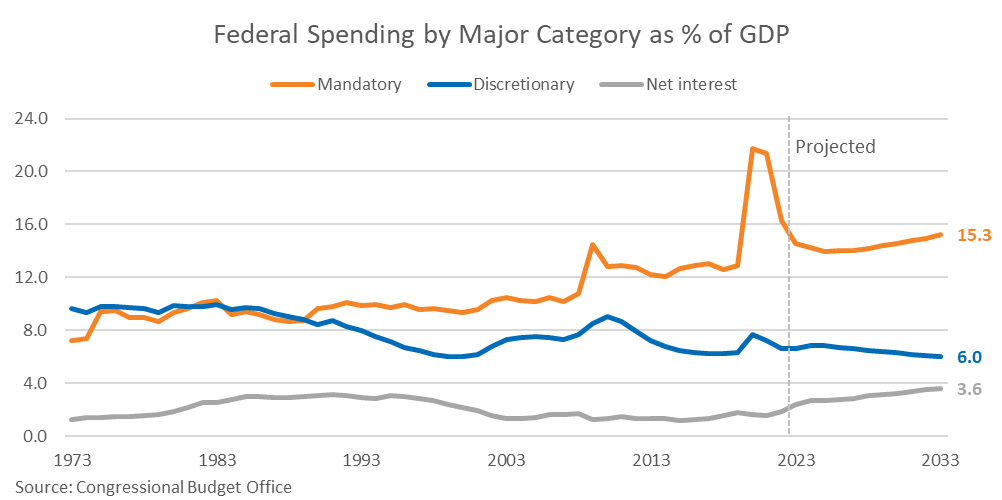
Discretionary spending resumes contraction in CBO’s model after the pandemic stimulus programs. This category includes the bulk of national security programs and all non-mandatory domestic spending. Demography puts a floor under mandatory spending and other factors cap revenue levels as a share of GDP. Fiscal math over the next decade is easiest with a mix of sustainable growth which generates revenues and layered, multiyear spending restraint.
Discretionary spending is less than half of annual mandatory outlays which will continue to sharpen debates over defense and non-defense budget plans. Contentious tradeoffs going forward are guaranteed precisely because the pie is smaller and shrinking. Over at least the coming seven quarters of fiscal ‘small ball’ we see more reasons to expect real increases to defense spending if only to replenish what has been an unanticipated drawdown of US war-fighting stockpiles.
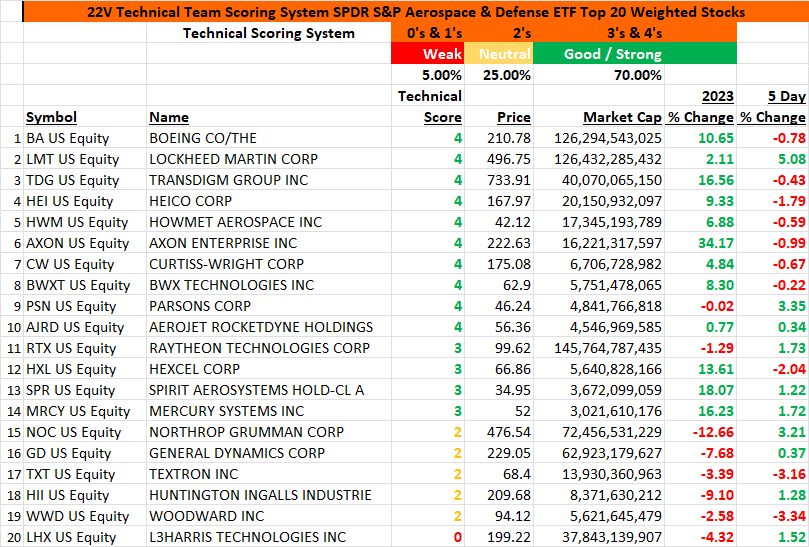
The XAR ETF remains our proxy for gauging federal defense flows to contractors. It’s price action since the start of this current Ukraine war rightly responds to actions rather than words. This leading indicator’s reliability is unlikely to lessen while war continues, and transformative fiscal policy is a distant possibility.

John Roque’s valued work assigns high scores to 70% of XAR top 20 constituents, and half those names receive the highest scores. After a few good trading days, the ETF is up 15% YTD. Inability to agree to new FY24 spending either through protracted government shutdowns or a long-term continuing resolution at FY23 levels after October 1 are the chief policy risks to this performance. It’s plausible even if less likely that bipartisan support for robust support of Ukraine ebbs. Those outcomes are worth noting, although credibly assessing tangible risk is impossible before spring and summer months of negotiation.
Source: 22V Research

