
China released 3Q GDP data on Monday after a one-week delay. The results beat expectations, with GDP coming in at 3.9% y/y versus the Bloomberg consensus of 3.3%.
While there had been some concern that the delay was due to Beijing wanting to avoid releasing disappointing data during the Party Congress, we noted at the time of the delay that it was just as likely to reflect Beijing’s desire to control the narrative and not necessarily reflective of the content of the release (please see: China’s 3Q GDP delay may be more about the politics than the data, 10/17/2022).
But our report also pointed out that even a positive print for 3Q would not be a strong indication of an economic recovery in China, given rising headwinds for 4Q, the continued drag from zero-Covid and the property downturn, and few reasons to anticipate major policy loosening that would offset these concerns.
The details of today’s release confirm that view:
- Growth is being driven mainly by state-directed infrastructure investment, which grew 8.4% y/y in September. The strength of quasi-fiscal spending has likely peaked and may weaken in 4Q as local governments run out of budget room to fund projects. Another indication that a broader revival of investment is not underway: private investment grew by only 2% y/y in September, versus 10.6% for state-owned enterprises.
- Overall demand remains quite weak, reflected in flat imports (0.3% y/y, the same rate as August). Consumption is anemic due to the impact of zero-Covid policies on employment and confidence: nominal retail sales grew 2.5% y/y (down from 5.4% y/y in August), and only 1.2% y/y excluding autos. Household demand won’t pick up until China makes a substantial pivot away from zero-Covid, which is certainly not imminent.
- Exports have been a source of support for China’s economy over the last year but are slowing as advanced economies tighten monetary policy. Exports (measured in USD) had already started to slow in August (7.1% y/y) and moved down to 5.7% y/y in September. Trade has helped prop up activity in China but this source of support is weakening and will likely also slow investment in China’s export-oriented manufacturing sector. (Property, infrastructure, and manufacturing each account for roughly one third of China’s fixed asset investment).
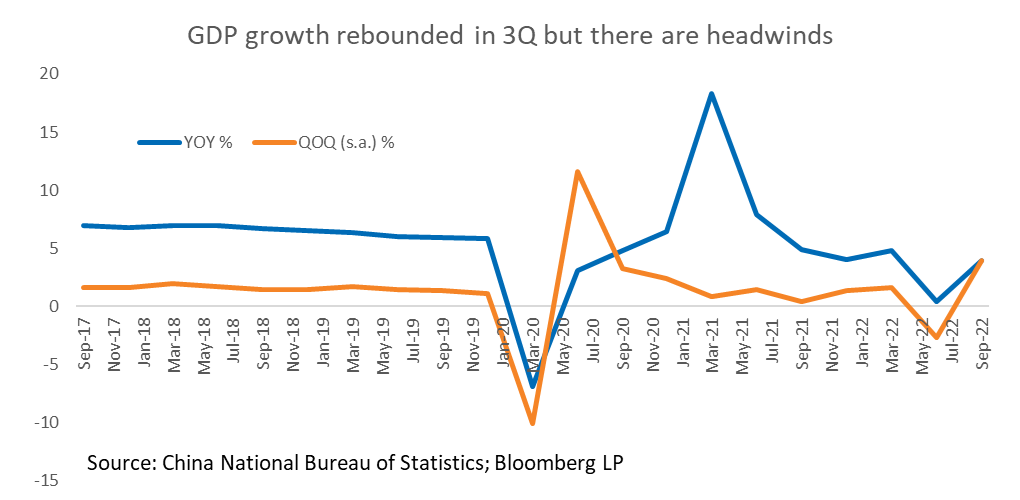
All signs point to subdued growth continuing at least through 4Q and well into the new year. Sentiment will depend less on data than on policy, especially signals of a pivot on zero-Covid or more robust support for the property sector. It will be important to monitor policy signals in coming weeks, especially in the leadup to the annual central economic work conference in early December. Still, major policy relief looks unlikely, especially in the near term:
- The pivot on Covid will be gradual and very cautious, not starting until after the March National People’s Congress at earliest. It would not be a surprise to see a shift in messaging in coming weeks, but when it comes this would be to start preparations for an eventual pivot that will be more protracted than many investors assume (please see: China: Beware of head-fakes on a Covid pivot, 10/20/2022)
- Property policies are loosening but it is unlikely that we’ll see the kind of financial firepower deployed that is necessary to revive property investment. The key hurdle remains the debt constraints and lack of financing for private property developers. Beijing is unlikely to have the political appetite to provide a strong backstop for developers. Loosening will help support demand, but property developers will need to use sales proceeds to pay maturing debt; a rebound in new property investment will be slow to come.
- Overall policy will likely remain incremental and reactive until the leadership transition is complete in March. Officials don’t formally take up their government posts until the National People’s Congress in March, and the intervening period is unlikely to see bold policy moves.

Broader fears over China’s political direction, combined with the lack of positive signals on the growth outlook, are hammering Chinese assets. Fears over the outcome of the Party Congress hit Chinese assets hard on Monday. Foreign investors sold a record number of China A-shares. The Hang Seng China Enterprises index fell 7.3%, the CSI 300 index fell 3%, and the USDCNY exchange rate weakened to a 14-year low. Pressure has been particularly intense for US-listed Chinese tech stocks.
Our report yesterday laid out the long-term implications of the leadership transition and noted some short-term watchpoints as well (please see: China: Xi’s power play increases risks for markets and the economy, 10/24/2022). We concluded that Xi Jinping’s moves to sideline voices from outside his inner circle, including with his choice of premier, point to politics over pragmatism, heightening risks of economic malaise, policy volatility and geopolitical tension.
That said, these dangers will generally play out over the medium-term rather than manifesting in ways that are immediately growth negative. Xi’s basic policy agenda is unlikely to see radical changes for better or worse. Some observers are positing that the new premier, Li Qiang, may bring a pro-growth orientation, citing his career at the local level in provinces with thriving private sectors (Zhejiang, Jiangsu and Shanghai). Banking on his dynamism seems overly optimistic – there are no signs that Li is a bold policymaker – but he will look to send reassuring signals as he takes up his government post in March. Sentiment could ease a bit as investors put the leadership change into broader context, though a reset is unlikely without clearer signs on the short-term growth outlook and the longer-term policy direction; reassurance on the latter will be especially difficult given that so much now comes down to Xi, with few officials who can credibly communicate his policy intensions (or are willing to).
It will also be important to keep an eye on geopolitical tensions, including whether Xi and President Joe Biden meet at the G-20 in mid-November (we think it is likely) and whether Beijing retaliates aggressively over US export controls on semiconductor technology (we think it is unlikely, though it depends on the actual impact of the controls on Chinese firms, which is still evolving).

