
China’s 20th Party Congress concludes this weekend with the announcement of the new senior leadership of the Chinese Communist Party (CCP) on Sunday. We will cover the leadership changes and implications for markets once the news is out. In the meantime, this note lays out final watchpoints and what to expect.
Our earlier analysis includes:
- Preview of the Party Congress (Oct. 12; link)
- Key takeaways from Xi’s report to the Congress (Oct. 16; link)
- Recording of our webinar on Xi’s report and what it means for China’s outlook (Oct. 18; link)
This weekend’s events:
- On Saturday, the Party Congress officially concludes with the election of a new Central Committee, the roughly 200 top members of the CCP. The Congress will also approve changes to the Party charter, a mostly ideological affair but with implications for Xi’s political stature.
- On Sunday, the newly appointed Central Committee will convene to appoint the very senior leadership of the CCP: the 25-member Politburo and its 7-member Politburo Standing Committee (PBSC). The moment of high drama comes when the new members of the PBSC step out on stage.
The watchpoints and context:
There will be a host of interesting narratives and nuances to take away when the new leadership team is announced. But from the standpoint of markets, two watchpoints matter most:
- The degree to which Xi keeps continuity in the PBSC by allowing some non-loyalists to stay on versus stacking this body with only his close allies.
- Xi’s choice of premier, a role that he has sidelined under current premier Li Keqiang but which remains highly important for economic management and policy implementation. The premier sits on the PBSC and is officially the second-ranked official in the CCP.
The composition of the new leadership team will not fundamentally change the direction of China’s policies. First, Xi already dominates policymaking – having even more control will only matter in an incremental way. Second, Xi’s report to the Congress last Sunday emphasized overall continuity in key policy themes (see our summary here). Xi’s basic agenda is already set.
Still, the stakes for global markets are high: if Xi only appoints his allies to key positions, regardless of their competence, it will increase the risks of poorly vetted policies, chaotic implementation, and economic uncertainty. These dangers have already been a staple of the last five years, with Xi laying out broad policy directives that the rest of the system implements rigidly, from the tech and property crackdowns to “wolf warrior” diplomacy to zero-Covid. Should Xi appoint a leadership team that is even less inclined to vet his policies, and less competent when it comes to implementing them, policy volatility and economic/market disruption will worsen.
This matters especially because Beijing’s margin for error is shrinking, given intense geopolitical tensions with the US and its allies, as well as mounting structural constraints to growth (debt, demographics, low productivity growth). Navigating these challenges will require nimble policymaking if China is to avoid stalled growth or the tail risk of an acute financial/geopolitical crisis.
Current outlook:
With only two days out, there have been few solid signals as to which way Xi go with these decisions. Our earlier preview report laid out a base case of Xi allowing two spots in the PBSC for officials outside his inner circle (down from 3 currently), and a toss-up between Wang Yang and Hu Chunhua – neither of whom are part of Xi’s circle – for the premier.
The Wall Street Journal and South China Morning Post are both reporting this week that Xi intends a more radical makeover of the PBSC and will choose ally Li Qiang, the party secretary of Shanghai, as premier – outcomes that we would view as downside scenarios increasing the risk of errant policies and uncertainty.
While these media reports are worth noting, we would view with them with some reserve – the selection of the PBSC is an incredibly secretive process and the media have an uneven track record with such predictions. Handicapping selections is even harder in this cycle than previous ones, since Xi has shown that he is willing to violate some traditional norms guiding the process (seen in his own decision to stay on for a third term) and much will come down to his personal inclinations.
Simply put, Wang, Hu and Li are all plausible candidates for premier, and the more useful exercise for now is laying out what each might mean for China’s policy outlook, summarized in the table below:
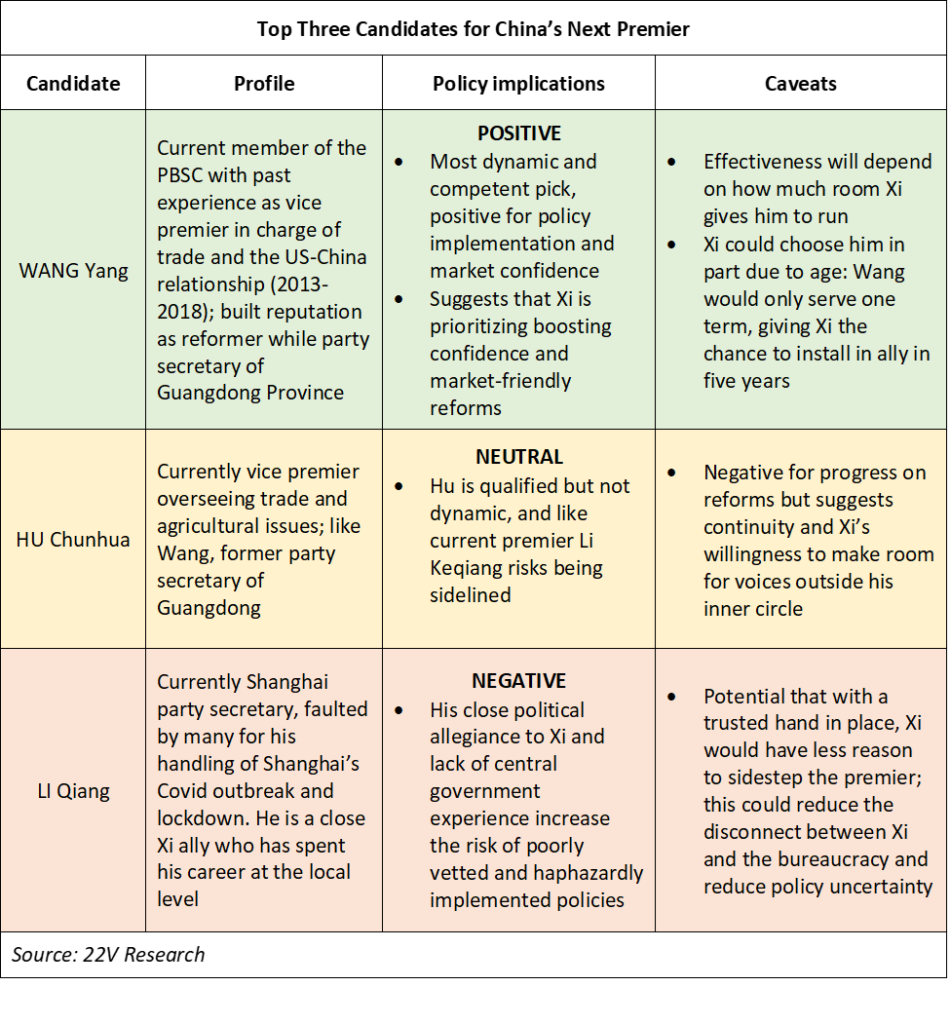
As the caveats above suggest, it is important to be humble about how much we can deduce about policy based on specific personnel moves. In an era where Xi dominates, much will come down to how he uses key personnel, and their personal inclinations and profiles may matter less. It will be important to take a holistic view of the new leadership lineup on Sunday, and to watch how the dynamics evolve over time.
A final point on ideology:
Amendments to the CCP’s charter on Saturday will further enshrine Xi’s standing as the most powerful Chinese leader since Mao. One of the interesting watchpoints on the ideological front is whether Xi comes out of the Congress with a new informal moniker such as the “people’s leader.” Party media and some officials have been using this term sporadically for more than a year, but usage has spiked in recent weeks. Would there be any practical implication? If this title gets widespread use, it moves Xi further along the spectrum to where even indirect criticism of his policies would be a political mistake and even crime. This would be another factor that would increase the risk of errant policies, given disincentives for anyone – especially government officials – to raise questions about his decisions.

