SUMMARY: The Dollar trade won’t be one-sided forever. Central banks will eventually have to do something to combat importing inflation via Dollar strength, but we don’t have any conviction about when that might be. Economic growth in the US needs to downshift meaningfully for the USD to reverse. Chinese lending data came in much stronger than expected, but China-sensitive currencies (AUD) and commodity prices (ex Oil) are moving lower. 22V’s China analyst Michael Hirson has high conviction that Chinese economic growth will remain weak, and reopening is still well off (HERE).
Defensive PEs are still significantly higher than they were during prior recessions (ex-COVID). All PEs have drifted higher in the post-GFC period, but the median Defensive PE is +8pts higher than its GFC level while the median Cyclical PE is 4pts higher. The recent drop in Defensive PEs has coincided with Treasuries gapping higher, making risk-free rates more competitive. If short rates remain higher for longer, Defensives will suffer. Defensives PE being unusually elevated is an implicit view that rates will come down and inflation will slow.
Like the valuation spread between S&P 500 Cyclicals and Defensives, the valuation spread between small caps (R2K) and large caps (S&P 500) is in its 5th percentile. The NTM eps spread, on the other hand, is at its median. Investors are paying a lot more for a dollar of large-cap earnings than small-cap.

There are tailwinds to small caps relative to large caps. The breadth of data in the US has recovered relative to the rest of the world and the US is likely to remain a more attractive option than developed world equities for some time. Meanwhile, the UK is collapsing, mainland Europe still has an energy crisis and a war, and China is battling through COVID protocols.
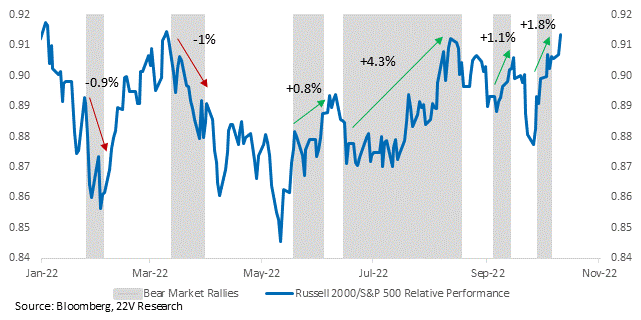
We would go long small caps relative to large caps, even in a down market. Small caps have extremely low PEs and are more insulated from ROW geopolitical risk. That should provide some support in a market downturn. Small caps also stand to benefit more in bear market rallies. Again, PEs are low, and the index should outperform as narratives about recession risk/the Fed shift. The R2K outperformed in the last four bear market rallies.
Full report below…
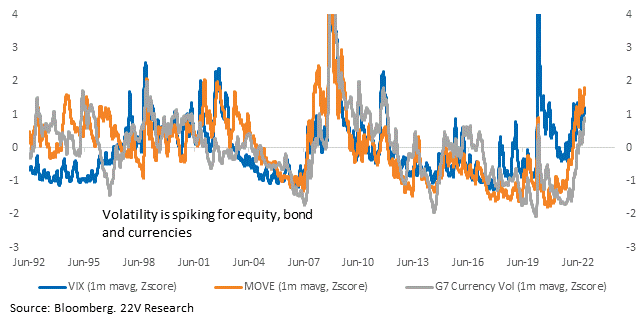
MARKET VIEWS: The BOE doubled down on its Friday deadline (HERE) after first purportedly signaling it was prepared to capitulate (HERE). The GBP initially dropped but is now trading higher overnight. Leaks that the BOE didn’t really mean what it said are leading to a reversal in GITLS. Markets are also pushing the BOJ; the USD/JPY reached a fresh high while Japan’s finance minister reiterated their commitment to defending the Yen. The Dollar trade won’t be one-sided forever. Central banks will eventually have to do something to combat importing inflation via Dollar strength, but we don’t have any conviction about when that might be. The mess of global policy uncertainty is keeping volatility elevated across asset classes. That at least seems unlikely to change.
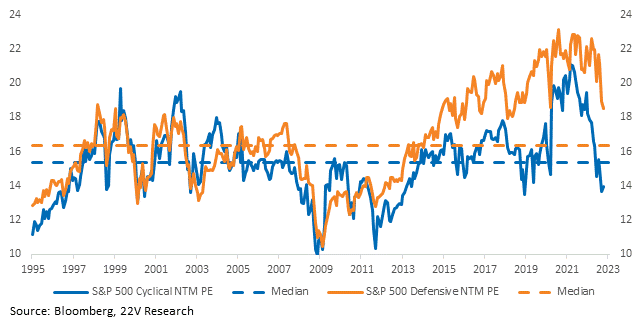
As we have been discussing the past few days, we have much more conviction on being long Cyclicals relative to Defensives, given how expensive Defensives are relative to Cyclicals, and the low yield Defensives are offering relative to the risk-free rates. Defensive PEs are still significantly higher than they were during prior recessions (ex-COVID). All PEs have drifted higher post-GFC, but the median Defensive PE is +8pts higher than the GFC while the median Cyclical PE is only +4pts higher.
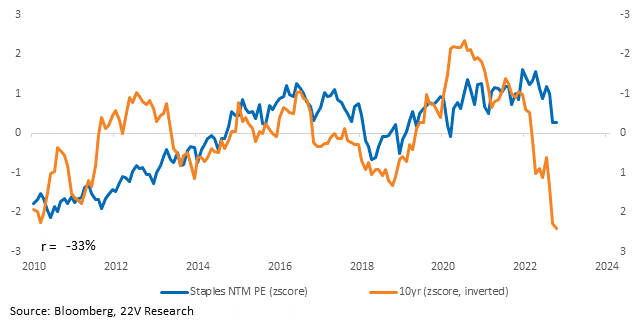
The recent drop in Defensive PEs has coincided with Treasuries gapping higher, becoming more competitively yielding products. Utilities, Health Care, and Real Estate all look like the below.
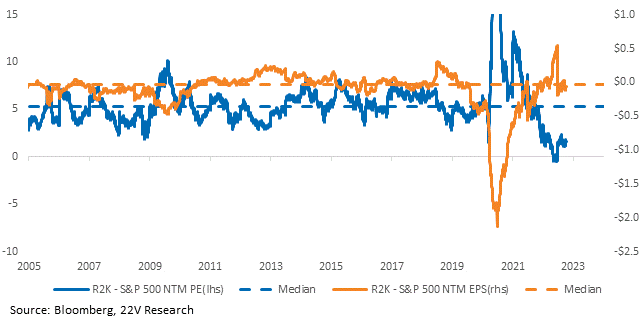
LONG SMALL CAPS TRADE: Like the valuation spread between S&P 500 Cyclicals and Defensives, the valuation spread between small caps (R2K) and large caps (S&P 500) is in its 5th percentile. The NTM eps spread, on the other hand, is at its median. Investors are paying a lot more for a dollar of large-cap earnings than small-caps (even though S&P multiples have fallen nearly -6 points) and small-cap relative earnings aren’t anticipated to be worse than normal.
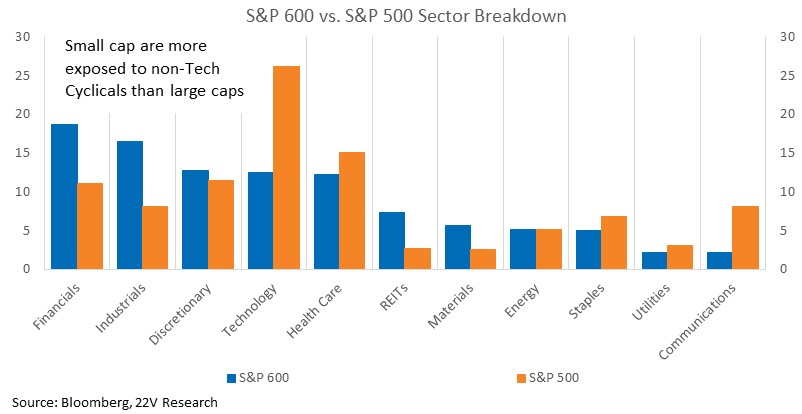
Recently, small caps have been relatively stable during down markets and have gained during rallies. Some of the performance can be tied back to the sector allocation within the S&P 600. Small caps are underweight, relative to the S&P, Defensives, and VERY overweight non-Tech Cyclicals. As growth has slowed and inflation has moved lower, Defensives have fallen out of favor, and stocks levered to rising real yields have gained (more about this from Quant HERE).
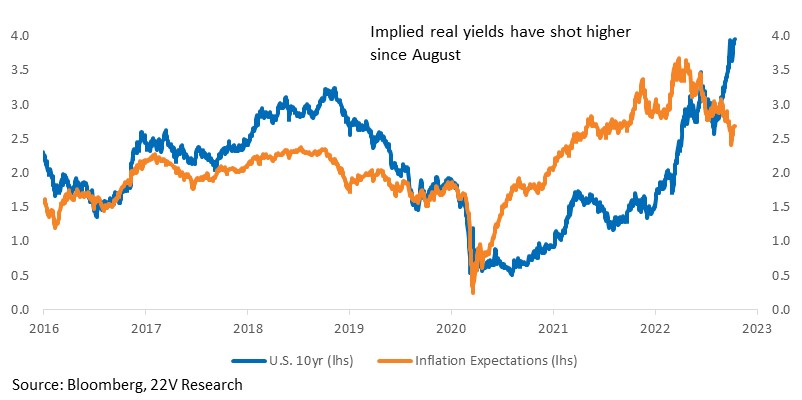
Real yields have shot higher over the past ~six weeks as 1) Treasury yields have moved too new cycle highs and 2) inflation expectations have fallen toward their lowest level of the year. Global central bankers are aggressively fighting inflation and futures/expectations markets reflect that trend. The result has been a spike in implied real yields, making slow-growing Defensive stocks less attractive than rising risk-free rates.
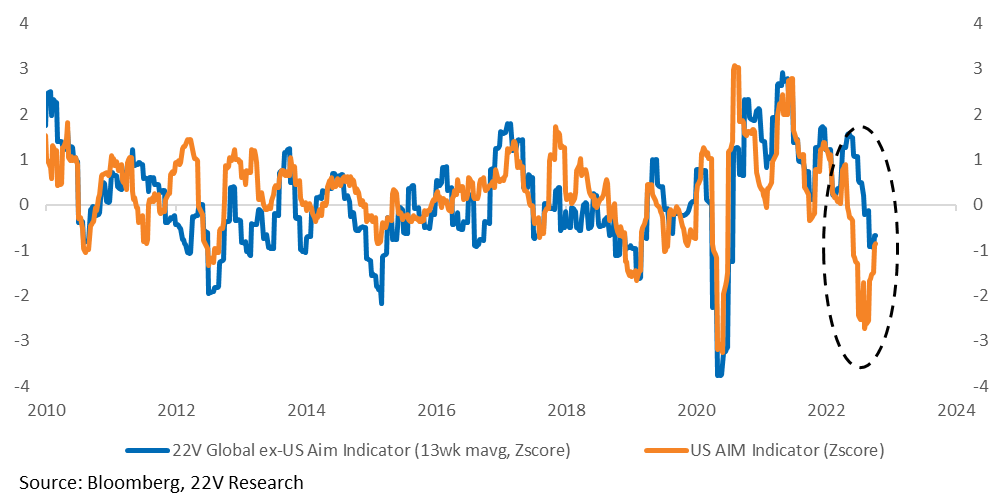
There are tailwinds to small caps relative to large caps. The breadth of data in the US has recovered relative to the rest of the world. Although recession risk is elevated, there is little reason to suspect a recession in the U.S. would be worse than in the rest of the world. Meanwhile, the UK is collapsing, mainland Europe still has an energy crisis and a war, and China is battling through COVID protocols.
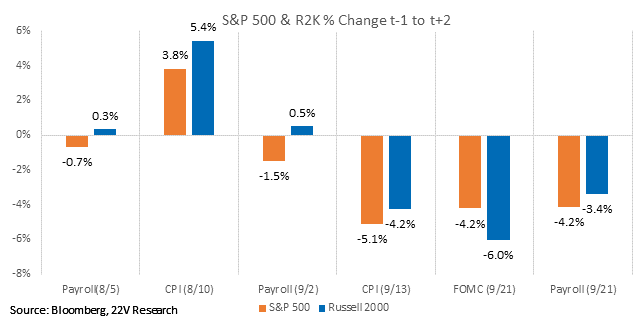
We would go long small caps relative to large caps, even in a down market. Small caps have extremely low PEs and are more insulated from ROW geopolitical risk. That should provide some support in a market downturn. The Russell outperformed the S&P by +6% after Russia invaded Ukraine and the S&P dropped -9%. The R2K has even outperformed the S&P in some of the downturns following big macro events, while also outperforming after August’s softer-than-expected CPI.
Small caps also stand to benefit more in bear market rallies. Again, PEs are low, and the index should outperform as narratives about recession risk/the Fed shift. It has outperformed in the last four bear market rallies, turning the corner in mid-May.
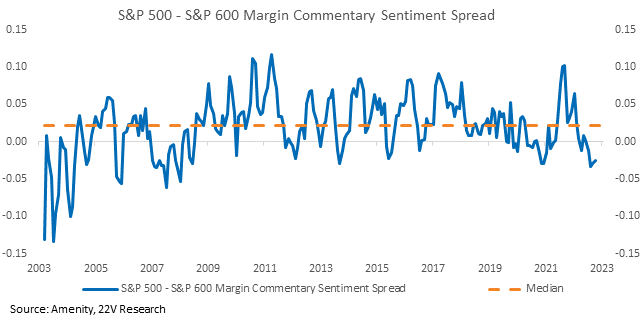
Some risks – small caps will do worse if a deep recession is priced in. We don’t see a reason for that, but the sentiment is terrible right now and narratives change fast. Small caps may have a margin problem. People are quitting smaller firms at a faster rate than large firms while wage growth is much larger for job switchers. The Fed is coming for inflation (the ability to pass along those higher costs). That being noted, margin sentiment is still better for small caps than large caps, so maybe they are better insulated than feared.
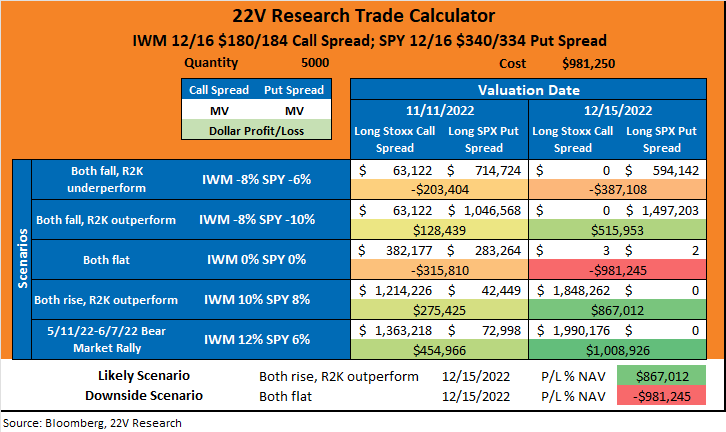
To position for directionally neutral, small-cap outperformance we recommend buying IWM call spreads and SPY put spreads. If we are right and IWM outperforms, it’s more likely IWM hits its call strikes in an up market and SPY its put strikes in a down market. The trade will not work if both indices are flat or only move modestly or if implied vol collapses. Given elevated macro uncertainty and implied equity volatility, we do not think flat with low vol is a likely outcome. The strikes are more than 5% out of the money but realized vol has been high; there have been 6 bear market rallies this year greater than 5%. The table below mocks up returns based on different scenarios and different time periods.