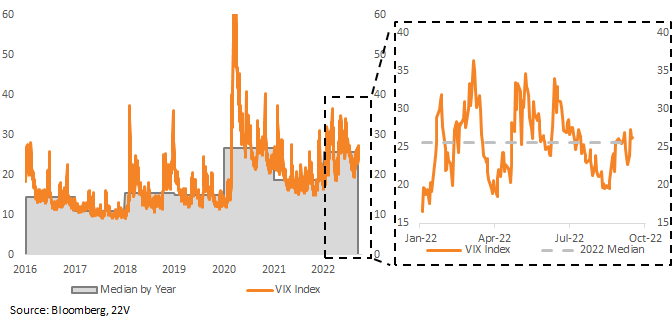
Implied equity volatility has been rising this year, pushing the YTD median VIX to its highest level since 2020. Recession risk and general economic uncertainty as the Fed continues to aggressively fight inflation suggests implied equity volatility will remain elevated into year-end. Investors the Strategy team surveyed this week (results HERE) showed 65% expect the market will decline through the end of October, which would suggest elevated implied volatility.
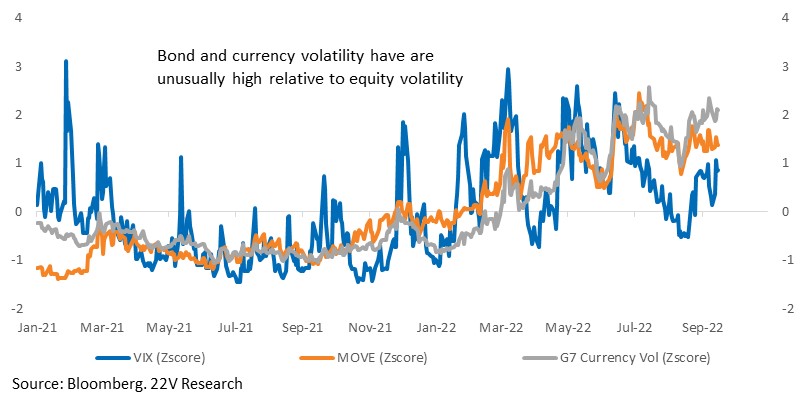
Relative to bond and currency volatility, which are in their 85th and 97th percentiles respectively, implied equity volatility is actually low. Compared to its long-term relationship with bond volatility, equity vol is in its 14th percentile. Either the bond volatility will drop or equity volatility should move higher. Rising yields and 100% odds of a 75bp rate hike next week leave higher equity volatility the more likely outcome.

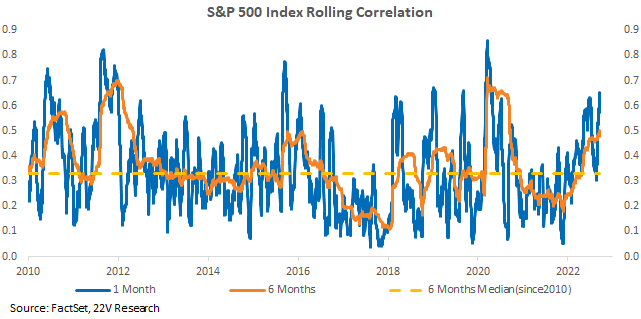
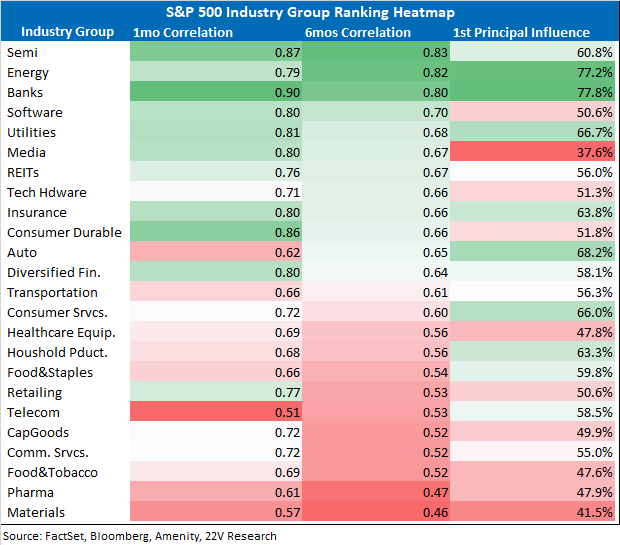
Overall, Short-term S&P correlation has rebounded too, reaching its highest level since 2H20. Long-term correlations have also climbed, reaching their 93rd percentile. Rising short-term correlations have been broad-based, impacting almost all industry groups except Telecom. Consumer Durables and Food & Tobacco have seen the largest increase in correlations. High correlations make alpha generation through single stock selection much harder than normal.
S&P stock and factor returns explained by the first principal component, a proxy for macro influence, has spiked here as well. So in addition to stock movements being more highly correlated, stock AND factor returns are being moved around by an unusually narrow set of forces. Macro shocks and shifts in market narratives will continue to have an outsized influence over market movements until there is a more clear path forward (toward or away from recession).
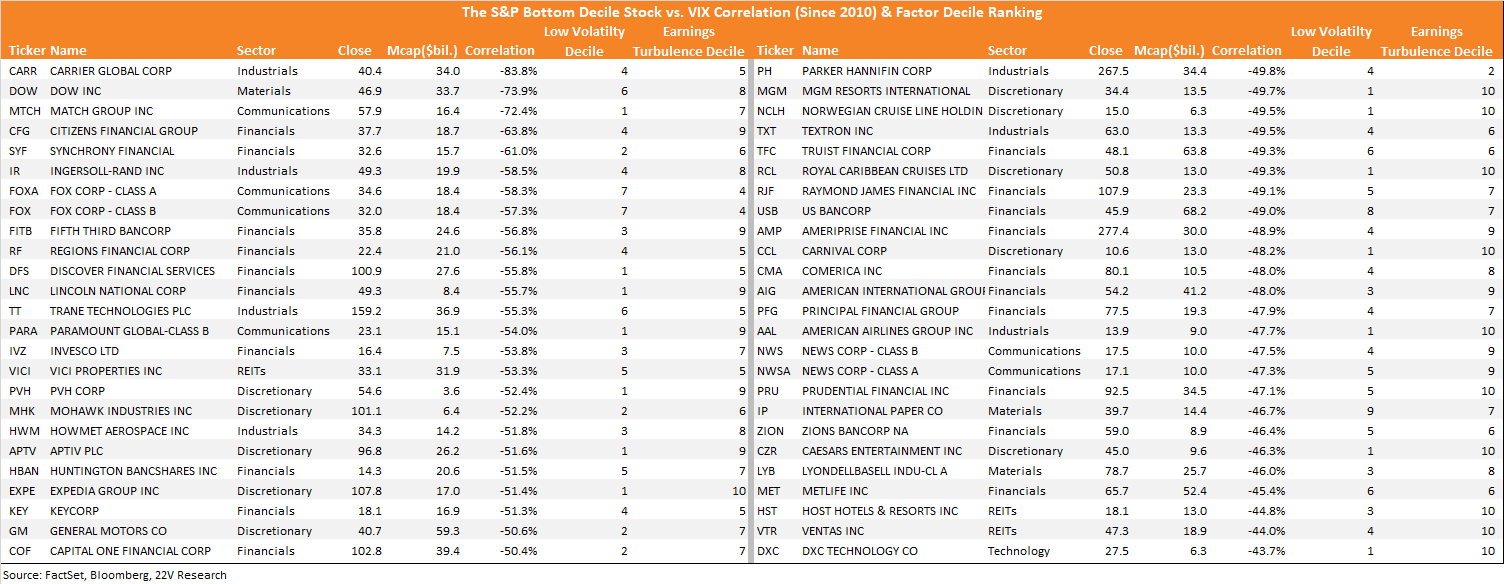
At the end of this report, we list the current short-term and long-term correlations together with macro influence on industry groups. We include a list of the stocks that are most positively and negatively correlated with the VIX. For the most part, stocks highly correlated with changes in the VIX tend to also fall into the high end of our Low Volatility factor. That is encouraging as tighter financial conditions, headline shocks, etc., also coincide with rallies in Low Vol.
Rising Volatility & Correlation Making Alpha Generation Harder: Implied equity volatility has been rising this year, pushing the YTD median VIX to its highest level since 2020. Recession risk and general economic uncertainty as the Fed continues to aggressively fight inflation suggests implied equity volatility will remain elevated into year-end. Investor the Strategy team surveyed this week (results HERE) showed 65% expect the market will decline through the end of October, which would suggest elevated implied volatility. Reporting season will provide some reprieve, assuming results are in line with expectations.
Relative to bond and currency volatility, which are in their 85th and 97th percentiles respectively, implied equity volatility is actually low. Compared to its long-term relationship with bond volatility, equity vol is in its 14th percentile. Either the bond volatility will drop or equity volatility should move higher. Rising yields and 100% odds of a 75bp rate hike next week leave higher equity volatility the more likely outcome.
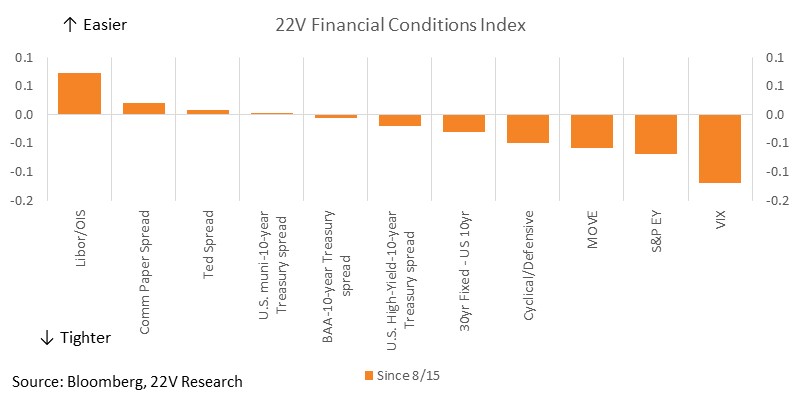
Financial conditions, one of the major drivers of the market rotation this year (HERE), have tightened again since mid-August. Most of that move has been market related (VIX, S&P, MOVE, Cyclical/Defensives relative performance. The first phases of tightening tend to be through volatility, with credit conditions rightening after.
Short-term S&P correlation has rebounded too, reaching its highest level since 2H20. Long-term correlations have also climbed, reaching their 93rd percentile. High correlations make alpha generation through single stock selection much harder than normal.
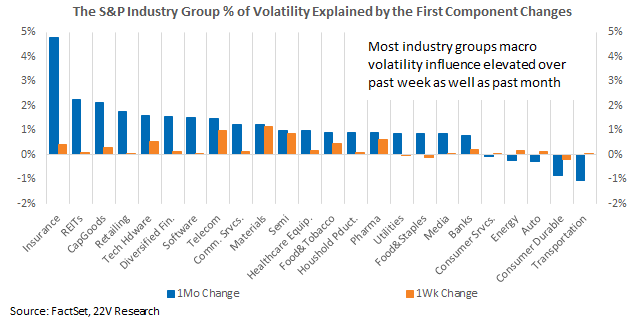
Rising short-term correlations have been broad-based, impacting almost all industry groups except Telecom. Consumer Durables and Food & Tobacco have seen the largest increase in correlations. Telecom is the only industry group where correlations have declined over the past month, but spiked higher this week.
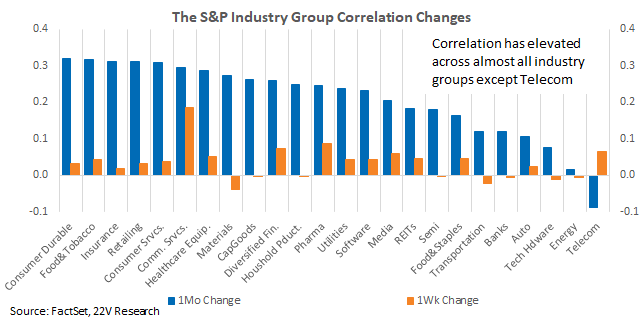
S&P stock and factor returns explained by the first principal component, a proxy for macro influence, have spiked here as well. So in addition to stock movements being more highly correlated, stock AND factor returns are being moved around by an unusually narrow set of forces. Macro shocks and shifts in market narratives will continue to have an outsized influence over market movements until there is a more clear path forward (toward or away from recession).
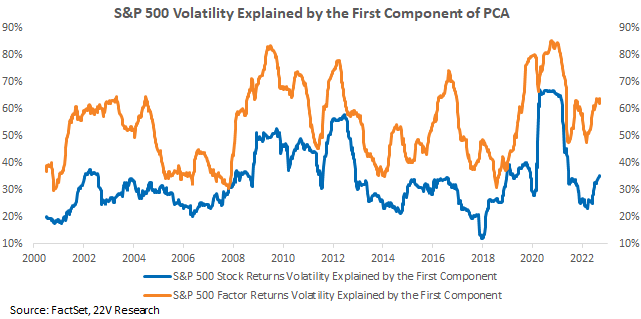
Insurance and REITs are the industry groups with the greatest increase in macro risk influence over the past month. While macro risk over Transports and Consumer Durable fell the most (FDX’s earnings are dragging Transports lower today, which will push correlations higher very short-term). Macro influence on Energy dropped a bit as well, but it remains one of the industry groups most impacted by macro forces, especially oil prices.
Below is the current short and long-term correlation as well as macro influence by S&P industry groups. Stocks in the industry groups with the highest correlations and macro influence are more likely to move together. Those with lower correlations and less macro influence offer more alpha generation opportunities.
Screening: With the VIX likely biased higher over the coming months, we looked at the stocks most highly correlated with changes in implied vol. For the most part, stocks highly correlated with changes in the VIX tend to also fall into the high end of our Low Volatility factor. That is encouraging as tighter financial conditions, headline shocks, etc., also coincide with rallies in Low Vol.
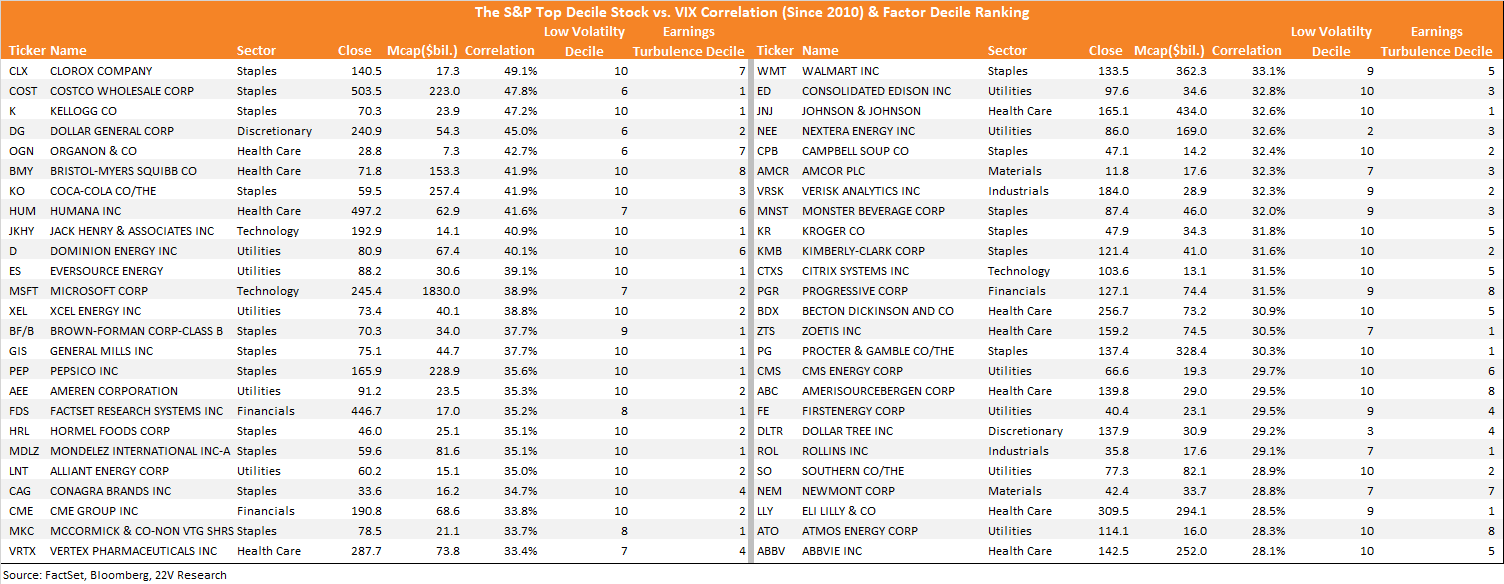
Below are the stocks most negatively correlated with the VIX as well.