Summary: After falling -10% from its mid-August high, the S&P increased +3.7% last week as economic data indicated near term recession risk remains low (claims lower, official service ISM strong, and the NY Fed Weekly Economic Index increased), helping offset rising global short rates. As we noted Friday, we could see a short-term risk-on factor rally continue if EU energy prices continue to fall (EU gas prices are -30% off their high) and if CPI this Tuesday is a non-event or comes in lower than expected. Investors we polled think the market reaction will be risk-on for a below consensus reading. We have a tough time chasing Cyclicals and risk assets, beyond a few weeks bounce, until the Fed is comfortable letting financial conditions ease. Growth is too strong for that now. Given low positioning and negative sentiment (European sentiment was particularly negative coming into last week), it is possible markets move higher through September. The month end estimate for the S&P when we polled investors two weeks ago (HERE) was 3870 and the skew was to the downside.
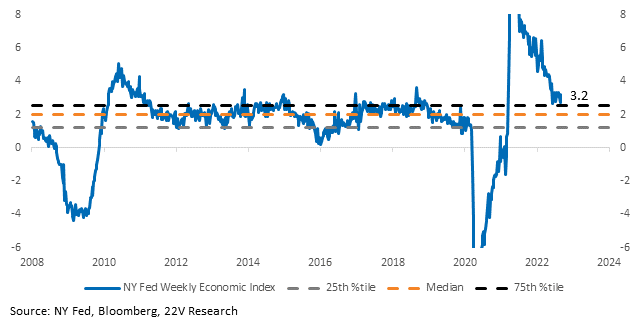
That is the short term. Longer term, The underlying demand outlook is still too strong, given unusually tight labor markets, which means trying to play for a sustained rally is difficult. The Fed will be reluctant to let financial conditions ease if underlying demand growth is above trend and the labor market is tight. After a decline last week, the NY Fed weekly economic index increased to 3.2%, indicating growth is still well above trend. The Fed’s estimate of trend economic growth is ~1.8%, so at the very least we need to see the NY Fed weekly economic index move to the 1% range before the Fed will think about letting financial conditions ease.
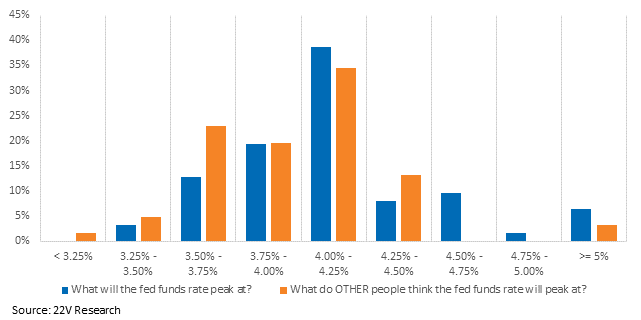
NOW, Fed Vice Chair Brainard was pretty nuanced last week (Brainard playing good cop?) when she noted the risks of overtightening. We think that is a large part of the reason markets rallied. If the fed funds futures curve is not shifting higher and the economy is expected to slow, then we can reasonably assume very little tightening and cuts vs hikes being priced in going forward. With investors we polled expecting a 4-4.25% fed funds rate, that might look too high if demand growth slows over the coming months. We think there is a large possibility that could happen. A positive combination for risk assets in 4Q would be a more obvious slowdown in economic growth, but not too slow, which leads to some repricing of fed funds next year as “easy disinflation” sets in. With positioning still very low and sentiment negative, that could lead to a sharp 4Q rally. Again, we need to see demand growth slow some from current levels for the 4Q rally idea to happen.
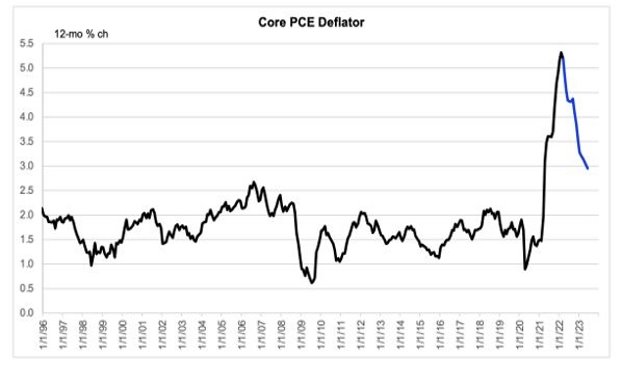
Pain Trade Idea – This Came Up A Few Times in Toronto Last Week: The most painful rally (at least relative to our call!) would be one of demand growth firm, labor markets ok/remaining tight, wages stuck at high levels, yields higher across the curve, AND a rally. Easy disinflation is setting in after all (this is a REALLY important point) and the issue is if core PCE levels out above 3% early NEXT YEAR (current 4.6%). If that is the case, it’s a major problem, but a major problem that investors might worry about next year. In the meantime, earnings could still be pretty strong as core PCE drops toward 3%. Or much better than most people expect.
FYI: What the Fed is guiding on, with seemingly ever-increasing clarity, is their focus on delivering timely disinflation and bearing the significant recession risks associated with that. Those risks apply to the medium-term, not the near-term. Investors focus more on near-term vs medium-term risks.
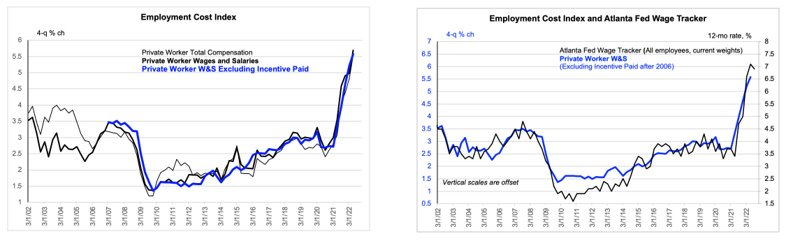
Easy Disinflation, but Still Too High Core Inflation Potentially Explained by Gerard: The main source of underlying inflation pressure is the tight labor market, although supply side shocks have played a larger role in determining the measured pace of even core or central tendency inflation. As these shocks unwind, particularly in rate of change terms and likely too in level terms, there will be an “easy” disinflation. The problem is that the easy disinflation will be to a pace that is still far too high for the Fed’s taste, and risks triggering a rise of inflation expectations – hard as they are to measure – which would be further destabilizing and increase the cost to the economy of achieving sufficient disinflation. Powell has been increasingly clear on this point. Two weeks ago, we got a hint of some moderation in wage pressures in the rise of average hourly earnings (AHE), which printed at 0.31% against the screen consensus of 0.4%. And controlling for sector mix shift implied an even softer read of 0.6%. But there were possibly residual “calendarity effects” (HERE) in that number and lasty Friday Wage Tracker from the Atlanta Fed, which controls for all forms of mix shift, printed clearly on the hawkish side. It points to another firm ECI in late October.
Bottom Line: We continue to fade extreme arguments (much higher or lower equity prices and our 3800-4200 S&P range remains) and remain largely defensive over the coming months. Stocks that benefit from tighter financial conditions continue to outperform, which makes sense to us. We think 10yr bonds are a buy now, and building housing headwinds reinforce that (Quality, Growth and Profitability factors should benefit if yields fall). That being said, our conviction in remaining defensive will be tougher to defend in 4Q if econ growth is ok, but slows some as we expect, and it becomes clear more tightening is not necessary, and positioning/sentiment remain unusually negative. Risk-on factors will work in that scenario. We favor stocks with Pricing Power and its an important theme of ours. Details and stocks identified in the report below.
Full Weekly Report Below…
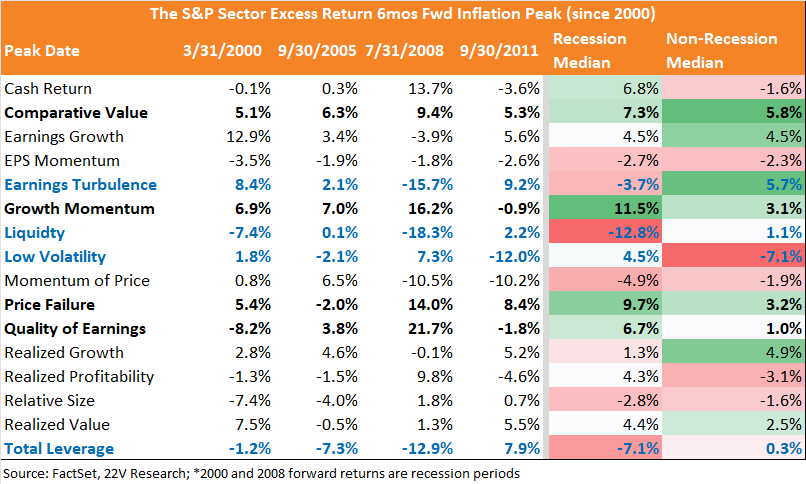
Indicators & Themes – Signals from Factors: As the Quant team noted earlier this week, Low Vol has done well in previous post-peak inflation backdrops that ended in recessions. If a recession does not occur though, Low Vol underperforms and risk-on factors tend to rebound (Earnings Turbulence, Leverage). Value, Momentum, Price Failure, and Quality have performed well in disinflationary backdrops regardless of recession risk. Low Vol is well off its recent peaks, which is a good sign for now.
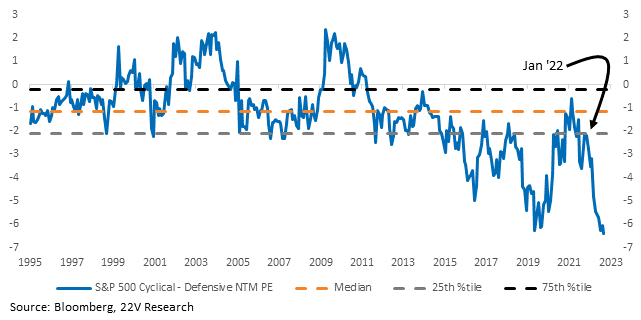
Very Short Term: Cyclical PEs are at an all-time low relative to Defensives, and Cyclicals have underperformed Defensive significantly over the past few months. We could see a short-term Cyclical/risk-on catchup, especially if EU energy prices continue to fall and CPI Tuesday is a non-event. Investors we polled are focused on CPI and agree the market reaction will be risk-on for a below consensus reading and risk-off for an above consensus reading. EU gas prices are -30% off their high. This is just a very short-term thought. It is tough to chase Cyclicals and risk assets until the Fed is comfortable letting financial conditions ease. Growth is too strong for that now.
Investors we surveyed (HERE) expect the fed funds rate to peak ~4-4.25%, up 150-175bps from here. The Fed dot plot has the rate peaking at 3.75% and the market is pricing an end point of about 3.8% (split between 4 and 3.75). If the downside risk to economic growth become more obvious (not happening now), investors’ expectations of the peak fed funds rate would come down. A positive combination for risk assets in 4Q would be a more obvious slowdown in economic growth, but not too slow, which leads to some repricing lower of fed funds next year. With positioning still very low and sentiment negative, that could lead to a sharp 4Q rally.
Labor Market Tight – Offsets Goods Disinflation – Longer Term Picture Tough: The main source of underlying inflation pressure is the tight labor market, although supply side shocks have played a larger role in determining the measured pace of even core or central tendency inflation. As these shocks unwind, particularly in rate of change terms and likely too in level terms, there will be an “easy” disinflation. The problem is that the easy disinflation will be to a pace that is still far too high for the Fed’s taste and risks triggering a rise of inflation expectations – hard as they are to measure – which would be further destabilizing and increase the cost to the economy of achieving sufficient disinflation. Powell has been increasingly clear on this point. Last Friday, we got a hint of some moderation in wage pressures in the rise of average hourly earnings (AHE), which printed at 0.31% against the screen consensus of 0.4%. And controlling for sector mix shift implied an even softer read of 0.6%. But there were possibly residual “calendarity effects” (HERE) that number and yesterday’s Wage Tracker from the Atlanta Fed, which controls for all forms of mix shift, although with its own issues, printed clearly on the hawkish side. It points to another firm ECI in late October.
Unfortunately, the underlying demand outlook is still too strong, which means trying to play for a rally is difficult. The Fed will be reluctant to let financial conditions ease as long as underlying demand growth is above trend and the labor market is tight. After a decline last week, NY Fed weekly economic index shot back to 3.2%, indicating growth is still well above trend. The Fed’s estimate of trend economic growth is ~1.8%, so at the very least we need to see the NY Fed weekly economic index move to the 1% range before the Fed will think about letting financial conditions ease.
Gerard’s middle-up PCE simulation has Inflation falling to roughly 3% on a core basis by 1Q23. If the Fed insists on taking inflation to 2% near-term, a recession is very likely. Last week, Gerard noted his view (or views similar to his) are beginning to make the rounds on the feds unwillingness to go to 2%. This will be an important theme going forward for markets; recession risk is still elevated, but opportunistic disinflation makes a sharp slowdown relatively less likely, which would support the reversal of recent recessionary internal performance. Unless inflation stays well above 3%. The most important risk right now is core inflation remaining above 3% well into next year as wages prove sticky to the high side and demand growth remains firm.
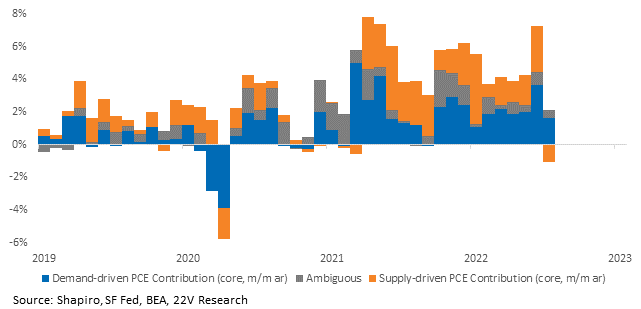
The Fed is committed to dealing with inflation. Persistent or higher supply-driven inflation would mean the Fed has to bring down demand-driven inflation more aggressively. There was supply-driven deflation last month, per a model run by the SF Fed (HERE), which is consistent with the “easy disinflation” call from Gerard.
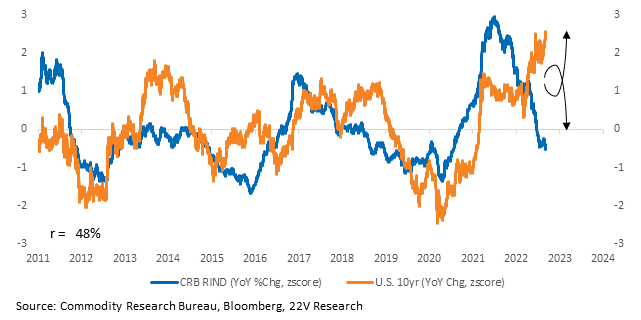
Oil is down -27%, copper is -30%, and the RIND is -15%. The 10yr is not, thanks largely to the mechanical effect of larger/more rate hikes and short-term strong growth. That is why the S&P is not back to its June low. Longer-term, global central banks will offset fiscal stimulus and economic growth will slow more. When economic growth is more clearly back below trend, 10yr yields will decline. We think that happens over the coming months. Either the hard way (the Fed leans much more aggressively on the economy and yield curves invert more aggressively) or the easy way, growth slows now without more fed intervention.
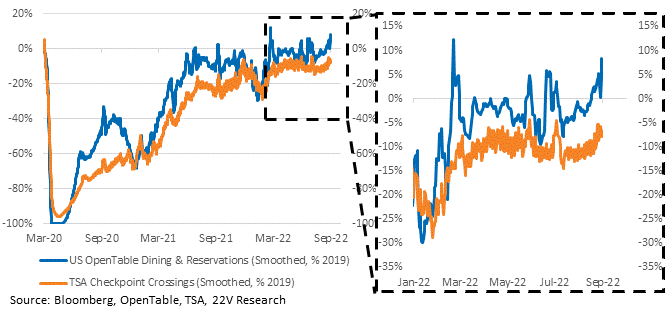
Demand Growth Through the Summer: One theory as to why demand growth has been unusually strong has to do with “revenge travel” idea. People haven’t been be able to travel or go out freely for two years, so are spending at high levels despite housing activity slowing, savings a bit lower, weak real incomes, long lines at the airport, high gasoline prices etc., etc., We’ll be monitoring TSA crossings and OpenTable res data this fall. If the “revenge travel” theory is correct, TSA crossing and OpenTable reservation data should fall off quickly this fall. Open Table has been unusually strong recently.
Housing Drag to Intensify – Not Meaningfully Impacting Demand YET: We are buyers of the 10yr around these levels as the pace of economic growth slowing is likely to quicken over the coming months. Economic growth has been surprisingly firm this summer, but as the reversal of credit creation takes hold, the “revenge travel” season ends and the Fed is more forceful in keep financial conditions tight, the economic slowdown should quicken. Housing will become a more obvious drag going forward with mortgage rates above 6% and mortgage spreads to US Treasuries in its 97th %tile.
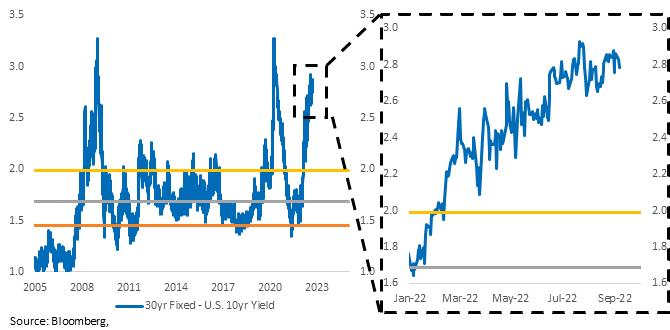
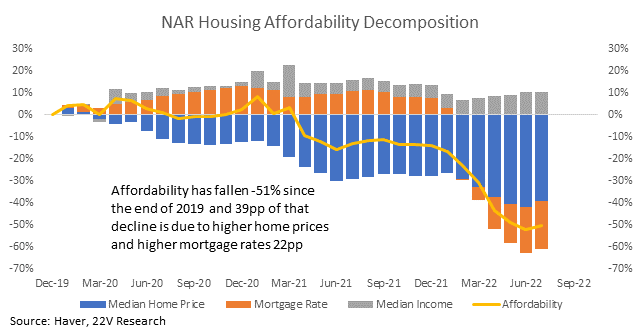
With 30yr fixed mortgage rates above 6% again, the housing affordability outlook remains troubling.
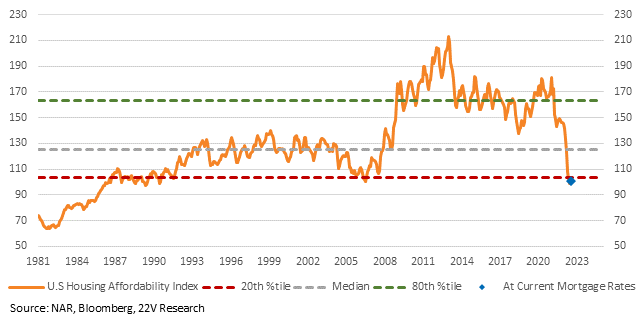
When we look at the decomposition of affordability, home prices are the biggest driver. Followed by mortgage rates. Point being, even if mortgage rates move lower, affordability is likely to remain depressed given the increase in home prices. And median income levels are likely headed lower as the Fed succeeds in slowing economic growth.
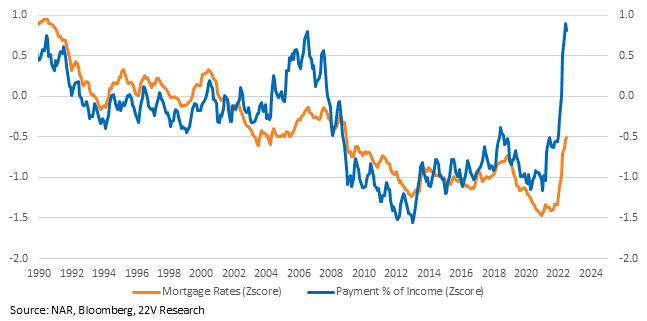
Mortgage payments as a percentage of incomes are above pre-GFC era highs. Incomes are unlikely to head higher as the Fed loosens the labor market. Payments are a function of mortgage rates and prices. Mortgage rates will remain elevated as growth slows. Home prices are supported by the unusually high FICO scores and exceptionally low borrowing rates of pandemic buyers. Unlike during the financial crisis, most owners do not have to sell, preventing the realization of losses.
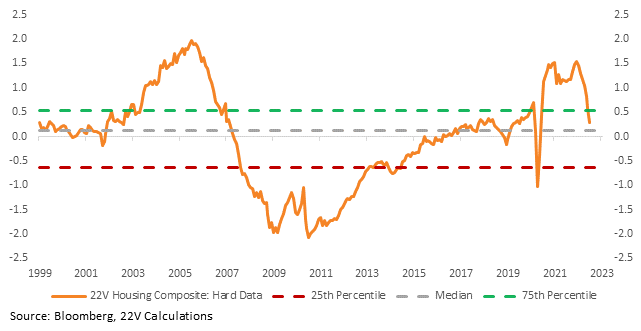
All of the above is why hard housing data has moved lower. Below is a diffusion index (each data point relative to the previous one) of hard housing data which includes: Existing Home Sales, New Home Sales, Pending Home Sales, Housing Starts, Permits, Construction, and Case-Shiller. Hard data has declined, but is back the median level. It has further to go.
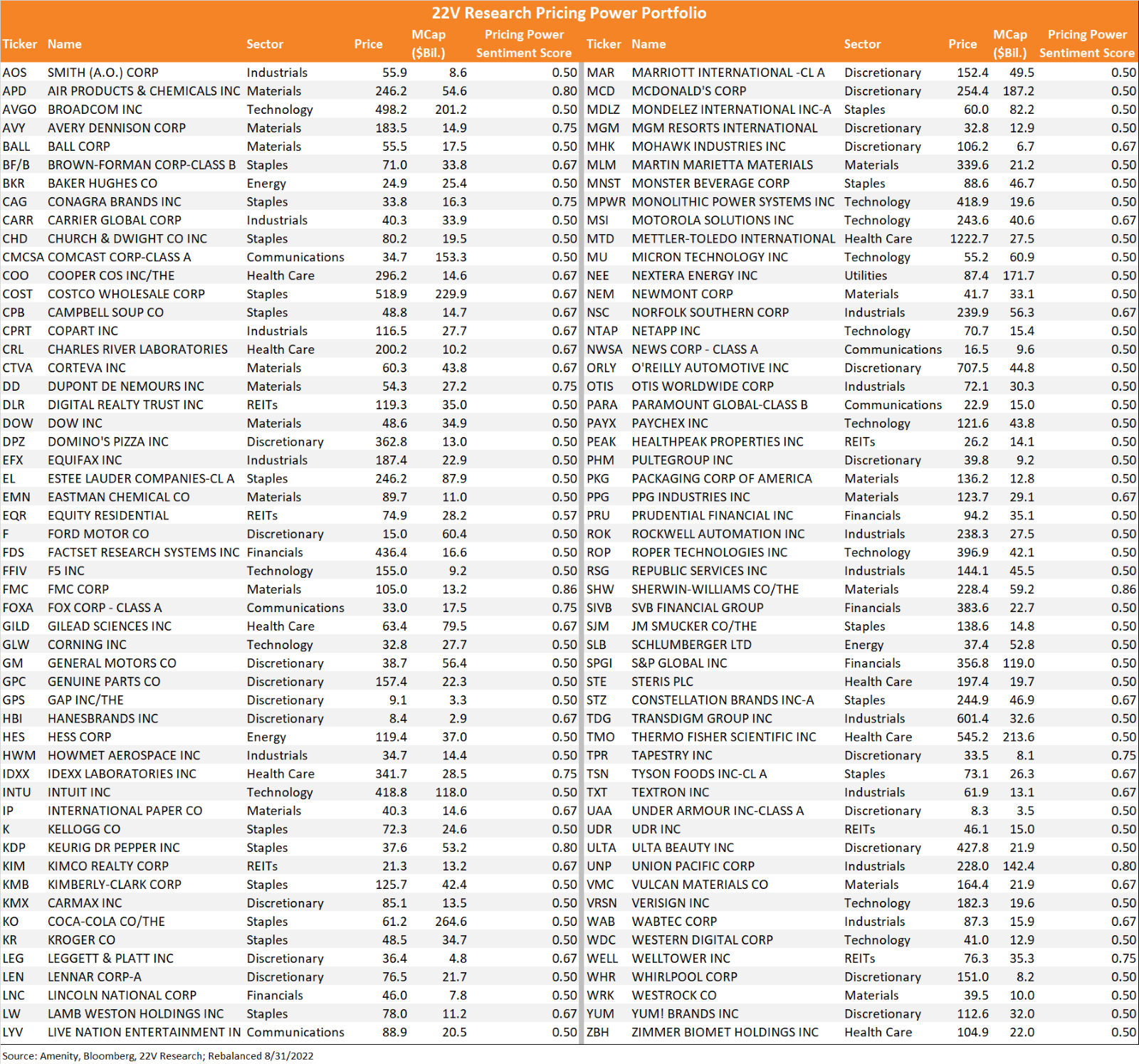
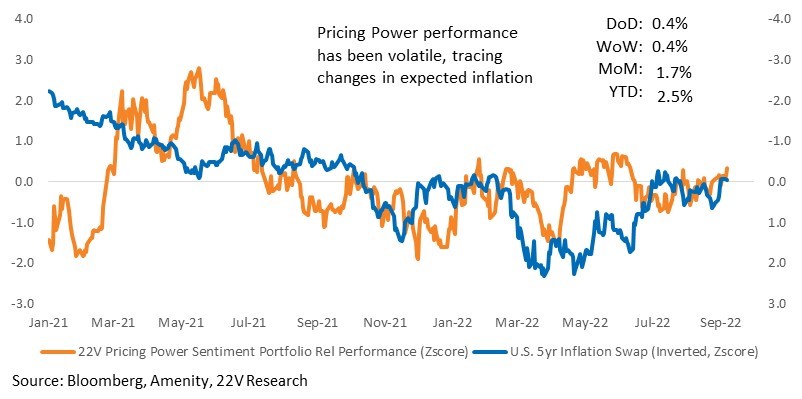
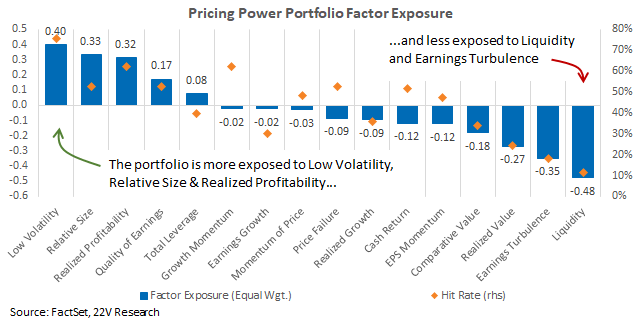
Pricing Power – An Important Theme: To help position for a backdrop of high inflation and rising rates, the Quant team created a high pricing power sentiment portfolio late last year. The stocks in this portfolio are selecting using Amenity data to determine the companies with the strongest pricing power sentiment as of their most recent earnings release. So far, the returns to this portfolio have been volatile, and closely track shifts in inflation expectations. As inflation expectations increase, providing more opportunities for companies to raise prices, the portfolio tends to underperform. A renewed focus by the Fed on fighting inflation through increased recession risk should be a tailwind for this basket.
As covered in a Quant report last week (HERE), the latest Pricing Power portfolio is well positioned for the current phase of tight financial conditions. Low Volatility and Relative Size exposures are both high, while the portfolio is under exposed to Liquidity and Earnings Turbulence. While inflation remains too high for the Fed, financial conditions should remain tight, favoring risk-off factors like Low Vol. That same exposure will be a risk to this portfolio when inflation moves materially lower. At that point, focusing on risk-on names with pricing power will be a better strategy.
The Quant team rebalances this portfolio at the end of earnings season each quarter. Below we list the latest names in the 22V Pricing Power portfolio.