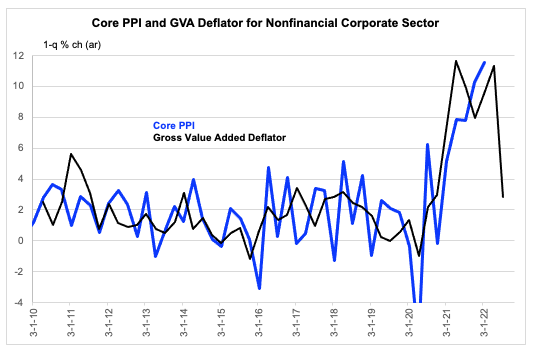
Summary – Weaker than expected inflation was a clear short-term positive for risk assets. Relatively firm demand growth and weakening inflation support risk-on gains. Especially in a backdrop of low gross exposure. With Cyclicals and risk-on factor PEs still at unusually low levels those groups will continue to outperform Defensive sector and factors until 1) the Fed does something to change the backdrop or 2) economic data is consistent increased tail risk (much strong data or more clear recession risk near term). We think commodity prices should be stable/higher until the Fed more forcefully pushes back.
For the coming week, housing data needs to stabilize and retail sales come in higher than expected for the “growth is too strong and financial conditions need to tighten more” rotation to come back into play. Defensives work under that rotation and Growth will lag. If housing/retail sales data are inline/weak, current internal trends will remain. Jason Furman, former chairman of the White House Council of Economic Advisors and someone who is pretty influential, noted in a WSJ article over the weekend that “the Fed is still so far from its inflation target that it can’t afford to continue to let financial conditions ease.” Financial conditions easing too quickly is likely to get much more attention.
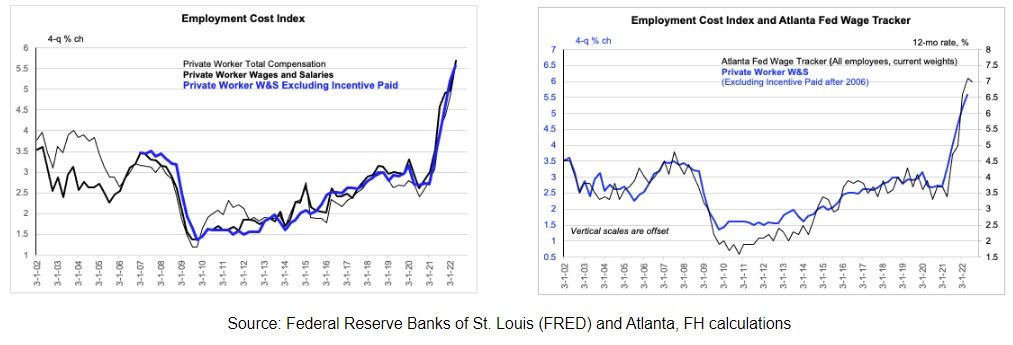
Financial conditions easing some despite inflation that is far from target is an issue because underlying demand is still relatively firm. The NY Fed’s weekly economic index (WEI), a high frequency indicator of real economic growth “scaled to match a 4 quarter GDP growth rate”, increased to 3.2% last week. That implies that underlying demand growth is still solid and wage growth will remain too high. We have had very good inflation news, but as Gerard noted last week (HERE),if trend productivity is running at ~1% and compensation is running at 5% (which looks to be the case now) underlying trend in unit labor costs is 4%, which is far too high to be consistent with the Fed’s inflation objective or – relatedly – with stable profit margins over the coming year. Margins are moving lower.
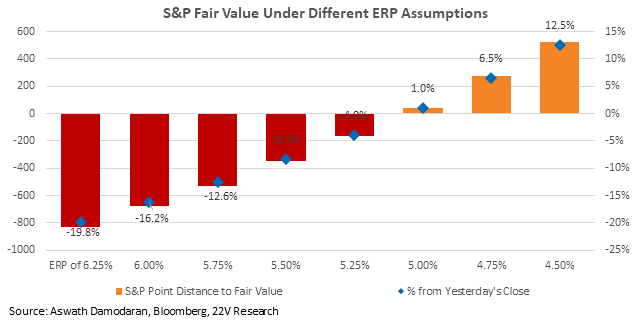
Longer Term: The Fed will remain hawkish (even if they only go 50bp in Sept, their focus remains on lowering inflation), and economic growth and earnings are headed lower, it’s just a question of how much. For now, lower inflation readings reduce tail risk, but the need for lower earnings and economic growth keep us from chasing the market higher from these levels. Our range remains 3800-4200 (more HERE). 4200 is a stretch area of our fair value range assuming earnings trough around $200 level, rebound 9% the following two years, and 10yr yields stay around 2.8%. Fair value could be higher BUT that requires a milder slowdown in earnings (call it $215 trough) with a large rebound/recovery. That seems unlikely.
Bulls are focused on this first part of disinflation, but keep in mind that the disinflation required by the Fed can be thought of as coming in two phases: the easy part that will not require sacrificing much growth or employment, and then the difficult part. The easy part appears to have begun. One aspect of this is goods disinflation. Given goods prices have risen steeply in real terms in response to the Covid-driven global supply chain shock, a stabilization in level terms is not an aggressive call. This alone would reduce core PCE inflation to 3.1% within a year. The “easy” disinflation will not cause the Fed to pivot away from targeting below trend growth though. They will need to take on the medium-term recession risk associated with this to deal with the underlying inflation problem. Unit labor cost inflation has accelerated dramatically and is running well ahead of core PCE-inflation. The argument that businesses can just absorb higher labor costs into super-normal profits is sharply against the data. Additionally, while housing inflation is likely to continue to slow on a sequential basis, it will continue to exert upward pressure on the core deflator.
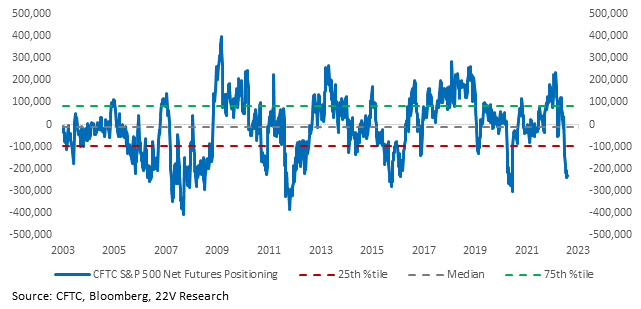
Indicators & Themes: Weaker than expected inflation data was a clear positive short-term. Strong demand growth and weakening inflation support further risk-on gains. A rotation into sectors and factors that lagged last month (Defensives and deeper Cyclicals), which is a call we made going into CPI (it was wrong) isn’t likely over the next few days. Equities in general are being supported by deeply negative positioning combined with the weak CPI reading. Sectors levered to curve steepening (Financials) and Cyclicals in general will benefit while hawkish commentary is being ignored (See Daly/Kashkari last week), inflation expectations are anchored, and underlying economic demand is still solid.
The NY Fed’s weekly economic index, a high frequency indicator of real economic growth “scaled to match a 4 quarter GDP growth rate”, increased to 3.2%. As Gerard noted yesterday (HERE), unit labor costs, if trend productivity is running ~1%, are rising at a 4% pace. Both those readings are far too fast to reduce inflation. Economic activity needs to slow more, increasing the risk the of more hawkish commentary by the Fed.
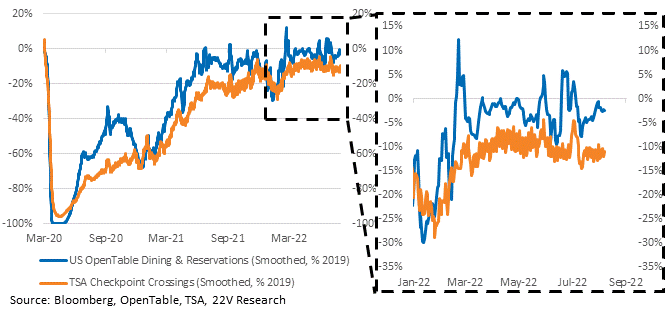
Service demand is still strong and will likely remain so through the summer. OpenTable data and TSA checkpoint crossings have remained stubbornly high. That’s a commodity price tailwind via its boost to economic growth short-term.
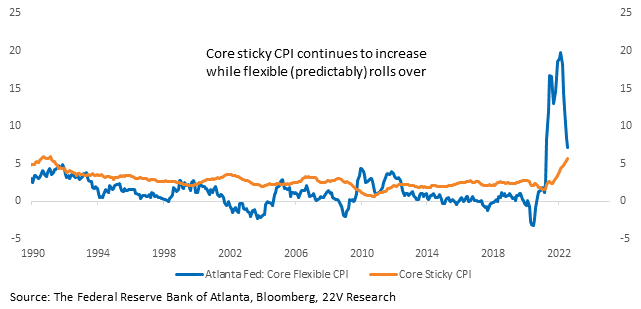
The sticky vs flexible CPI breakdown provided by the Atlanta Fed demonstrates that disinflation is in the flexible, not the sticky parts. The Fed is concerned with sticky inflation (currently running at over 5% ar) becoming entrenched.
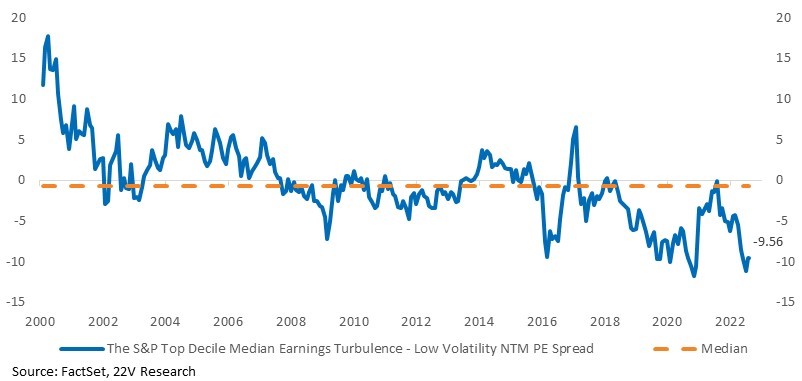
Extreme valuation spreads between risk-on/off factors, and Growth/Value favors higher quality Growth over lower volatility Value. Low volatility in general is historically expensive relative to earnings turbulence. The Fed needs to be much more hawkish, which increases recession risk near term, for low volatility to lead.
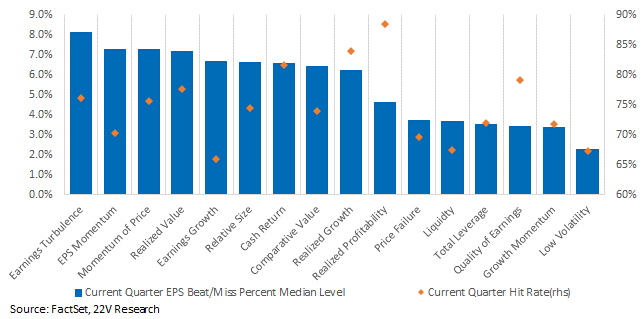
Breaking earnings surprises down by factor exposure, Earnings Turbulence names have posted the largest beats while Low Volatility names have the lowest. That helps explain the rebound of risk-on factors in general and the outperformance of high Earnings Turbulence relative to higher Quality of Earnings this quarter.
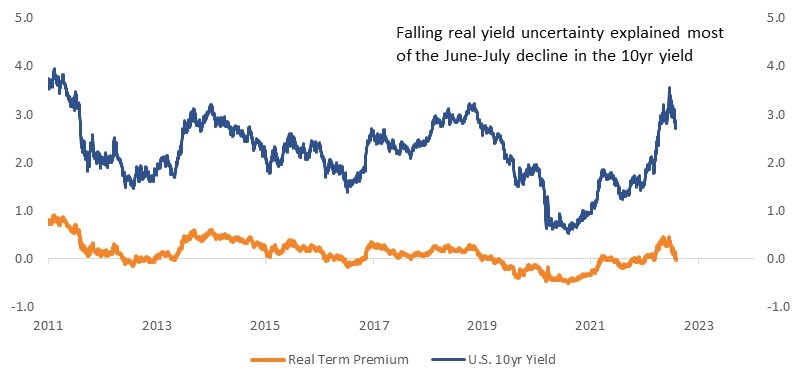
Rate Vol – Maybe A Near Term Low? Sentiment shifts have been sudden this year, driven by expectations about growth and policy that are largely unknowable. Equities rallied alongside the decline in Treasury yields, which was driven by lower uncertainty about the future path of rates/yields. Macro volatility should remain high as the economic backdrop increasingly flirts with recession or Fed officials become much more concerned about easing financial conditions, so investors should expect more rate/equity volatility ahead.
Fair Value: 4200 is a stretch area of our fair value range assuming earnings trough around $200, bounce 9% the following two years, and 10yr yields stay around 2.8%. Fair value could be higher BUT that would require a milder slowdown in earnings (call it $215 trough) with a large rebound/recovery. Last week’s data doesn’t make the higher fair value range much more likely. What the weaker CPI print DID was reduce some economic tail risk. The market is eventually a fade but making money on the short side will require much more obvious recession risk and or a Fed that comes out in favor of much tighter financial conditions.
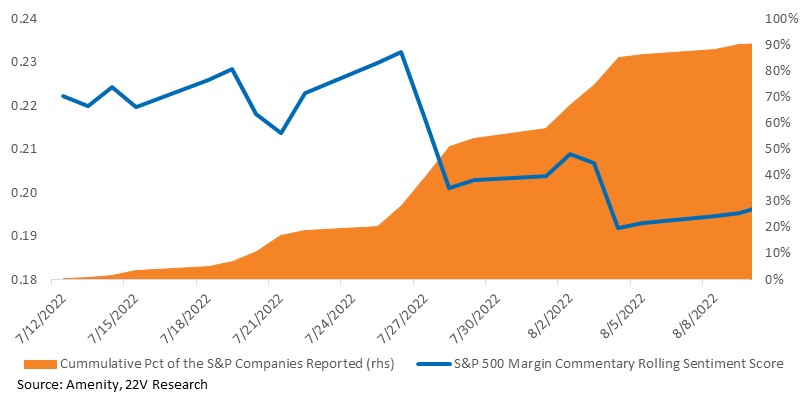
Weaker inflation will put margins at risk in 2H22, but corporate profitability has remained surprisingly resilient. Sentiment is still pointing to a weakening of margins ahead. Forward looking margin sentiment expressed by S&P managers moved lower over the course of 2Q reporting season, suggesting concerns toward forward profitability. Major retailers release earnings next week, which will provide an important update to the margin outlook for 3Q and beyond.
As Gerard has noted (HERE), there have been three phases to the profit cycle during the post-Covid-shock era. 1) Strong margins because productivity was strong as output increased, wage growth was muted, and output prices were strong. 2) Labor costs began to increase as output and productivity growth slowed, but output prices continued to accelerate (inflation). 3) The Fed has committed to stopping pricing power (inflation), intensifying output and productivity weakness while cutting into output price growth, but with stubborn wage growth. So, margins are set to weaken.