
Summary – We continue to think the economy will slow aggressively over the next 6-12 months and long bond yields are headed lower, but a recession is not imminent (see non-recessionary bullets at the end of the report). Which has implications for factors and markets near term. Especially as disinflationary forces continue to strengthen.
Just a week or so ago the most popular narrative was recession risk becoming a clear and present danger and how much earnings would fall. As our June 30th flash strategy survey showed (details here) most (71%) investors expect 2Q earnings will be a negative catalyst for stocks, and that both 2Q and year-end earnings need to be revised lower. Earnings are moving lower medium-term recession risk is elevated and a significant drag from Europe remains a major risk. That being said, as the Payroll and Services ISM highlighted, aggregate demand within the GDP bean count is still rising (Atlanta Fed GDPNow measure is misleading) AND disinflationary forces appear to be gaining traction. That is a positive combination for risk assets.
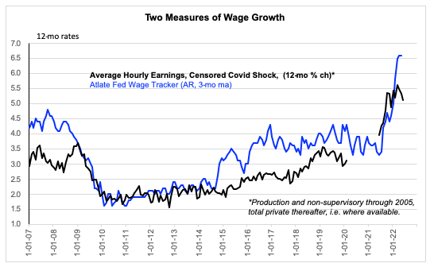
As Gerard pointed out the payroll data was more mixed than hawkish (many investors took the headline reading as very hawkish). Average hourly earnings rose just 0.3% on the month and at an annualized rate of 4 ¾% over the past three months. As Gerard noted “While this was in line with the screen and should therefore not be characterized as a miss per se, it does – again – challenge the signal from the Atlanta Fed’s Wage tracker which shows a much more alarming situation. Given that sectoral mix shift again failed to play any role in distorting the average hourly earnings figures in the employment report, this must tilt perceptions slightly toward the view that wage growth is a bit less alarming. “Along with the -315K print in Household…the payroll report was not super hawkish at all.
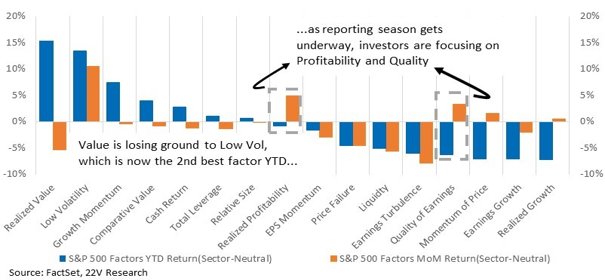
Additionally, last week’s service ISM showed prices rolling (still very high), and supplier deliveries and backlogs of orders are down (supply chains easing), while business activity has expanded. Supply chain sentiment has been steadily improving, according to the Amenity Natural Language Processing tool, and freight rates continue to decline. Side note, from a factor point of view this is important, Quality of Earnings has been a surprising laggard this year, which is tied to the poor cost sentiment of higher quality names. To the extent supply chains/commodity prices are driving the negative cost sentiment (still uncertain), Quality and Realized profitability should benefit. Quality and Realized profitability have outperformed MoM.
The main point of the above, many investors have thought in binary terms (either inflation will keep surging or there will be a deep depression). If reality ends up somewhere in the middle, it will be a support for risk assets. As we have noted many times, if inflation is BOTH supply and demand related, it means a deep recession is not required to slow prices and real yields are unlikely to move significantly higher from here. We think inflation is both supply and demand related, which is why we are less negative on the overall market than some. That being said, monetary policy is a blunt tool and recession is still a significant possibility, which makes it tough to be outright long the market, particularly as negative earnings revisions get underway.
Investors Hedging Creates Short Term Upside: The VIX put call ratio is in its 15th %tile, indicating investors are positioning for a higher volatility. Investors don’t trust the recent decline in the VIX. This is consistent with investors being focused on Inflation and payroll data. We did an investor survey that highlighted this point (focus on the data points). With exposure super low and people hedging for bad outcomes, to the extent that the data is not a game changer (payrolls were not a game changer, lets see what CPI brings Friday), the markets can grind higher near term.
Earnings Season: In general, short-term correlations fall during the earnings season as returns are driven by new fundamental data rather than macro concerns. Presuming CPI is not outlier on Wednesday, we don’t think another sharp macro sell off will overpower the influence of new earnings data and guidance. Over the past few months, S&P volatility has become increasingly tied to macro conditions. Investors should still expect divergences based on earnings releases/guidance, but the persistence of those moves and the influence from earnings at the industry, sectors, and index level will be less.
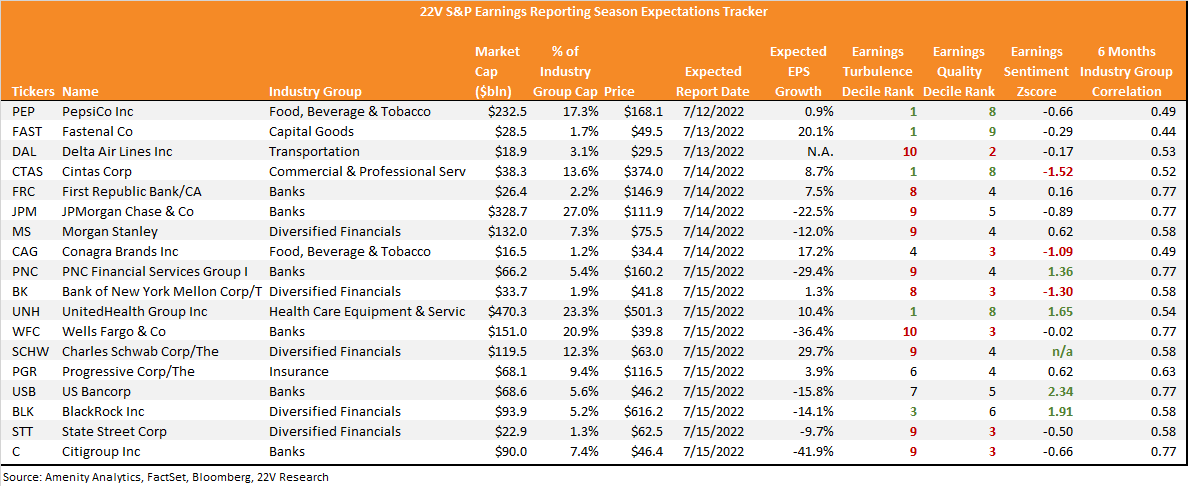
This coming week, 18 names are reporting earnings including a number of the large banks. In this report we list those names along with their Earnings Turbulence and Quality of Earnings scores, as well as earnings sentiment. Stocks with less earnings volatility, higher quality, and stronger sentiment are more likely to report positive earnings surprises.
Lastly, earnings expectations for the full year remain too high and risks to this current reporting season are skewed negative, but fundamentals are far from dire. The percentage of the S&P companies lowering their sales and EPS guidance has increased meaningfully, suggesting more negative revisions. At the same time, cost sentiment has become less negative and pricing power remains strong. Given how many investors expect 2Q earnings to be a negative catalyst, there might be some disappointment risk. Especially since demand growth is not slowing as aggressively as some have thought.
Full set of charts that support what we wrote about above are below…
Macro Backdrop: There is heightened discussion now of recession risk, in part because the Atlanta Fed GDPnow model shows the economy contracting at an annualized rate of about 2% during 2Q, following the 1.6% decline in Q1. We will take the over relative to the Atlanta Fed, because they do not have a good record and assume an extreme inventory flow drawdown. More substantially, though, there appears to be agreement that the most core measure of aggregate demand within the GDP bean count is still rising. And even this probably understates underlying momentum.
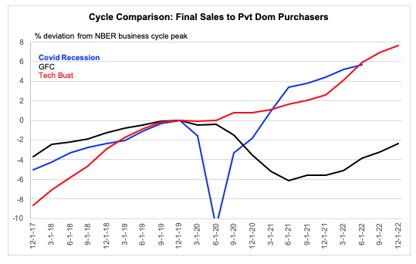
Recession risk is elevated at the medium term and relates to the need for the Fed to guide growth to below trend and to keep it there for a while. On the extent of that risk, we got some good news Friday (payroll’s firm). Wage growth did not surprise, but it does challenge the signal from the Wage Tracker
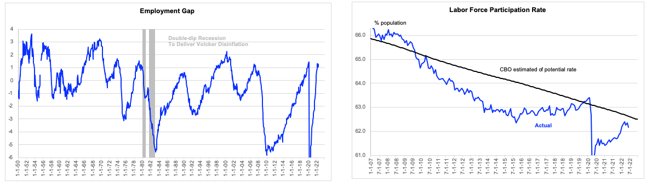
We are less sure what to make of the measures of labor market tightness from the household survey. The employment gap actually ticked down to imply less labor market tightness, but the stalling of the participation rate may more than fully offset the signal there.
Short Term Squeeze Potential: The volume of VIX calls has been significantly higher than the volume of puts, indicating investors are positioning for higher volatility.
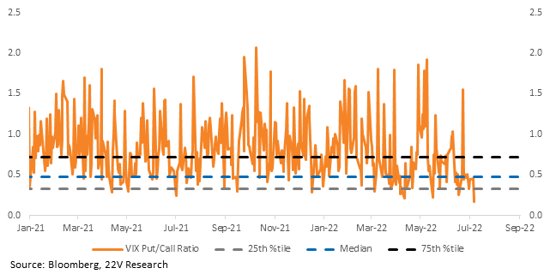
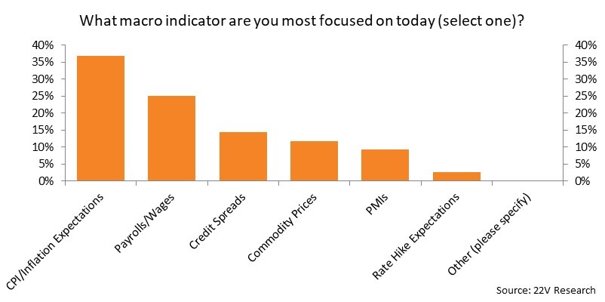
Macro influence over equity volatility has been moving higher as growth slows and the Fed remains committed to fighting inflation despite rising recession risks. Respondents to our flash survey are most focused on inflation readings (35%) followed closely by payrolls (23%). Investors seem to have internalized the Fed’s data dependence. Many investors are concerned about what the data means form markets (most are worried the data will be a negative catalyst). Along with concerns over earnings, that helps explain the elevated level of VIX calls relative to Puts.
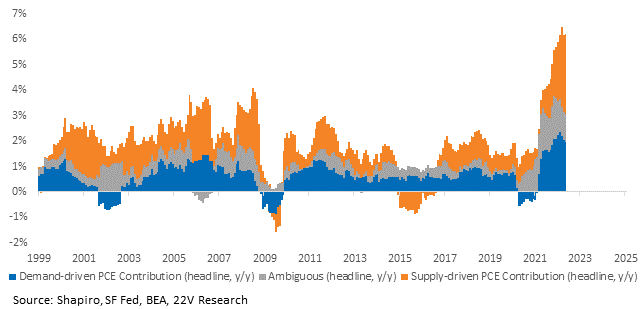
Inflation Is Not All Supply – And That is Important: The SF Fed does an update of supply vs demand PCE inflation. A component of inflation is supply driven if its price increases but quantity decreases and a component is demand driven if price increases and quantity increases. That’s run for each of the smallest subcomponent of PCE and then aggregated up. Demand-driven inflation moderated in May (+1.2% m/m ar, down from 1.9%). Supply-driven accelerated (1.6% m/m ar, up from 1.3%). The point is that inflation is BOTH supply and demand related, which means, if true, that a deep recession is not need to slow inflation.
A Better Backdrop for Quality & Profitability: Quality has been a surprising laggard this year, which is tied to the poor cost sentiment of higher quality names. To the extent that supply chains/commodity prices are driving the negative cost sentiment (still uncertain), Quality and Realized profitability should benefit as supply related inflation eases. Quality and Realized profitability have outperformed MoM.
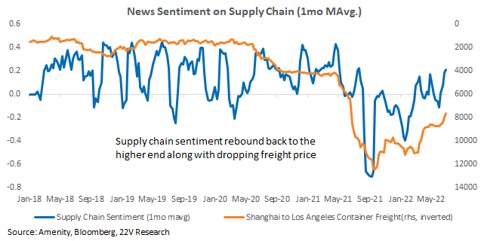
Supply chain sentiment has been steadily improving and freight rates continue to decline. That is an important positive for inflation. Chinese Premier Li Keqiang has told five prosperous coastal provinces that form the backbone of the economy to “exhaust all means” to stabilize production and employment, as the country stands at a “critical point” in economic recovery from the coronavirus pandemic.
Earnings Seasons & Correlation: In general, short-term correlation fall during the earnings season as returns are driven by new fundamental data rather than macro concerns. That presumes that the recent selloff stabilizes. Bear markets overpower the influence of new earnings data and guidance. If the bear market plunge intensifies, S&P correlation will continue to rise during earnings season.
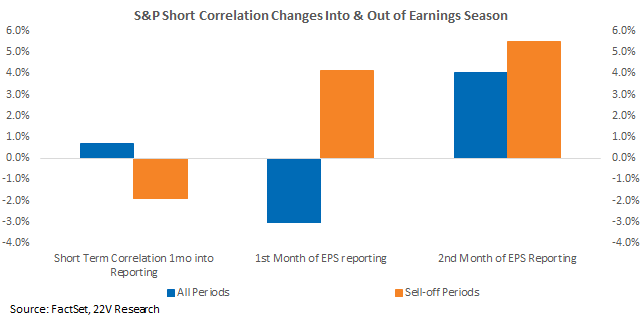
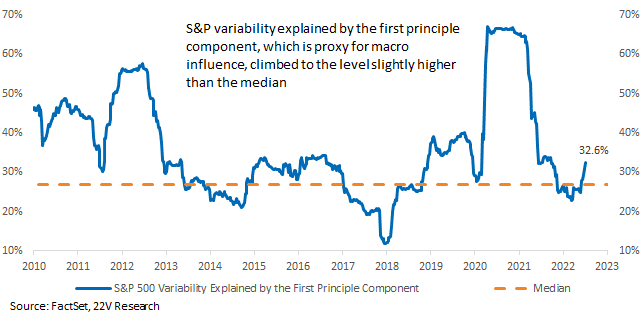
Over the past few months, S&P volatility has become increasingly tied to macro conditions. S&P volatility explained by the first principal component, which is usually viewed as proxy for macro influence, has climbed sharply since end of May and its now in its 70th percentile. High inflation and slowing growth may push higher risk from macro readings on the S&P volatility into earnings season. Investors should still expect divergences based on earnings releases/guidance, but the persistence of those moves and the influence from earnings at the industry, sectors, and index level will be less.
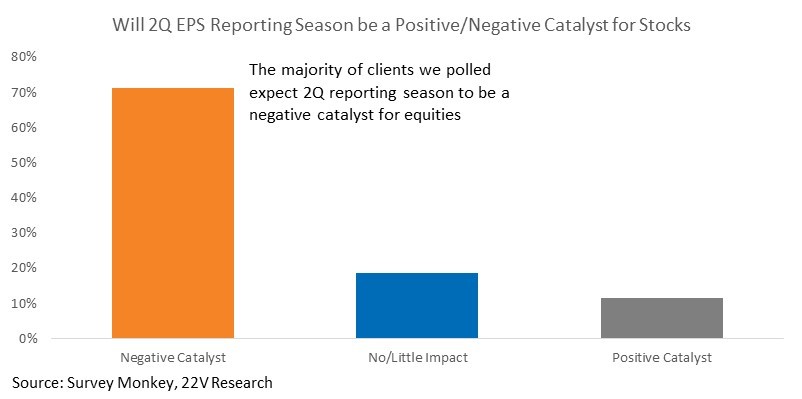
Earnings Season Preview: As last week’s flash Strategy survey showed (details here), most (71%) investors expect 2Q earnings will be a negative catalyst for stocks, and that both 2Q and year-end earnings need to be revised lower. Investor earnings expectations are consistent with the general decline in economic activity and market pricing. Implied vol still indicated 1.7-1.8% daily S&P moves through the end of 2022. 10yr yields are down -65bp from their June high and 10s-2s are inverted. Expectations are low heading into reporting.
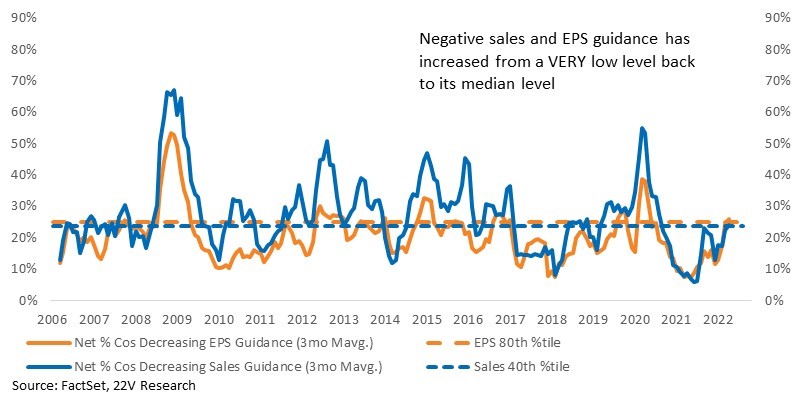
Earnings expectations for the full year remain too high and the risks to this current reporting season are skewed negative, but fundamentals are far from dire. The percentage of the S&P companies lowering their sales and EPS guidance has increased meaningfully, suggesting more negative revisions. The absolute level of negative guidance remains around its long-term median and is coming off its all-time low reached in 2021. Company management is lowering expectations, as should be expected as rates move higher and leading indicators lower.
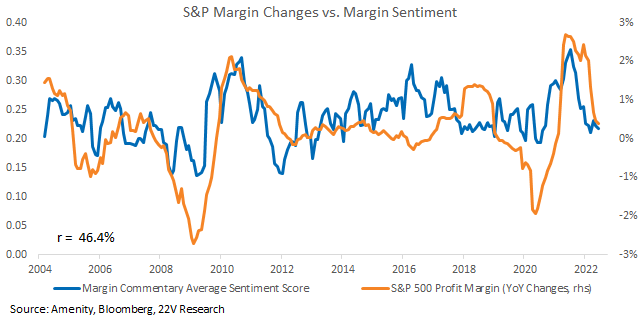
Management sentiment from 1Q earnings calls suggest profitability is coming under pressure. Both margin sentiment and actual profitability have been declining/slowing from since 2H21. Margin commentary (forward looking comments) has fallen to the low end of its range and realized margin growth has stalled. It is hard to see a path from this point where margins expand.
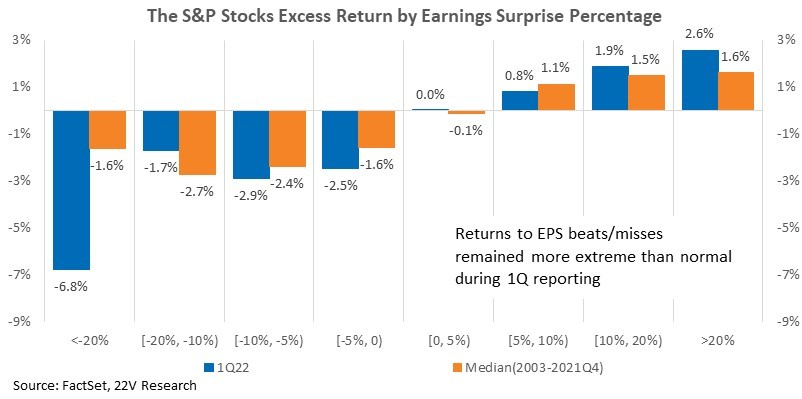
High analyst expectations combined with weakening management guidance suggests increased earnings misses this quarter. Investors appear better positioned for negative earnings surprises than in previous reporting periods. That should help reduce the larger than normal negative price reactions to earnings misses that we have seen over the past few quarters. Companies that miss estimates consistently underperform around reporting, so it is still important to limit the risk of negative surprises. Companies that beat estimates saw slightly better than normal returns last quarter, a trend that should accelerate as index level growth becomes scarcer.
For next week, there will be 18 names reporting earnings. Below we list those names together with their Earnings Turbulence and Quality of Earnings scores, as well as earnings sentiment. Stocks with less earnings volatility, higher quality, and stronger sentiment are more likely to report positive earnings surprises.
From Gerard on recession: Some reasons not to expect an immediate dip into recession, away from the idea that core demand is still growing:
Labor input growth remains very strong and is a source of momentum on both the production and income sides. It both lags and is a source of momentum.
Wealth effects are moderating but are not yet negative, at a time when personal income growth remains solid (see above).
The required moderation in the flow of inventory investment was delayed by a quarter relative to what we might have thought even a few weeks ago. But there is a good chance that much of this adjustment has now been achieved. Secondarily, there is no evidence of generalized overbuilding in terms of the stock.
The services side of the economy seems strong, as evidenced by the nonmanufacturing ISM for June. There is some pent-up demand there.
Housing has weakened and will probably continue to do so, but by historical standards the weakness there has not been sufficiently intense to signal likely recession.
While the Excess Savings Stock thesis seems wrong, as I often belabor, consumers do not appear to be financially strained.
Real economy imbalances generally seem limited, away from the inflation issue (!).

