Summary – Economic growth is set to slow, potentially aggressively, and 10yr yields are near the high end of their range. That is our call on 10yr yields and it worked well last week with Treasury yields moving lower (10yr -10bp 2yr -12bp). A backdrop of peaking yields, slowing growth and easing inflation favors Growth, early cyclicals (which have been crushed relative), and Defensives groups work well too (as long as recession risk remains high). Late-stage Cyclicals levered to commodities and investment will struggle though. Energy fell -6% last week and -17% MTD.
To review the 10yr call, a near-record credit impulse drove a shift in spending that was WELL above other post-recessionary periods. As the credit impulse fades, the spending slowdown could significant. This is set to happen alongside goods disinflation. The NY Fed DSGE model now has 10% odds of a soft landing and a hard landing in the 80% range. The definition of a hard landing being four quarters where the average growth rate is less than -1%.
The biggest surprise to us since we have been more forceful about the coming slowdown is the lack of appreciation of the credit impulse in driving strong spending/inflation higher. Yes, supply has been a major driver of inflation (the San Francisco Fed assumes 50% of inflation is supply related), but the rest is mostly demand. Many of the inflation/interest rate bulls assume inflation is predominantly supply related and the Fed will be reluctant to bring inflation lower as a result. It is true that a flat Phillips Curve AND predominantly supply led inflation would mean a MUCH sharper recession needed to slow growth, so we understand the concerns. We just don’t think ALL inflation was supply related. Most high frequency CPI trackers indicate demand was partially demand driven, and goods deflation is already setting in.
Slowing global growth continues to be a drag on US yields. Citi’s Nathan Sheets, someone we know and respect, puts the probability of a global recession near 50%. The move in credit spreads in Europe and sharp decline in commodity prices (especially ex-oil) is concerning.
The consumer still has some “reopening momentum,” which is why timing these calls is always tough, but the direction of travel seems clear. Economic growth will slow and inflation will eventually follow. As it always does.
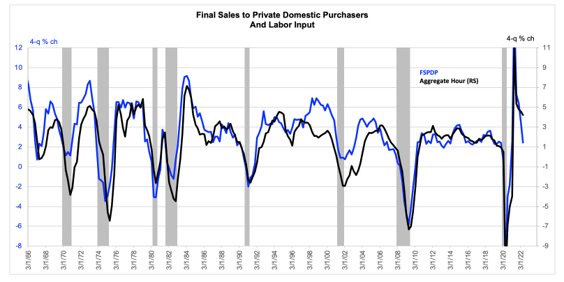
Risks to Our Call: As Gerard pointed out Friday, the core measure of demand in the GDP release looks to be tracking at about 2% (ar) as indicated by the last observation, despite the weaker GDP print. Also, the index of aggregate hours worked in the private sector has definitely slowed and will probably continue to do so. However, its absolute strength is a source of momentum and is inconsistent with an immediate dip into recession. To repeat, the issue is apparently more about the period beyond the next six months – or more. SO, a scenario where CPI misses slightly or don’t shock to the upside, but recession risk remains low, could steepen curves and favor Value/ deeper Cyclicals relative to earlier Cyclicals/Growth (which worked last week). That is the why the revision lower in U of Mich last week was a bit concerning for our call. Long rates went up on the number and the short rate was anchored as a full 25bp of hikes for 2022 were removed.
A simple example of the risk using an extreme example. 75/75bp hikes by the Fed over the next two meetings would favor our call of long rates topping, longer term, better than 50/25. The later scenario assumes economic growth doesn’t crater. But 75/75 with base case CPI would lead to much higher recession probability nearer term. KEEP THIS IN MIND. The higher or stickier inflation is now, the higher recession risk will climb.
Buying The Market Longer Term is Still Tough, but if we assume a mild-recession scenario where 2022 revenue growth is half current expectations (~5.4%) and margins decline a full point (to 12.4%) persistently, S&P fair value is around 3310, about -15% from yesterday’s close. But that assumes the ERP to remain in its 97th %tile. That backdrop discounts earnings of $198 in 2022, $216 in 2023, and $235 in 2024. If inflation slows and 10yr yields move lower, AND we avoid a recession, the market IS A BUY. Until it becomes clear what the bottom in economic growth will look like, chasing rallies will be tough. Also, the easy call on the outlook is the Fed driving inflation to 3%. From there, opportunistic disinflation approach provides more wiggle room. The Fed may be willing to accept inflation in the 2s without pushing core PCE lower and causing a deep recession. That ONLY happens if it is proven that supply IS NOT the major driver of inflation.
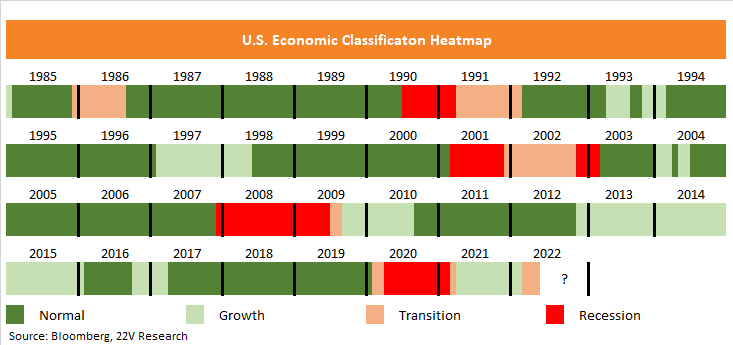
High inflation and the Fed’s forceful pivot to fight upward pressure on prices have led to a rapid regime shift in risk assets. Our objective U.S. economic classification system currently puts the economy in a “Transition” period that frequently ends in recession. Though only if unemployment starts moving meaningfully higher.
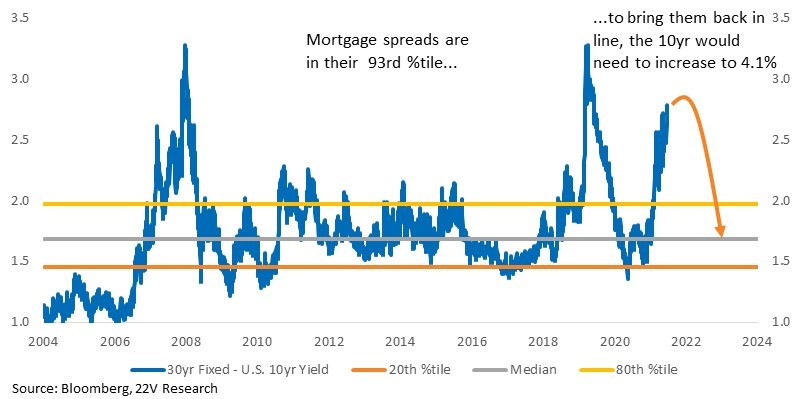
Important Conceptual Point – Please Read: The more people believe Powell’s commitment to crushing inflation, the less rate hikes are actually needed. Don’t focus SOLELY on what short rates need to do. Tighter financial conditions will do the work for the Fed. This is precisely why inflation expectations are anchored, gold has move lower and the USD up. Just look at 30yr mortgage rates at 5.8%, which is 97%tile wide vs 10yr yields. For the mortgage spread to move back to its median either 1) the 10yr Treasury needs to increase to 4.1%, or 2) mortgage rates need to fall to 4.8%. Or to put it differently, mortgage rates at 5.8% are equivalent to 10yr yields at 4.1%.
Full set of charts that support what we wrote about above are below…
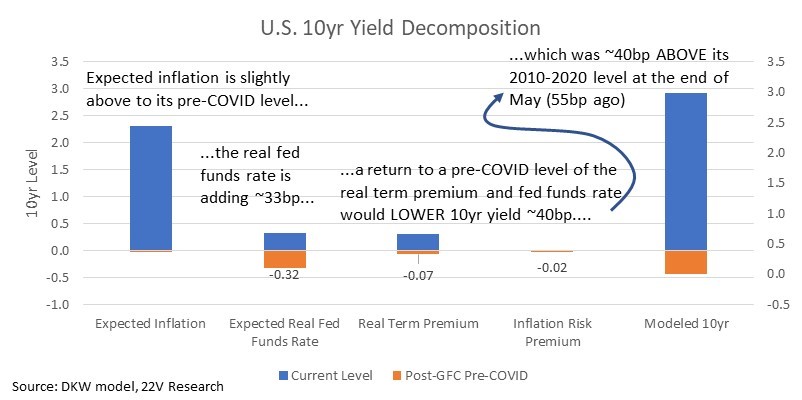
Macro Backdrop – Bond Mechanics: The Fed DKW model was updated last week and gives a breakdown of what is driving 10yr yields. The expected real fed funds rate, at the end of May, was 33bp ABOVE its post-GFC level. Since the Fed meeting, the expected real Fed funds rate has surged higher, pushing up Treasury yields 40bps (now closer to 100bp) above its 2010-2020 level. The real term premium is still very low, but well above its pre-COVID levels. Bottom line, if recession risk increases meaningful (it will), there is downside risk to those important drivers of rates. Expected inflation, real fed funds estimates, and the term premium. 10yr yields would move significantly lower. IF the fed is UNWILLING to accept increased recession risk and lets inflation stay well above 2% (the pushback we get to our topping 10yr call is that the recession would be too deep for the Fed to accept), the term premium and expected inflation would push 10yr yields higher. We are trying to lay out the mechanics of the argument.
Tighter financial conditions will do the work for the Fed. This is precisely why inflation expectations are anchored, gold has move lower and the USD up. Just look at 30yr mortgage rates at 5.8%, which is 97%tile wide vs 10yr yields. For the mortgage spread to move back to its median either 1) the 10yr Treasury needs to increase to 4.1%, or 2) mortgage rates need to fall to 4.8%. Or to put it differently, mortgage rates at 5.8% are equivalent to 10yr yields at 4.1%.
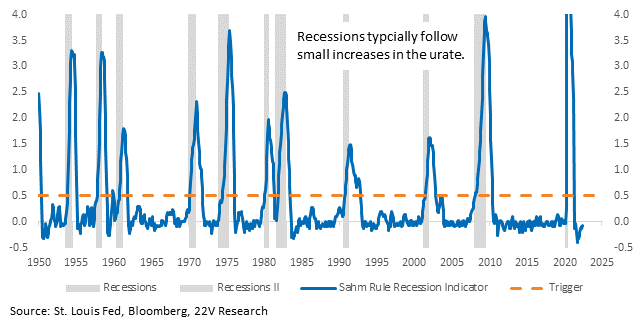
Former NY Fed president Bill Dudley is making the case for a hard landing. Briefly… 1) the Fed is focusing on inflation, 2) the focus is relentless, 3) the slowdown is likely to be abrupt given tighter financial conditions and little room for the consumer to expand, and 4) the odds of a soft landing are low when the urate rises, which it will. Dudley echoes some of the recent work by the NY Fed and Gerard agrees the Fed is taking on recession risk (see here). BUT the opportunistic disinflation approach provides more wiggle room. The Fed may be willing to accept inflation in the 2s without pushing it to target.
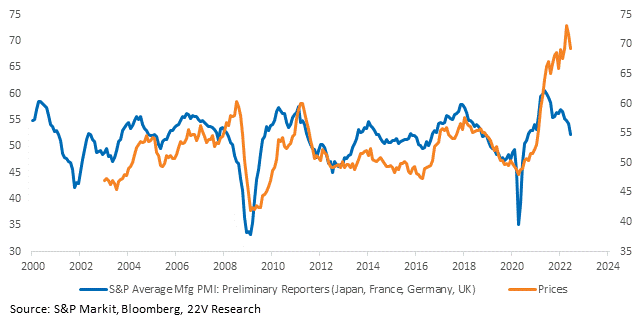
Rest Of World A Problem: Global PMIs continue to decline – the readings in the euro area and the UK were unexpectedly weak – while the prices component indicates continued pricing pressure, albeit with some first derivate improvement. Weaker PMIs are generating headlines about recession risk, but weaker PMIs are also in-line with the goal of global central bankers to slow growth to tame inflation. If prices don’t converge with activity, CBs will take on more recession risk. The Fed, at least, is inflation first. Equity rallies will be bear market rallies until price pressures are more clearly under control.
Recession risk is Not a Today Thing: From Gerard “Employment and labor input growth can be lagging indicators, although less so in recent cycles. The index of aggregate hours worked in the private sector has definitely slowed and will probably continue to do so. However, its absolute strength is probably a source of momentum and is inconsistent with an immediate dip into recession. To repeat, the issue is apparently more about the period beyond the next six months – or more.”
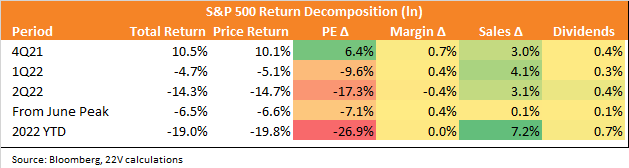
The move lower in markets has been ALL PE related and fundamentals have held up. That will change going forward. As investors focus on earnings and less on the tightening of financial conditions (the focus shifts as economic growth slows), internals of the market will increasingly shift to companies that benefit from slower growth. Which are Growth stocks and names with the pricing power needed to maintain profitability as top line slows.
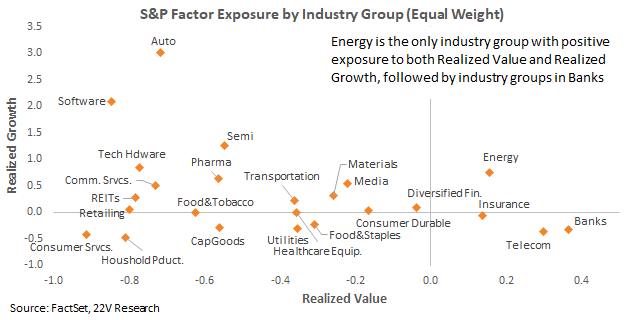
Economic Backdrop & Industry/Factor Rotation: The dispersion between Value and Growth has narrowed with the rank correlation between Realized Value and Realized Growth now slightly positive, one of its highest levels historically. Put simply, Growth and Value names have a LOT more overlap than normal. The correlation is still near zero, so all Value is not Growth, but broad baskets of the two factors will have much more crossover than normal. That suggests stocks are less influenced by rotations between Value and Growth today. Bottom line, being long Value and Short Growth is tougher now. And Energy shows up in both. The Quant team elaborated on this topic in a report last week.
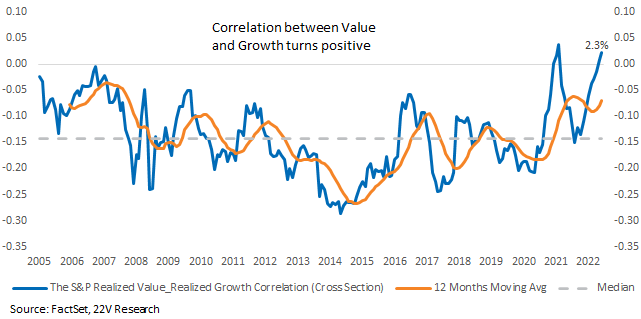
As oil prices rebound with the global economic reopening, Energy company earnings picked up quicky, leaving those stocks more positively exposed to both the Realized Growth factor. Evidence of this shift was reported last week as a number of Tech darlings were shifted into Value indices and Energy names were added to Growth.
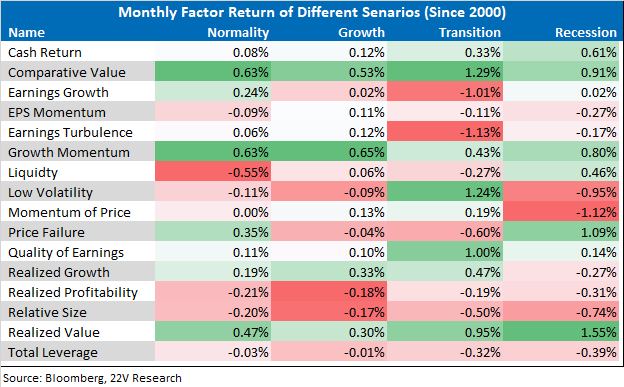
High inflation and the Fed’s forceful pivot to fight upward pressure on prices have led to a rapid regime shift in risk assets. It is pretty well accepted that regime shifts happen and have a large impact on internals, but monitoring/defining periods tends to be a highly subjective, narrative-driven process. To systematize that process we built a Gaussian Mix Model (GMM) inspired by a Two Sigma paper (here) that assigns macro/market data into different Gaussian/Normal Distributions. Our classification system currently puts the economy in “Transition”, a period that frequently ends in recession. Though only if unemployment starts moving meaningfully higher.
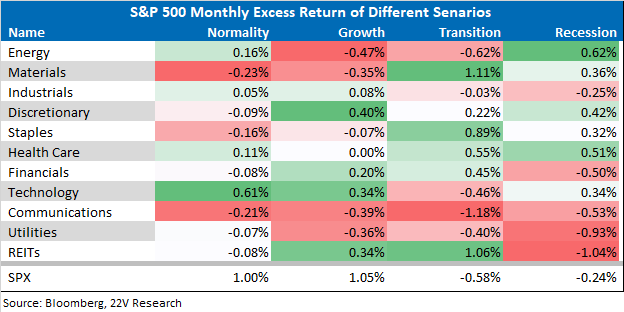
At the sector level, Materials, REITs, and Staples lead during Transitions sectors. In general, Defensives outperformed Cyclicals during Transitions, which is consistent with recent market trends.
At the factor level, Transitions have seen Low Volatility, Quality of Earnings, and Value factors outperformed at the expense of Earnings Turbulence and Earnings Growth. Realized Value and Low Volatility have been the best performing factor this year, while Quality of Earnings was one of the worst performers. There should be some recovery of high quality names given how high recession risk is today. A catalyst for that rotation could be the upcoming reporting season, where misses and negative earnings revisions should increase.