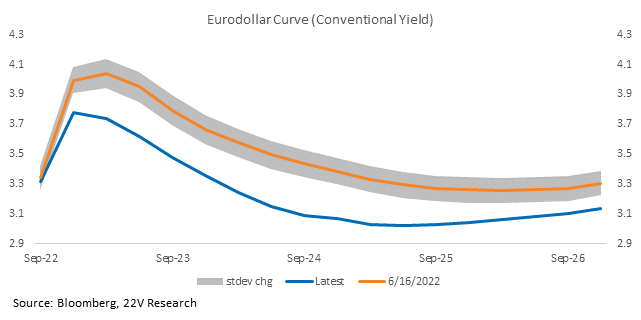
SUMMARY: With inflation still high, there is some confusion as to why rate hike expectations are falling. Keep in mind the primary mechanism for slowing growth is broader financial conditions. High inflation prints led to the fed hiking faster and threatening to hike more aggressively in the future, leading to broader financial conditions tightening meaningfully. The more people believe Powell’s commitment to crushing inflation, the less rates actually need to increase. Tighter financial conditions will do the work for the Fed. Just look at 30yr mortgage rates at 5.8%. Tighter financial conditions lower the forward growth outlook.
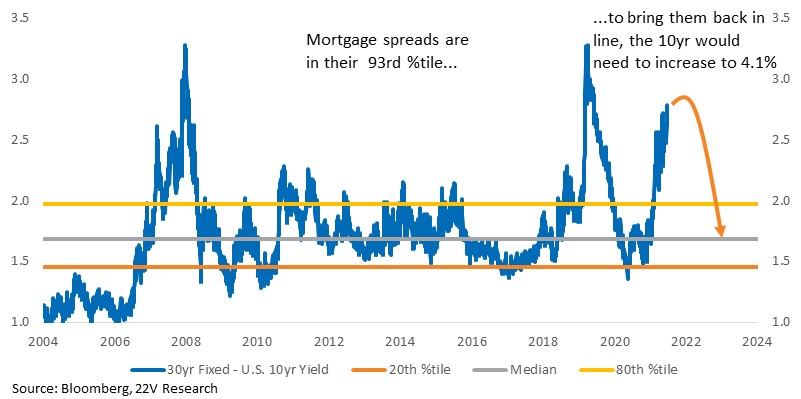
Hopefully, this drives the point home on financial conditions. In order for the mortgage spread to move back to its median either 1) the 10yr Treasury needs to increase to 4.1%, or 2) mortgage rates need to fall to 4.8%. Downward pressure on mortgage rates is building. Or to put it differently, mortgage rates at 5.8% are equivalent to 10yr yields at 4.1%.
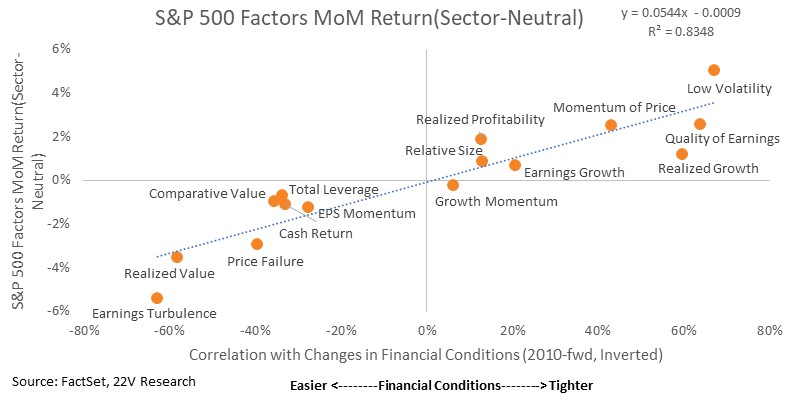
Market internals have picked up on this dynamic. Growth, Low volatility, Quality of Earnings, and Momentum have all outperformed MoM. In both down and up markets. What is going on in the rest of the world is having an impact as well. One area we add meaningfully to the growth conversation is pointing out that US personal spending has been mainly driven by the credit impulse (realizing net worth gains through credit). Aggressive tightening of financial conditions and meaningfully decline in net worth, suggest a sharp slowdown in economic growth over the coming 6-12 months. Bottom line: the first phase was the financial conditions tightening trade (very bad for growth). The second phase is the impact of financial conditions slowing economic growth trade. That appears to have started.
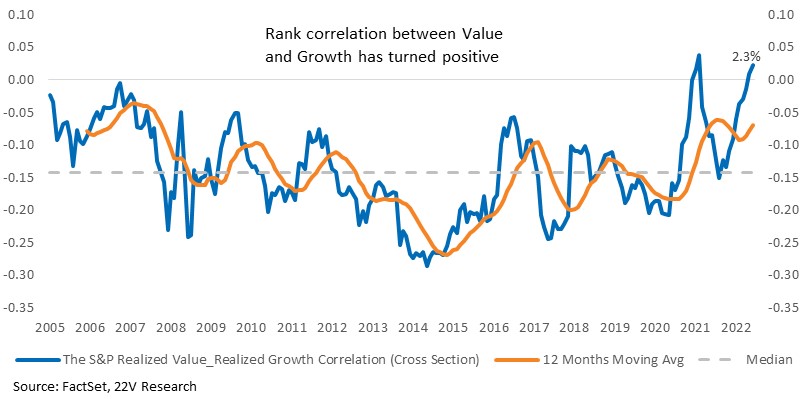
Factor Changes – Important: As noted by the Quant team earlier this week, rank correlations between Value and Growth is now slightly positive. A Growth stock is more likely than normal to also be a Value stock. Yesterday, a WSJ article noted that META, NFLX, and PYPL “…will jump into the Russell 1000 Value Index, and their weights in the Russell 1000 Growth Index will dwindle.” Energy names have more Growth characteristics today, and a number of small and mid-cap Energy stocks are now large caps. Tech becoming Vaue and Energy becoming Growth will drive passive flows. Micro influences and now structural shifts are making the Style trade increasingly complicated. It is more important today to consider the factor rankings of stocks.
Full report below…
MARKET VIEWS: Europe’s fast deteriorating economic outlook (PMIs terrible across the board, Ifo weaker than expected today) and the U.S. slowdown have driven Fed rate hike expectations meaningfully lower over the past week. With inflation still high, there is some confusion as to why rate hike expectations are falling. Keep in mind the primary mechanism for slowing growth is broader financial conditions. High inflation prints led to the fed hiking faster and threatening to hike more aggressively in the future, leading to broader financial conditions tightening meaningfully. The more people believe Powell’s commitment to crushing inflation, the less rates actually need to increase. Tighter financial conditions will do the work for the Fed. Just look at 30yr mortgage rates at 5.8%. Tighter financial conditions lower the forward growth outlook.
Hopefully, this drives the point home on financial conditions. In order for the mortgage spread to move back to its median either 1) the 10yr Treasury needs to increase to 4.1%, or 2) mortgage rates need to fall to 4.8%. Downward pressure on mortgage rates is building. Or to put it differently, mortgage rates at 5.8% are equivalent to 10yr yields at 4.1%.

Market internals have picked up on this dynamic. Growth, Low volatility, Quality of Earnings and Momentum have all outperformed MoM. In both down and up markets. What is going on in the rest of the world is having an impact as well. Investors have rotated into factors that perform best when financial conditions are tightening. The next stage of the rotation will be about growth.
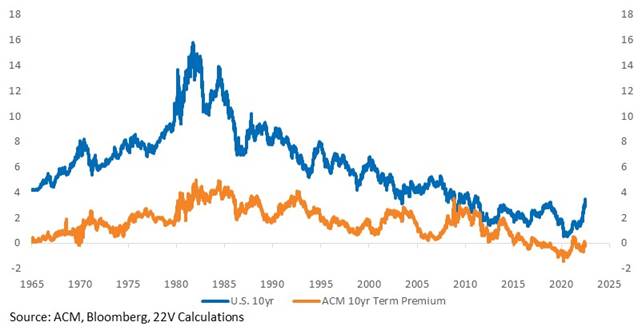
One area we add meaningfully to the growth conversation is pointing out that US personal spending has been driven mainly by the credit impulse (realizing net worth gains through credit). The aggressive tightening of financial conditions and meaningfully decline in net worth, from a rate of change point of view, suggest a sharp slowdown in economic growth over the coming 6-12 months. With Powell seemingly ok with a higher unemployment rate as economic growth slows, expect Growth/stocks that benefit from slower growth to outperform. That is a different than thinking about stocks that benefit or not from tighter financial conditions. The financial conditions trade was the first trade. The slowdown trade is building, which will keep term premium and UST yields anchored.
Factor Changes – Important: The worst sectors this year are Discretionary (underperforming by -16% eq wt) and Tech (-10% underperformance). At the start of the year, both sectors were under exposed to Value and Tech had the greatest Growth exposure. Energy, the best performing sector (61% outperformance) had the greatest concentration of Value.
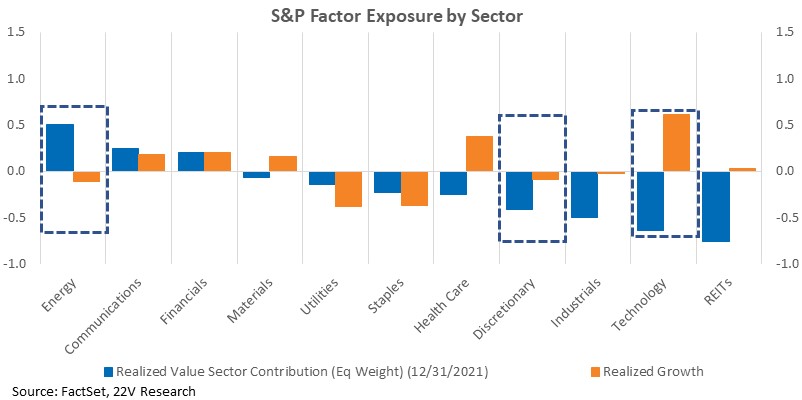
The Quant team pointed out earlier this week that the rank correlation between Realized Value and Realized Growth has turned slightly positive. In other words, a Growth stock is more likely than normal to also be a Value stock. Yesterday, a WSJ article noted that META, NFLX, and PYPL “…will jump into the Russell 1000 Value Index, and their weights in the Russell 1000 Growth Index will dwindle.” Energy names have more growth characteristics and a number of small and mid-cap Energy stocks are now large caps. Those transitions will lead to large passive flows. Micro influences and now structural shifts are making the Style trade increasingly complicated. It is more important today than it has been in years to consider the factor rankings of stocks.