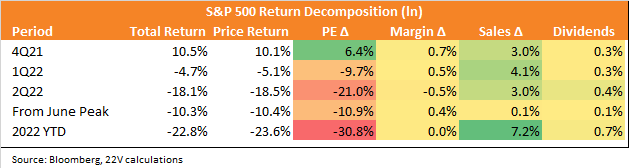
SUMMARY: Nathan Sheets from Citi, someone we know and respect, puts the probability of the global economy moving into recession near 50%. Copper is down -14% since June 3rd. The move lower in markets has been ALL PE related and fundamentals have held up. That will change going forward. As investors focus on earnings and less on the tightening of financial conditions (the focus will shift as economic growth/earnings slow), internals of the market will increasingly shift to companies that benefit from slower growth. Which are growth stocks.
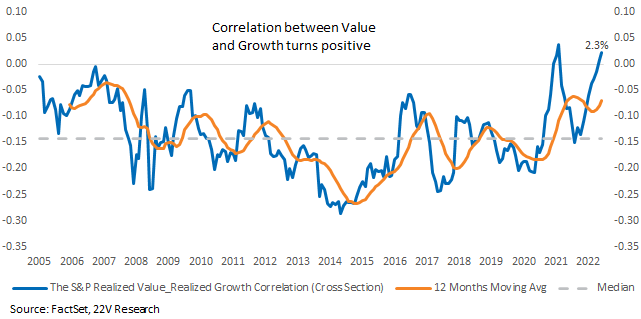
Keep in mind that the dispersion between Value and Growth has narrowed with the rank correlation between Realized Value and Realized Growth now slightly positive, one of its highest levels historically. The correlation is still near zero, so all Value is not Growth. But broad baskets of the two factors will have much more crossover than normal. That suggests stocks are less influenced by rotations between Value and Growth today. Bottom line, being long Value and Short Growth is tougher today.
10yr yields are headed lower, but a hard landing (a mild recession is not a hard landing in our view) is not as obvious as some economist think. It really depends on whether inflation is due to supply constraints, and if inflation expectations can remain anchored. If inflation is predominantly supply related, odds of a hard landing increase meaningfully. We will have more on this subject later today, but IF inflation is both supply and demand related, the sacrifice ratio (economic damage needed to reduce inflation) is lower. Recession risk is meaningfully higher and Gerard agrees the Fed is taking on recession risk (see here). BUT the opportunistic disinflation approach provides wiggle room. The Fed may be willing to accept inflation of ~2% without pushing it to target. Again, how much of the inflation is transitory is a key consideration in how hard a landing will be.
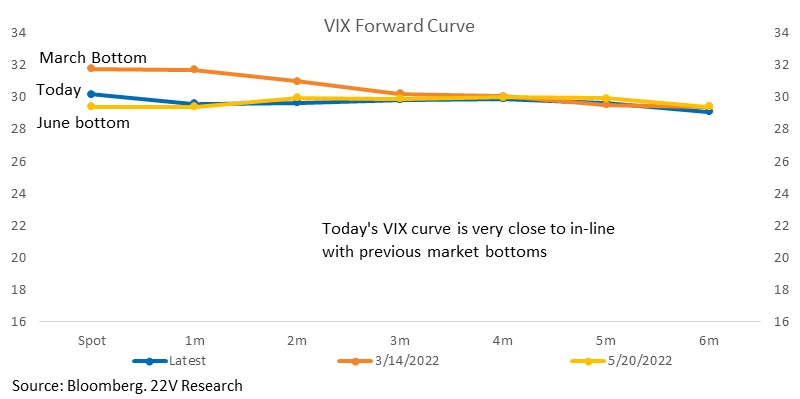
The VIX curve MIGHT be overpricing a hard landing scenario, which is still an open question. FYI: The VIX curve is now a mirror of the past two market bottoms.
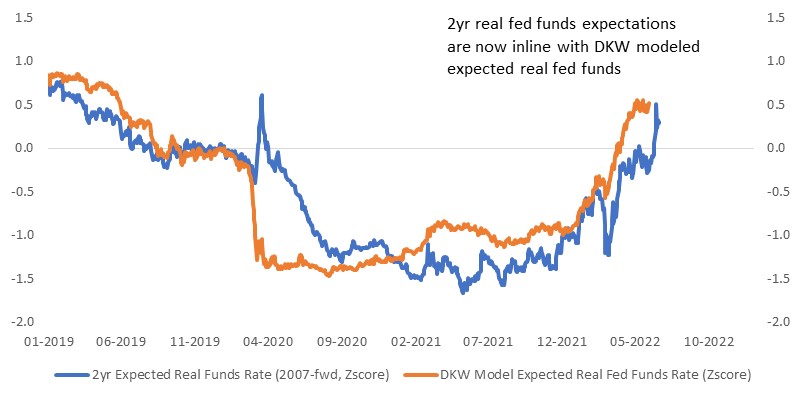
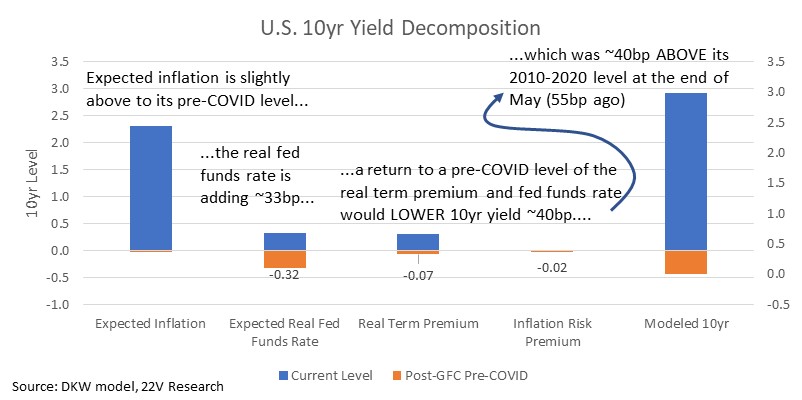
Bond Yield Mechanics: The Fed DKW model is updated and gives a breakdown of what is driving 10yr yields. The expected real fed funds rate, at the end of May, was 33bp ABOVE its post-GFC level. Since the Fed meeting, the expected real Fed funds rate has surged higher, pushing up Treasury yields 40bps (now closer to 100bp) above its 2010-2020 level. The real term premium is still very low, but well above its pre-COVID levels. Bottom line, if recession risk increases meaningfully (it will), there is downside risk to those important drivers of rates, expected inflation, real fed funds estimates, and the term premium. 10yr yields would move significantly lower. IF the fed is UNWILLING to accept increased recession risk and lets inflation stay well above 2% (the pushback we get to our topping 10yr call is that the recession would be too deep for the Fed to accept), the term premium and expected inflation would push 10yr yields higher. We are trying to lay out the mechanics of the argument.

MARKET VIEWS: Oil and 10yr yields are both moving lower this morning and inflation expectations are off their highs, all of which is consistent with a slowing growth outlook. Nathan Sheets from Citi, someone we know and respect, has probability of the world economy moving into recession near 50%. Copper is -14% since June 3rd. The move lower in markets has been ALL PE related and fundamentals have held up. That will change going forward. As investors focus on earnings and less on the tightening of financial conditions (the focus shifts as economic growth slows), internals of the market will increasingly shift to companies that benefit from slower growth. Which are growth stocks.
Keep in mind that the dispersion between Value and Growth has narrowed with the rank correlation between Realized Value and Realized Growth now slightly positive, one of its highest levels historically. The correlation is still near zero, so all Value is not Growth. But broad baskets of the two factors will have much more crossover than normal. That suggests stocks are less influenced by rotations between Value and Growth today. Bottom line, being long Value and Short Growth is tougher now. And energy shows up in both. The Quant team elaborated on this topic in a report today.
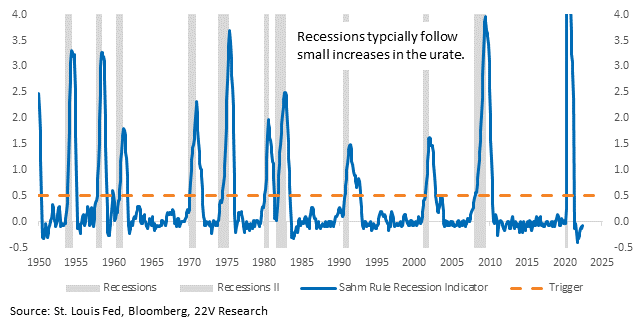
Former NY Fed president Bill Dudley is making the case for a hard landing. Briefly… 1) the Fed is focusing on inflation, 2) the focus is relentless, 3) the slowdown is likely to be abrupt given tighter financial conditions and little room for the consumer to expand, and 4) the odds of a soft landing are low when the urate rises, which it will. Dudley echoes some of the recent work by the NY Fed and Gerard agrees the Fed is taking on recession risk (see here). BUT the opportunistic disinflation approach provides more wiggle room. The Fed may be willing to accept inflation in the 2s without pushing it to target.
10yr yields are headed lower, but a hard landing (a mild recession is not a hard landing in our view) is not as obvious as some economist think. It really depends if inflation is related mostly to supply constraints or not and if inflation expectations can remain anchored. If inflation is mostly supply related, the odds of a hard landing increase meaningfully. We will have more on this subject later today, but IF inflation is both supply and demand related, the sacrifice ratio (economic damage that is needed to lower inflation) is lower. The VIX curve MIGHT be overpricing a hard landing scenario, which is still an open question. FYI: The VIX curve is now a mirror of the past two market bottoms. This is NOT a timing tool, but does suggest another shock is needed to drive stocks meaningfully lower. Then again, who wants to hear that after a -12% decline.
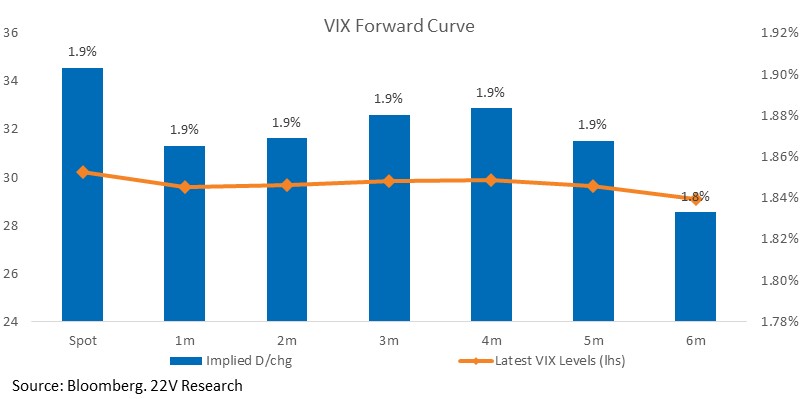
The VIX readings are basically all 90th %tile. Anticipating 1.8%+ moves for over 6 months. This kind of extreme expected vol needs to come down across the curve for a sustained rally (it should come down SOME). Moves like yesterday and this morning are ‘normal’ in this VIX backdrop.
DKW Model Update (the model that breaks down what is driving 10yr yields): The expected real fed funds rate, at the end of May, was 33bp ABOVE its post-GFC level. Since the Fed meeting the expected real Fed funds rate has surged higher, pushing up Treasury yields 40bps (now closer to 100bp) above its 2010-2020 level. The real term premium is still very low, but well above its pre COVID levels. Bottom line, if recession risk increases meaningfully, you have downside risk to term premium, real fed funds estimates and term premium. 10yr yields move significantly lower. IF the fed is UNWILLING to take on recession risk and lets inflation stay well above 2% on core (the pushback we get to our topping 10yr call is that the recession would be too deep for the Fed to accept), term premium and expected inflation would push 10yr yields higher. In any event..we are trying to lay out the mechanics of the argument.
Keep in mind that with inflation expectations stable(ish) the thing that really should have moved is the expected real Fed funds rate. And that is important because the market-based medium-term real funds rate (2yr Eurodollar – inflation expectations) has risen to the level implied by the DKW model at the end of May. The other argument for higher 10yr yields is a Fed that needs to drive real fed funds much higher to slow economic growth.