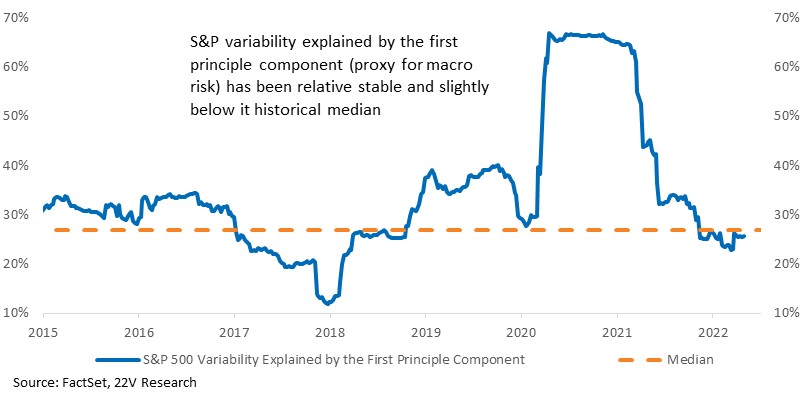
With near 60% of S&P companies reported (74% of market cap), volatility tied to earnings reporting is now winding down. Realized volatility has increased in 2021 relative to last year despite macro risk, measured by the first principal component, remaining stable and slightly below its historical median. Micro trends and narrative/sentiment shifts rather than large macro trends appear to be driving volatility this year.
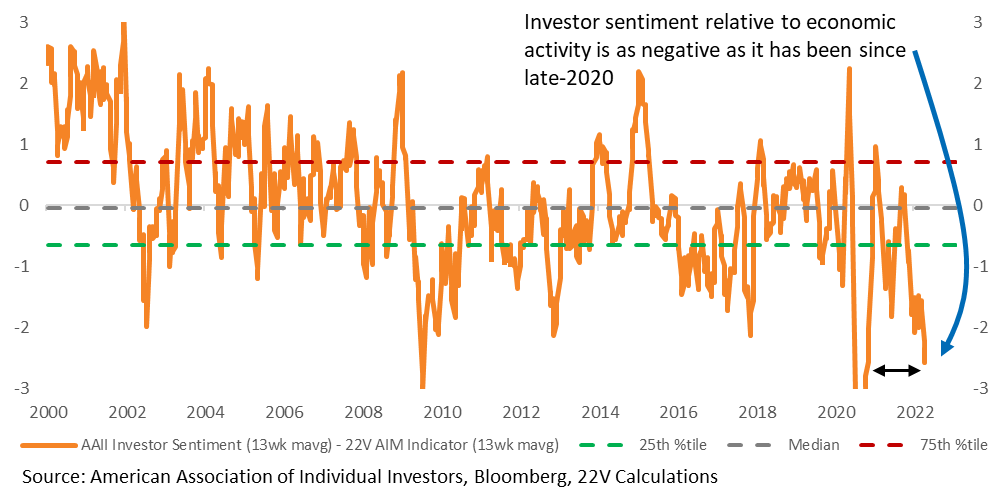
As we highlighted on Friday, the spread between investor sentiment and economic activity has fallen to recession like levels. Sentiment readings remains depressed as investors work through uncertainty tied to U.S. monetary policy, European growth, and China COVID lockdowns and stimulus. There will be some clarification on the U.S. policy front this week, setting the backdrop for another potential positive narrative shift.

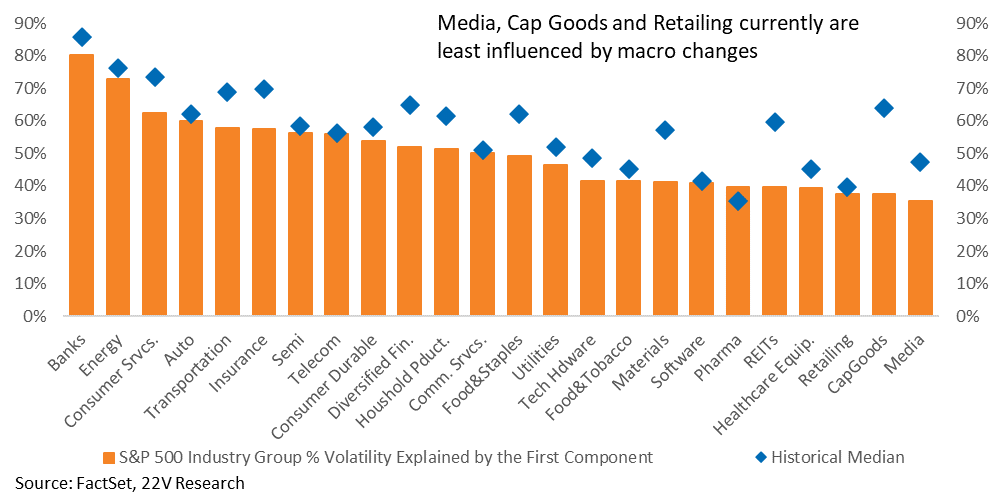
Market leadership at the factor/industry group level has shifted multiple times this year, and at an unusually rapid pace. Many of those shifts can be tied, loosely, to macro catalysts such as Fed meetings, war developments, and shifts in financial conditions. There have been some enduring trends that have been largely isolated from broader narrative shifts (Energy outperformance being one clear example). This is tied to an point we have been making for the past few quarters (here, here, here); highly correlated, highly macro industry groups are less likely to be influenced by broader narrative shifts. Industry groups less influenced by macro factors, such as Media, Capital Goods and Retailing, create better opportunities to generate alpha through quantitative factor screening.
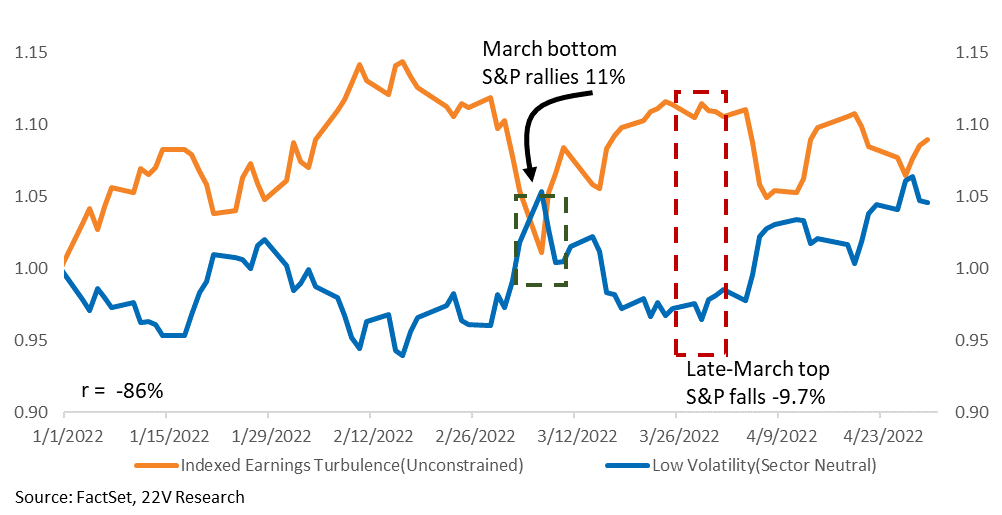
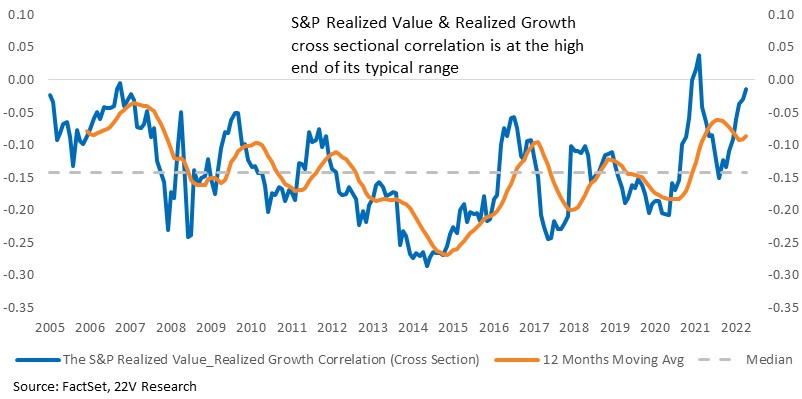
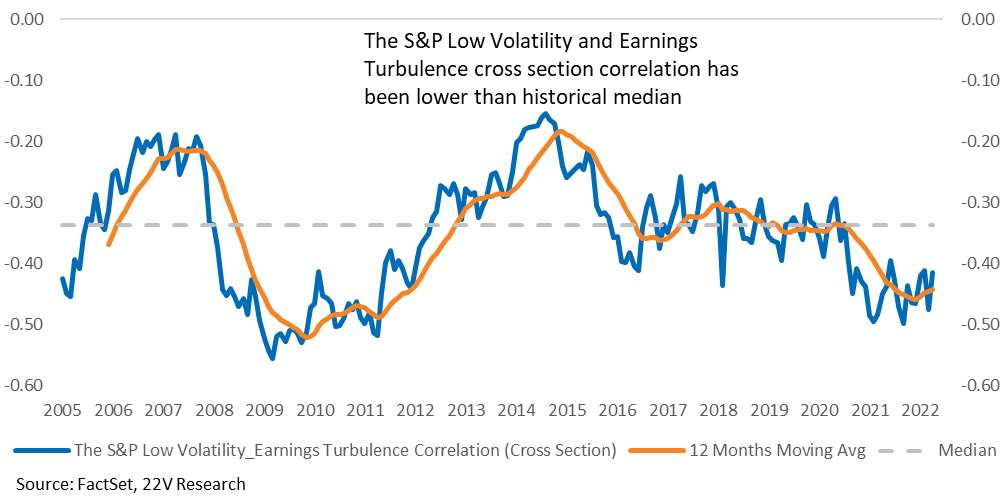
Factor rank correlations, how much factor rankings overlap, are far from static. Today, Value and Growth factor scores are less negatively correlated than normal. Rotations into and out of Value do not necessarily translate into rotations out of or into Growth. On the other side of the correlation spectrum, Low Volatility and Earnings Turbulence are more negatively correlated than normal.
If the policy/growth narrative improves after this week, we would expect to see a rotation into Risk-On factors like Earnings Turbulence, and out of Low Vol (started last week, but broad factor rotation still favored De-Risking/safety trades). Value has had a tremendous run recently (Realized Value +6.8% in April) and should struggle if the market narrative shifts, but that is not necessarily a support for Growth names. The cleaner rotation would be into risk, and we list the names of the stocks with high Earnings Turbulence at the end of the report.
Setting up for a Post Earnings Risk-On Rotation: Market volatility has increased this year with average implied volatility ~25 relative to 19.6 last year. But there has not been a spike in overall macro influence. S&P volatility explained by the first principal component, which can be viewed as proxy for macro risk, has been stabled and slightly below its median level. The increasing volatility appears to be the result of micro trends.
Investor sentiment has been declining relative to economic activity since 4Q21 and is currently as negative as it has been since late-2020. That is a midst-of-a-recession reading, but it taking place in the middle of a period of firm trend growth. With earnings reporting season more than halfway over, and results once again much better than expected, the backdrop for another rebound in sentiment is in place. The Fed meeting and payroll report this week could provide the catalyst for short-term recovery in risk assets.
There have been some strong macro forces with specific industry groups, and those areas of the market have remained largely outside the influence of narrative/risk rotations. At the industry group level, Banks, and Energy remain more influenced by macro changes, while Media, Capital Goods and Retailing are least influenced. Volatility of those industry groups are more impacted by factors such as sentiment, industry group risk, and stock risk etc. Factor screening has better potential to add value within less macro influenced areas of the market.
As we discussed in earlier report (here), factor rotations have been more frequent this year. Fed meetings, the War, and financial condition changes have all provided catalyst for market rotations. The end of earnings season, the upcoming FOMC meeting (Wednesday), and the payroll report could be another potential driver of a factor rotation.
Cross sectional correlations between factor rankings suggest a Risk rotation is more likely than a Style (value/Growth) rotation. Realized Value and Realized Growth correlations have increased to ~0, much higher than their typically negative correlation. That suggests Style has become less binary as many names are exposed to components of both factors. If factor returns were more correlated, that could be a reason to expect mean reversion, but these are rank level correlations that suggest fundamentals make these names more similar than normal.
At the same time, rank correlation between Low Volatility and Earnings Turbulence has declined to near its COVID-era low, which helps explain more binary rotation between risk-on and risk-off factors this year. Some relief to policy uncertainty this week could setup another sharp rotation between risk-on vs. risk-off factors.
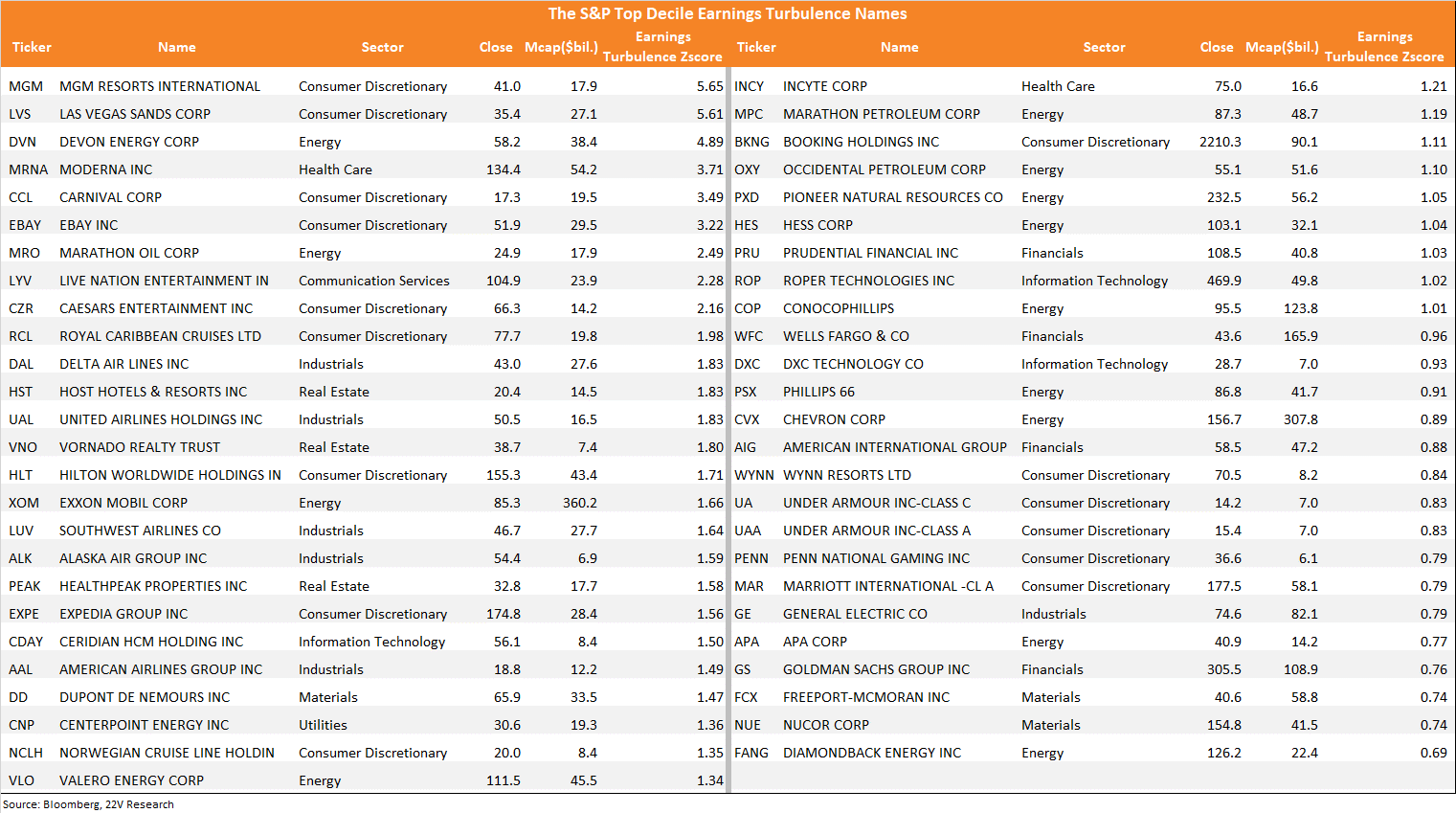
Below we list the S&P names with the highest Earnings Turbulence exposure. As near-term uncertainty settled next week, there is some potential for the recovery of risk-on factors as investors are less concerned, which should benefit the names with high risk. As we highlighted above, Energy and Financials names are least likely to benefit from that rotation while Media, Retail and Cap Goods stand to see the most factor related divergences. Names from both all groups are included below to provide a broad screening. Please let us know if you would like a more tailored list.