
Nothing manifests stress like an adult tantrum. Russian President Vladimir Putin yesterday lashed out at an ambiguous collection of Russian western sympathetic “traitors, midges, and scum” for questioning his rationale for the Ukraine war. It wasn’t a good day for anyone in that part of the world, especially Putin and the Ukrainians he continues to massacre.
Putin’s war continues to trend in a direction he is unlikely to have anticipated, in part because he had no clue of the stunningly severe measures coming his way. That miscue is understandable since the world has never seen economic combat of this magnitude. The following is a summary from the interactive analysis done by the Peterson Institute that tracks sanctions by country/region and sector.
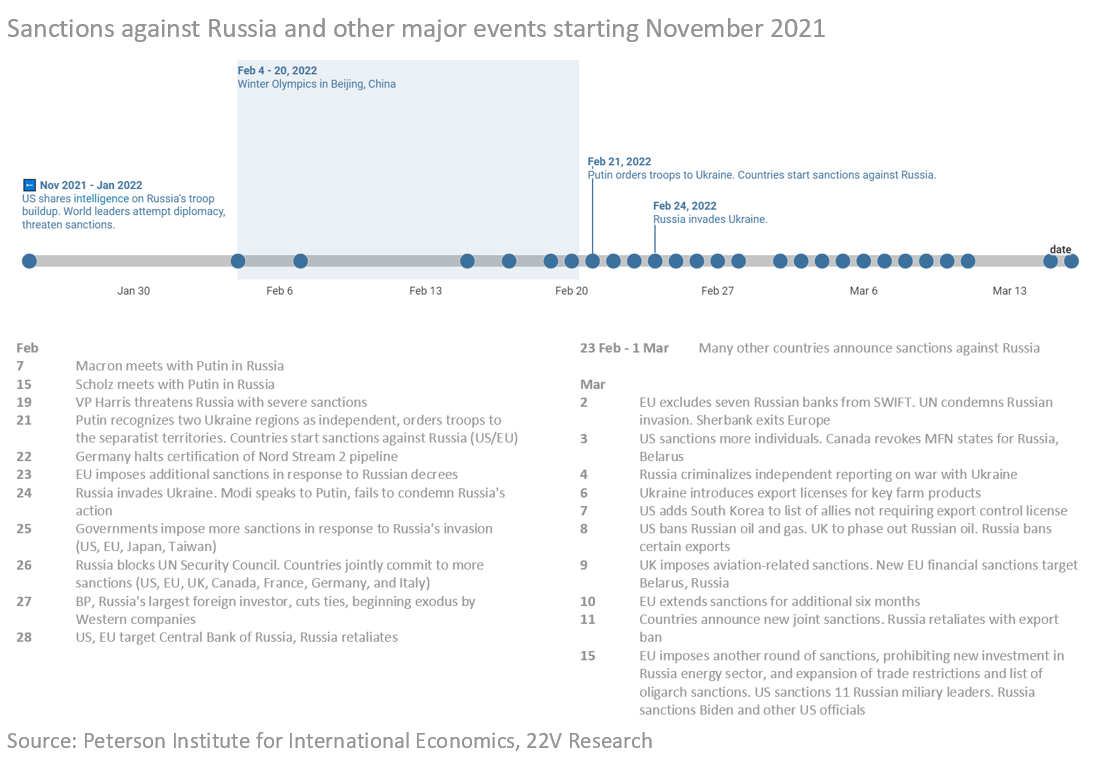
Last month we made the obvious observation: that this situation was a classic battle of attrition testing sanctions imposers and those on whom the restrictions would be imposed. It was early in the conflict and general commentary then revealed expectations that what would be imposed would come from a circa 2014 playbook – unpleasant but manageable with lots of room for substitution. Those views under-estimated what was to come, from whom, and the clear understanding that the West and Japan recognized the historic need to take the fight to Putin.
It’s possible the West and Asia (including China for different reasons) strategically outsmarted an ill-prepared Putin. Global coordination is working and, second only to Ukrainian determination, may prove to be the more important factor in exploiting the Kremlin’s overreach. Putin remains one of the more dangerous men alive, but the Oz-like veneer of omnipotence is forever gone, along with some of the foundations of the Russian economy.
Central Bank of Russia (CBR) Chairwoman Elvira Nabiullina this morning again reassured that Russia remains creditworthy. Our 22V colleague, Colin Crowley, encourages constant marking of events to markets. “For now,” surely applies to the chairwoman’s assertion. Analysts at the Geoeconomics Center at the Atlantic Council have tabulated that about 80% of CBR’s reserves are held by China, France, Japan, Germany, US, UK and the BIS and IMF. It’s not possible for Russia to continue paying or rolling its international debt given sanctions and the locus of its reserves.
The military effort was dominated yesterday by reports of Ukraine pressing the fight in two sections of the war theater – not a headline broadly expected a month ago when the war drums were being pounded on the eastern border. And although tactical disagreements have surfaced regarding a no-fly zone, President Zelensky has received a steady flow of war materiel from NATO countries of the sort that his military and volunteers are using with stunning effectiveness. The US yesterday augmented those stockpiles with a long list of offensive and defensive weapons along with protective gear for 25,000 fighters.
China isn’t yet publicly reinforcing Putin. Earlier today, Beijing announced it wouldn’t attack Ukraine. A direct assault wasn’t ever expected, so this might imply that indirect attacks aren’t in the offing either. US intelligence hasn’t told the world of arms shipments from China to Russia, as surprisingly requested by President Putin earlier this week. Probably unrelated, Beijing in the past 18 hours announced it would allow US (SEC) audit of some Chinese companies. The de-listing issue has been played up at times as a decoupling factor; the announcement doesn’t tamp down G2 competition but neither does it further pull China from the US. Russia’s early February photo-op at the Olympics leaves open Aretha’s question “who’s zoomin’ who?” The White House this morning announced presidents Biden and Xi are set to speak tomorrow about Ukraine and managing G2 competition.
Europe fights back in a few ways, including economically, and not just via sanctions. Intel’s plan to build chip fabrication facilities in Germany and other EU countries along with the $5.5 billion subsidies to encourage it was announced the same day Norway decided to increase gas production solely for Europe markets. Despite the intense shelling and certainty of more, Ukraine’s farmers collectively pledged to sow more grain than earlier planned.
Putin is much scarier than those fearsome flying monkeys in the Wizard of Oz (I can say now). And his presser yesterday only hardened the notion that his retreat into dark corners might be the ultimate bad trade for the world, but as we mark to market geopolitical events this week, all non-mutually assured destruction trends are working against him personally and burying any hope of his grand plan for re-absorbing parts of eastern Europe.
Netflix restarting streams of “Servant of the People” starring Zelensky further evinces public support for Ukraine and its atypical leader. The Fed has earned the top spot in investors’ minds in part because the finish line of their job seems further away than the next phase of Russia’s war. We aren’t calling a top in Putin risk but there has been a discernible erosion of his strategic vision and tactical standing. The stiffening of Europe’s backbone is only beginning, it would seem, making the continent an interesting policy buy. US/UK support, and those of companies based there bolsters the investment case we outlined last week in our Project Fortress Europe note.

