
We believe Europe’s response to Russian aggression in Ukraine is a most interesting global policy question/opportunity.
Russian President Vladimir Putin has convinced Brussels of the geostrategic threat and the imperative to build “Fortress Europe.” The geopolitical realities are on the surface; no country in old or new Europe can reasonably confuse the economic and societal choice of autocratic over democratic governance. The same is true of commercial and financial enterprise. The 2015 Five Presidents’ Report (FPR) detailed challenges of strengthening European Union capabilities. While true the focus on economic deficiencies was driven by a financial crisis, there are more than a few applications to the current crisis.
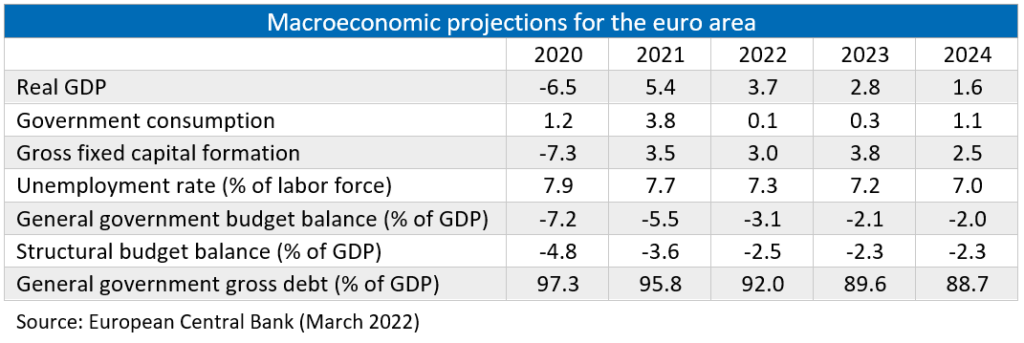
Many mileposts exist to date stamp the birth of conceptual EU. As students of the topic, Professor Kathleen R. McNamara and others point to the 1958 Treaty of Rome as a decent starting point (at least for Americans). The decades of differentiated history and experience naturally complicate most decisions. Part of our thesis is that Putin has pointed out the futility of allowing history to limit the future. The table below shows the continent has space to access EU and global credit markets to self-invest for future payoffs (relatively low deficits and debt). Estimates being what they are, even a haircut to these projections doesn’t materially change the challenge revealed by this war.
The extraordinary multilateral efforts taken to punish Putin’s economy will test the coalition’s resolve as ramifications effect Europeans households, and coalition partners to a lesser degree. It’s also clear that the crisis presents allies, particularly within the transatlantic bloc, an opportunity to reassess economic policies that revealed vulnerabilities including energy and defense but not limited to those sectors. ECB chief Christine Lagarde yesterday opened her monthly presser by invoking her predecessor’s rally cry of a decade ago: “We will take whatever action is needed to fulfill the ECB’s mandate to pursue price stability and to safeguard financial stability.” The war threatens both parts of that pledge.
There is an investment opportunity unfolding in Europe, in our view. The EU has unique advantages of existing structures and procedures to engage Project Fortress Europe not to threaten another sovereign but to protect its sovereign members from unwarranted shocks. Three established central banks call Europe home: the ECB, the Swiss National Bank, and the Bank of England. Support for a common bond to finance enhanced defense and energy spending wrapped by an ECB guarantee could attract new investment through many vehicles including the European Investment Bank and the European Bank for Reconstruction and Development.
The US and EU should quickly revive the Transatlantic Trade and Investment Partnership with renewed vigor, first to signal this fabricated crisis will catalyze enduring action and then to attract global investment in the Project. Surely all US/EU/UK frictions that scuttled last decade’s attempt are diminished or erased by the current crisis and its geostrategic and economic implications. A more complicated question that we conveniently skip today is whether now is an advantageous time to gauge the value of Brexit.
Military analysts are convinced Putin will cause severe damage in Ukraine. We’ve hosted a few geopolitical experts who are of the mind that Putin’s war against Ukraine is the beginning of his fulfilling by force a plan to redraw Europe’s map. Nothing in the past three weeks would suggest a different purpose. One risk of the Project is that Putin finds it destabilizing, but we would think this further validates the urgency of investment suggested in this note. Consistent with the FPR the continent has every reason to complete a banking union, to create a credit markets union to match the US system of dual intermediation, and to address labor migration. Europe will need safe, long-term credit for the Project and fortunately has existing and potential conduits for doing so.
The reasons analysts and citizens have previously had to deride the EU or EMU melt away in a war that represents existential risk. Germany was the impediment to much of Draghi’s 2012-2015 policy recommendations; Germany now leads the energy and defense renaissance. This could be a constructive if not telling shift in reviving Europe’s common purpose which is being tested unlike any time in nearly a century. The next leg in the European Experiment would seem to favor industrial, commercial, and financial sectors. The main risk to our view is the ultimate geostrategic worst case, which is impossible to reliably invest against. Short of that, Project Fortress Europe is a viable bet.

