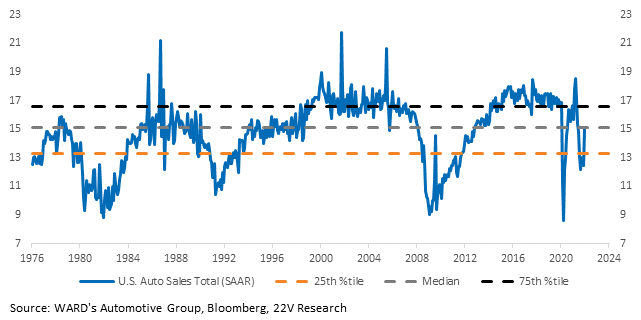
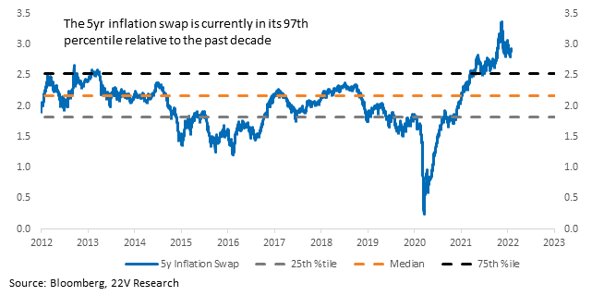
SUMMARY: PMIs, vehicle sales, JOLTS data, and business sentiment of reopening stocks reporting 4Q earnings all indicate the Omicron soft spot wasn’t very soft. That helps explain the still high level of inflation expectations, which we take as a proxy of longer-term demand, and the still easy level of financial conditions. Thanks to the equity market rally, financial conditions are a bit easier this week. That is despite the rate hike curve continuing to shift higher, even as Fed speakers uniformly back away from a 50bp hike in March.
All of the above helps explain a narrative that is currently going around – economic growth will rebound more quickly than the Fed can or is willing to offset. Fed officials backing away from a 50bp hike is important because it suggests the Fed will not aggressively offset a near-term economic rebound. If true, that would favor a significant reversal in Cyclicals, higher real yields, and reopening stock performance. The yield curve flattener trade would reverse. Defensives would be the biggest losers, and big-cap tech would continue to rebound. Value vs Growth would not be the call. More long Cyclicals relative to Defensives.
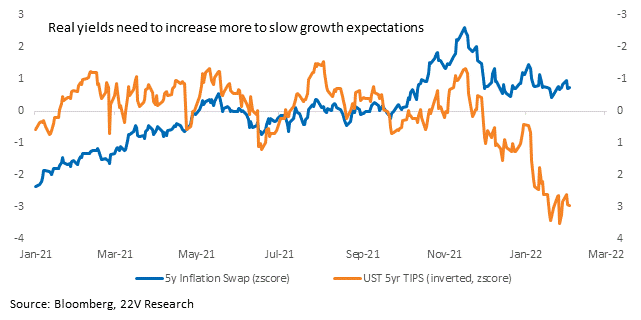
We have more sympathy for the above scenario than for the argument that the Fed will back off tightening because of weak economic growth. Weak growth is inconsistent given recent data and the likely post-Omicron bounce. The Fed will use policy to offset economic strength, so financial conditions will have to tighten significantly. That process has barely started. When the Fed increases real yields enough to lower inflation expectations, Cyclicals will struggle. If it becomes apparent the Fed will raise rates 25bp until something breaks (real yields go up significantly), financial conditions and inflation expectations will react.

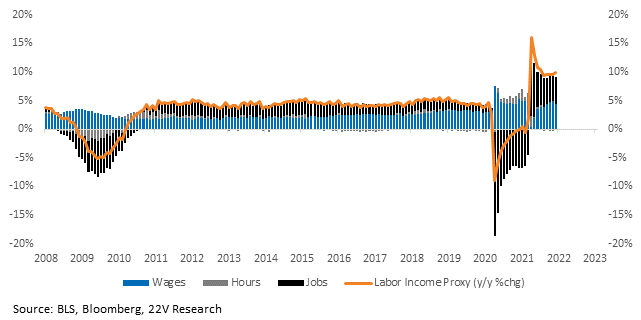
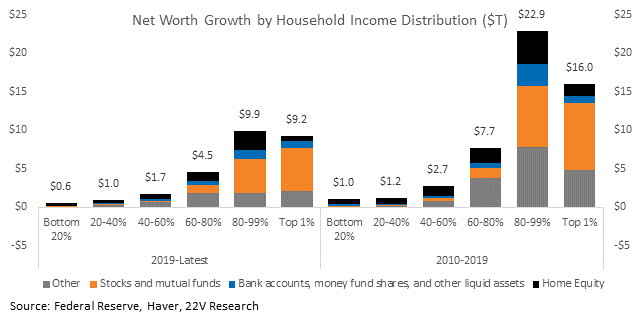
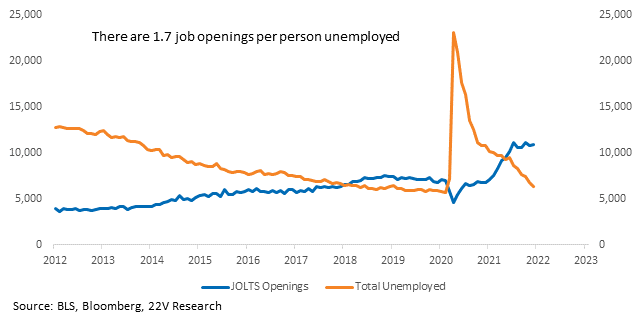
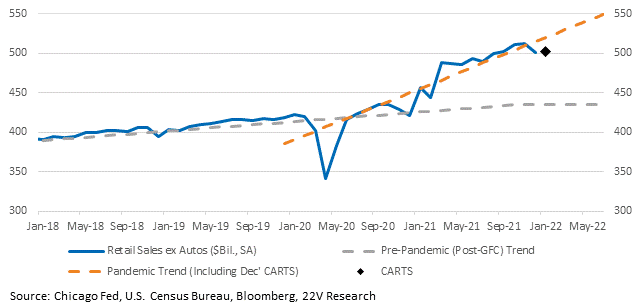
The full report covers some of the main indicators we use to track trend economic growth. The labor income proxy has surged post-COVID. The wealth effect has been massive. There are more job openings than people unemployed, and the spread is wider than any point in history. Early indications from the Chicago Fed CARTS data show retail sales remain well above trend. And the increase in Wards vehicle sales is consistent with solid spending growth.
MARKET VIEWS: Financial conditions have eased this week, and inflation expectations have increased; both suggest a relatively firm economic backdrop. Recent PMI data, Wards vehicle sales, JOLTS labor market data, and business sentiment from reopening stocks (see Amex, Visa & Mastercard earnings) all indicate the Omicron soft spot wasn’t very soft. That helps explain the still very high level of inflation expectations, which we take as a proxy of longer-term demand…
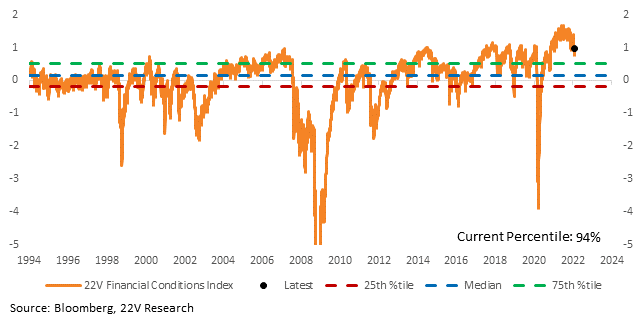
…and the still easy level of financial conditions. Fromt their peak, financial conditions have tightened some but remain above the 90th percentile. Thanks to the equity market rally, financial conditions have eased some this past week.
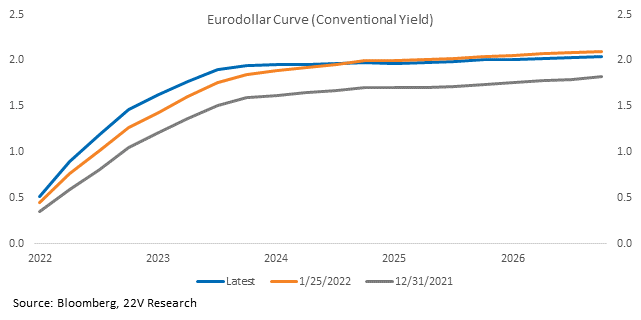
Keep in mind that inflation expectations have not budged and financial conditions have only tightened mildly, but the rate hike curve has shifted meaningfully higher. This week, Fed futures are a bit higher, despite Fed speakers uniformly backing away from a 50bp hike in March.
All of the above helps explain a narrative that is currently going around, which we have some sympathy for given our expectation that economic growth will remain strong. The argument is that economic growth will rebound more quickly than the Fed can or is willing to offset near term. That is why backing away from the 50bp hike is important; a near-term economic rebound will not be aggressively offset. If true, that would favor a significant reversal in Cyclicals. But that view also suggests rising yields. So 10yr yields break out globally, and reopening stocks move higher. The yield curve flattener trade, which we mentioned last week and seemed like a clear outcome of the FOMC meeting, would reverse. Defensives would be the biggest losers, and big-cap tech would continue to rebound. Value vs Growth would not be the call. More long Cyclicals relative to Defensives.
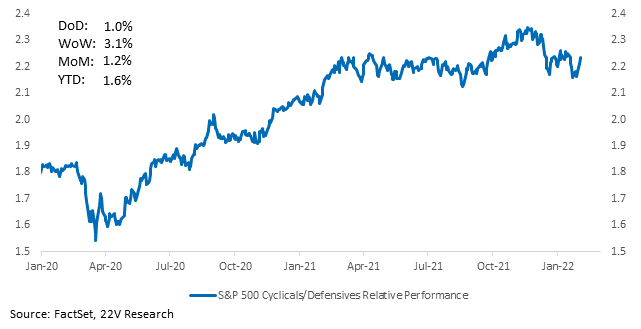
We have more sympathy for the above scenario than for the notion that the Fed will reduce tightening because of weak economic growth. Weak growth does not seem likely given recent data and the still likely post-Omicron bounce. The Fed will offset economic strength, so financial conditions will have to tighten significantly, a process that has barely started. At some point, the Fed will increase real yields enough to push inflation expectations lower. Cyclicals will struggle when that happens. If it becomes accepted that the Fed will tighten by 25bp until something breaks (real yields go up significantly), financial conditions and inflation expectations will react more.
Below we cover some of the main indicators we use to track trend economic growth. The labor income proxy has surged post-COVID and never turned lower as fiscal stimulus rolled off. As long as the labor income proxy is well above its post-GFC trend, don’t expect the latest “fiscal cliff” concerns to impact spending meaningfully.
The wealth effect has been massive. In the past two years, low-end wealth has increased by ~60% as much as it did in the nine years following the GFC.
There are more job openings than people unemployed, and the spread is wider than any point in history. At the end of December (last data point) there were 1.7 job openings per unemployed person. The labor market is robust, which will continue to support spending and keep upward pressure on inflation.
Early indications from the Chicago Fed CARTS data are for retail sales to continue well above trend. Based on the first two weeks in January, retail sales ex-autos should increase +0.4% m/m.
Wards vehicle sales beat expectations by 2 million, rising from 12.5mil to 15mil. The increase is consistent with strong spending growth.