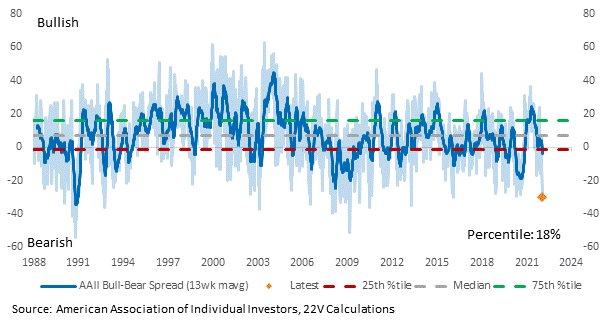
Summary – Starting with the Short Term: Equities are deeply over sold and sentiment has collapsed. The AAII bull bear spread is near its pandemic low (latest click) and chaos hedging (paying for protection against extreme short-term market declines relative to extreme upside) reached its 99th %tile for NDX and S&P. The above suggests a decent bounce in markets and some near-term underperformance of Defensives, which are 1) even more relatively expensive now, and 2) have massively outperformed Cyclicals.
The above would imply, with weak conviction, a few weeks (made-up short-term timeframe) of a market rally. Given how many are recommending rallies to “be sold” (including us), it likely will get painful on the rally side before the rally is actually sold. Expect oversold conditions to normalize some.
Longer term: As Powell made clear in his press conference, the funds rate can go up a lot – or financial conditions can tighten a lot – without slowing growth to trend (which is fine, unless slowing growth to trend or below trend is required to slow core inflation, which we think is the case) and Powell suggested Fed tightening will not have been excessive until it affects the level of labor market conditions. As Gerard highlights “this is hawkish on growth because it suggests – again reading in my own priors to some extent here – that what Powell has in mind is growth falling to trend, which the Fed puts at 1.8%, or less than half their most recent formal forecast of GDP growth during 2022”. For reference, the Fed’s 2022 GDP forecast in the December SEP was 4%. Big cap tech and other high quality and high cash return stocks will benefit as growth slows.
The FOMC meeting made it clear that short rates would do the heavy lifting slowing economic growth. That should flatten yield curves and is a headwind for Financials (a large part of Value). Economic growth slowing to trend likely happens with both the consumer and housing sector slowing, which will remain a headwind for Retail (XRT) and Homebuilders (ITB). Energy will be fine as it is more dependent on rest of world economic growth and global central banks are still largely pro-growth now,
Immaculate Tightening Disagreement: Our largest disagreement with clients is the idea of the immaculate tightening being possible. i.e. the idea that the Fed can raise rates a few times, headline inflation will ease some and given we just hit “peak hawkishness” risk assets can move higher and credit spreads will not widen (strong growth lower inflation risk combo). We think clients will be shocked when headline inflation starts to ease (goods deflation sets in), but the Fed keeps attempting to tighten financial conditions. Core PCE will still be trending well above the Fed’s target, economic growth will still be above trend, and full employment conditions are already met. The Fed will keep tightening. Later in the year will be more interesting for a long market call (see below), not now.
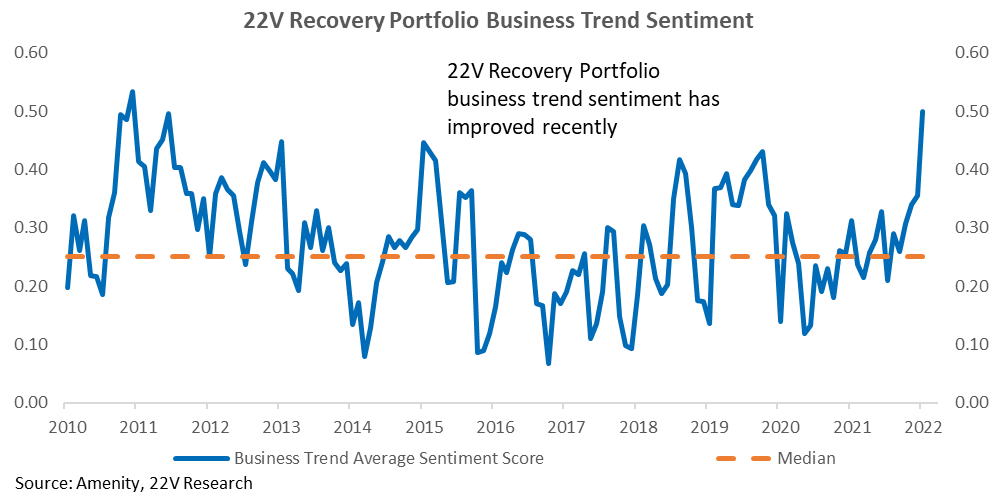
Business sentiment from recovery stocks has moved sharply higher, consistent with strong retail sales and the card spending data mentioned by AXP and Mastercard and Visa. Omicron clearly caused a slowdown in travel during December, but that demand was delayed not destroyed. 1Q GDP growth will be weak, so the immaculate tightening concept could help extend a short-term risk-on narrative, but a snap back in spending growth in Feb/March will reinforce above trend economic growth and a Fed that will have to be more aggressive in tightening financial conditions (which have a LONG WAY TO GO to slow demand growth).
Fair Value: Under a 4.5% EPR, which remains our target for the end of 2022, S&P fair value is now around 5150, about 17% above yesterday’s close. The path from here to there is dependent on investor risk appetites improving over the course of the year. If the required risk premium remains elevated (~5% that it is now) there is still upside to the S&P, but only in the mid-single digits. Once financial conditions have tightened significantly, GDP is obviously moving to 1.8%ish, and a recession has been avoided, being long the market will be MUCH more interesting. Hopefully late 3Q or 4Q of 2022 presents this opportunity. We need to prove a fed tightening can take place, without secular stagnation setting in, before equity risk premiums fall.
Alpha Opportunities: To date, stocks have done most of the heavy lifting in tightening financial conditions. If we are correct that other areas of financial conditions are going to start contributing to slowing economic growth, short rates have much higher to go and credit spreads will widen more aggressively. That will leave high earnings volatility and highly levered stocks vulnerable. Plus, those most sensitive to changes in credit conditions. Bottom line, we expect large cap and higher quality tech to start to diverge from ARKK and unprofitable tech going forward. Some differentiation should be expected as short rates increase.
Improving business sentiment for reopening stocks would typically be good news for reopening stocks, but the factor profile of the recovery portfolio suffers as financial conditions tighten. We would focus on the higher quality recovery stocks.
Financial Conditions: The Fed is pursuing generally tighter financial conditions, which isn’t achieved through equities exclusively. That doesn’t mean a bear market won’t happen, but Fed jawboning will pursue sustained tightening of general financial conditions, not just equities. Credit conditions normalizing (spreads widening) would help. That’d be a headwind to equities but not necessarily to the tune of a bear market. High yield spreads are further from normal relative to equities. That was not the case a few weeks ago, so it stands to reason that high yield spreads have further to move wider. Given that financial conditions are still generally easy…
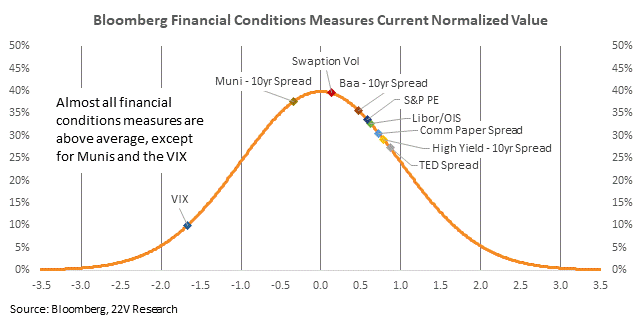
…and have a long way to go to normalize.
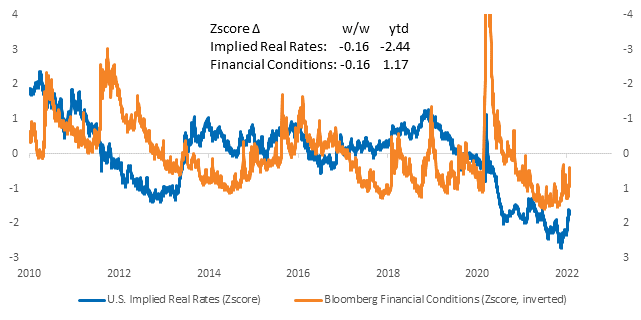
Powell emphasized how easy financial conditions are currently and that he would interpret tightening as damaging to the labor market only if the unemployment rate were to rise. Strictly speaking, this means he is comfortable with growth slowing to trend. This is the money line for us. It implies flatter yield curves and as equities have done significant work tightening financial conditions (see chart below), should help stabilize large cap tech. That assumes credit spreads move wider or short rates rise (other financial conditions tighten). It is not just equities carrying the load.
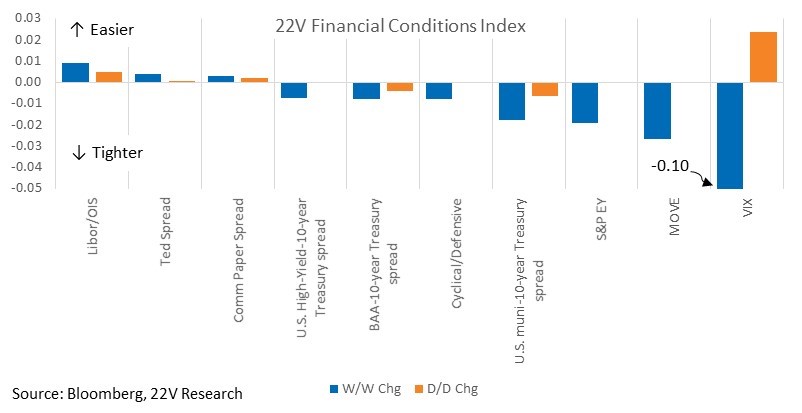
If we are correct that other areas of financial conditions are going to start contributing to slowing economic growth, short rates are headed much higher and credit spreads will widen more aggressively (started to happen, but still have a long way to go). The Fed funds rate two years from now suggest MUCH higher 2yr yields.
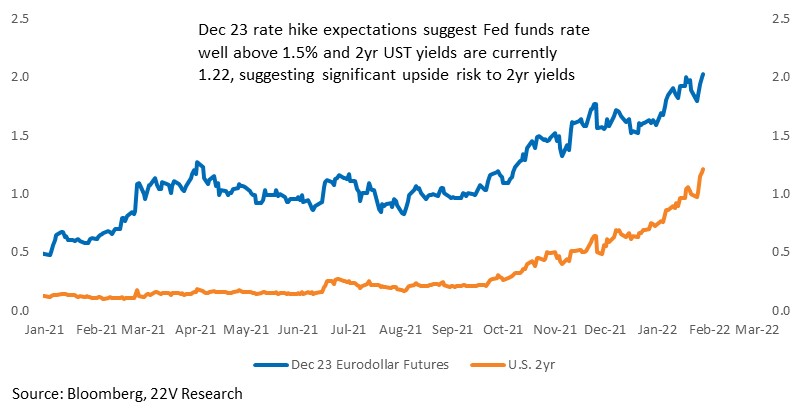
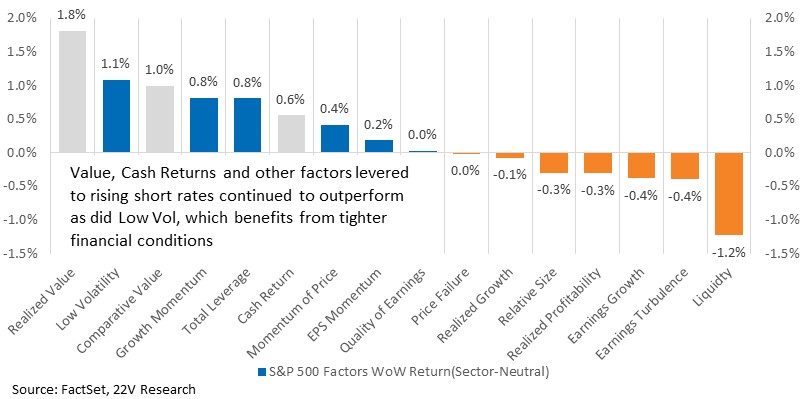
That will leave high earnings volatility and highly levered stocks vulnerable. Plus, those most sensitive to changes in credit conditions. Bottom line, we expect large cap and higher quality tech to start to diverge from ARKK and unprofitable tech going forward. Some differentiation should be expected as short rates increase. That is basically what happened yesterday with low volatility, size, quality and cash return outperforming. Low liquidity and Earnings risk suffered again.
Sentiment: The latest click on the AAII bull bear spread was back near its pandemic lows.
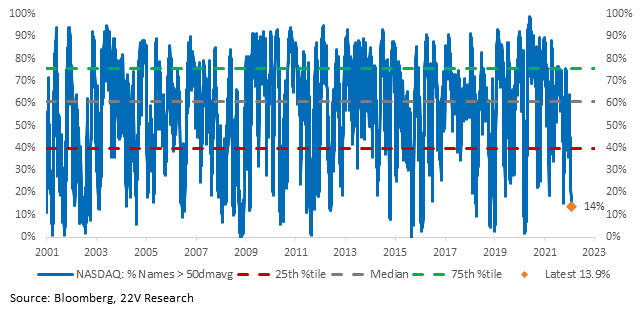
14% of NDX stocks were trading above their 50 day moving average at one point last week.
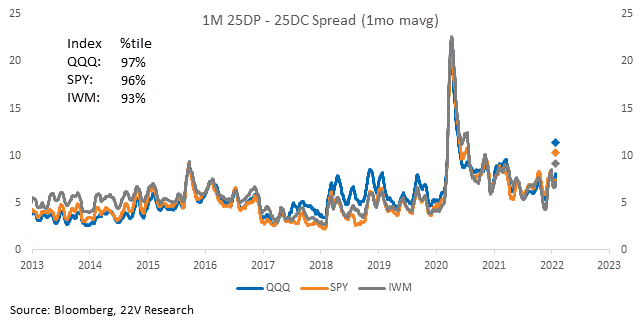
Investors are paying up for protection against a 25%-probability decline over the next month relative to a 25%-probability increase.
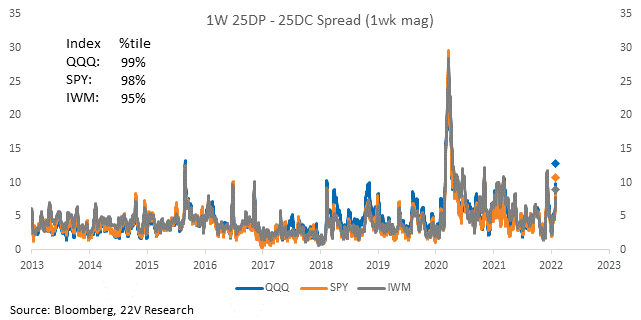
The spreads are as acute for a 25%-probability decline over the next week too.
Demand Growth Still Firm: During 4Q reported management sentiment of Recovery Portfolio companies toward Business Trends has moved sharply higher. We measured from earnings call transcripts using the Amenity natural language processing tool and the latest readings are consistent with strong retail sales and the card spending data mentioned by AXP, Mastercard, and Visa. Omicron clearly caused a slowdown in travel during December, but that demand was delayed not destroyed.
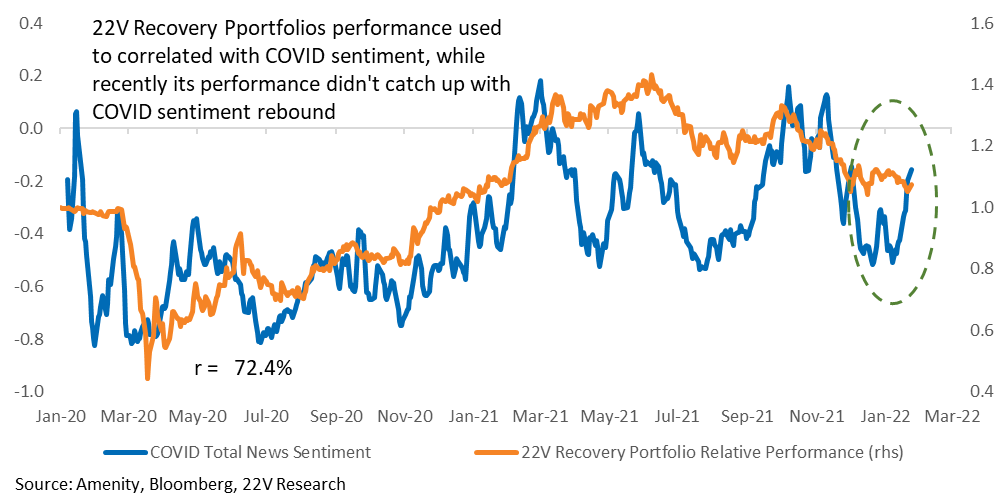
But, as we covered in a Quant report last week, the tightening of financial conditions that have been driving market internals are also working against a rebound in Recovery stocks. COVID news sentiment has improved as case growth and hospitalization in the U.S. and Europe fade, and lockdowns in China are removed. But stocks with factor profiles poorly suited to a backdrop of tightening financial conditions (high Earnings Turbulence low Low Vol), which includes many Discretionary and unprofitable companies, face ongoing headwinds from the Fed’s increasingly aggressive “inflation containment” policy.
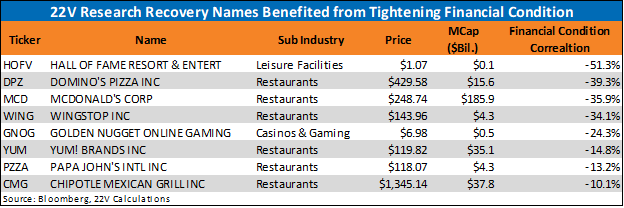
To narrow in on names that 1) benefit from easy COVID headwinds, and 2) are well positioned for tightening financial conditions, we filtered the Recovery portfolio for names with attractive financial condition tightening factor profiles. The 8 names listed below are the subset of Recovery names that meet those criteria.
Fair Value Update: Macro uncertainty tied to inflation and fed policy remains high, helping push asset price volatility up as well. The MOVE index (Treasury vol) is near its highest point of the year the VIX closed the week at 28, indicating daily average S&P volatility of over 1.7%. Determining fair value in that backdrop is very tricky and a handful of assumptions can significantly alter one’s perception of market skew. Our preferred valuation metric is Aswath Damodaran’s equity risk premium, which is essentially a discounted earnings and cash return yield adjusted for the level of bond yields and corporate payout. 4Q earnings growth is coming in stronger than expected with about 80% of companies beating estimates. 4Q21 ESP growth has been revised up to 24% from 19.5% at the start of reporting, put the level of 2021 EPS on track to reach $205 (we think it ends the season closer to $207). But the level of the equity risk premium is the single largest determinant of fair value.
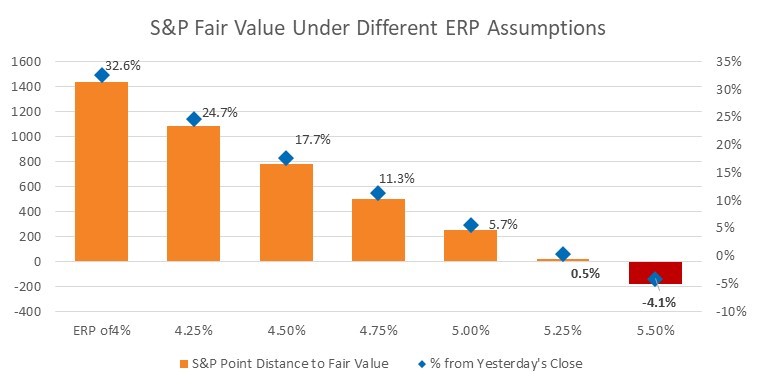
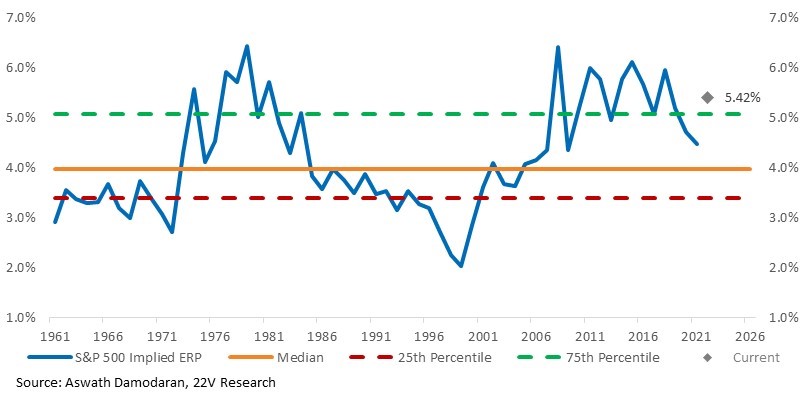
Apologies if the following is a bit confusing. It is meant to illustrate the importance of the assumptions that go into calculating the ERP. Using the Damodaran fair value framework as a starting point, applying Bloomberg consensus earnings estimates for the next two years, and assuming the 10yr yield remains steady, the S&P equity risk premium is 5.4%. At the start of the year the ERP, calculated under the same approach, would have been closer to 5%. Damodaran’s official ERP, which uses top-down earnings estimates and assumes a steady state cash return, was closer to 4.7%. At 5.4%, the ERP would be well above its long-term 75th %tile. At 4.7%, it would be elevated, but still within its normal range.
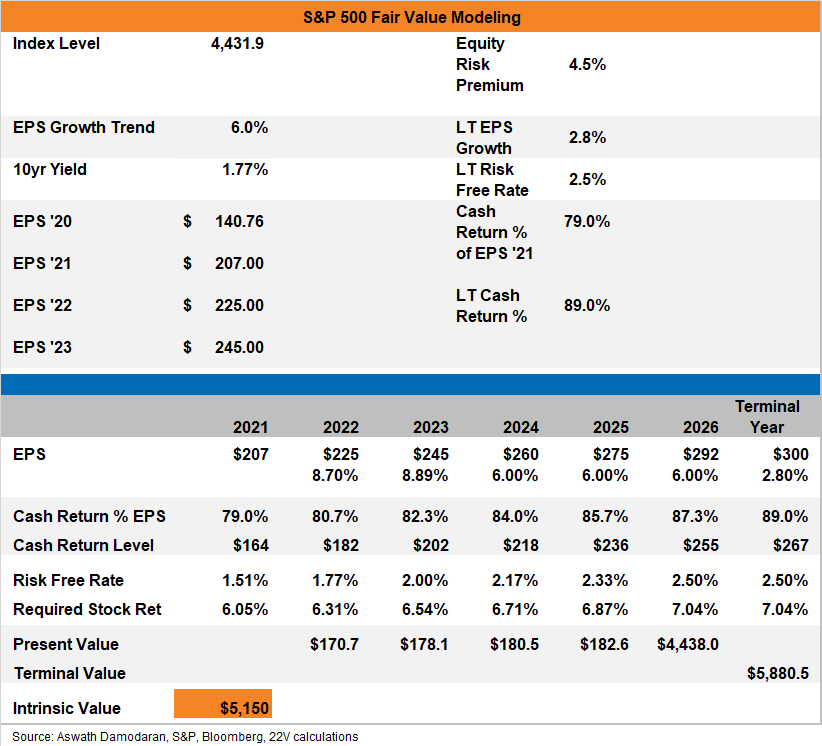
We have updated our fair value target using updated yields, adjusting the long-term target for the 10yr to 2.5% and a lower long-term earnings growth rate (as a result of rolling off depressed 2020 EPS). Under a 4.5% EPR, which remains our target for the end of 2022, S&P fair value is now around 5150, or about 16% above yesterday’s close. The path from here to there is dependent on investor risk appetites improving over the course of the year. If the required risk premium remains elevated (~5%) there is still upside to the S&P, but only in the mid-single digits.
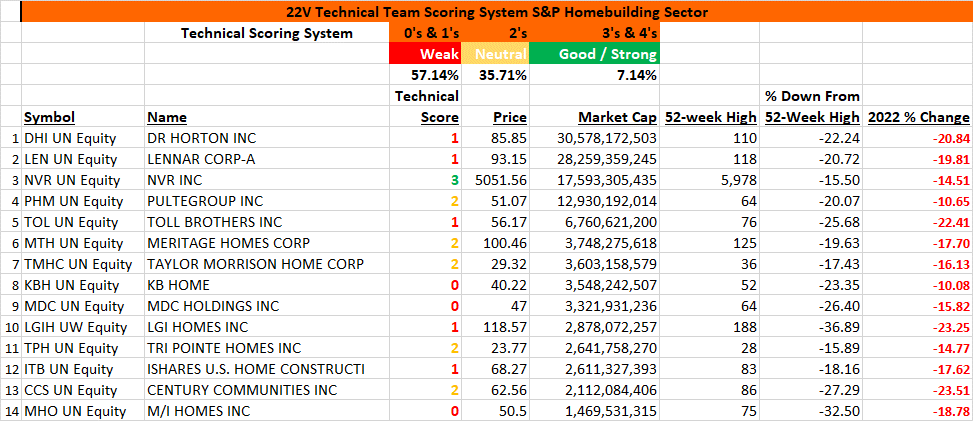
SHORT HOMEBUILDERS: Borrowing costs are headed higher, which is a headwind to the housing market. John Roque, 22V’s technician, thinks Homebuilders are a good short here. John’s scoring table (scores 0-4, 0 the worst and 4 the best) and stocks to short are below. Per John, “You’ll see quickly that the commentary for DHI, LEN and TOL is homogeneous because they are, virtually, the same – makes me more confident about shorting these stocks.”
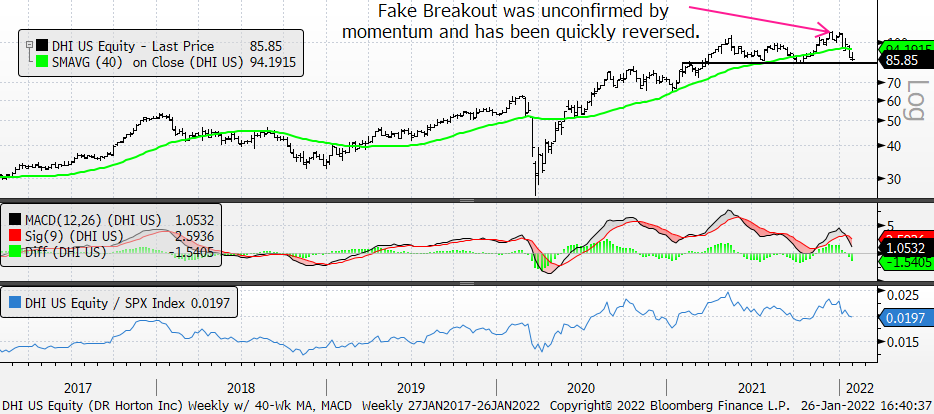
DR Horton (DHI – Technical Score 1)
Technical negatives include: 1) DHI beneath cresting 40-week moving average and 2) deteriorating weekly momentum that did not confirm the “fake” Dec ’21 breakout. We hate “fake” breakouts, and they often result in sharp reversals in the opposite direction. Consequently, we don’t believe support at 83 – 85 holds. 1) Topping relative price action vs. the S&P 500 (bottom panel). 2) We believe the stock has risk to 60.
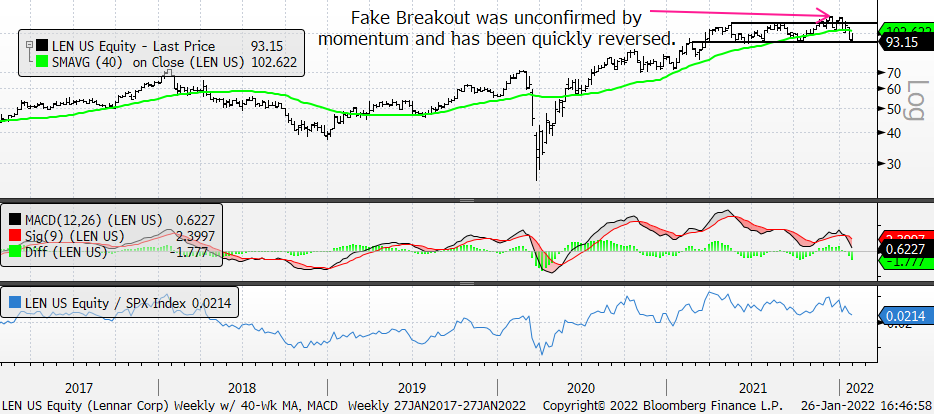
Lennar (LEN – Technical Score 1)
Technical negatives include: 1) LEN beneath cresting 40-week moving average and 2) deteriorating weekly momentum that did not confirm the “fake” Dec ’21 breakout. We don’t believe support at 90 holds. 1) Topping relative price action vs. the S&P 500 (bottom panel). 2) We believe the stock has risk to 70.
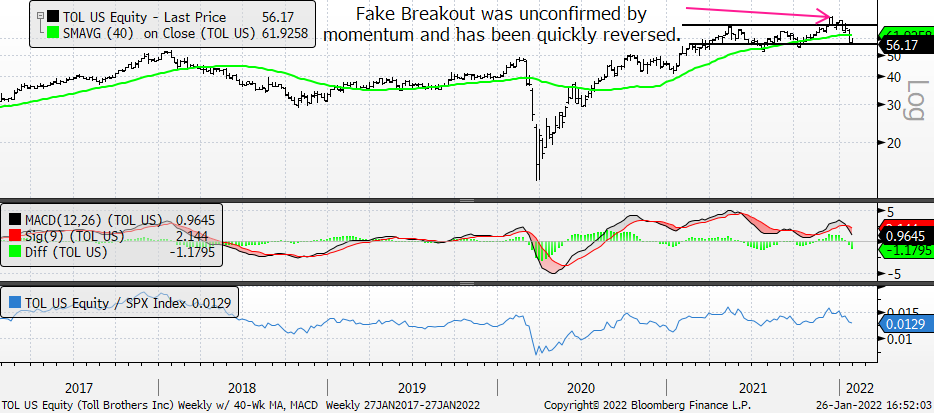
Toll Brothers (TOL – Technical Score 1)
Technical negatives include: 1) TOL beneath cresting 40-week moving average and 2) deteriorating weekly momentum that did not confirm the “fake” Dec ’21 breakout. We don’t believe support at 55 holds. 1) Topping relative price action vs. the S&P 500 (bottom panel). 2) We believe the stock has risk to 40.