This is shorter today because we would like you to focus on the Outlook. All the charts related to the themes we mention are in there. And take a look at the Outlook webinar if interested as well.
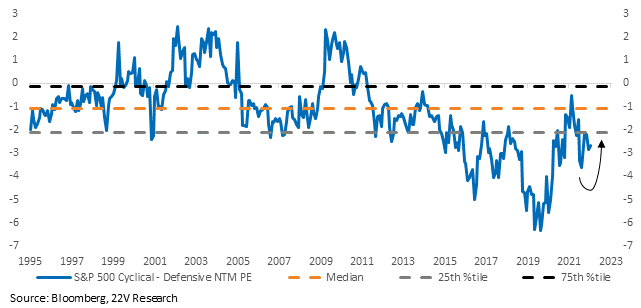
Summary: In an effort to avoid anchoring to the wrong view amidst unrelenting shocks, we released an Outlook piece last week that lays out a framework for thinking through the longer-term backdrop. The main themes of the outlook center around an above trend global demand backdrop, still strong corporate fundamentals, rising real rates (they still have much further to go) and an overall market backdrop unlikely to come under intense pressure unless it becomes obvious the Fed NEEDS to slow demand growth aggressively. The last point is critical as Cyclicals have an historically low PE relative to Defensives and higher expected earnings growth. Fundamentals favor Cyclicals (Cyclicals actually outperformed last week, but sector returns were all over the place), but those fundamentals will become overwhelmed if it becomes clear the Fed needs to significantly reduce demand to achieve its longer-term goal of guiding inflation towards its roughly 2% target for core PCE.
Our bias is that firm productivity and an eventual increase in participation will allow the fed to achieve its inflation goals without having to crush growth. That means fundamentals will support Cyclicals longer term. Also, it’s not clear how intense the owners equivalent rent impact on inflation will be (we get a view on rents with CPI Wednesday).
It’s a long year and estimating productivity, participation etc., which are likely to determine how much the Fed needs to slow growth, is really hard. For investors to get comfortable that the Fed doesn’t need to tighten financial conditions significantly, participation needs to trend toward pre-pandemic levels, rents need to increase less than Zillow data implies, and productivity should move above ~1.25.
The economy is dealing with multiple unusual shocks, so forecasts need to be humbler and more cautious, particularly when based on extrapolating near term trends. Extrapolating short term narratives (stagflation, curve inversions, 10yr yields going to 3%) was the fastest way to lose money last year, which is why mean reversion was such a powerful strategy. That means we should focus on relatively easy calls now. The fed wants real yields to go higher (see the Fed focus on QT to push up rates), the macro backdrop justifies real yields moving higher and investors should position for that longer term.
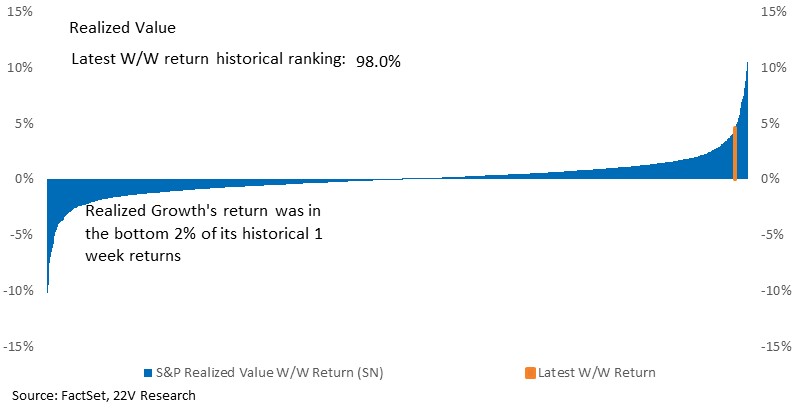
Nothing goes in a straight line though, so pressing shorts on Growth after a 2nd %tile W/W relative performance to Value is risky. Expect some rebound in Growth into and following the CPI print Wednesday (assuming no outlier move). Also, earnings season will help large cap tech as well. Keep in mind large Cap tech does fine in our longer-term backdrop. Unprofitable tech does not.
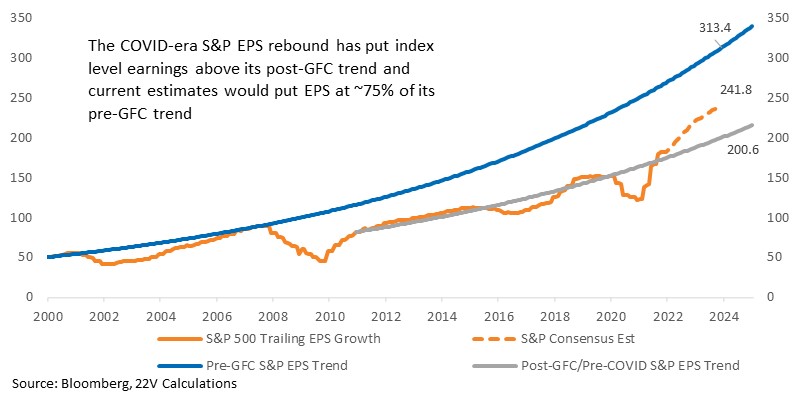
We put 2021 S&P EPS at $207, and forecast $225 in ’22 and $245 in ’23. S&P EPS is now above its post-GFC trend. That is an important longer-term support for equities unless the Fed is compelled to crush growth in order to slow inflation.
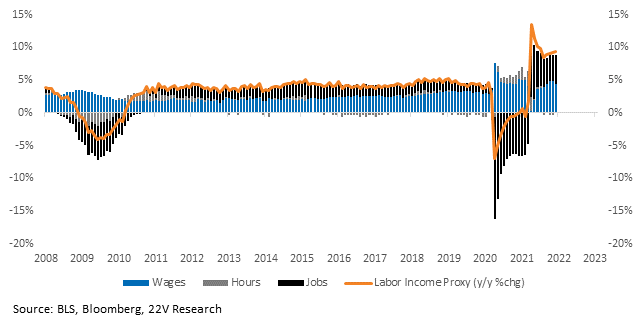
Marking To Market On Demand and Fed Reaction Function: Last week’s labor market data and global demand trends both favored higher real rates. 22V economist Gerard MacDonnell noted following the payroll report that his measure of the employment gap is now on track to reach the same level of tightness as was achieved prior to the Covid shock by August of 2022. Before that data, the target date there was December 2022. The labor market is getting tighter faster. Also, the labor income proxy remains very strong at 0.8% m/m and 9.9% y/y. Consumers are in a VERY good spot and even if consumption slows some in January due to Omicron, don’t expect a change in consumer spending trends. The global PMIs were firm and the US PMI was weaker than expected because the supply chain situation improved. A falling Supplier Delivers reading contributed 50% to the decline in the headline PMI.
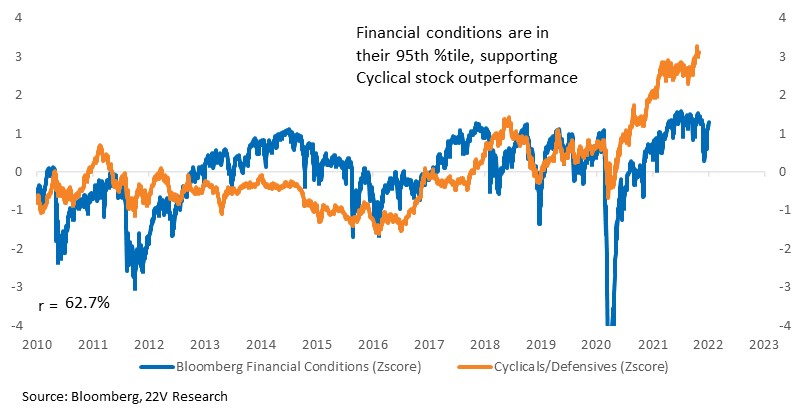
Marking To Market On Financial Conditions: The FOMC minutes showed “inflation containment” is now the goal of the Fed and that means tighter financial conditions and higher real rates near term. That works against an outright long in Cyclicals. Deeper Cyclicals, Quality, Value, Cash Return, Relative Size and some Defensives will find support as financial conditions tighten and real yields increase. If/when it becomes clear that the Fed will not have to crush growth with much tighter financial conditions, that’s when Cyclicals will outperform outright. Likely a few months from now.
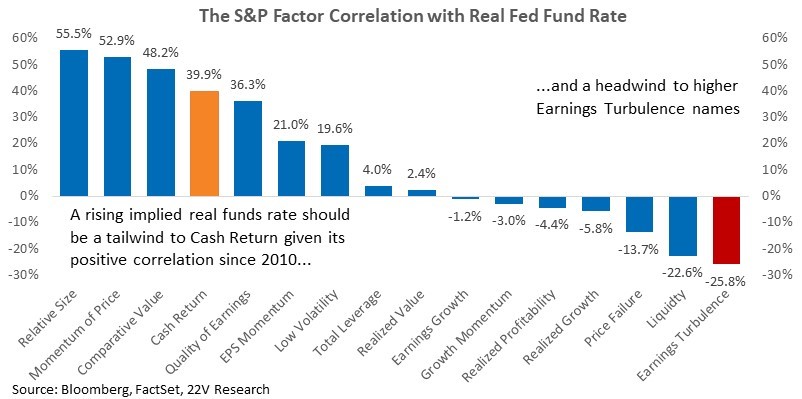
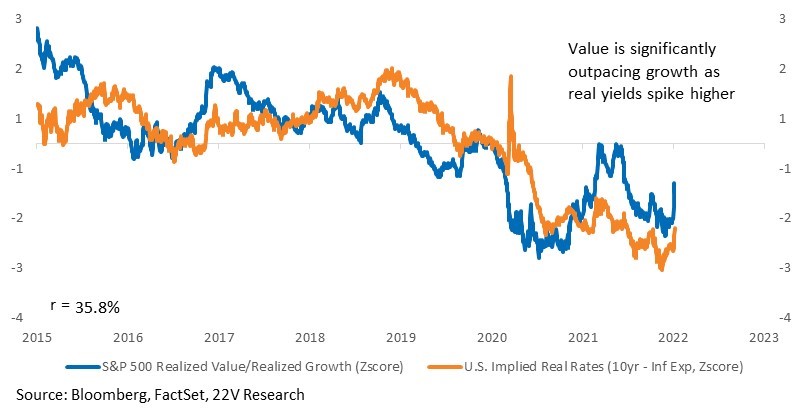
Being more nuanced on the Cyclicals relative to Defensives means it is better to focus on factors that benefit from higher real yields.
Our bias is that firm productivity and an eventual increase in participation will allow the fed to achieve its inflation goals without having to crush growth. That means fundamentals will support Cyclicals longer term. Also, it’s not clear how intense the owners’ equivalent rent impact on inflation will be (we get a view on rents with CPI Wednesday).
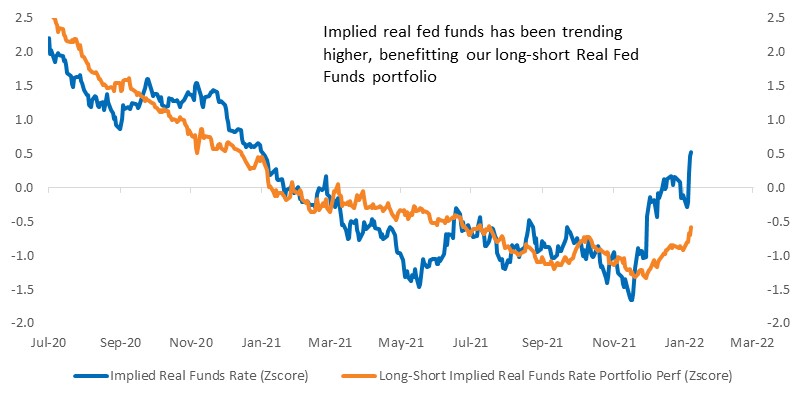
Marking to Market on 10Yr/Supply Chains: We believe that 10yr yields are headed higher as investors get more comfortable with an improved COVID backdrop. Reopening stocks have moved off their lows and 10yr yields across the world have increased. The sharp decrease in global yields happened the day after Omicron was announced (11/26). Global bond yields, Value stocks, the average stocks relative performance to the cap weighted index fell in the weeks following 11/26 and have now rebounded and then some. The COVID news is trending positive in the developed world and is a tailwind for 10yr yields. The Fed focusing on QT to lift long rates is positive for 10yr and a headwind for housing stocks. Our long-short real fed funds portfolio has been moving higher as well, but not keeping pace with the rapid increase in the expected real funds rate. Some continued catchup by these names seems likely given the Fed’s ongoing policy pivot (happy to send the list).
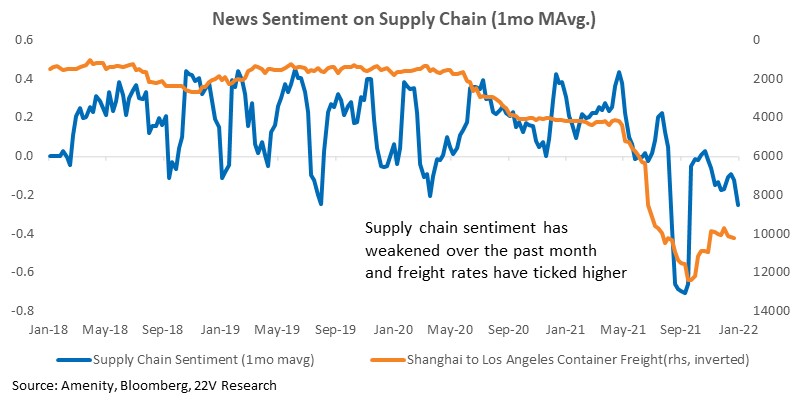
A surge in Omicron cases in Asia would be a headwind for the 10yr (supply chains suffer and demand growth estimates decline). We are long companies that benefit from improving supply chains and they have outperformed significantly. That is a longer-term idea and we stand by it. But expect some consolidation near term.
Very short term, following the CPI 10yr yields take a breather (assuming no outlier number), which would help large cap tech stocks. Investors could focus on some slower January data and the impact of an Asian Omicron surge. Also, Growth’s relative performance to Value was in the 2nd %tile historically W/W. That WILL NOT continue short term. Earnings season will likely help large cap tech as well. Large Cap tech does fine in our longer-term backdrop. Unprofitable tech does not.
Longer term on real yields, we don’t know how much more they need to increase to achieve the Fed’s goal, but we know it is higher than current levels. Value has overshot near term, but real yields are moving higher unless markets start to price in the Fed crushing growth.
Marking to Market on Earnings: 4Q21 S&P reporting season gets underway next week and we anticipate another round of strong upward revisions during reporting season. Over the past six quarters, actual EPS growth has exceeded estimates by 10pp or more. 4Q consensus estimates imply more than a point of margin contraction, which there is little macro reason to expect. Margins holding steady at their 1-3Q ’21 average level would add $4 to 4Q EPS, which translates into an 8pp beat. Under that scenario, we put 2021 S&P EPS at $207, and forecast $225 in ’22 and $245 in ’23. S&P EPS is now above its post-GFC trend. That is an important longer-term support for equities unless the Fed is compelled to crush economic activity.