Currently, markets are pricing in three rate hikes in 2022, which will drive short rates higher as the Fed and other global central bankers move to normalize policy over the coming quarters. Intent matters and the Fed’s goal is to remove policy accommodation to gradually reduce inflation. They are also motivated by the goal of moving away from zero lower bound policies like quantitative easing and long-term forward guidance, and toward an economy that can support higher real short rates.
Given strong wealth effects supporting the economy and the resumption of reopening over the coming months, demand growth will tend to be strong and core inflation higher, but not too high, during 2022. Job openings are still near their all-time high, business investment is rising, and cash return has moved back to pre-pandemic levels. At the same time, corporate profitability has remained high, supported by strong pricing power, fueling an expected 47% expansion of earnings in 2021.
Equity returns in 2021 were exceptionally strong, but those gains were hampered by ~1 point of multiple compression. Sales growth and margin expansion powered the increase in earnings that pushed the S&P up nearly 27% last year. Earnings growth will slow significantly in 2022 but remain in the high single digits. That means large upside or downside will be dependent on a shift in the willingness to pay for a dollar of earnings.
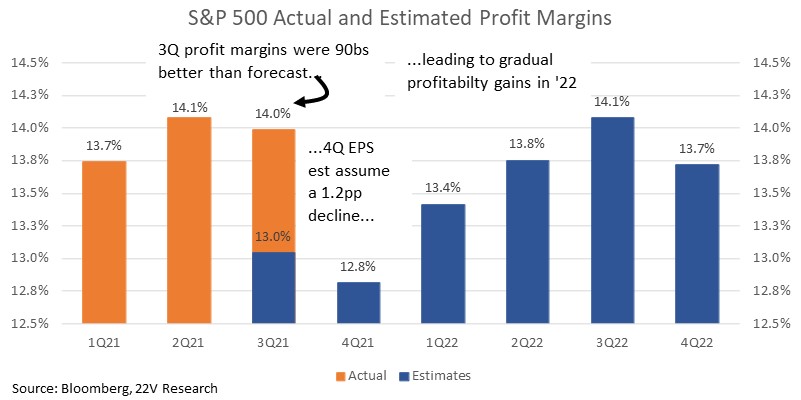
4Q21 S&P reporting season gets underway next week and we anticipate another round of strong upward revisions during reporting season. Over the past six quarters, actual EPS growth has exceeded estimates by 10pp or more. 4Q consensus estimates imply more than a point of margin contraction, which there is little macro reason to expect. Margins holding steady at their 1-3Q ’21 average level would add $4 to 4Q EPS, which translates into an 8pp beat. Under that scenario, we put 2021 S&P EPS at $207, and forecast $225 in ’22 and $245 in ’23.
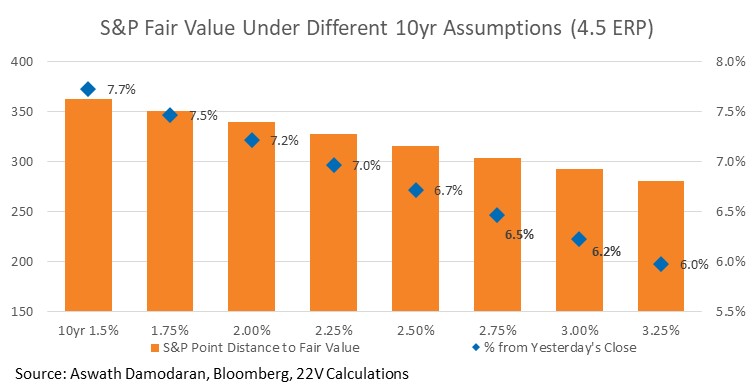
Equity risk premia, or what return investors demand from stocks relative to bonds, have been elevated over the past decade, reflecting the low level of growth and the downside risks of being at the zero lower bound. A 4.5% ERP seems appropriate while growth remains above trend and bond yields are normalizing. With our earnings estimates and assuming a 2% 10yr yield, our fair value target for the S&P is 5040 or about +7.2% higher than yesterdays’ close. Headwinds from inflation, Omicron, and supply chains (all of which are tied together) likely need to fade before ERPs move lower, but downside risk should be limited unless the Fed shifts from removing accommodation to meaningfully slowing growth to combat inflation.
To put a finer point on that, markets are unlikely to come under intense pressure unless it becomes obvious the Fed NEEDS to slow demand growth aggressively. So far they have not signaled such a shift and 22V’s economist Gerard MacDonell forecasts an easing of core PCE inflation to 2.8% by year end. That is roughly in line with the Fed’s forecast of 2.7% core PCE and their expectation of raising rates three times in 2022. Removing policy accommodation to slow inflation means tightening financial conditions by pushing yields higher. This is a key point that needs to be internalized. The Fed wants higher real yields and has the tools to make that happen, so investors should position for that outcome.
Today, economic growth is above trend, supply chain risks have eased some, consumer demand is robust, corporate profitability is strong, and financial conditions remain exceptionally easy. That is a backdrop that favors Cyclicals, particularly those levered to rising real rates like Financials, Energy, and Industrials.
If the intent of the Fed shifts from removing accommodation toward slowing growth aggressively, the market outlook will shift. Internals will still be driven by rising real rates, favoring Value, Cash Return, Quality and Size, but a significant tightening of financial conditions would push Cyclicals lower relative to Defensives.
Unfortunately, the likelihood of a Fed policy shift is dependent on things nobody can predict like productivity and participation rates. The funds rate is skewed higher than is currently priced into markets. Rents and wages suggest a modestly faster pace of tightening. Now it’s just a question of what type of growth backdrop will come along with an eventual move to 2%ish Core PCE. Will it be 0-1%. Or 2-3%.
We start the year with a long Cyclicals bias, but with market level correlations low relative to the past few years and IPC, a measure of macro influence, well off its high, thematic investment rotations are our focus in 2022. In the full report we detail out view on real rates (higher) and look at some of our major thematic trades like negative supply chain sentiment and reopening.
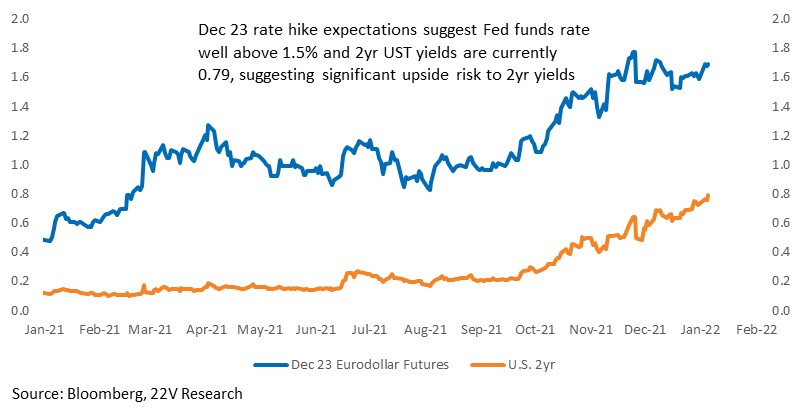
Rising Real Rates & Major 2022 Market Forces: Our single highest conviction view for 2022 is that real rates will trend higher as the Fed hikes and the Omicron/inflation headwinds that are restraining bond yields fade. Medium term rates show how much upside there is to Treasury yields. 2yr Eurodollar futures are indicating a 2023 funds rate over 1.5%. At the same time, 2yr Treasury yields are around 80bps. One of those two levels is unsustainable; we think it is USTs.
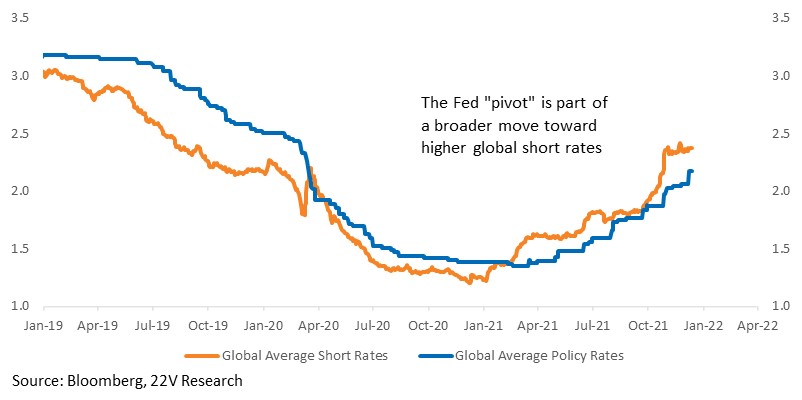
The FOMC made their intention to raise rates in 2022 explicit at their November meeting and they reinforced that point at their December meeting. Their goal is to move off the zero lower bound to restrain inflation and finally take policy off the war footing that has existed for most of the post-GFC era. The Fed policy pivot is part of a broader move toward higher policy rates across the globe. Policy and short-term interest rates have moved higher across major economies since early 2021.
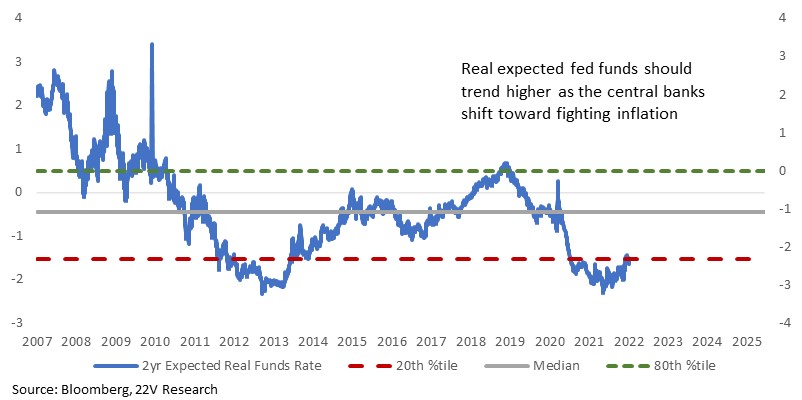
Real yields are biased higher over the coming quarters by central banks shifting toward fighting inflation and raising rates. Currently, the level of expected real yields is still deeply negative and far below where it was before the pandemic. To reach their median level of -45bp, 2yr forward real expected fed funds need to climb +100bps from current levels. During the last rate hike cycle, the 2yr expected real funds rate averaged -23bp, 125bp from their current level.
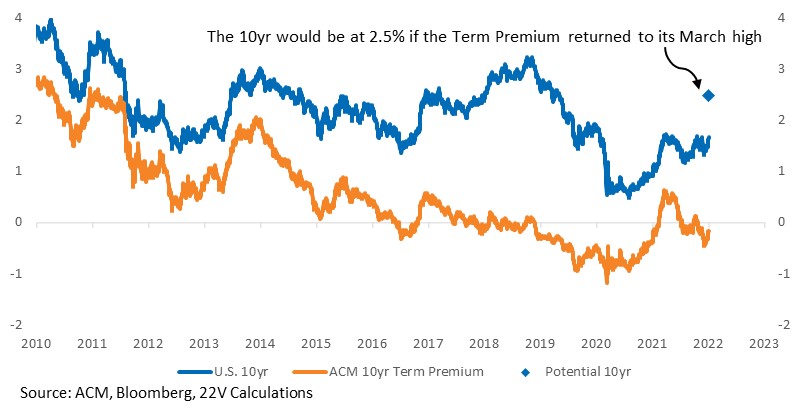
Years of aggressively supportive global central bank policy and repeated economic shocks have left the term premium depressed. The term premium should trend higher as global policy makers move from supporting growth to fighting inflation. Even a return to the March-’21 high would put the 10yr at 2.5%. Yields are still constrained by multiple forces (low competing sovereign yields, ongoing macro uncertainty, etc.) so the 10yr is unlike to quickly move about 2%, but the skew is clearly higher.
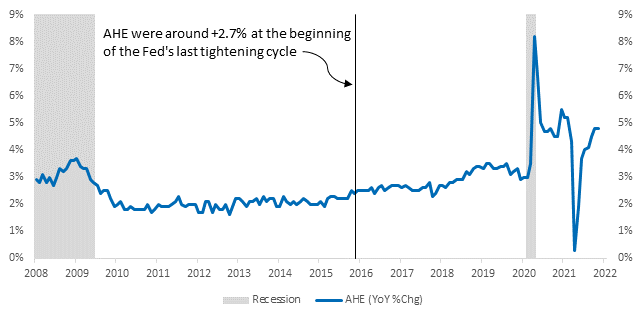
An important point to internalize is that Fed policy is still FAR from restrictive. Paraphrasing Jason Furman, who was well ahead of the shift in Fed policy (and some say helped cause the shift), monetary policy should continue to be expansionary, just not extremely so. Think about it in these terms, when the Fed started tightening in the last cycle, core PCE was in the 1.6 to 1.7% range. Today it is 3.6% and wage growth is MUCH stronger.
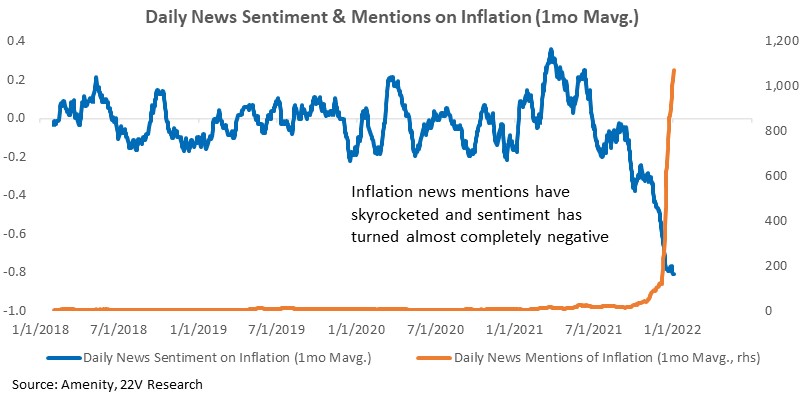
Inflation & Supply Chains: Negative sentiment toward inflation is providing fuel for bearish market narratives. Inflation was in a downward trend for the better part of 40 years, leaving investors with little experience in or hard data on navigating high inflation backdrops. Inflation bottomed in April of 2020 when y/y CPI fell to 0.6%, but strong consumer demand and growing supply constraints have driven headline inflation to 6.8%, its highest reading since 1982. News mentions of sentiment have shot higher and sentiment has plunged over the past two months.
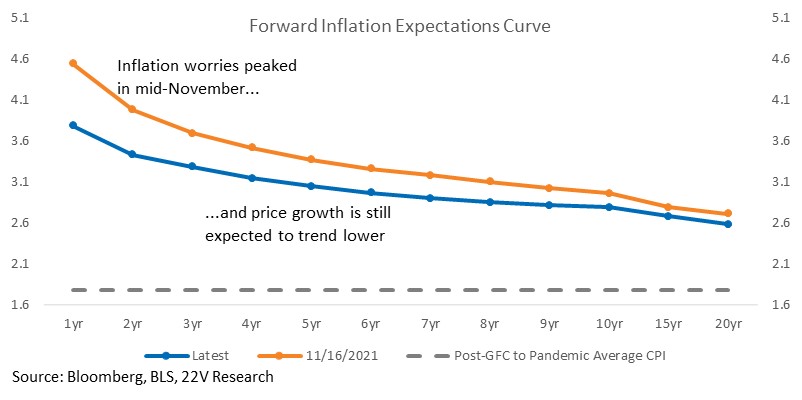
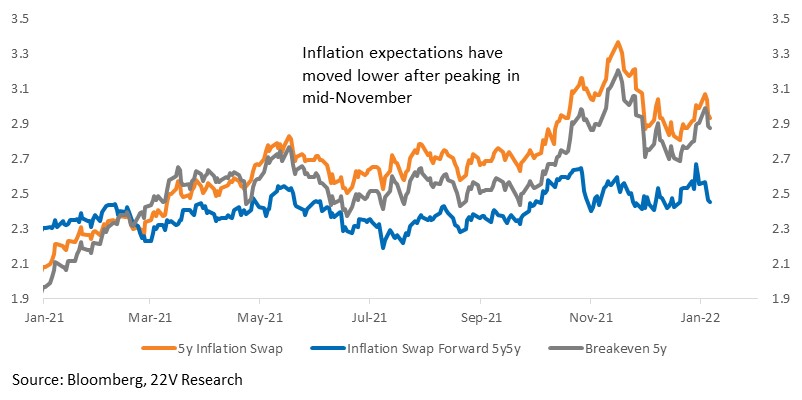
Market-based inflation expectations peaked in mid-November when supply chain concerns were greatest. Since then, the Fed has clearly shifted from pursuing to fighting higher inflation and some supply chain constraints have eased. The result has been a decrease in near-term inflation expectations. The long-term endpoint on expected inflation has remained steady at ~2.6%.
As 22V’s economist Gerard MacDonell has pointed out, there are two important PCE trends: “First, the inflation spurt during the past year has already made up for a lot of past lowflation and is one of the major considerations driving the Fed’s so-called “pivot” to inflation fighting. Second, the trend of underlying inflation has clearly picked up meaningfully, if not necessarily alarmingly. And this reinforces the case for the Fed placing greater emphasis on inflation containment than on quickly returning the economy to “maximum” employment”.” Gerard’s base case is for core PCE to end the year at 2.8%, slightly above the Fed’s 2.7% forecast. Risks to inflation are skewed to the right, though, with the path of productivity and supply constraints determining the outcome.
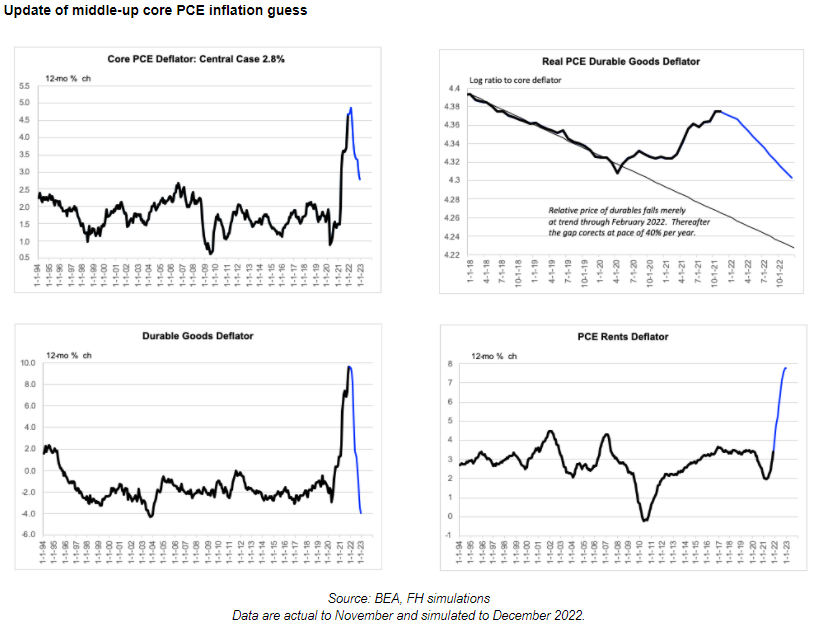
Ongoing supply chain issues and very strong consumer demand skew inflation risk higher over the coming quarters, particularly if an Omicron wave in Asia leads to another round of broad shutdowns. News sentiment toward supply chains has deteriorated over the past month but remains well off its Fall-’21 low. Freight rates have also ticked higher.
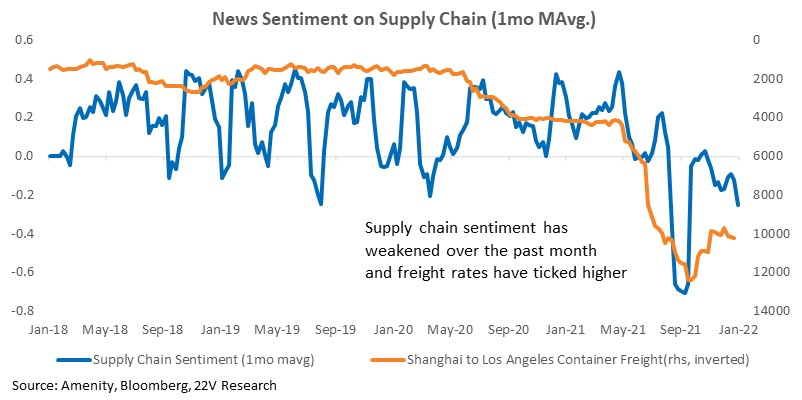
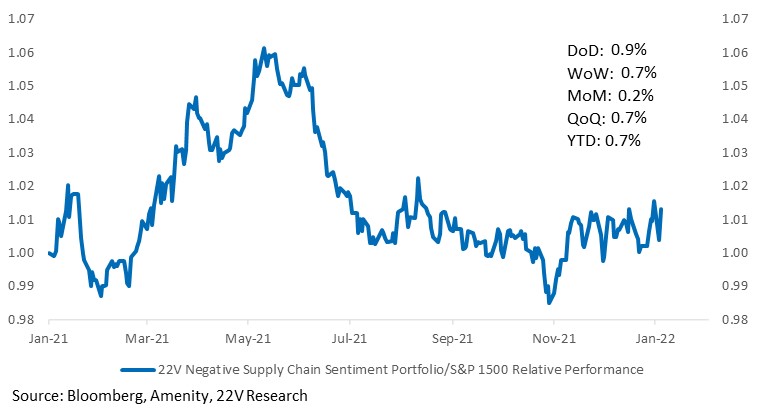
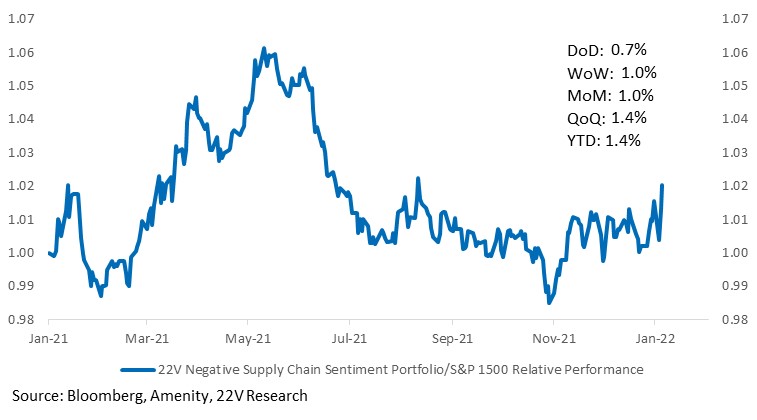
However, equities most negatively exposed to supply bottlenecks have been trending higher over the past month. Our negative supply chain basket is constructed using quarterly management sentiment readings toward supply chains, measured using the Amenity natural language processing (NLP) tool. 4Q earnings season will provide important new information on this topic, but current investor positioning does not indicate broad expectations that supply chain issues will deepen.
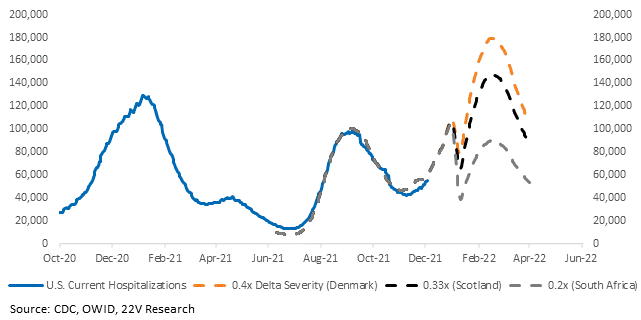
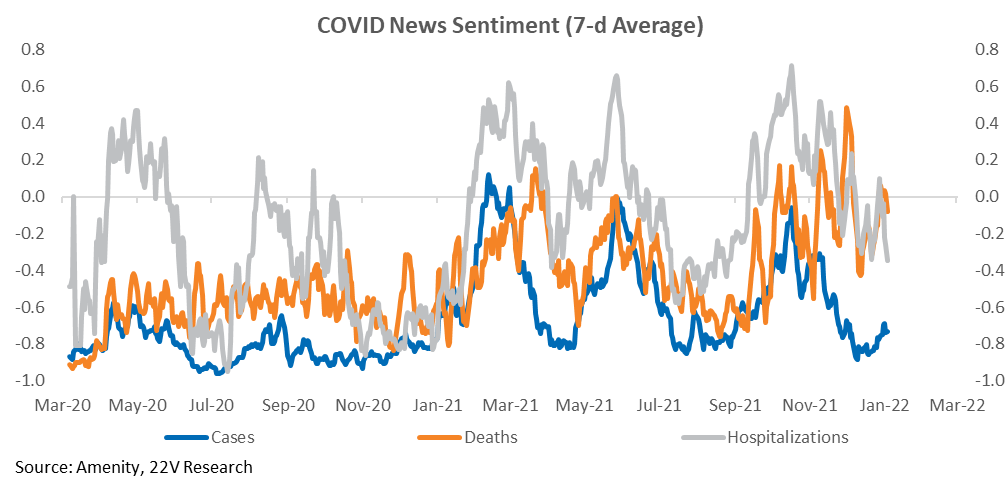
Omicron Headwinds Fading: COVD-related bottlenecks are a risk but Omicron severity data, new therapeutics, and new booster data all indicate the worst-case scenarios are off the table, despite rapid case growth. Severe cases (hospitalizations and deaths) matter the most for activity and policy. The range of initial estimates of hospitalizations was extremely wide; the uncertainty about severity was a significant headwind to 10yr yields and COVID-sensitive industries. The range has narrowed and the outcome, from an economic and market perspective, looks benign. It’s unlikely Omicron will be a significant demand shock.
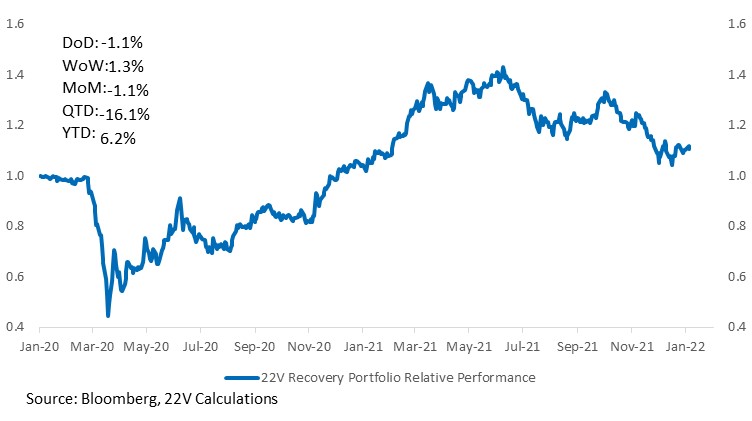
COVID news sentiment concerning severe disease, calculated using the Amenity Natural Language Processor, is volatile but better than during the pre-vaccine and Delta COVID waves. The 10yr yield has diverged from headline COVID sentiment recently but our Recovery Portfolio has not increased in the same fashion as the 10yr. Better sentiment will alleviate a significant headwind to COVID-sensitive stocks.
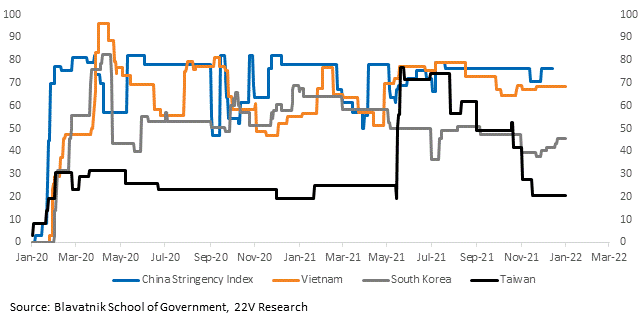
The primary risk, while estimates of severity are roughly accurate, is whether an Omicron outbreak in Asia disrupts supply chains. How countries respond to Omicron will have an important impact on supply chain issues near term, but there is not yet enough data to determine which way that will break. China’s zero-COVID policy appears to be in full effect. Supply chain sentiment is deteriorating while the intensity of supply chain news is increasing. Case growth in Asia ex-China is, for now, tame, but headlines are beginning to pop up about case growth in Asia (and not just China). We are monitoring Oxford’s stringency indices to track the level of restrictions.
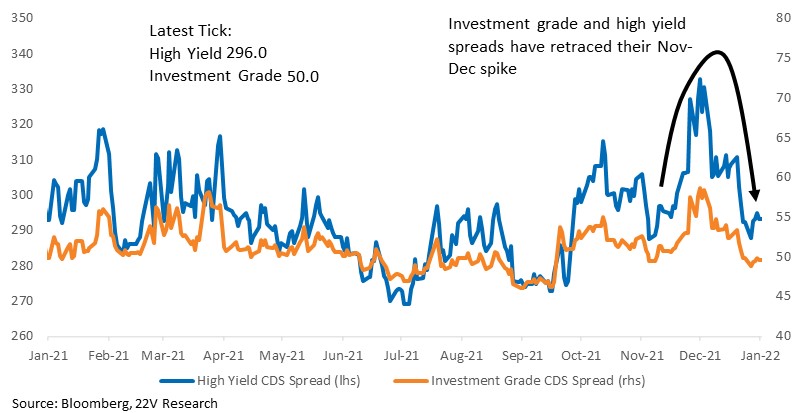
Still Strong (But Not Too Strong) Growth Backdrop: Part of the reason we expect benign outcomes from the Fed pivot, inflation/supply chain risks, and omicron is that financial conditions remain easy despite all those sources of uncertainty. Borrowing costs remain low across consumer and corporate credit, and IG and HY spreads remain tight.
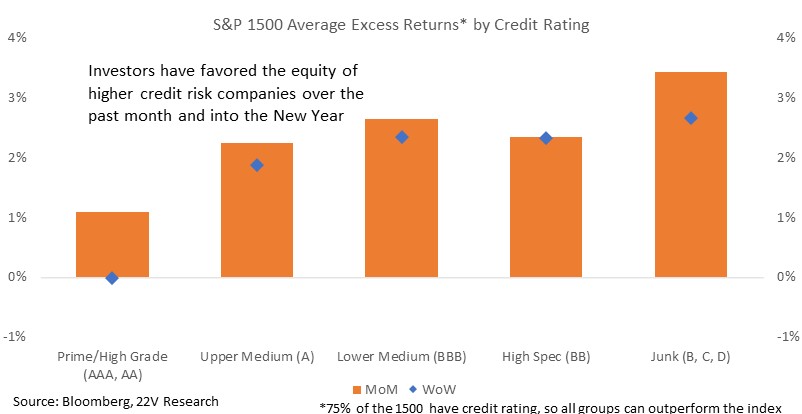
Additionally, investors have been rotating back into equities with riskier credit profiles. Though rising rates should be a headwind to high yield bonds, S&P 1500 stocks with the lowest credit ratings outperformed over the past month. Investors show no sign of being worried that the Fed rate hike cycle will lead to a meaningful increase in defaults, which is reasonable given the easy level of financial conditions.
Though persistently high inflation and supply chain issues represent a real risk to economic growth, positive economic surprises are outpacing higher inflation surprises. Headline and core inflation readings will remain high near term, but trend economic growth remains firm.
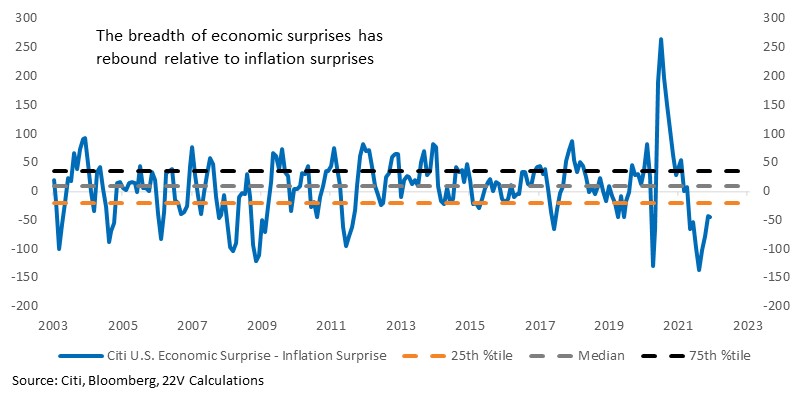
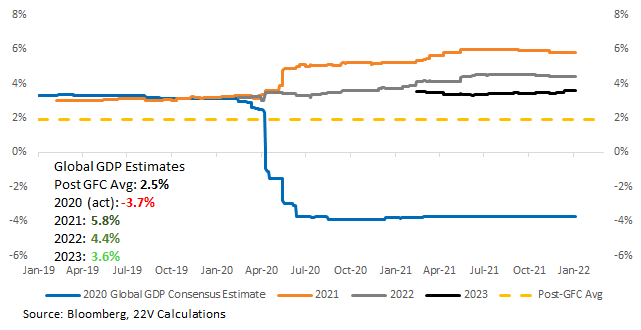
Easy financial conditions and economic surprises outpacing inflation surprises help explain why global real GDP growth estimates remain well above trend for the next few years. Economic activity is expected to remain above trend through 2023, helping keep credit spreads and overall financial conditions easy.
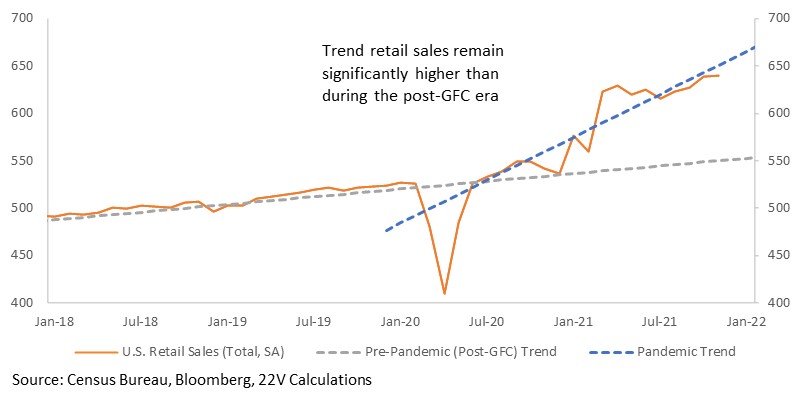
One very important reason growth expectations remain high is that consumer demand is robust. Job openings remain extremely high, as does the quits rate. Retail sales, supported by fiscal and monetary policy, have been in a strong upward trend since collapsing during the pandemic. Importantly, consumer demand has remained WELL above its pre-pandemic, post-GFC trend even as central banks and fiscal authorities have moved away from aggressive support.
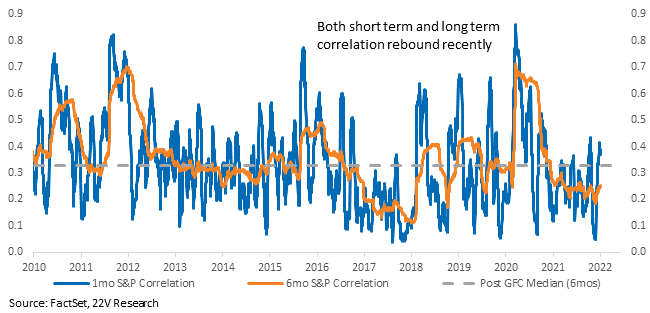
COVID, inflation, and Fed policy shift fears combined in 4Q to push equity correlations higher, but the smoothed readings remain near multi-year lows. Omicron and inflation risks are easing modestly and earnings reporting season will get started next week, all of which bias correlations lower in January. Longer-term correlations should remain well below their COVID levels, reinforcing the more stock specific, micro trend driven market.
Market Outlook: The S&P forward PE ended 2021 about 1 point BELOW its end of 2020 level after the S&P rose 27% last year. This is an important point and runs counter to the common bear-case argument that the removal of central bank stimulus will deflate equities. Markets rose last year DESPITE a contraction in willingness to pay (PEs), not because of a greater willingness to pay. EPS are forecast to have expanded over 46% in 2021 on nearly 16% revenue growth.
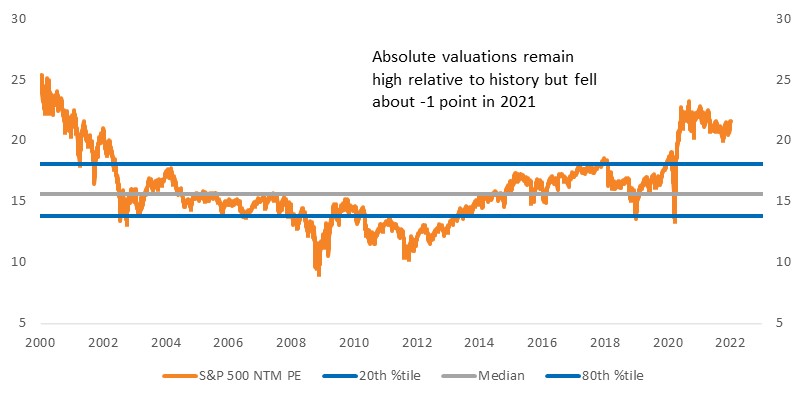
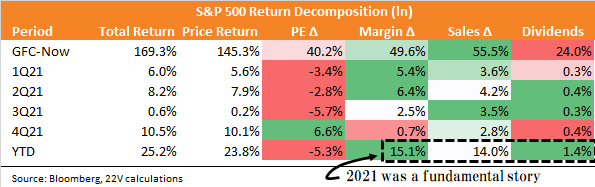
Overall, PE contraction took 5pp off the S&P’s gain (ln) in 2021 while sales growth added 14pp and margin expansion contributed another 15pp. The importance of fundamentals is a shift from the post-GFC era trend where PEs were responsible for about a quarter of returns. Over the past two years multiple expansion plus tremendous earnings growth supported annualized returns of ~21%. Going forward, the pace of returns will be much slower and upside more tied to fundamentals.
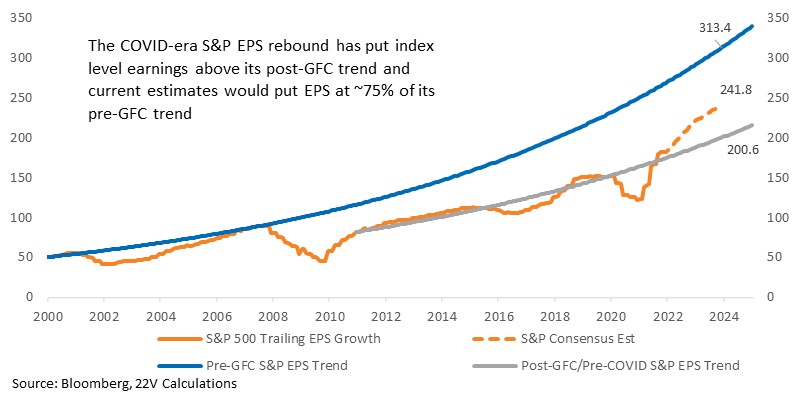
Earnings have rebounded from their pandemic decline and broken out relative to their GFC-era trend. In 2008, trend earnings growth fell sharply from the pre-GFC trend. But just like overall economic growth is now running above its post-GFC level, S&P EPS is now above its post-GFC trend. That is an important longer-term support for equities.
Near-term inflation remains elevated and is unlikely to fade significantly. Rising price levels have been good for corporate earnings because inflation, so far, has been in goods rather than wages. Profit margins in 3Q were much stronger than analysts forecast, and the result was much better EPS growth than was expected at the start of reporting season. Margins are again expected to decline in 4Q, a forecast that seems unwarranted.
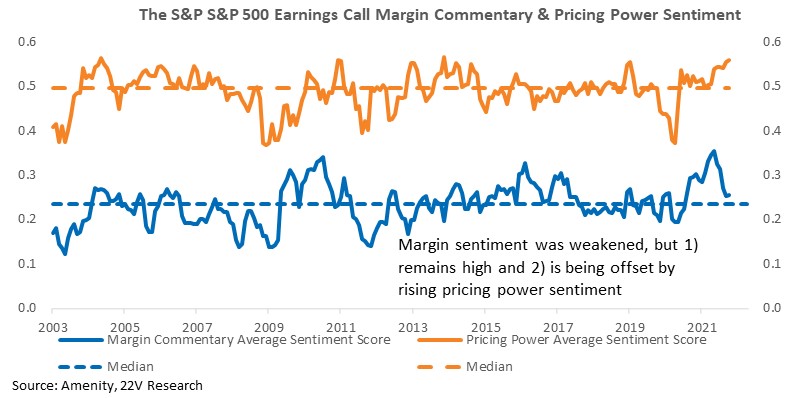
As of 3Q, management sentiment toward expected profit margins had moved lower, adding to concerns that wage pressures and supply chain issues would push the high level of corporate profitability lower. Objective management sentiment, calculated using the Amenity NLP tool, tells a different story. Margin sentiment has weakened but remains at a high level. Pricing power sentiment has moved to a new all-time high. Persistent supply bottlenecks or growing wage pressures are potential threats to profitability in 2022, but corporate manager sentiment does not indicate that outcome is likely.
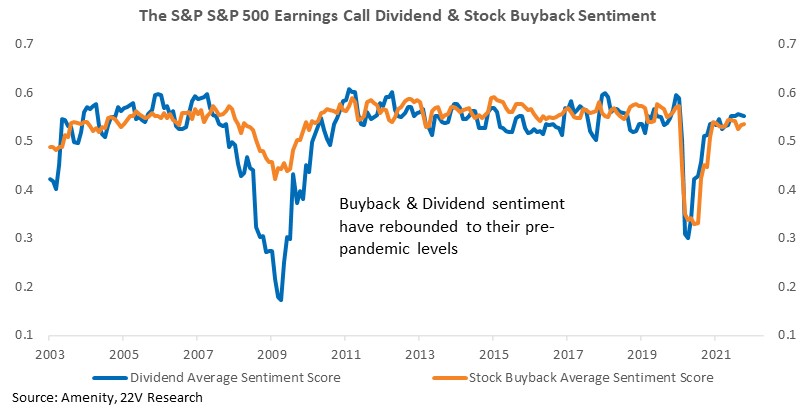
The dividend contribution to returns has been small over much of the past decade, but total cash return remains an important driver of markets. Management sentiment toward buybacks and dividends has trended higher since crashing during the initial phase of the COVID pandemic. As of 3Q earnings reporting season, sentiment toward cash return had rebounded to just under its pre-pandemic level.
Improving sentiment and strong earnings help support a rebound in cash returns. Dividend and buybacks are on track to reach record levels in 2021 once 4Q earnings are recorded. The previous peak in net share repurchases was $744bil in 2018; 2021 is on track to reach $770bil (+3.5%). Dividends are tracking $528bil, 2% above their 2019 peak.
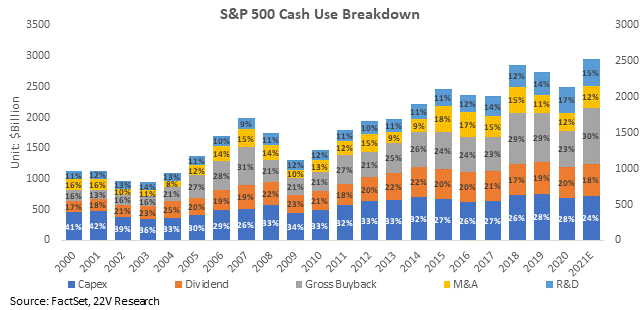
Relative to 2018, earnings are less impacted by buybacks today as the S&P market cap has grown ~90%. However, at nearly $1.3 trillion per year, cash return is equivalent to about 3% of the S&P’s market cap and needs to be considered when thinking about how to value equities. High cash return is one reasons we prefer Aswath Damodaran’s equity risk premium (ERP) over more traditional valuation measures. Under his framework, using an ERP of 4.5%, a 10yr yield of 2%, and our EPS estimates ($207 in 2021, $225 in ’22, $245 in ’23) gives us an S&P fair value target of 5040, about 7% above yesterday’s close. The assumptions that make up that target are below.
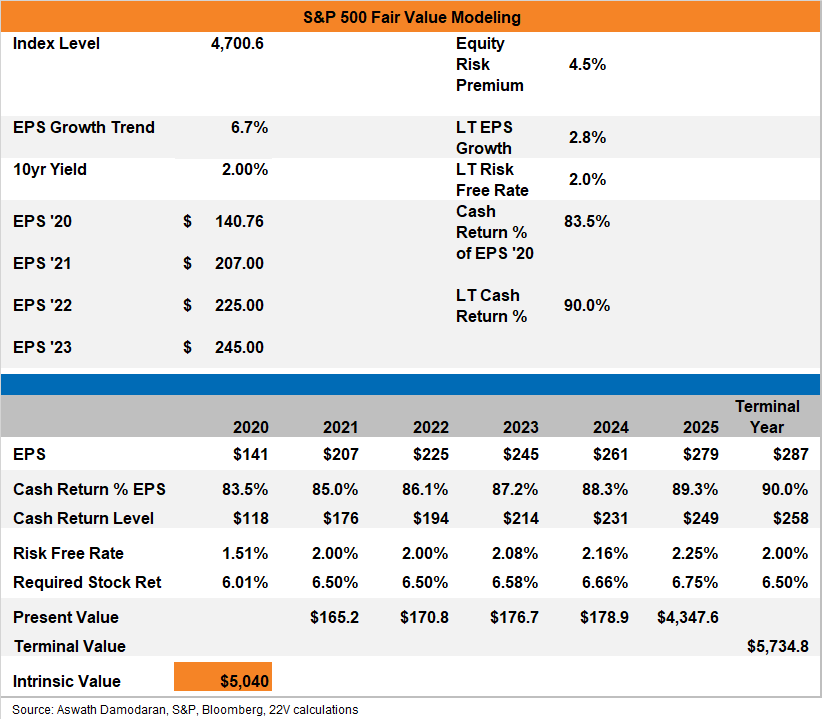
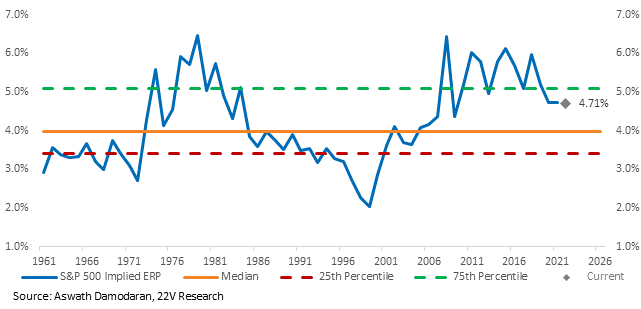
Equity risk premia, or what return investors demand from stocks relative to bonds, have been elevated over the past decade, reflecting the low level of growth and the downside risks of being at the zero lower bound. A 4.5% ERP seems appropriate as long as growth remains above trend and bond yields are normalizing. Headwinds from inflation, Omicron, and supply chains (all of which are tied together) likely need to fade before ERPs move lower. But the downside risk to equities near-term should be limited unless the Fed needs to raise rates much more aggressively than currently expected.
Our market forecast requires earnings to expand, but within the range of current estimates, there is high single digit upside as long our 10yr and ERP forecasts are correct. Even if the 10yr yield moves significantly higher than we anticipate, the S&P should move higher in 2022.
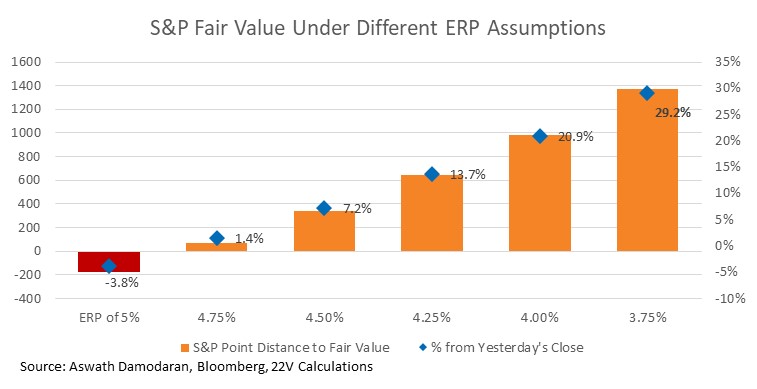
The more important swing factor today is the level of the ERP. Today, the ERP is around 4.7%, up from 4.6% in November. That increase in the ERP took about 3% off S&P fair value. A decline to 4.5% leaves fair value at our +7% target. The path to a lower S&P is through an increase in the ERP to 5% or above.
Fed & Rising Real Rates: The Fed’s policy shift over the past few months (and Omicron concerns) has helped push inflation expectations off their November peak. More contained inflation plus firm growth does not guarantee higher real yields, but as Gerard has noted “some tightening of overall financial conditions, led by higher yields or lower risk asset prices, would probably be judged appropriate.”
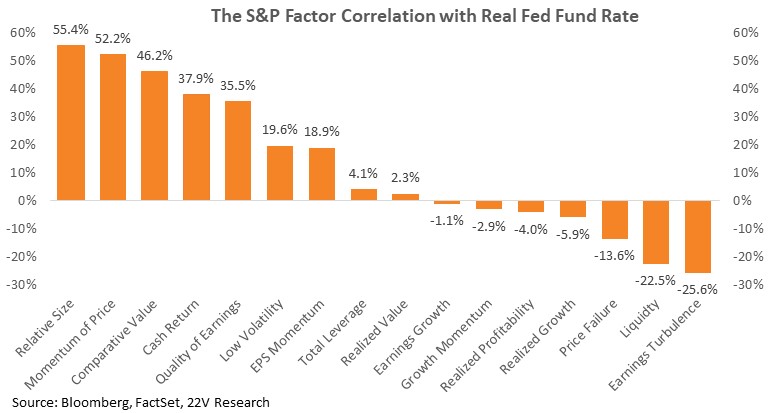
Implied real rates (10yr yields) and real fed funds should move higher as policy accommodation is removed. Higher term premiums and lower inflation expectations are pushing real yield higher, while declining inflation expectations are moving the real fed funds rate lower. That has specific factor rotation implications. The overarching theme is to be long Value, Size, and Cash Return.
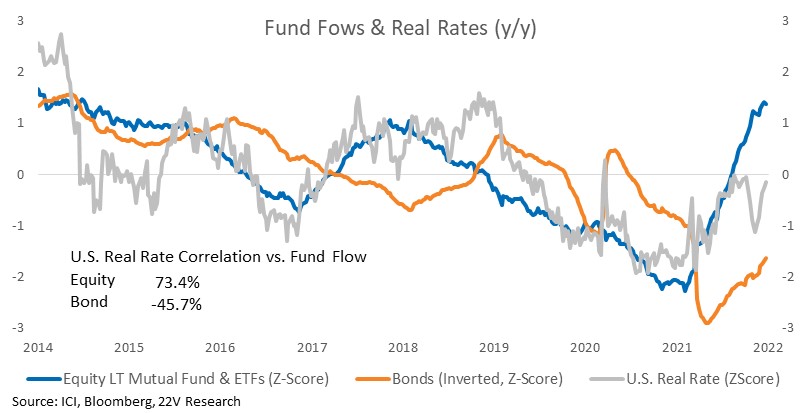
Bond fund flows are negatively correlated with U.S. real rates while equity flows tend to rise alongside real rates. Today, real rates remain near their all-time low but the Fed is expected to hike short rates at least three times this year and has specifically mentioned they would like real rates to increase. Easing of omicron risks and steady economic growth should drive U.S. 10yr yields higher, encouraging a further allocation to equity funds.
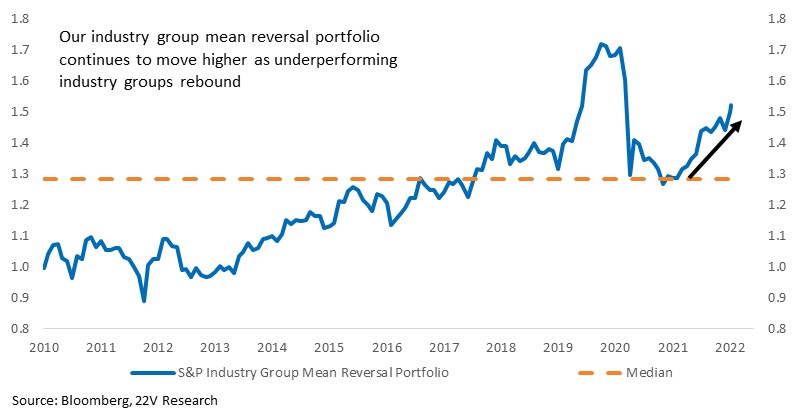
Mean Reversal: Macro uncertainty tied to the economic recovery, COVID variants, inflation, and the Fed’s change of stance led to higher risk asset volatility in 2021. Though the S&P trended higher most of last year, internal factor, industry group, and stock rotations made trend following less effective. Our mean reversal portfolios from the stock to the industry group level have all posted consistent gains over the past several quarters.
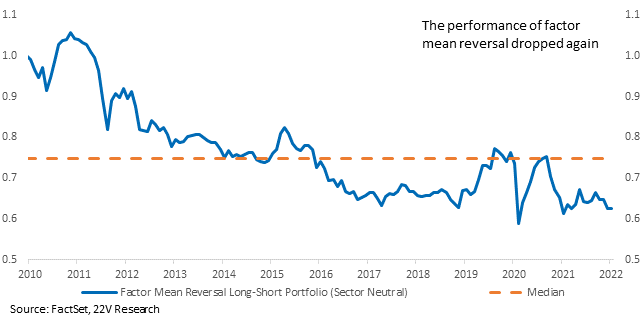
Though factor returns have been more persistent than industry groups historically, even our factor mean reversal portfolio posted a few quarters of outperformance in 2021.
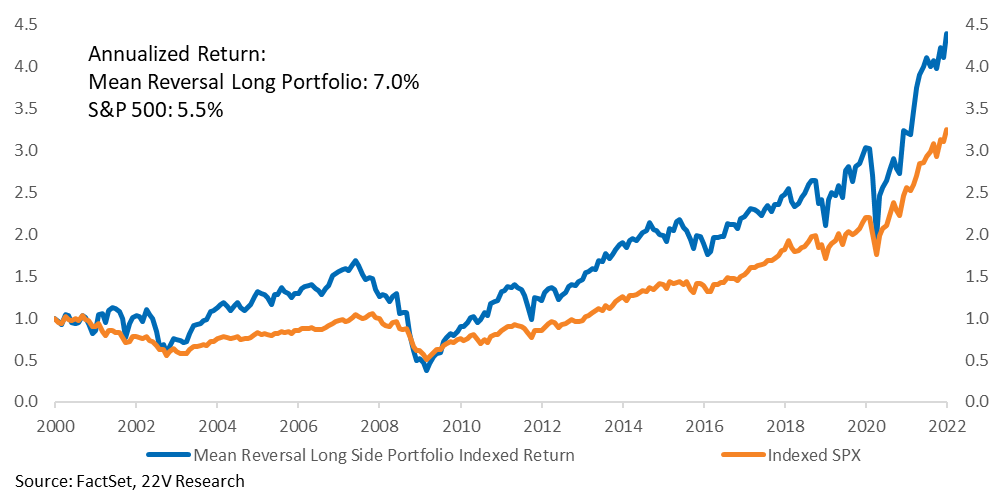
A mean reversal strategy was also effective at the stock level. We constructed a S&P mean reversal portfolio that is long the bottom 100 stocks from the previous month and short the top 100 performers. Back test results show the strategy outperformed, especially the long side, which has posted a 7% annualized return, exceeding the S&P’s 5.5% return since 2000. The long portfolio performed extremely well in 2021, gaining 36.8%.
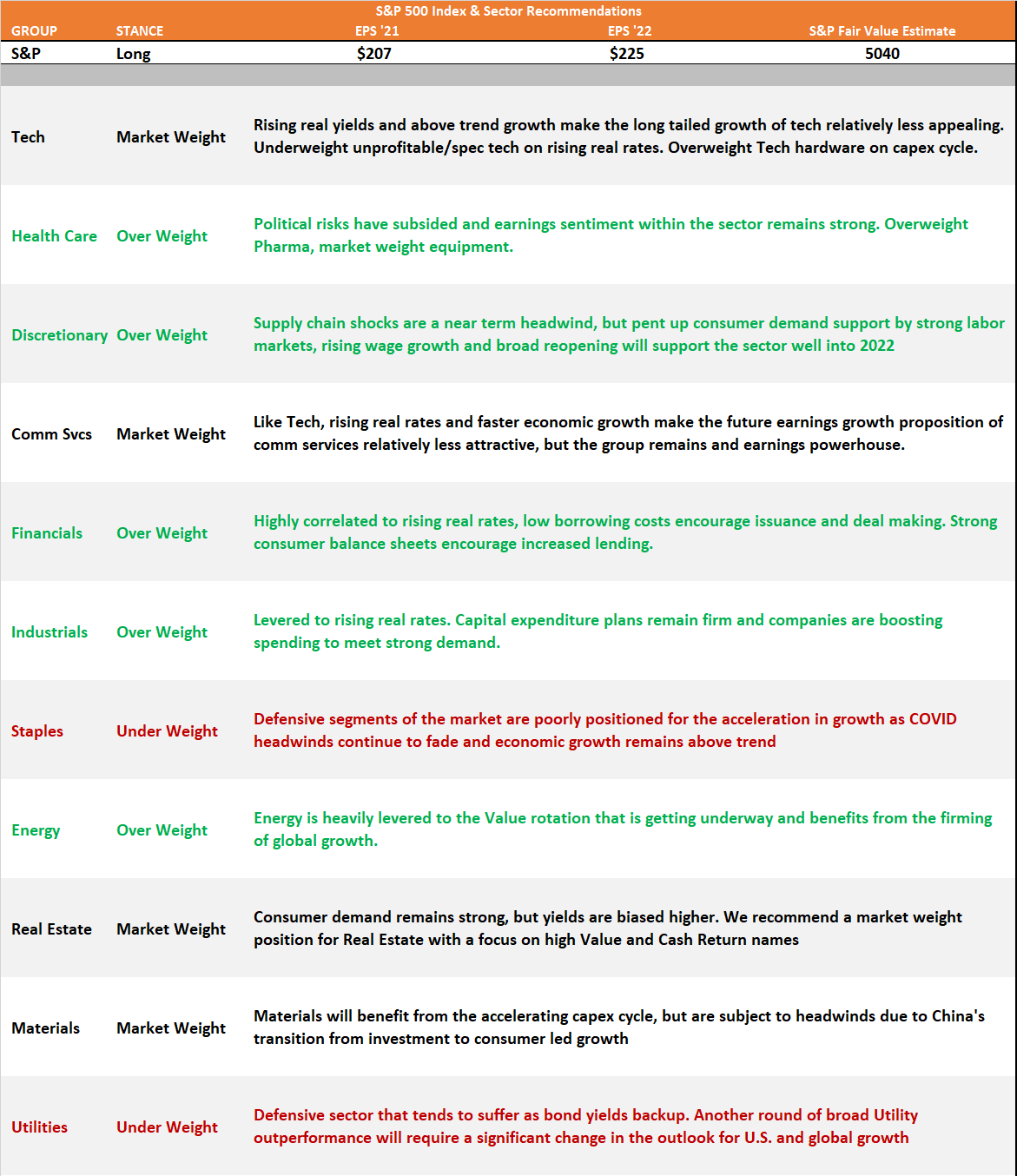
Sector & Industry Positioning: The S&P ended 2021 with a 26.9% gain while the U.S. 10yr yield increased +60bp. Though Omicron’s impact remains uncertain, concerns about its potential impact on the economic recovery have eased, focusing attention on the Fed regime shift and inflation. Markets are pricing in three rate hikes this year and lower inflation, translating into a higher real funds rate. Value and Cash Return style factors have the highest correlations with changes in the expected level of the Fed funds rate, and strong positive relationships with the expected real fed funds rate, indicating they will benefit most from the rate hike cycle. At the sector level, we prefer Cyclicals over Defensives, but like Healthcare within the Defensive space.
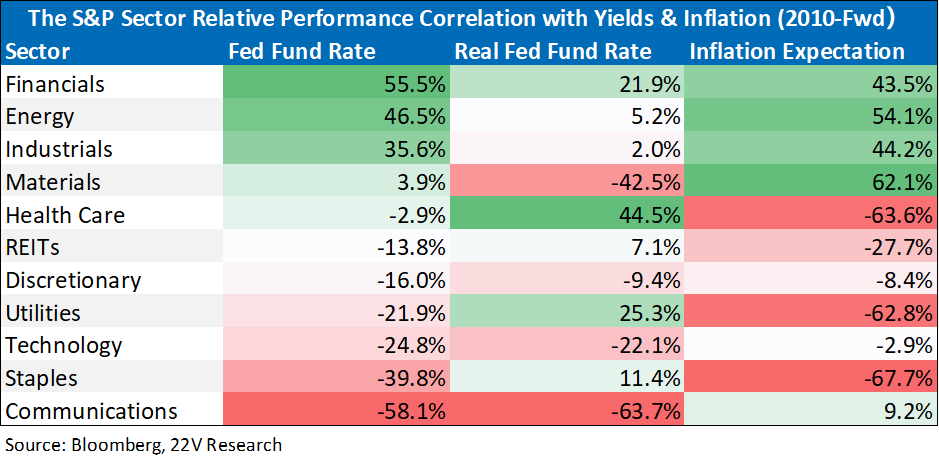
At the sector level, Financials, Energy, and Industrials are most positively correlated with changes in the real fed funds rates. Financials and Energy are also have more than index exposure to both Value and Cash Return. In general, Cyclicals have a more positive correlation with changes in the expected funds rate and inflation than Defensives.
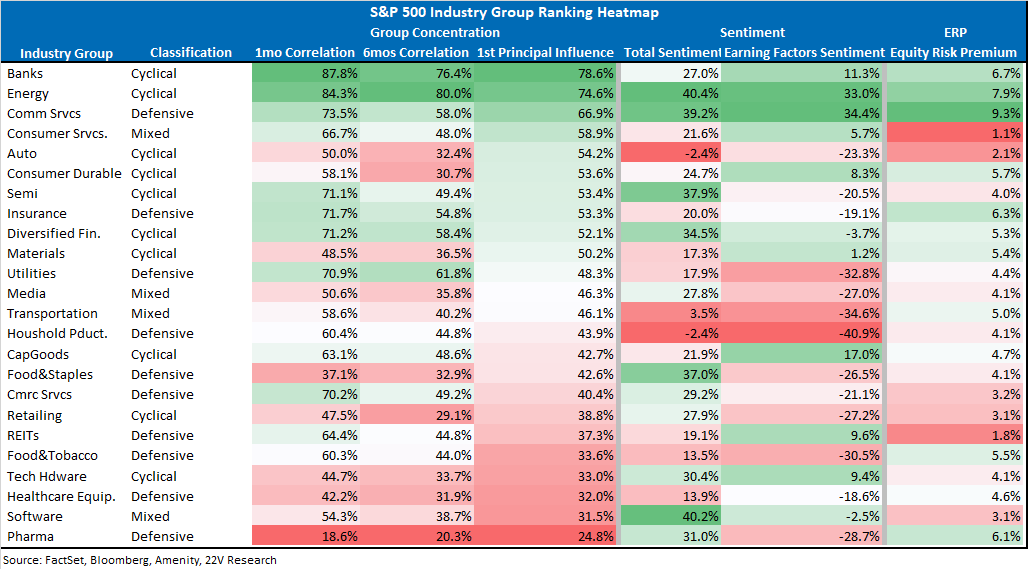
There are points to consider when thinking about factor screening. 1) No factor works across all periods, so it is essential to understand the current market regime when constructing screening tools. 2) Even within a given regime, factor screening can be more or less valuable depending on the factor’s alignment with and the level of macro/micro/idiosyncratic influences. We track those differences using a heatmap of correlations and 1st PC percentage. To help with screening we built a quick industry heat map showing
The idea of this heat map is to screen quickly for industries that have high potential for micro trends (high correlation, larger macro influence), and which ones have the most attractive fundamental backdrops (high sentiment, higher ERPs). It is also a quick way of looking for industries that offer higher stock specific potential. REITS, Pharma, Software tend to have lower correlations (more potential for stock specific deviations within groups).
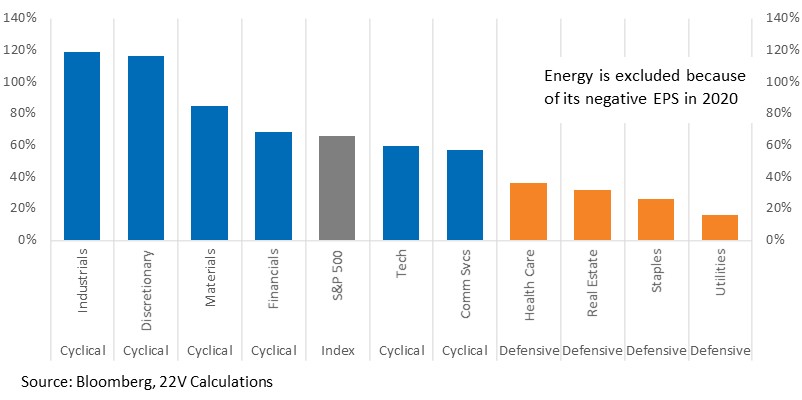
Cyclicals: Under the backdrop of a benign Fed pivot, fundamentals will drive returns rather than shifting risk appetites. Looking out over the next few years, consensus earnings estimates, which we think are too low, favor Cyclical sectors.
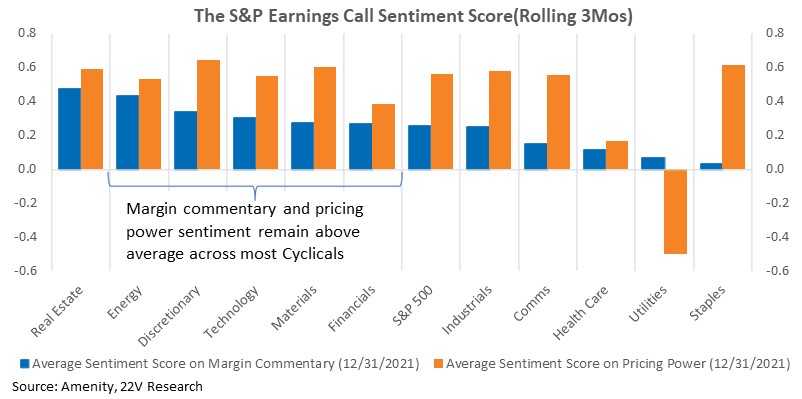
Earlier in this report we noted that strong management sentiment toward margins (falling but at a high level) and pricing power (all-time high) indicates S&P profitability will remain high, at least through 4Q21 reporting season. Assuming supply bottlenecks continue to ease, margins should also remain elevated throughout 2022. Within the index, Cyclicals tend to have the strongest margin commentary and pricing power sentiment. Real Estate, a traditionally defensive sector, has the strongest sentiment measures and we like the sector despite the upward skew on bond yields given strong consumer demand and high affordability.
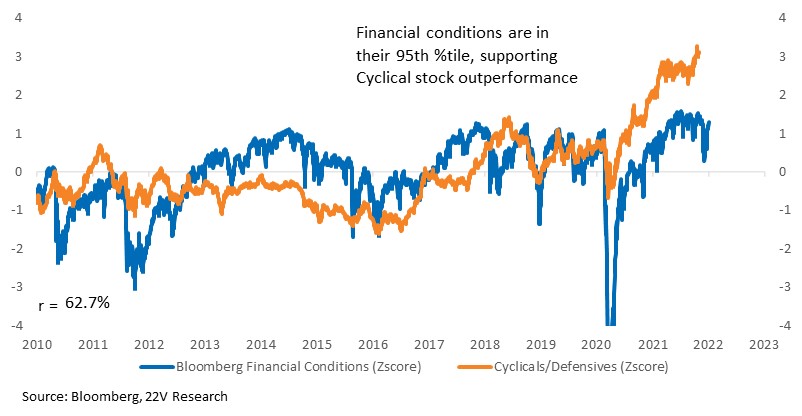
Easy financial conditions are also a support for Cyclicals relative to Defensives. Financial conditions should tighten some over the coming quarters, with is a headwind for Cyclicals, but the absolute level of financial conditions remains exceptionally high (easy) even as investors have moved to price in three rate hikes next year. Firm growth, strong consumer demand and high profitability are all supports for overall economic activity and Cyclical sectors unless the Fed needs to tighten more aggressively than currently forecast.
Themes: Market level correlations remain low relative to the past few years and IPC, a measure of macro influence, has declined as well. With top line market upside limited and stocks trading more on micro forces than macro trends, thematic investment rotations are our focus in 2022. We have already discussed at length our views on rising real rates, below we touch on that topic again and look at Supply Chain and Reopening trades. For a complete list of the stocks that make up these portfolios, please email us.
Rising Real Rates: We have written a number of times in this report and over the past several weeks about the importance of rising real rates. Fed policy is focused on raising implied real rates, which remain exceptionally low. That is a paradigm shift relative to the much of the past decade and will influence portfolio returns at the sector, industry, factor, and stock level.
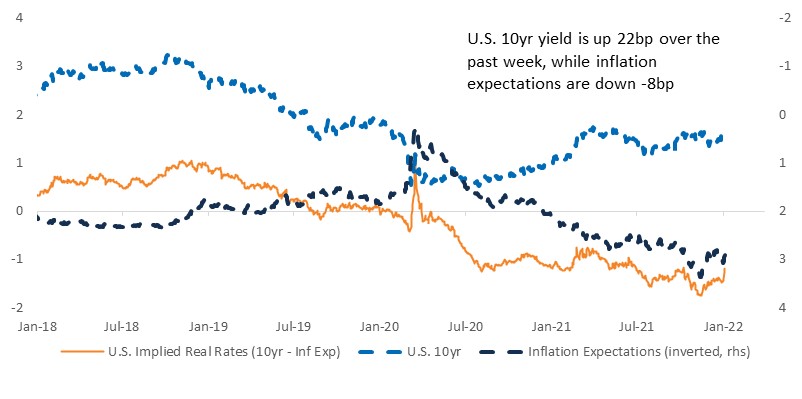
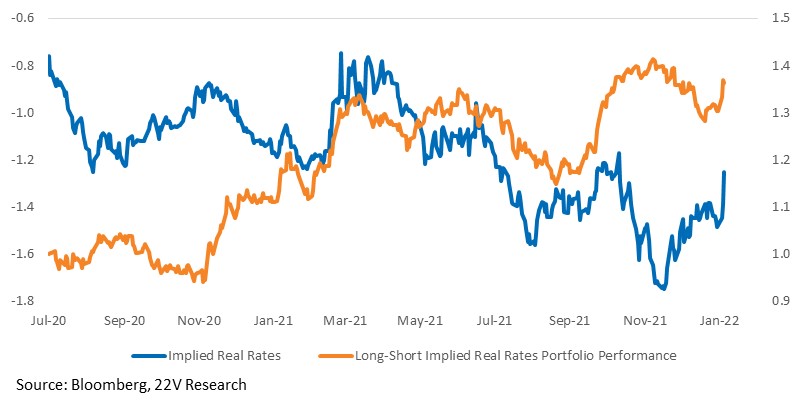
To position for a shifting real rates backdrop, we constructed a portfolio of the S&P stocks with the highest correlations to changes in real yields. So far, the index, on a long-short basis (long top correlated names and short bottom correlated names), has closely followed changes in implied real yields. As real yields have shot higher, so to have the returns to our long-short real rates portfolio (particularly the long end). Recently, the long end has outperformed the short, suggesting investors are starting to either position for higher real yields or, at least, are shying away from the stocks most levered to falling real yields.
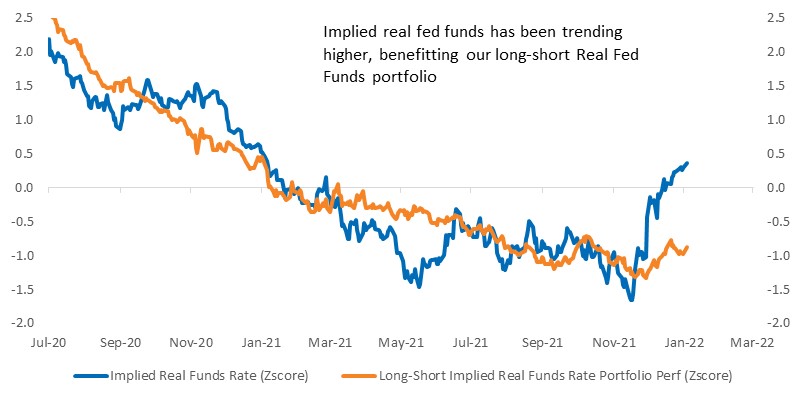
Our long-short real fed funds portfolio has been moving higher as well, but not keeping pace with the rapid increase in the expected real funds rate. Some catchup by these names seems likely given the Fed’s ongoing policy pivot.
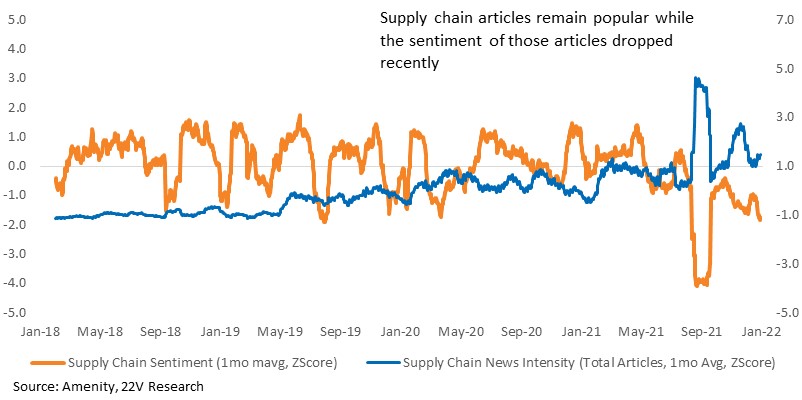
Supply Chain Sentiment: Overall news sentiment about supply chain issues is well off its low but has stumbled recently. Omicron and inflation sentiment both remain deeply negative. Supply Chain news intensity is off its peak but remains elevated. High news intensity makes an improvement in sentiment more important.
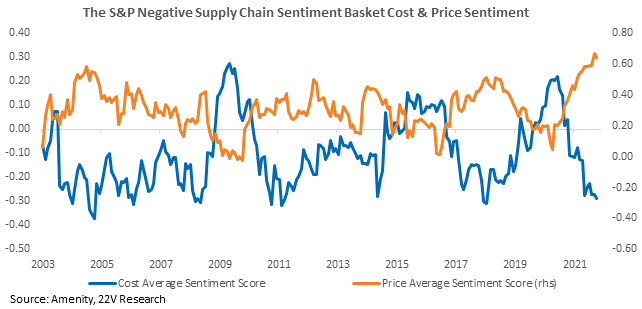
At the company level, supply chain sentiment has a long way to go before normalizing. Cost sentiment within the negative supply chain basket remains deeply negative. Price sentiment is near an all-time high, offsetting poor cost sentiment. One of the reasons companies have been able to maintain a high level of profitability during the supply chain crisis is through strong pricing power.
Over the past few months, investors have rotated back into companies with the most negative supply chain sentiment readings. The trend is choppy as Omicron uncertainty ebbs and flows, but the portfolio has recently broken out even as supply chain news sentiment has deteriorated. 4Q earnings reporting season will provide important signals on the outlook for supply chains in terms of the impact of bottlenecks on future revenue and margin trends.
Reopening Stocks: Investors have had consistently negative views of reopening stocks. Since the rise of the Delta and Omicron variants, stocks most levered to economic reopening (Airlines, Casinos, Cruise Lines) have fallen. Despite ongoing Omicron concerns, reopening names have stabilized recently.