SUMMARY: The bottom line on how people are thinking about Omicrom is as follows; Reports yesterday indicated that the R0 was extremely high, which complicated the backdrop. If Omicron is the new dominate strain, BUT has lower severity and some vaccine protection, that would ultimately be positive. The path to figuring that out though will be bumpy even if it’s true. If severity is high, there is significant downside economic risk (early indications are low severity). The later scenario leads to tighter lockdowns, other negative externalities etc., That is what investors are grappling with just as books are closing for the year. More information on how this will break will come out over the coming weeks, making the next few weeks of trading tough.
Real Yields vs. Software, what people are missing: We got an unusually large number of questions on why Tech and Growth have come under pressure despite the decline in 10yr yields. A few things. First, the combination of Powell’s hawkish pivot and uncertainty related to Omicron has taken out the right tail risk of inflation. Inflation expectation have shifted lower at a faster pace than 10yr yields. So implied real yields have actually moved higher over the past few days. The absolute level of implied real yields is still extremely low, but they are higher. Second, over the past six months the correlation between the IGV software ETF and implied real yields has collapsed (basically zero). Generally speaking, lower implied real rates = software outperformance. But the correlation has broken down. Something else is going on.
That something else is credit. The software ETF (IGV) has been highly correlated to changes in credit spreads. During the delta wave this past summer, credit spreads tightened the entire summer and software outperformed. Fast forward to today, and the move wider in CDX spreads has been much more aggressive. This is what people are missing when thinking about how Growth factors and Software are reacting to moves in 10yr yields and inflation expectations. The odds of a large problem for the economy have gone up (hawkish pivot + Omicrom), which leads to wider credit spreads than in previous waves (the Fed was max dovish in previous waves) and encourages de-risking.

Just about all scenarios that don’t involve a terrible Omicrom outcome will ultimately lead us back to an extremely low real implied high yield backdrop. The fundamental supports limiting downside risk to the market and economy are important and we cover them in the report. Software will be fine. ARKK and other unprofitable Tech will not. We continue to believe the extreme oversold condition in small caps makes them a poor hedge against the NDX and expect small caps to outperform relative. And lower credit quality names as well over the next six months (again, next two weeks will be tough). See our Webinar from yesterday for details.
Full report below…
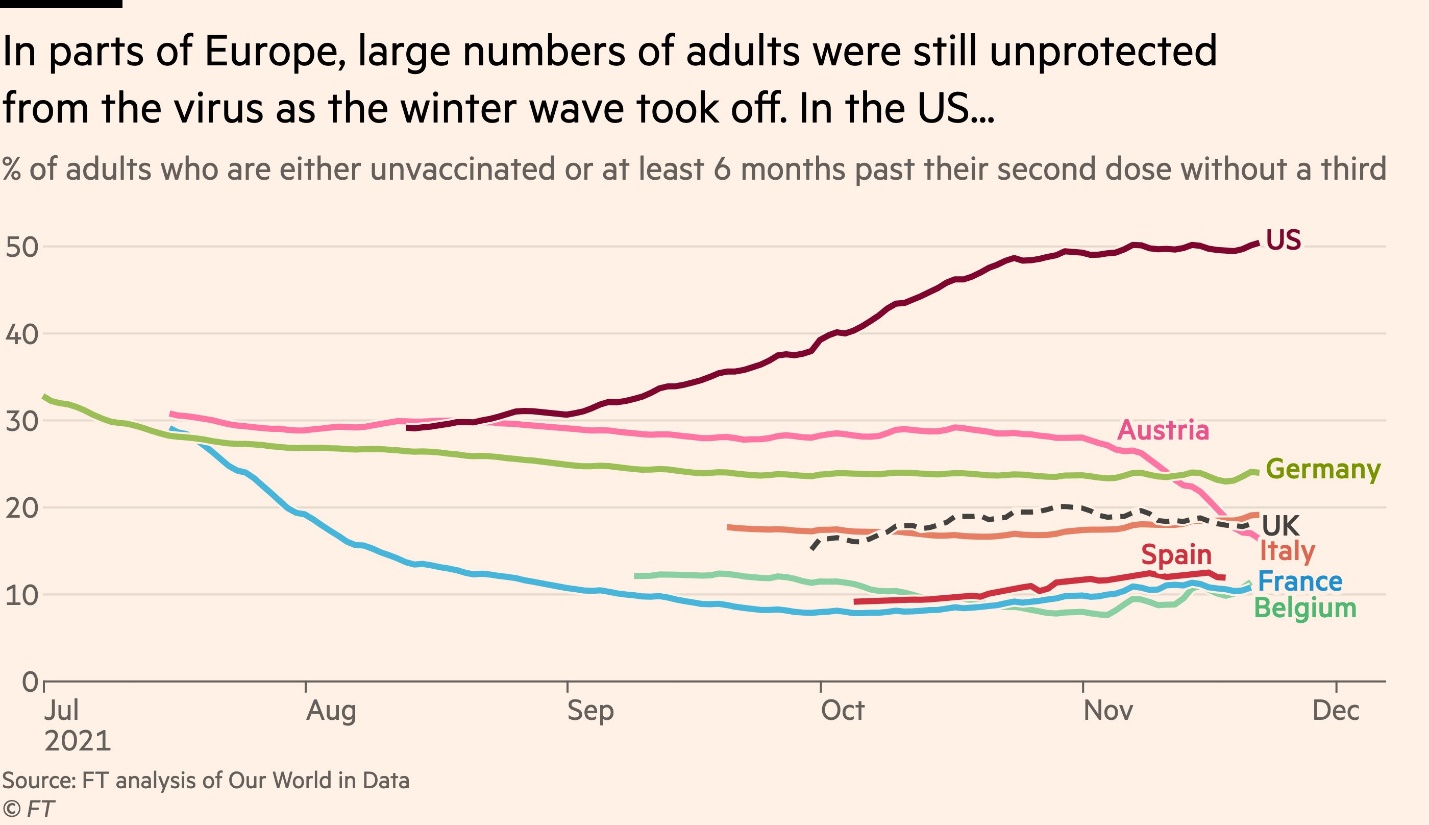
MARKET VIEWS: Omicron uncertainty combined with hawkish Powell comments has helped drive equity volatility into its 99th percentile this week. We’ve covered the news and how we think about it in our daily COVID update (latest two HERE and HERE). ~50% of adults in the U.S. are either unvaccinated or have not had a booster, so if Omicron variant has an extremely high R0 (reports yesterday indicated that the R0 was high, which is what started the move lower in risk assets), it becomes critical that severity remains low. Early indications are that is the case. Bottom line, a new dominate COVID strain that has lower severity and some vaccine protection would ultimately be positive. The path to figure that out though will be bumpy even if it’s true. And if turns out that severity is high, we have significant downside economic risk. The later scenario leads to tighter lockdowns, other negative externalities etc., That is what investors are grappling with just as books are closing down for the year.
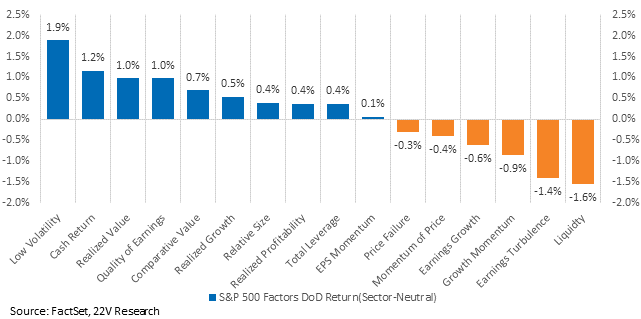
The uncertainty mentioned above helps explain why safety factors continue to outperform and anything with high earnings turbulence, high volatility and low liquidity is underperforming. Value actually outperformed yesterday, despite lower 10yr yields, because yesterday was about de-risking some of the winners (taking down gross exposure).
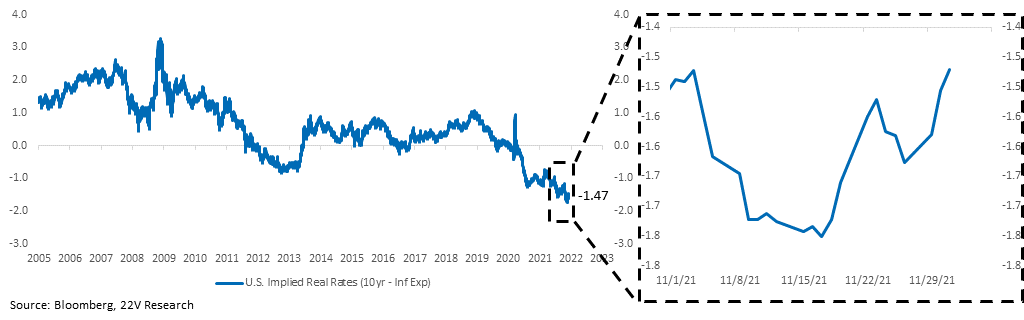
People are wondering why Tech and Growth have come under pressure despite the decline in 10yr yields. A couple of things to keep in mind as to why this happened. First and foremost, the combination of Powell’s hawkish pivot and uncertainty related to Omicron has taken out the right tail risk of inflation. The inflation expectations curve has shifted lower.
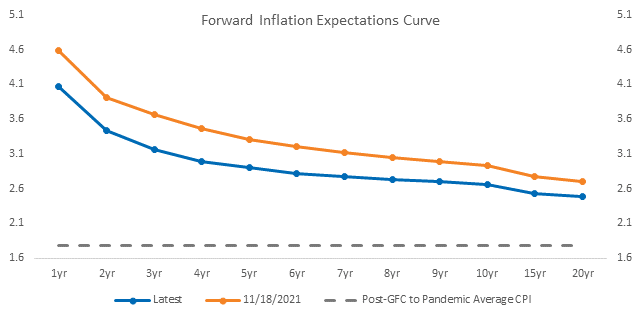
Inflation expectation have shifted lower at a faster pace than 10yr yields. So implied real yields have actually moved higher over the past few days. The absolute level of implied real yields are extremely low, but they have moved up. That’s the first point.
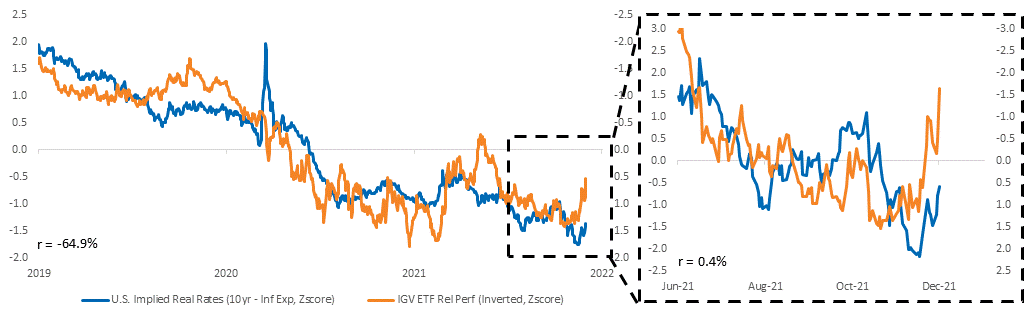
Second, over the past six months the correlation between the IGV software ETF and implied real yields have collapsed. Generally speaking, lower implied real rates = software outperformance. But the correlation has broken down. Something else is going on.
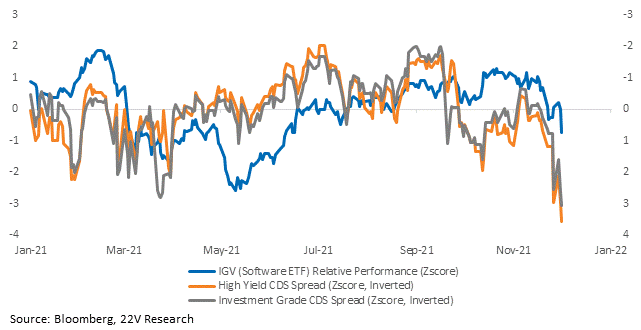
Credit is the issue. The software ETF has been highly correlated to changes in credit spreads. During the delta wave this past summer, credit spreads tightened the entire summer. CDX spreads on IG and HY debt made new lows. Fast forward to today, and the move wider in CDX spreads has been much more aggressive. This is what people are missing when thinking about how Growth factors and Software is reacting to moves in 10yr yields and lower inflation expectations. The odds of a large problem for the economy have gone up (hawkish pivot + Omicrom), which leads to wider credit spreads than previous waves (the Fed was max dovish in previous waves) and encourages de-risking.
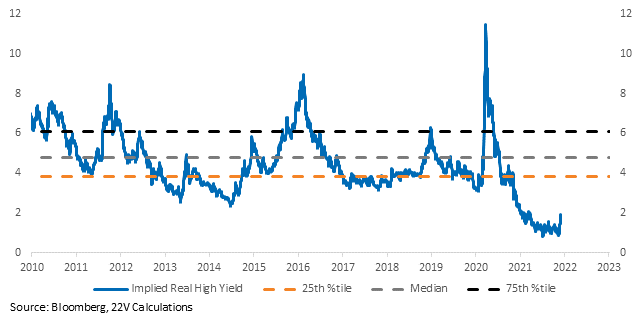
Fortunately, under just about all scenarios that don’t involve a major COVID problem, real HY implied yields will be very low and encourage risk taking again. So many of the quality software names that have come under pressure will be fine. The unprofitable Tech names (ARKK in particular) is a different story. They are in trouble.
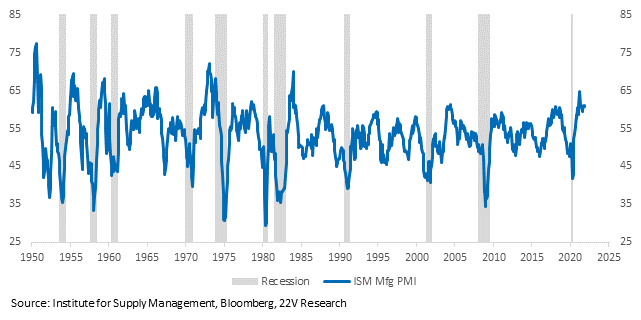
FUNDAMENTALS LIMIT DOWNSIDE: The national PMI increased m/m and regionals have slowed some. As Gerard noted yesterday “Purchasing managers are reporting that the level of inventories among their customers are much too low. This suggests that a further acceleration of inventory accumulation is extremely likely.” It is important to remember that the typical path of the ISM is not peak to trough. Between most recessionary periods there are multiple +50 peaks.
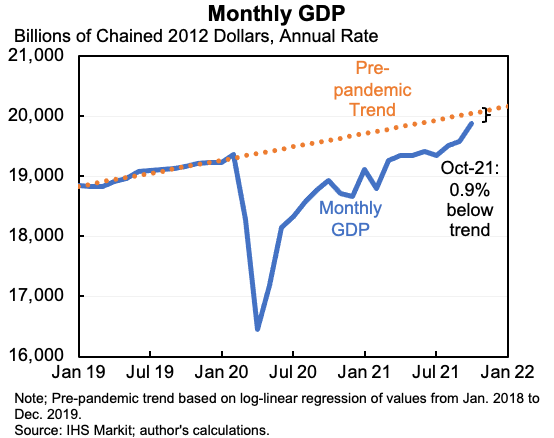
Near term growth is shaping up to be unusually strong despite supply chain bottlenecks and omicron. As Jason Furman pointed out yesterday on Twitter, “According to IHS Markit real GDP was up 1.5% in October, a blistering pace for a single month, bringing it close to trend. Even if no growth in Nov and Dec the quarter would still be 8.4% (annual rate).” As he also pointed out, monthly GDP readings indicate growth continued to accelerate even after the Delta variant wave. Overall economic activity is almost back to its pre-pandemic trend.
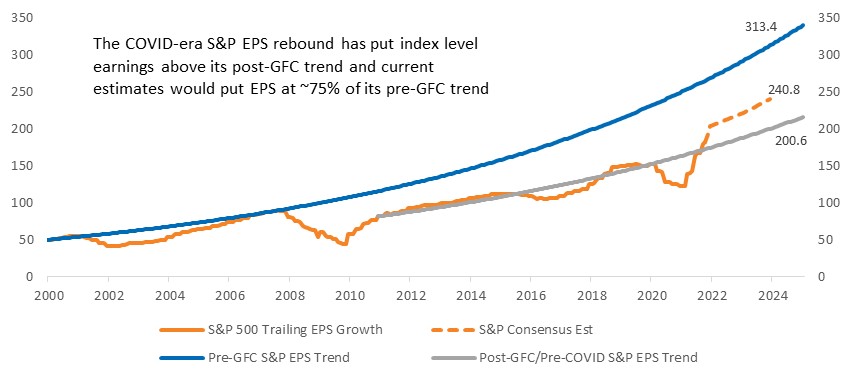
As we have noted in the past, that is consistent with the rapid rebound in corporate profitability. S&P earnings are modestly above their pre-pandemic trend. If consensus estimates for the next few years prove accurate (2021 = $204, ‘22=$220, ‘23=$240). Macro volatility will remain a headwind for equities and risk assets in general, likely leaving the level of volatility higher that investors have been used to in the post-GFC era, but with a stronger fundamental backdrop.
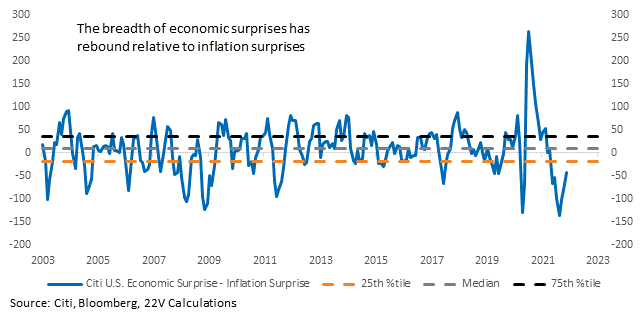
FYI…the growth relative to inflation mix is improving. This won’t matter today, but it is an important positive for sentiment over the coming months.