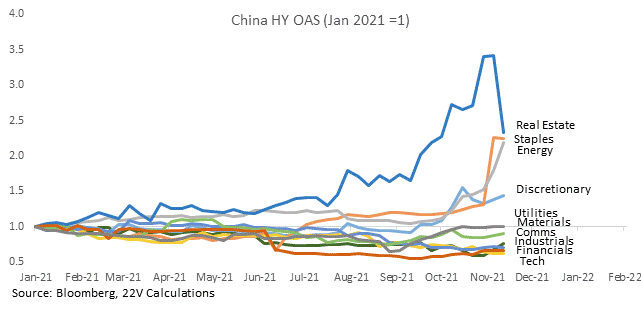
SUMMARY: China’s industrial production and retail sales both beat expectations despite the latest COVID outbreaks, a power crunch, property sector strains. China high yield credit spreads have declined. Sector-level analysis shows credit spreads have tightened within Real Estate but are still wider within Staples, Energy, and Discretionary. Not out of the woods, although better-than-expected data is still a positive.
Yesterday, we covered why real wage growth, wealth effects, and household income and spending intentions indicate continued consumer strength despite poor sentiment readings. The Chicago Fed releases weekly retail sales based on high frequency data (called CARTS), which is rolled up into an estimate of retail sales ex autos, currently at +2.6%. Consensus estimates are for +1%. CARTS has been a consistently better estimate of retail sales than. Plus, consumer credit data from the NY Fed shows credit utilization is exceptionally low. The tailwind from consumer spending is sustainable.
Macro headwinds remains many and volatile (inflation/supply chain issues, central bank policy, COVID, etc.) but have done little to stand in the way of further fundamental gains. S&P earnings have grown consistently and significantly faster than expected. 2021 EPS are on track to reach a new all-time high of $203. At the start of the year S&P EPS were forecast to reach $164.6, meaning actual earnings are $38 or 23.3%, stronger than analysts expected at the start of the year. Strong revenue and margins are responsible for almost all of the 25% S&P gain in ’21. This has been a fundamentally driven market.
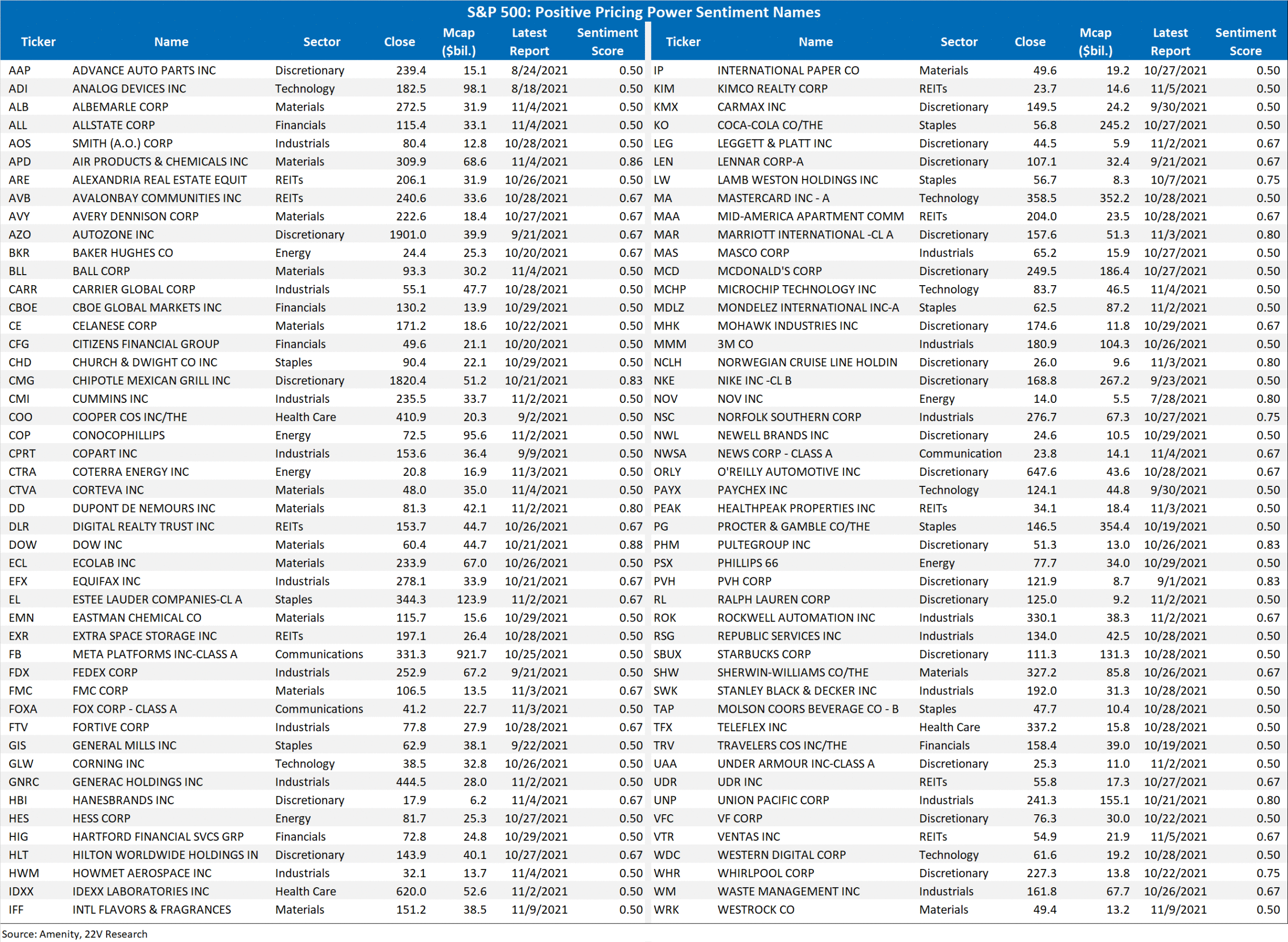
As we noted in a Quant report this morning, the path for ongoing strong profitability is not easy with supply chain headwinds, labor shortages and rising wages threatening to derail margins. Top line growth remains firm, insulating earnings, but deterioration in margin commentary (forward looking) sentiment in 3Q is a clear sign management is worried about the profit outlook. In the full report, we detail a portfolio of stocks where management expressed the most positive sentiment about pricing power as of the end of 3Q. Companies where management is most confident about pricing is a good place to look for names that will get through the coming rough patch.
MARKET VIEWS: China’s industrial production and retail sales both beat expectations despite the latest COVID outbreak, power crunch, and strain on the property sector. The COVID outbreak and China’s zero-COVID policies have generated headlines over the past few weeks. Since China’s data is notoriously opaque, we have been relying on Oxford’s stringency indices to gauge the severity of China’s lockdowns, which have increased but are below levels of the previous waves. China high yield credit spreads have narrowed. Sector-level analysis shows credit spreads have tightened within Real Estate but are still wide within Staples, Energy, and Discretionary. Not out of the woods, although better-than-expected data is still a positive.
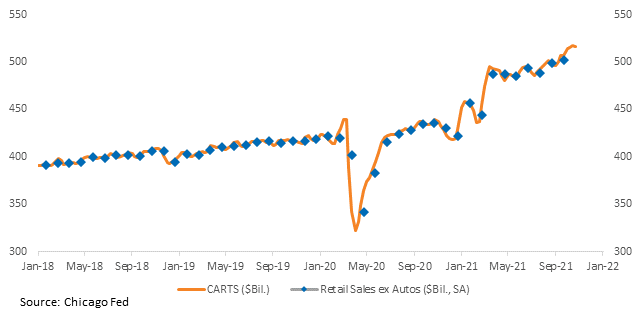
Yesterday, we covered why real wage growth, wealth effects, and household income and spending intentions indicate continued consumer strength despite poor sentiment readings. The Chicago Fed releases weekly retail sales based on high frequency data (called CARTS). The Weekly Index of Retail Trade decreased 0.1% after increasing 0.4% in the previous week. CARTS is rolled up into an estimate of retail sales ex-autos, currently at +2.6%. Consensus estimates are for +1%. CARTS has been a consistently better estimate of retail sales than consensus. Poor consumer sentiment and concerns about inflation have not resulted in poor consumption.
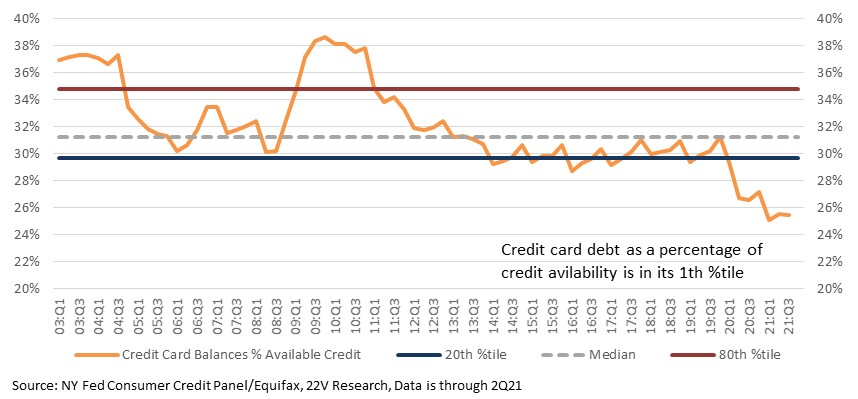
Consumer credit data from the NY Fed shows credit utilization is exceptionally low. So, spending has been strong but not at the expense of stretched credit utilization. The tailwind from consumer spending is sustainable.

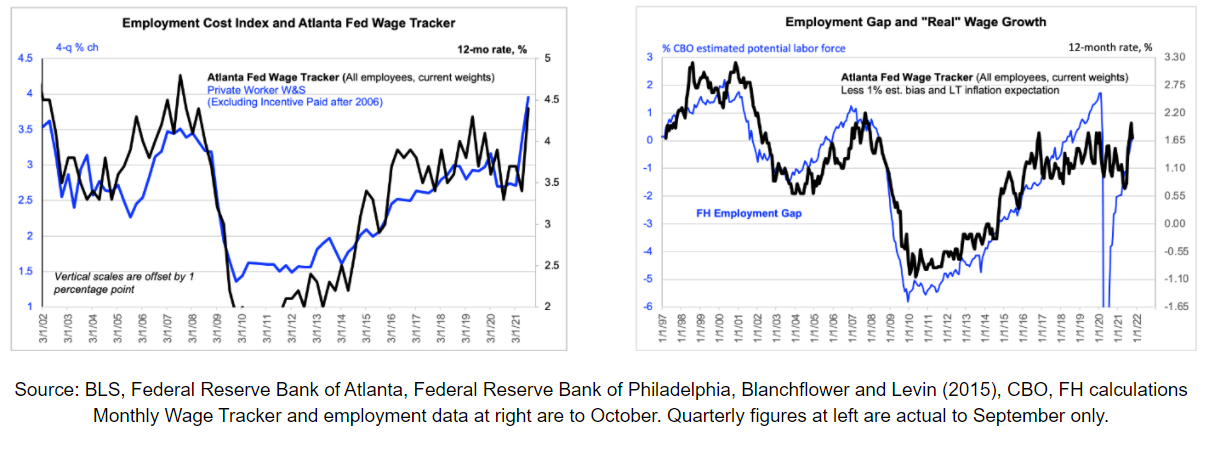
Wage growth is still positive. Per Gerard, “…nominal wage growth looks slightly less perky, and the real wage growth is a tad less perky still because longer-term inflation expectations have nudged ever so slightly higher. This is not a scene changer, but one disinflationary – or at least not incrementally inflationary – print after a string of indicators that had pointed in the same direction.”
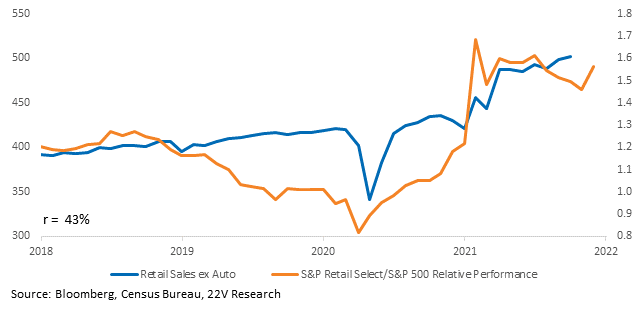
XRT, the retail ETF, has outperformed recently. We like the group as retail sales continues to expand faster-than-expected, supported by all we discussed yesterday and above.
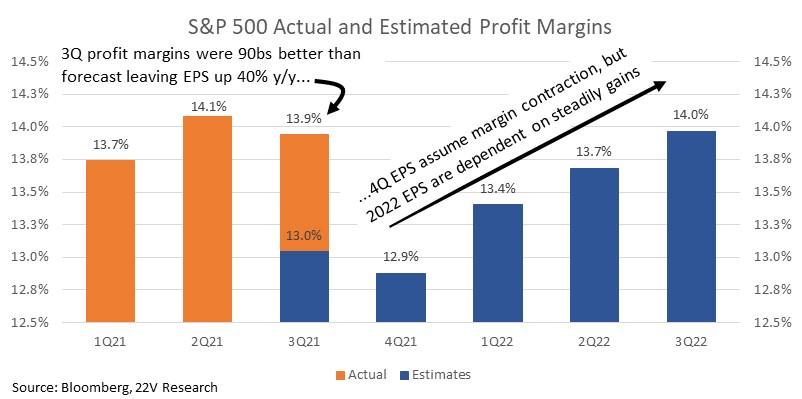
PRICING POWER PORTFOLIO: Macro headwinds remains many and volatile (inflation/supply chain issues, central bank policy, COVID, etc.) but have done little to stand in the way of further fundamental gains. S&P earnings have grown consistently and significantly faster than expected. 2021 EPS are on track to reach a new all-time high of $203. At the start of the year S&P EPS were forecast to reach $164.6, meaning actual earnings are $38 or 23.3%, stronger than analysts expected at the start of the year. Strong revenue and margins are most of the reason the market is up nearly 25% this year. Looking forward, analysts expect profitability to dip in 4Q, but rebound over the course of ’22, pushing index EPS to $219 (we are looking for $220 with an upward bias).
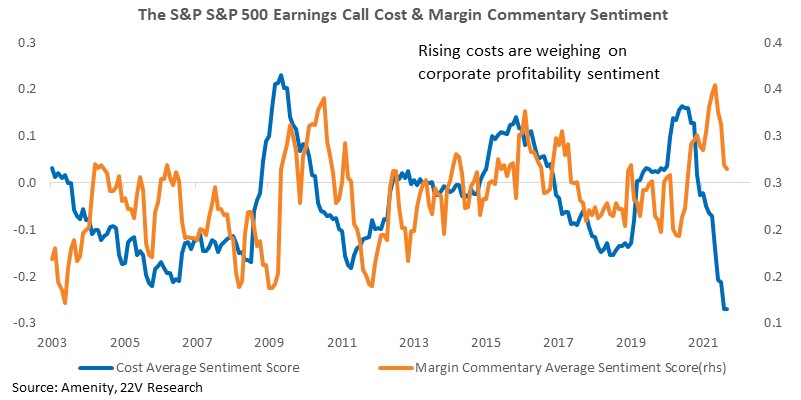
As we noted in a Quant report this morning, the path for ongoing strong profitability is not an easy one. At the company and industry level, supply chain headwinds, labor shortages and rising wages threaten to derail margins. Top line growth remains firm, insulating earnings, but the deterioration in margin commentary (forward looking) sentiment expressed during 3Q earnings conference calls is a clear sign that company managers are increasingly worried about the profit outlook.
As we have shown, companies that missed earnings during 3Q reporting season saw much greater than normal underperformance. One way to reduce of the risk of earnings-miss driven blow-ups is to focus on our Pricing Power portfolio, which contains stocks where management expressed the most positive sentiment about pricing as of the end of 3Q. Below are the constituents of that portfolio. Though supply chain issues appear to be easing they will remain a headwind for a few quarters and companies where management is most confident about pricing is a good place to look for names that will get through the coming rough patch.