The outlook for the enactment of some Democrats’ healthcare priorities remains positive despite yesterday’s setback in the House Energy and Commerce Committee. Congressional Democrats plan to use the reconciliation process as a vehicle to lower prescription drug prices. The fiscal savings from giving Department of Health and Human Services the power to negotiate prices of prescription drugs creates an attractive offset to fund other top healthcare priorities such as the expansion of healthcare coverage and investment in scientific innovation – signature components of Bidenomics. There is both political and electoral support for these policies, making their inclusion in final reconciliation legislation likely.
The scale and scope of these Democrat priorities will remain in influx until there is a final agreement on the overall price tag of the reconciliation package (between $2.0 – $2.5 trillion, in our view). Of course, headline risk related to the underlying legislation and specific provisions will remain as complex negotiations play out and compromises are made. As we stated in our note Neither Budget nor Policy Developments Yet Surprise, September 10, we continue to believe enactment of reconciliation legislation is likely by yearend. Because reconciliation is Democrats’ only real hope to enact a prescription drug pricing plan (and pay for healthcare coverage expansion), we expect its inclusion in some form.
A brief examination of the current drug pricing debate in Congress and competing factions within the Democratic caucus inform of the likely range of drug policy outcomes.
Democrats remain in the negotiation phase for a prescription drug pricing plan, despite the failure of the subtitle to advance out of Energy and Commerce. The tight arithmetic involved for enactment was on full display as the opposition by three moderate Democrats blocked its inclusion in the Energy and Commerce Committee’s portion of the House reconciliation bill. The subtitle failed in a tied vote (29-29) as Representatives Scott Peters (D-CA), Kurt Schrader (D-OR), and Kathleen Rice (D-NY) joined their GOP colleagues to oppose it. On the other hand, the House Ways and Means Committee passed (24-19) the language from that subtitle in its reconciliation instructions. In the House of Representatives, the two committees share healthcare jurisdiction.
The math also underscores the difficulty of enacting the overall reconciliation package: House Speaker Nancy Pelosi only has a three-vote advantage and the 50/50 Senate led by Majority Leader Chuck Schumer cannot afford a single defection from his caucus. While these narrow margins allow some Democrat Members to wield outsized power in the negotiations of specific provisions such as drug pricing, we remain skeptical that any would thwart the party’s social and economic agenda in a “no” vote on the entire bill.
The current House drug pricing plan would apply to all parts of Medicare to authorize direct negotiations with drug manufacturers on the prices of some single-source drugs from a list of the most expensive commonly used drugs, including insulin. The list would comprise of 125 drugs that account for the greatest Medicare spending and 125 that account for the greatest national spending. The negotiated price would be linked to an international reference price (not to exceed the 120% average price in Australia, Canada, France, Germany, Japan, and the United Kingdom). Among its other provisions are penalties for drug manufacturers who increase prices faster than inflation and an excise tax of up to 95% for drugmakers if negotiations fail. Previous scoring of a similar bill by the Congressional Budget Office, estimated the fiscal savings at $456 billion over ten years.
House progressives and centrists are at the extremes of the drug pricing debate within the caucus. Progressives want to expand further the number of drugs on the list and provide tougher penalties for those who do not comply with the negotiation requirements. Centrists like Peters and Schrader want a much narrower approach. Their plan among other things would limit drug price negotiations to only Medicare Part B (drugs administered by doctors in the hospitals) and exclude the international reference price. Notably, Peters has voiced strong opposition to the inclusion of the international reference price, despite having voted in support of healthcare legislation in 2019 and 2020 that included a similar provision.
Meanwhile, the Senate has yet to weigh in with a drug pricing provision for the reconciliation bill. Finance Committee Chairman Ron Wyden indicated this week that he is working on a bipartisan provision that would include power for Medicare to negotiate prices and could pass both the House and Senate. He indicated that the House Democrats’ favored plan did not have the votes to pass the Senate.
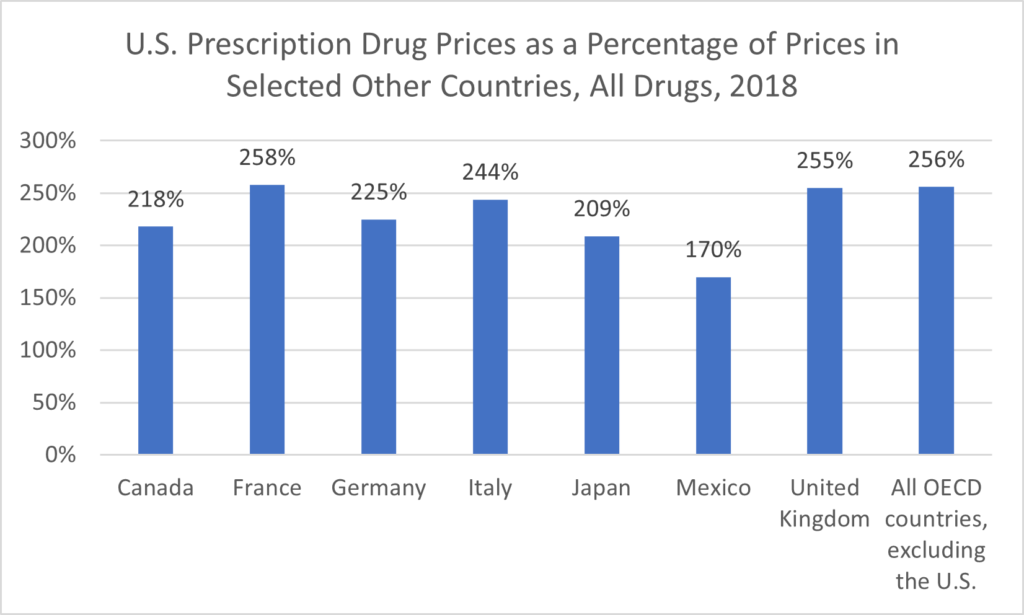
President Biden has made lower prescription drug prices a top priority. On September 9, the administration released its blueprint for lowering prescription drug prices in a report to its newly-formed White House Competition Council. While the president’s plan is broader in scope than legislation under consideration, the report supports the key provisions of House Democrats’ signature bill. The administration used the accompanying graph in its report to argue that Americans pays about 2.56 times more than other countries for prescription drugs. Additionally, the report outlines administrative measures under consideration to reduce drug prices through improved market competition and investment in scientific innovation.
Electoral politics bolster our view for inclusion of a lower drug pricing provision. Congressional Democrats will want a big political healthcare win ahead of the 2022 midterms. Such policies tend to become more bipartisan as Election Day approaches. As currently drafted, the House bill would give Medicare negotiation authority over 250 drugs and insulin that would be effective in 2025 for at least 25 drugs and at least 50 drugs in subsequent years.
However determined Democrats are to demonstrate support for greater access and lower healthcare costs, this will not mitigate all headline risks as stakeholders negotiate their positions in committee and the media. Importantly, Democrats need the provision to fund their other top healthcare priorities such as an expansion of benefits provided under Medicare and the extension of Affordable Care Act subsidies.