A handful of House committees are set to complete their reconciliation instruction markups today. Notably, the Ways and Means Committee rolled out its agency program agenda before it turns to tax reform next week. The 13 House committees required to do so hope to complete this phase of action by September 15 to facilitate floor action by September 27 on budget reconciliation and infrastructure. The 12 ‘reconciled’ Senate committees also are working to meet the mid-September date.
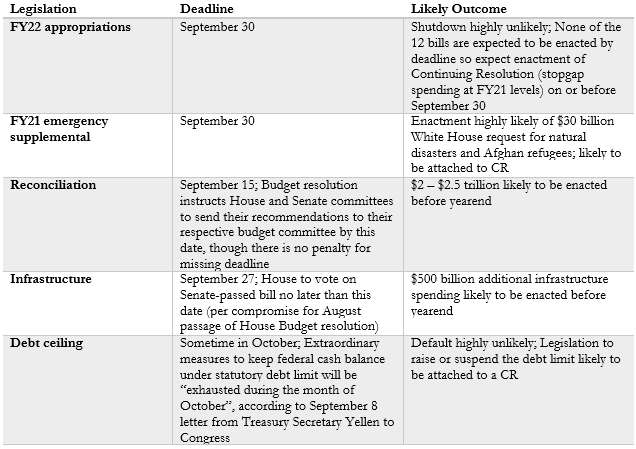
The following table tracks the five fiscal tasks Washington will consider between now and yearend. Three are relatively routine as are the politics surrounding each. Two are extraordinary. The deep downside realties and political folly of default continue to make that the least likely outcome of the debt limit discussion, so we’ll call it routine until events necessitate a different point of view. The other two routine chores are FY22 appropriations and a FY21 supplemental emergency spending bill for natural disasters and Afghanistan refugees.
The extraordinary items are President Biden’s fiscal stimulus (reconciliation) and the Senate-passed infrastructure bill. Each is a signature of his broader agenda hence the extraordinary designation by us. Votes seem to be there for both for different but elated reasons: the politics of each satisfies policy objectives. Nineteen GOP senators supported the infrastructure package for any number of reasons including a long list of deferred or hoped-for projects at home. Reconciliation rules helped five of the last six presidents push through signature fiscal proposals; we have not yet seen anything that would block Biden from being added to the list. We will update the chart weekly until all five have been completed.
The Congressional Budget Office earlier this week published a rack up of the December 2020 and March 2021 laws enacted to combat the pandemic. As the status of US economic growth gains attention, it’s worth mentioning that many federal programs spend out slower than others. Some of what has been enacted will hit the economy over the next two years.
If the president’s major budget agenda is enacted this year, some of those monies will spend out over the coming four years. For example, federal pandemic outlays and Democrats’ human capital investment plans imply stimulative impulse for years to come. Importantly, $400 billion was appropriated to state and local governments in the American Rescue Plan of last March. Half of that is not slated for release until next spring. For context, according to the CBO, it took ten quarters for states to spend 90% of 2009 recovery money. As we know from that period, states sat on federal appropriations to bolsters their books and keep muni bond analysts at bay. That cushion proved helpful, and it might again if demand slows next quarter and into next year.
Policy mistakes happen all the time; magnitude and timing usually are the dominant factors influencing politics. On this point, proponents of Biden’s agenda will be less affected by the views of politicians, particularly opponents, than results. A member of Congress’s macroeconomics opinion matters less to most presidents than Federal Reserve officials, trusted academics, market participants, and the staff at the Council of Economic Advisors and National Economic Council.
Over the longer run political results matter to the extent a policy agenda proves both popular and effective, most often measured by subsequent midterm elections and later a president’s re-election campaign. But before 2024, in this case, measurable economic results and overriding outlook will have a serious effect on politics.
Process is important. Few congressional activities are subject to written rules, statute, and Article I prescriptions as fiscal policy. First-term presidents with a congressional majority usually enjoy early support for their agenda, particularly budgets. House and Senate committee FY22 plans include very little not requested by President Biden, although Congress under all circumstances modifys presidential requests with discernible policy tweaks or favors for supporters. Nothing in the past month deviates from this path.
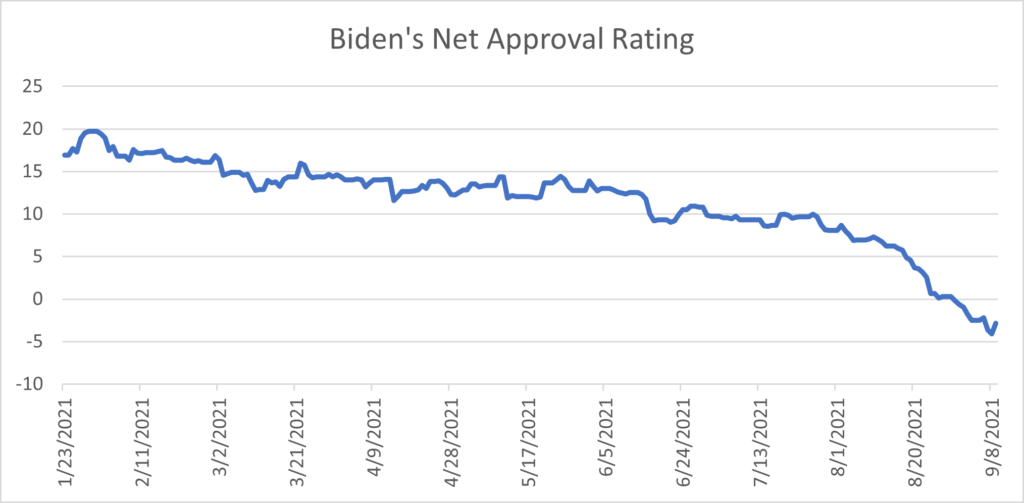
What changed meaningfully this summer is Biden’s approval rating which remains a net single digit negative in publicly available polls. This hard turn south emboldens political adversaries, may complicate the president’s 2022 non-fiscal agenda, but is unlikely to jeopardize enactment of significant stimulus next quarter ($2.5 – $3 trillion combining infrastructure and reconciliation). If we’re correct, that money will spend out over the coming four or five years in the main. Joined with the $5 trillion enacted between March 2020 and March 2021, federal fiscal stimulus will be an element of US economics through 2024 irrespective of when and how the Fed tightens.
If gloomier case factors emerge about the pandemic and its global economic drag, the mix of fast and slower spending 2021 stimulus could be a blessing. Of course, if Democrats’ human capital investment signals don’t help sustain recent increases in private capital expenditures, Washington will be confronted with increasingly uglier choices of how to promote and protect economic recovery – all while potentially dealing with a pandemic wreaking more damage than most people wanted or ever imagined.