
The House Ways and Means Committee tax proposals to fulfill its FY22 budget reconciliation instructions contain interesting changes which for the most part are consistent with President Biden’s request and a Senate Finance Committee staff list of 25 items for members consideration (see our September 7 note). The Joint Tax Committee scores Chairman Neal’s plan as raising $2.1 trillion and spending $1.3 trillion over ten years.
The committee is set to continue marking up the bill today and tomorrow in order to meet a September 15 deadline. We would expect the $800 billion difference will be used during further House negotiations, possibly pushing the final House reconciliation number to $2 trillion. All of which confirms that to date, despite a slim congressional majority, competing demands by individual Democrats haven’t dislodged fiscal policy unity. We continue to expect a final reconciliation bill in the $2 – $2.5 trillion range.
The White House, and Democrats in the Senate and House are aligned to get the bulk of their new revenues from corporate tax provisions both domestic and international, high-earners both in the form of income and investment taxation, closing loopholes used by high-earners and businesses, and increasing IRS’s ability to enforce compliance. Most of that money would be used to ease tax and other financial burdens on working families and taxpayers making less than $400,000 annually. It’s a form of fiscal realignment that captures reasonable demands of progressives while remaining reasonably acceptable to moderate and conservative Democrats.
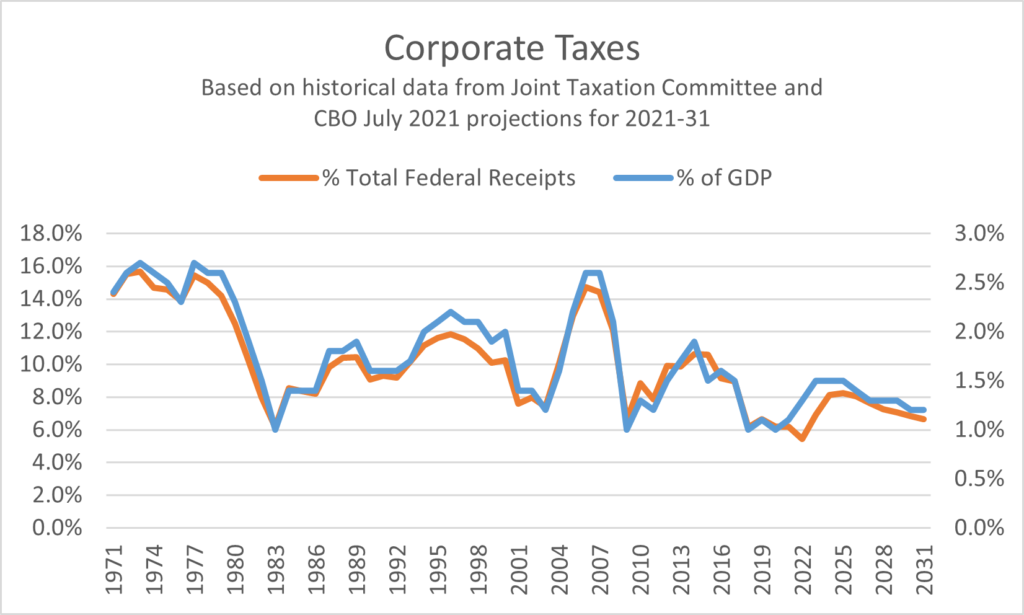
We are of the view that corporate tax policy has morphed into exactly what the business community and many tax writers claim not to favor, a lack of predictability. That said, corporate taxation has been the third largest source of federal revenues when measured as a share of GDP and overall annual revenues. Democrats’ plans wouldn’t change this ranking. While it’s true reconciliation rules give disproportionate leverage to Senate majorities, the first session of the 117th Congress affords sway to all Democrats and Independents at this stage of the process only because nearly every one of those votes will be needed. We get plenty of questions about Senator Manchin of West Virginia, but his vocalization of preferences and discomforts does not mean he is the only senator Majority Leader Schumer has to cajole and convince. The same is true for House of Representatives Speaker Pelosi.
We are unaware of any Democrat or Independent currently serving in Congress positioning themselves to defeat President Biden’s economic plan. If we are not missing a renegade movement, congressional leaders, White House officials, and their staffs understand lots of overlapping negotiations will occupy most of their time from now until the end of this year. Negotiating an endgame, smoothly or otherwise, is a much better task than creating a unifying program and then negotiating it to a finish line.
President Biden’s economic program is sufficiently transformative and broad to attract enough votes to pass – barely – in a form he would be inclined to sign. Democrats’ unity on fiscal policy and politics is an advantage for the president. The weight of failure rests on any Democrat finding reason to vote against the eventual bicameral plan – that’s enormous weight. That weight is shared evenly by all Members caucusing with the Democrats. Vote count math still supports enactment of Biden’s fiscal request by late fall or early winter, including infrastructure.
Senator Manchin is one of the West Virginia senators. The other is Senator Shelly Capito who is one of the lead Republicans responsible for negotiating the bipartisan infrastructure plan pending in the House. One of their political forebearers, Robert C. Byrd, from his seats as Appropriations Committee chair and Senate majority leader steered billions of dollars over decades to numerous infrastructure programs (“every holler and hill” was the running joke). Manchin has plenty of reasons, like every member of Congress, to negotiate hard for his priorities. Killing the infrastructure deal (vocally supported by his Republican governor) or the broader stimulus package directly aimed at many of his constituents is not one.

