
Uncomplicated math is one attraction of fiscal policy. Another appealing feature of fiscal policy is its unmistakable footprint of presidential core priorities. National security policy is the other governing policy statement chief executives own. Bidenomics combines the two as transparently as any president not commanding an active hot war.
Plenty of factors define the US fiscal balance. Recession, wars, and other economic shocks, a pandemic for example, cause spending spikes. As shown in the following graph, policy decisions and economic growth most impact revenues. Tax cuts in the 1980’s, the beginning of this century, and the end of last decade show a quick response to overall revenues and deficits. The last period of US hyper-growth came during global sector liberalization and a balanced deficit reduction policy which passed Congress on a strict party line vote (the 1993 bill President Clinton signed).
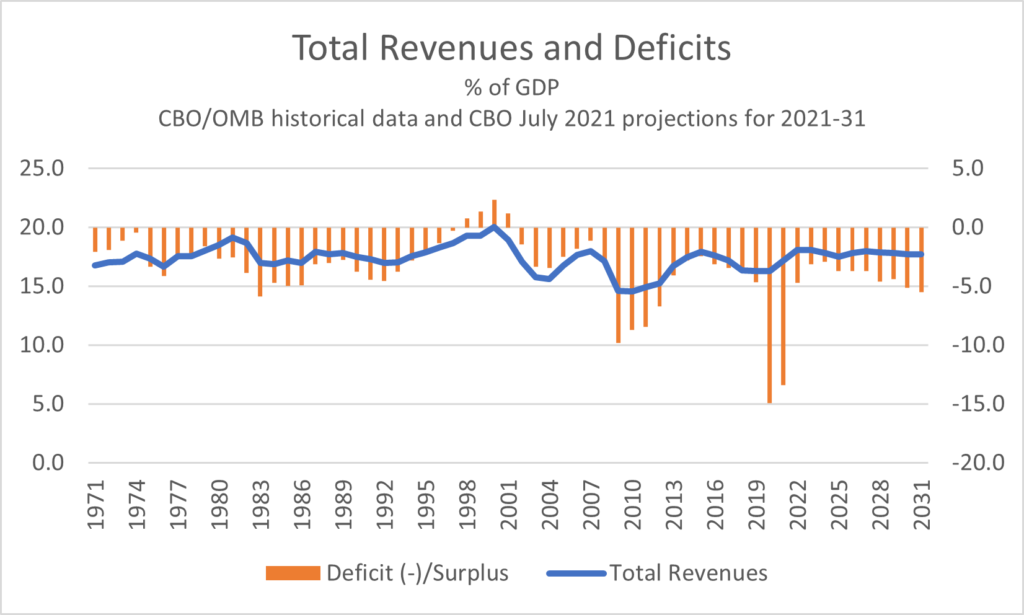
Policy is a driver of economics, but not the dominant one. That impulse comes from the hard work, innovation and risk-taking of many Americans (including workers). Except for the last five years of the last century Washington has lived beyond its means, as is exhibited in our 50-year graph. Bidenomics is an attempt to stabilize revenues and focus spending on the bottom half of Americans in hopes that these moves, along with a healthy dose of industrial policy will help produce sustainable, more broadly shared growth.
There are five not-so-easy pieces of fiscal policy between now and the end of December. FY22 budget decisions directly impact three of the five: reconciliation (which contains tax legislation), infrastructure spending as House votes on that bill have been tied to reconciliation votes, and routine appropriations for the fiscal year beginning in three weeks. The other two are a vote on FY21 supplemental spending (hurricanes, fires, and the man-made disaster, Afghanistan) and a debt limit increases or further suspension. Democrats present the spending portion of Bidenomics as investment and the revenue side of the ledger as fairness. Whether marketing or policy, it’s clear the president’s fiscal policy agenda targets change.
Last Thursday night a draft of Senate Finance Committee Democratic staff’s list of potential revenue raisers began making the rounds. The four-page document represents the widest basket of committee Democrats’ wish list. As is always the case at this stage, some of the items enjoy broad support, others are pet projects of one Member or a small group, and some appear to scratch the itch of powerful advocacy groups or political funders. The House Ways and Means Committee is going through the same process, but we haven’t yet seen that list.
There are 25 separate items, a few are related, including international, high-earner, and business tax reforms. All are aligned with the president’s budget. Some are important to policy realignment (“fairness” or “confiscation” depending on one’s perspective), some are necessary to fund Biden’s overall fiscal program, and some are both. Our read of it yields only a few items highly unlikely to make it on Democrats’ final list – carbon pricing strikes us more a second term possibility. We would put CEO disparity excise taxes as a difficult reach for a bill that will need all Senate Democrat and Independent votes and can afford to lose fewer than a handful of House Democrats. That is math not a value judgment.
Custom and the Constitution dictate that the House moves first on tax legislation. One item most Democrats embrace, and most Republicans oppose is Biden’s request to increase IRS funding. The administration wants an additional $80 billion over ten years to increase capacity to conduct and conclude sophisticated audits, to modernize a woefully deficient IRS information technology system, and to provide more examiners to help voluntary taxpayer compliance. This provision highlights the uncertainty of multi-year fiscal impact estimates. Gross and net results of policy changes are affected by human behavior – both on the front end of the estimating process and the back end of taxpayer decisions to comply or further seek avoidance of new law applications.
Both the Joint Committee on Taxation and the Congressional Budget Office devote plenty of horsepower to figuring out the annual and ultimate impact of tax code changes to the fiscal balance. CBO’s director, Phill Swagel, on September 2 published a blog exploring the possible consequences of increasing IRS funding. On June 7 this year JCT published an analysis of selected issues addressing the so-called tax gap. These nonpartisan advisors to Congress found that more money for the IRS results in more money for the Treasury. Both agree that gross and net figures change based on some assumptions about how the money is used and how taxpayers react to the changes. Each starts off a 5:1 collection ratio, meaning the agency would bring in about five additional dollars for each new dollar spent on compliance and technology spending (investments). Each organization concludes five incremental dollars would not be realized, but each also agrees the provision would raise money in the important five- and ten-year budget scoring windows. CBO estimates the provision would raise $200 billion over ten years.
The release of Senate Finance Committee staff work wasn’t a leak; it was a necessary step in that committee’s eventually voting to fulfill its FY22 reconciliation instructions. House staff are doing the same for their bosses. The tax side of Bidenomics is gaining momentum reliant on razor slim majorities in Congress, the results of which depend on several policy and political uncertainties that nonetheless are narrowing.
It’s clear that any semblance of the president’s request becoming law portends meaningful restructuring of the tax code and overall levels of annual revenues at least until another president alters Biden’s program. Politics influenced by several narratives, especially populism, point to Biden’s proposed fiscal realignment maintaining strength at least through this year.
The pandemic put sharp attention on US economic inequalities that have intensified over the past four decades, pointing to under-investment in newly acknowledged essential workers. That most of these people across the country fall into acceptable definitions of working- and middle-classes implies sufficient popular support to produce the simple math necessary to enact the tax policy component of Bidenomics.
Those thin voting margins will lead to Democrats insisting on spending and taxing levels lower than the president proposes. We think a $2 – 2.5 trillion range rather than $3.5 trillion for the final legislation is a reasonable guess. If we’re right that something will be enacted and it is closer to our range, President Biden will close out the year with a significant step toward fulfilling campaign promises to restructure fiscal policy to help combat economic disparities. Should Democrats fail on the fiscal plank, their midterm outlook darkens as would Biden’s 2024 aspirations

