
President Biden returned to the US early yesterday with his list of international accomplishments and troubles not meaningfully altered from when he departed last week. Overall, that probably isn’t concerning in the near term. There is much for investors to concern themselves with over the next year, the least of which is US politics (although that should be a worry beyond the midterms).
Biden’s return to US soil leaves all of us guessing at whether his Southeast Asian foray both improves US standing in the region and further erodes the once Oz-like aura of Chinese regional influence. Moreover, it is unclear whether all that can be accomplished absent any direct congressional involvement. On the last point, the Biden team (many of whom were on earlier Clinton and Obama teams) surely believes that the Trans-Pacific Partnership (TPP) was a sensible way to achieve those dual objectives. But a generally uninvested Congress contributed to the mistaken ease with which Obama’s successor turned away from that deal, handing Beijing a victory it hadn’t earned.
This theme of under-investment to a point of self-detriment is an undercurrent of re-globalization. Treasury Secretary Yellen’s oft-referenced “friends-shoring” mixes economics and geopolitics. The global search for more supply chain resiliency certainly has been informed by the invasion of Ukraine in terms of self-sufficiency when possible. But more important is the ability to rely on trusted partners for energy, national security, food and medicine, and other basic economic and social inputs.
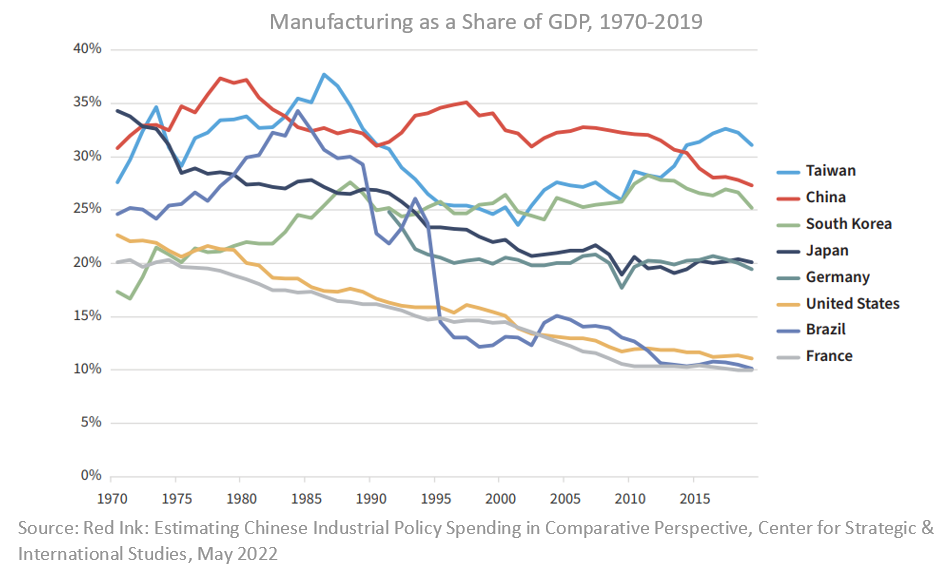
The US under-investment in domestic manufacturing is a good example of the point. The following graph borrowed from a Center for Strategic and International Studies (CSIS) assessment of US industrial policy reveals no superpower frittered away its manufacturing base more than the US in the past half century. Part of Bidenomics is informed by the pandemic-related supply chain disaster and Putin’s war by investing in America’s ability to produce. This aspect of his agenda has bipartisan support in Congress, as demonstrated by the INNOVATE Act conference committee underway.
Few continents in the past half year been untouched by targeted US economic and geopolitical outreach. Russia’s hot war has galvanized the transatlantic alliance in stunning ways compared to the policy drift that characterizes much of this century. The 15-nation Indo-Pacific Economic Framework is just that – a voluntary agreement lacking treaty status. Each of the signatories, however, would be hard pressed to explain why it doesn’t represent sovereign interest, especially compared to the TPP and its Chinese competitor the Regional Comprehensive Economic Partnership (word of which is debatable).
Next month an Americas Summit comes to Washington, DC even if a few member countries abstain. Also, this summer Biden could visit Riyadh as the administration attempts to prove its new mettle in getting the Saudis, Israelis, and Egyptians to re-open communication lines by resolving decades old land issues (baby steps matter). Prosper Africa is one of two recent initiatives to promote US public and private investment to a continent representing the best hopes and worst desires of mankind.
Any of these efforts pursued outside the protections (and hassles) of a treaty can be undone relatively easily by succeeding administrations. The only political protection is if the policies lead to practical results supported by voters and businesses. That’s a reversal of late 20th and early 21st centuries US trade policies. Biden termed it inside-out trade politics six quarters ago when his agenda was ascendant.
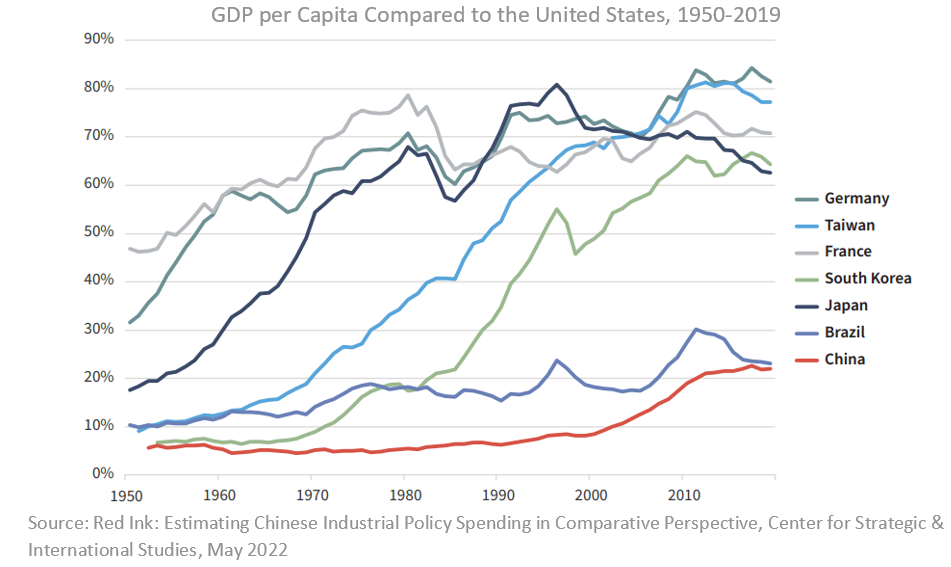
The next graph also comes from the CSIS study. Most of the world has been closing the per capita GDP gap against the US since WWII, a welcome development. The World Trade Organization (WTO) helped China mightily, but this hybrid economic model has a long way to go and current challenges won’t be as easily overcome since it and the global feel-good vibe it created cannot be replicated soon.
Countries around the world of varying governance models are confronting consequences of decisions made by current or relatively recent policymakers. Germany, France, and the US, for example, wish they could generate power from nuclear resources they either throttled back or eliminated. Ukraine expressly wishes it had not relinquished its nuclear arsenal 30 years ago. A few African nations would be better off today if their natural resources had not been given away by corrupt elected officials to companies complicit in horrific ecological outcomes. Many western companies and populations would’ve been better served if elected officials and company managers had been more present in global value chain decisions well before the pandemic. China’s list of policy mistakes the past years, including the handling of every aspect of COVID-19, begs the question of whether the communist government/quasi-market economy will survive pressing demographic and financial pressures.
Our long point is that public and private decision makers usually have an A and B agenda; the former is what one would like to accomplish, and the latter is filled with circumstances one wishes could be different. The heads of state with the largest nuclear arsenals find themselves battling the B list and hoping A list opportunities come along before they exit the stage.
US strategic challenges primarily are domestic – violent ideology, under-performing K-12 educational attainment (mainly in some public systems), and a macroeconomic policy adjustment filled with mistakes of the present and recent past. Russia and China too suffer structural challenges, arguably of at least the magnitude here in the US and likely more significant (even accounting for very different governance models). President Biden very likely cannot do much to preclude a Republican Congress next year.
We believe Biden and his team have decided the more meaningful policy and political achievements available on their B list are geopolitical, conveniently away from the Legislature. Success will depend on results, and those outcomes will have to cut through thick, often counter-productive domestic politics to endure. The salient policy question is whether these efforts can improve the lot of the bottom half of the US economic strata while demonstrably improving US trust and ability at home and abroad.

