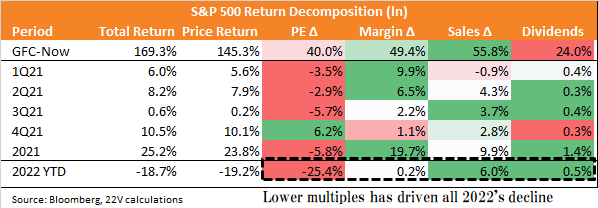
SUMMARY: Overnight news is running the gamut of investor concerns: geopolitical risk, tightening CB policy, China lockdowns, and crypto. The news isn’t groundbreaking, but illustrates an important point: fundamentals help, but can’t offset a collapse in sentiment. PEs have been a -25pp drag on the S&P this year.
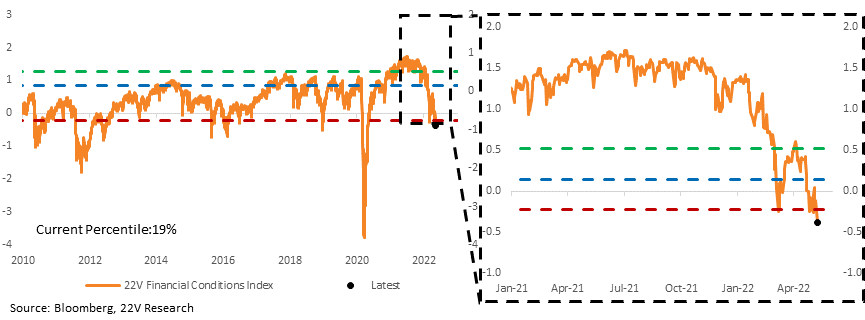
Economic growth is rolling and that should eventually lead to lower core CPI, but the worry is that we would need MORE financial conditions tightening to get those sticky parts (and heavily weighted parts) of core inflation toward the Fed target. Yesterday’s inflation data, taken in isolation, point to a sharper economic slowdown being needed. Value and deeper Cyclicals outperforming as 10yr yields move lower would be very unusual.
The USD is higher again, rising alongside a decline in Treasury yields. Both 2yr and 10yr yields (94th %tile w/w). The flight to safety trade is in full effect. Our high conviction call is that growth will slow. An economic growth slowdown will be associated with tighter financial conditions if activity levels don’t cool off. Right now, inflation trends are too high.
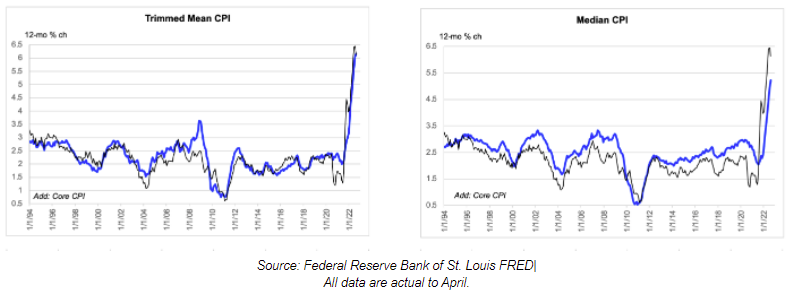
Per Gerard, discussions about peaking inflation are misleading. Trimmed mean, median, and sticky CPI metrics are all still increasing. Inflation pressures are probably still broadening. The real question is whether the coming disinflation will be steep enough to satisfy the Fed without the help of a significant weakening of the labor market, via below-trend growth. Given what we are seeing in rent inflation, probably not.
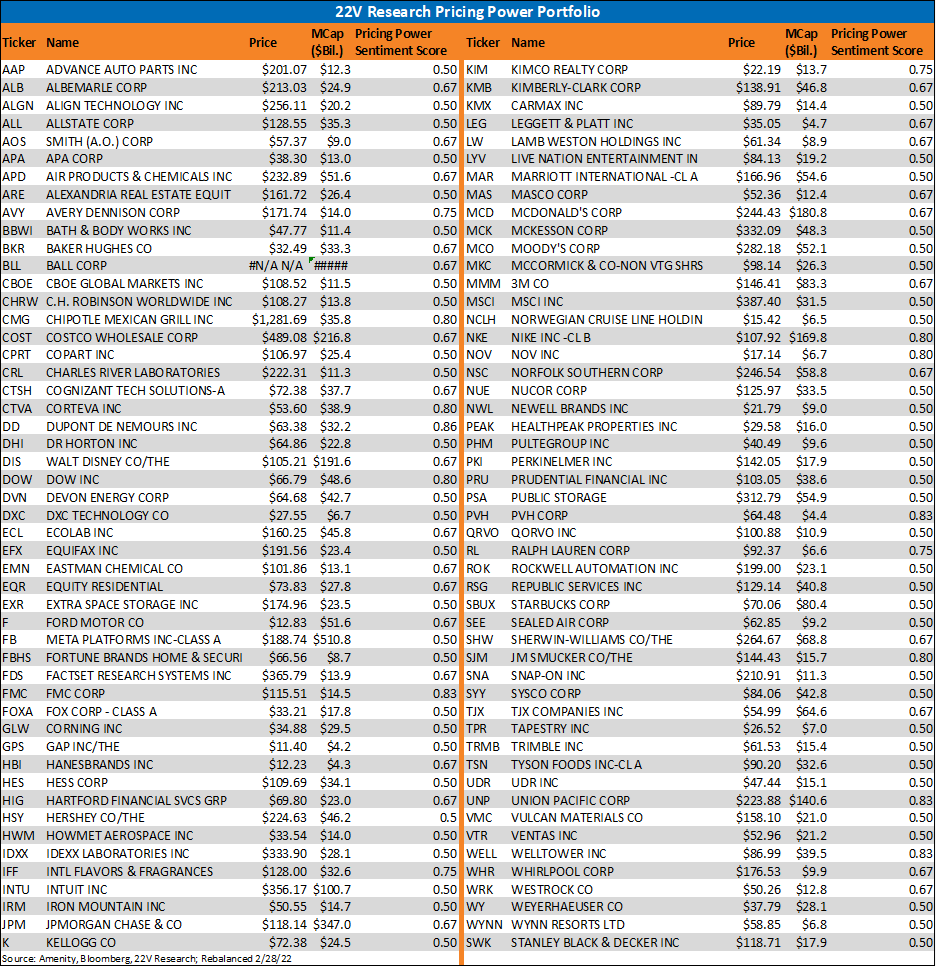
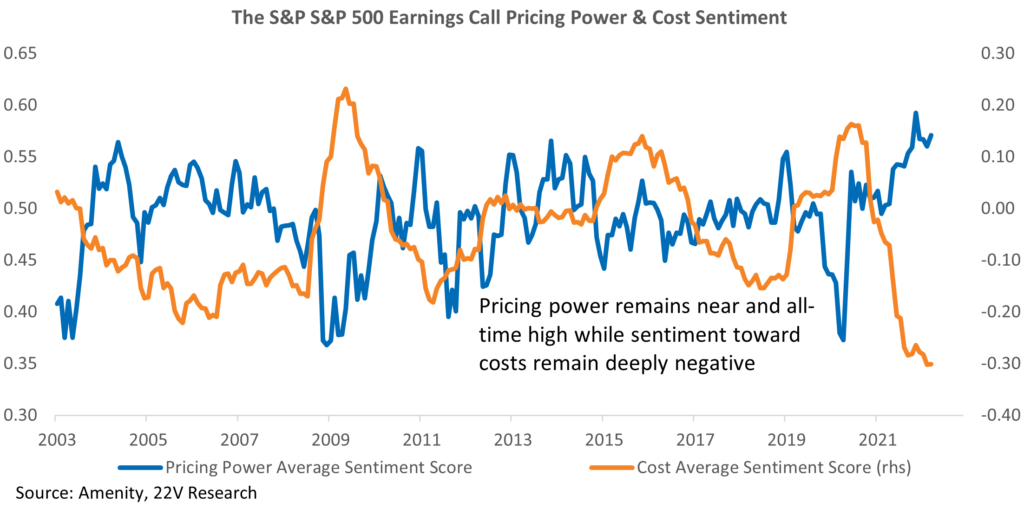
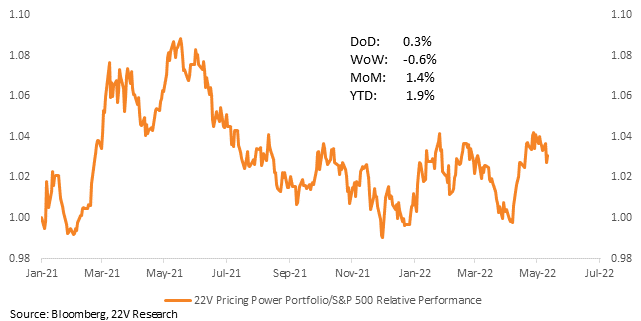
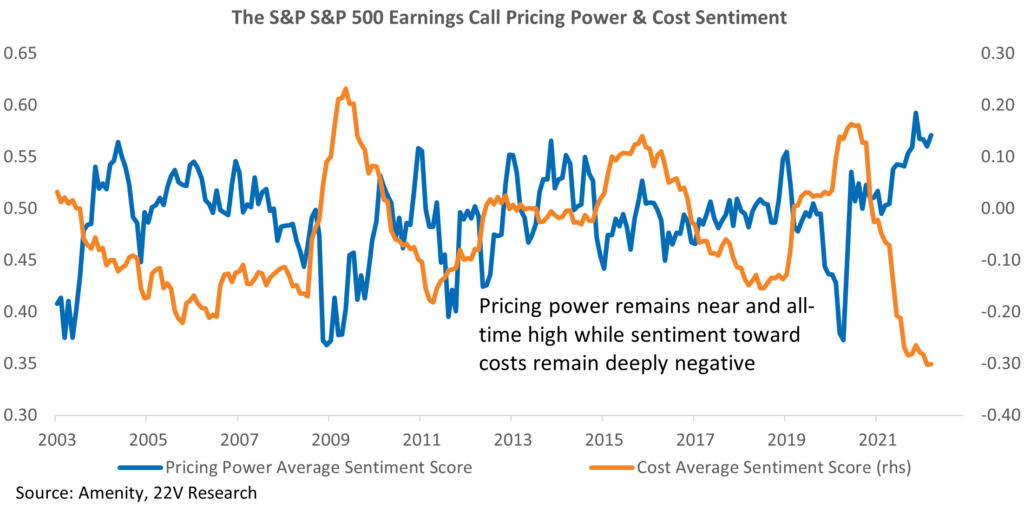
Our Pricing Power Portfolio has underperformed the S&P over the past week. Pricing power across companies is too strong – represented through inflation – and so differentiating between companies that have strong pricing power has not generated alpha (most do). Pricing power sentiment, measured using the Amenity natural language processing tool (quick primer here), was strong in 1Q. And continued strong pricing power sentiment is part of the reason to expect margins to remain elevated through 2Q EPS. That also implies the slowdown the Fed is after is being pushed to 2H22.
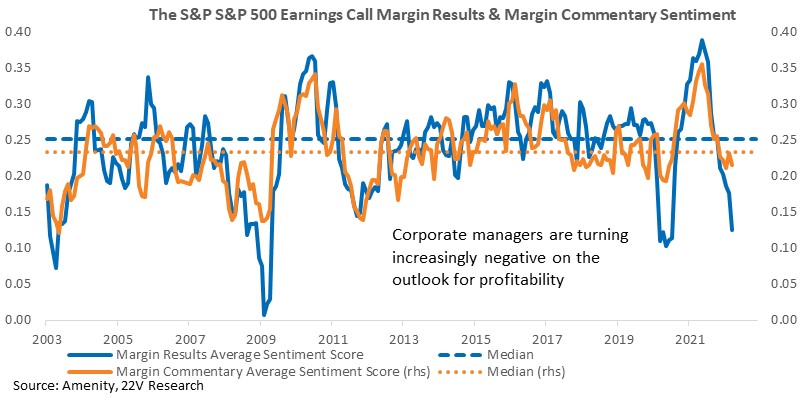
There are signs that central bank pressures are starting to impact management sentiment. Sentiment toward profitability has fallen sharply over the past year (peaked July ’21). There are divergences between sentiment and actual margins, but over time they are well correlated (43%). Margins need to fall to meet the Fed’s targets and managers are increasingly worried that profitability will move lower.
Full report below.
MARKET VIEWS: Overnight news is running the gamut of investor concerns. Geopolitical risk is heightened – Finland announced its support for a NATO application while Germany’s Economy Minister stated Russia is weaponizing energy by recently reducing natural gas supplies. The ECB is ratcheting up its tightening commentary – two ECB voters overnight discussed likely rate yikes this year. China lockdowns are not easing – Shanghai’s lockdown was extended and people in Beijing were told to limit movement. But the PBOC is prioritizing growth, guiding interest rates lower and allowing the yuan to weaken while the CCP is meeting with the private sector, possibly to unwind some crackdowns. And cryptocurrencies are tumbling. The news isn’t groundbreaking, but illustrates an important point: fundamentals help, but can’t offset a collapse in sentiment. PEs have been a -25pp drag on the S&P this year.
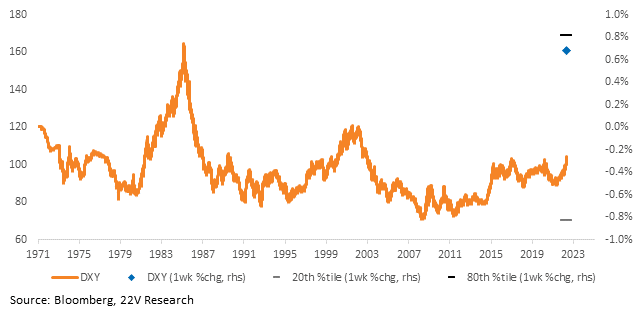
The USD is still getting a bid, but its pace of returns is slowing. The WoW return is 75th %tile, but the USD was logging consistent 90+ %tile moves in early May. The USD is already pricing in a hawkish Fed relative to other CBs, a better relative growth outlook in the U.S., and geopolitical risk. That coupled with the intensity of the Dollar run could lead to some stabilization near-term, which would provide relief to high foreign sales stocks (heavily weighted into Tech).
Per Gerard, discussions about peaking inflation are misleading. Trimmed mean, median, and sticky CPI metrics are all still increasing. Inflation pressures are probably still broadening. The real question is whether the coming disinflation will be steep enough to satisfy the Fed without the help for a significant easing of the labor market, via below-trend growth. Given what we are saying about rent inflation, probably not.
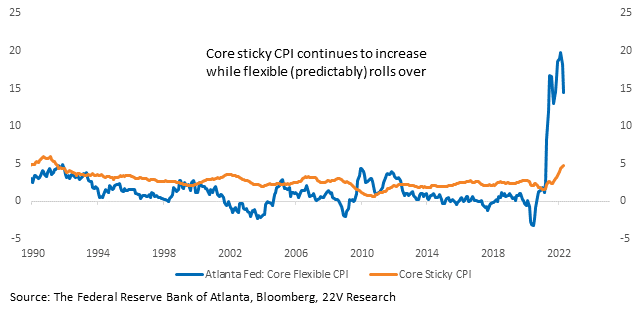
Economic growth is rolling and that should eventually lead to lower core CPI, but the worry is that we would need MORE financial conditions tightening to get those sticky parts (and heavily weighted parts) of core inflation toward the Fed target. Yesterday’s inflation data, taken in isolation, points to a sharper economic slowdown being needed.
Our Pricing Power Portfolio has underperformed the S&P over the past week. Pricing power across companies is too strong – represented through inflation – and so differentiating between companies that have strong pricing power has not generated alpha.
Pricing power sentiment, measured using the Amenity natural language processing tool, showed this into 1Q earnings season. And continued strong pricing power sentiment is part of the reason to expect margins to remain strong through 2Q EPS. Good for earnings. Bad for markets.
Strong pricing power also implies the slowdown the Fed is after is being pushed to 2H22, which, again as Gerard says, may not lead to a steep enough disinflation to put core inflation on a trend toward its target without a prolonged period of below-trend growth and heightened recession risk. Central tendencies of inflation remain VERY strong.
There are signs that central bank pressures are starting to impact management sentiment. Margins, as reported so far in 1Q (based on est comparable EPS), increased q/q to 13.4%, and are down only modestly from 2021’s 13.7% level. But management sentiment toward profitability, measured using the Amenity Natural Language Processing tool (quick primer here), has fallen sharply over about the past year (peaked in July ’21). There are divergences between sentiment and actual margins, but over time they are well correlated (43%). Margins need to fall to meet the Fed’s targets and managers are increasingly worried about margins falling.
We like this portfolio eventually because the Fed is committed to its goal. Pricing Power constituents below.