SUMMARY: Market-based rate hike expectations increased slightly yesterday, but the market rallied as Powell did not do anything to suggest financial conditions need to tighten more aggressively near term. Powell also held to the view that inflation can come down without increasing the unemployment rate. That is unlikely, but until it is more obvious unemployment needs to increase and the Fed is comfortable with that, financial conditions are likely to remain around current levels. All things equal, that provides a floor for equities near term. Especially given the deeply oversold condition, poor sentiment, and unusually high implied equity yields.
Gerard maintains the Fed may need to push the unemployment rate up to reverse above trend inflation. The Fed wants to slow growth and it seems they will get there. There is some possibility recent tightening of financial conditions and confidence impacts from the war will have a significant impact on economic growth. We just have very little idea how much of an impact and neither does the Fed. That sets up a backdrop of the rate path being stable for months/quarters until the Fed has more data to judge the growth trajectory (are they still well behind the curve or not). We will monitor inflation/inflation expectation indicators, personal consumption, and labor markets to gauge whether the Fed can afford to tighten along their current path or if more needs to be done.
Excluding war shocks, expect bond volatility to decline until the next payroll report on April 8th. Put differently, markets should face weaker headwinds, from a financial conditions point of view, between now and then. That should cause a short-term reprieve for stocks/factors that face headwinds from tightening financial conditions (Earnings Turbulence, Value, Liquidity and Cyclicals over Defensives). If it becomes obvious that growth is still too strong and inflation stubbornly high, the Fed would be forced to increase rates faster and there would be upside risk to the unemployment rate later this year. Risk-on assets would face increased headwinds again.
Powell mentioned repeatedly that containing inflation is job one. And they will slow economic growth to achieve that goal. Its just a matter of how much recession risk needs to increase in order for inflation to come down. Longer term, that is a backdrop that favors being long Quality Growth. Momentum should benefit as well.
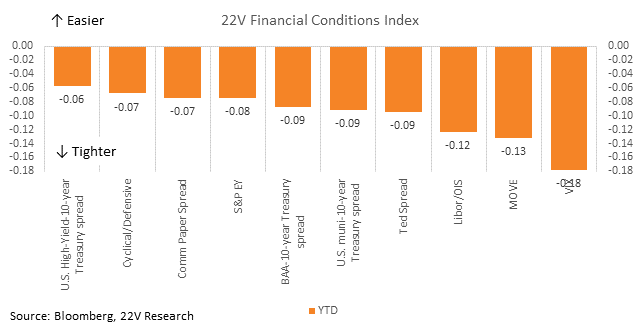
Theoretically, easier financial conditions after communicating more rate hikes (happened yesterday) should mean more rate hikes to come. The Fed may have to be more aggressive to tighten financial conditions as vol eases, but YTD spreads in bonds and money markets have contributed to tightening financial conditions as well. It’s not all equities, so all the ‘progress’ slowing the economy won’t be lost if equities recover some.

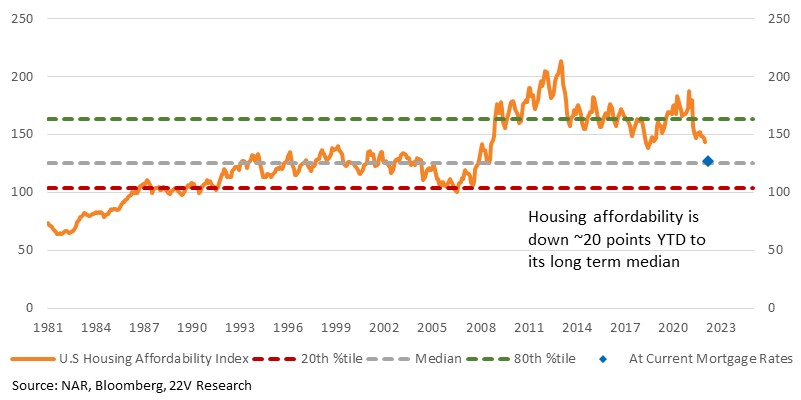
Thinking About the Impact of Tighter Financial Conditions: The absolute level of corporate borrowing costs remains low. That does not necessarily fully reflect changes in credit availability, but it will take time to see how the expected slowing of growth tied to rate hikes/war sanctions impacts credit markets. On the consumer front, housing affordability, which combines borrowing costs, incomes and homes prices, has fallen 20 points this year and is back to its long-term median. That level of affordability is not a major headwind, but it should help reduce the pace of home price appreciation and is another sign of the overall tightening of financial conditions. 30yr mortgage rates have moved significant higher recently.
We are attempting to provide some context/clarity in a world of intense noise. It is a tricky backdrop, but that is our goal. Hopefully we live up to it. Full report below…
MARKET VIEWS: Equities are lower this morning as volatile Russia-Ukraine headlines continue to capture focus. Overnight, the Kremlin played down progress made in negotiations. Lots of focus is on global central banks too; the BOE is set to raise rates today, Lagarde stressed flexibility overnight, and the Fed officially began its tightening cycle yesterday. Generally speaking, Powell was hawkish, communicating the FOMC understands the acute need to restore price stability. But his commentary, the FOMC statement, the SEP, and the dot plot weren’t far from what was already priced in. Market-based rate hike expectations did increase but the market rallied on the Fed’s the economy’s ability to digest the Fed rate hike path that is priced in.
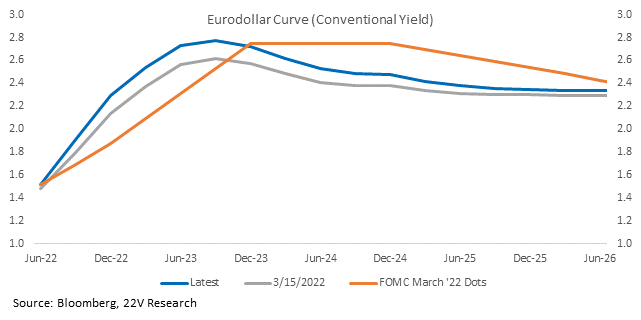
The rate path increased but financial conditions have eased over the past few days (including yesterday) as equity vol declined. Theoretically, easier financial conditions after communicating more rate hikes should mean more rate hikes to come. The Fed may have to be more aggressive to tighten financial conditions as volatility eases, but YTD spreads in bonds and money markets have contributed to tightening financial conditions as well. It’s not all equities, so all the ‘progress’ slowing the economy won’t be lost if equities recover some.
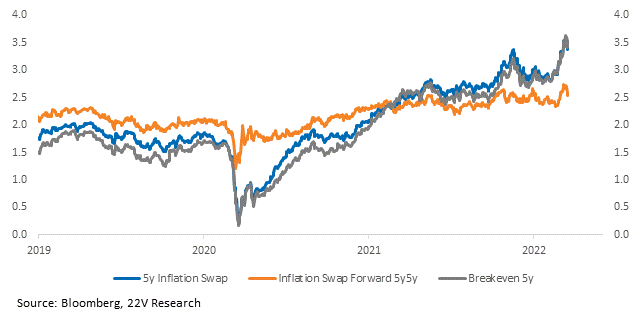
Gerard maintains the Fed may need to push the unemployment rate up to reverse above trend inflation. Certainly the Fed wants to slow growth. Financial conditions have tightened and it isn’t clear how much growth has slowed. We think the Fed is unlikely to provide a hawkish surprise before data over the coming months provides some clarity on how much growth has slowed. In other words, the rate path could be stable for months/quarters until the Fed has more data to judge the growth trajectory. Monitor inflation expectations to help gauge whether the Fed can afford to be patient.
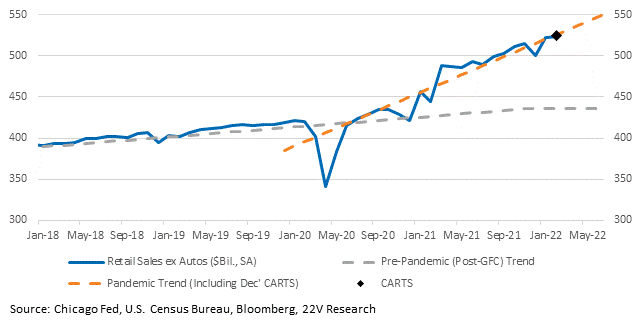
And CARTS – the Chicago Fed’s high frequency indicator of retail sales – is a good measure of activity to keep on your radar. It’s released every 2 weeks and has a good track record estimating retail sales ex autos. If CARTS indicates the post-pandemic trend of retail sales is cooling, it’s evidence the Fed can wait to tighten more.
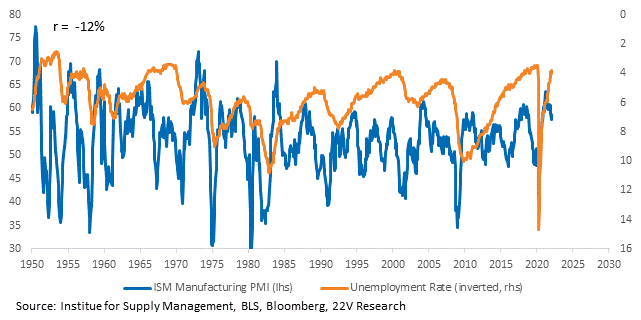
The labor market is extremely tight, and the SEP indicates the FOMC expects it to stay tight, even as growth comes in and the unemployment rate stays at 3.5%. Powell explicitly said the Fed believes it can lower inflation while sustaining jobs. Growth has slowed without a deterioration in employment in the past, but as Gerard has pointed out, soft landings are notoriously difficult to orchestrate.
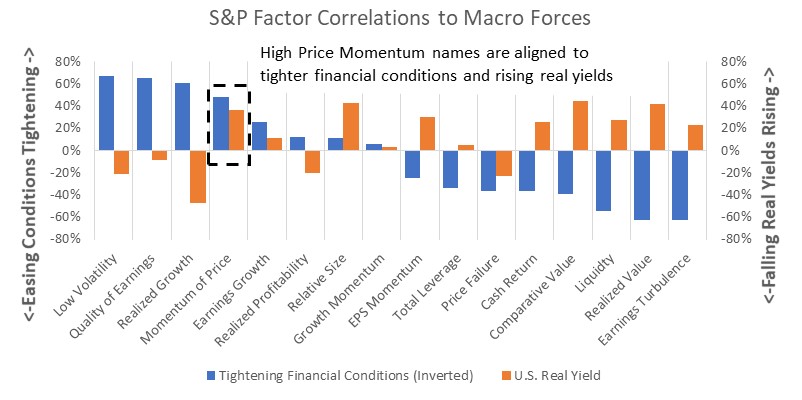
So, financial conditions might not tighten meaningfully while the Fed waits for economic data to disprove its optimist case of slowing growth without employment weakening. That should be a reprieve for stocks/factors that face headwinds from tightening financial conditions (Earnings Turbulence, Value, Liquidity). Higher real rates and yields are a prevailing theme, and stocks/factors that benefit should outperform (Momentum, Value, Cash Return). In a quant report on Friday, we highlighted that Momentum tends to perform well in both backdrops, making it an interesting addition to stock screens.
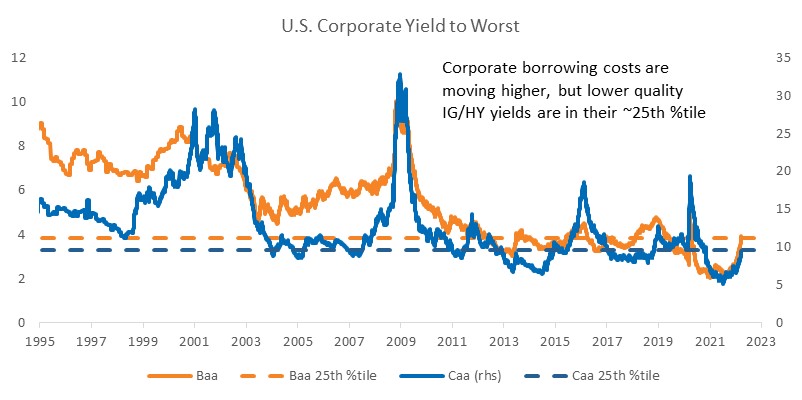
The absolute level of borrowing costs remains low across broad credit markets. Corporate borrowing costs have moved higher on Fed tightening signaling and growth uncertainty tied to the war in Ukraine. Even with their recent back up though, Baa and Caa yields are around their 25th %tiles historically. At the margin, credit costs have moved higher, but the level of financing costs are low. That does not necessarily fully reflect changes in credit availability, but it will take time to see how the expected slowing of growth tied to rate hikes/war sanctions impacts credit markets.
On the consumer front, mortgage costs have moved sharply higher this year. Bank rate puts the 30yr fixed rate at ~4.5%, up from 3.25 at the start of 2022. Again, the absolute level of mortgage rates remains low, but affordability, which combines borrowing costs, incomes and homes prices, has fallen 20 points to this year and is back to its long-term median. That level of affordability is not a major headwind, but it should help reduce the pace of home price appreciation, and is another sign of the overall tightening of financial conditions.
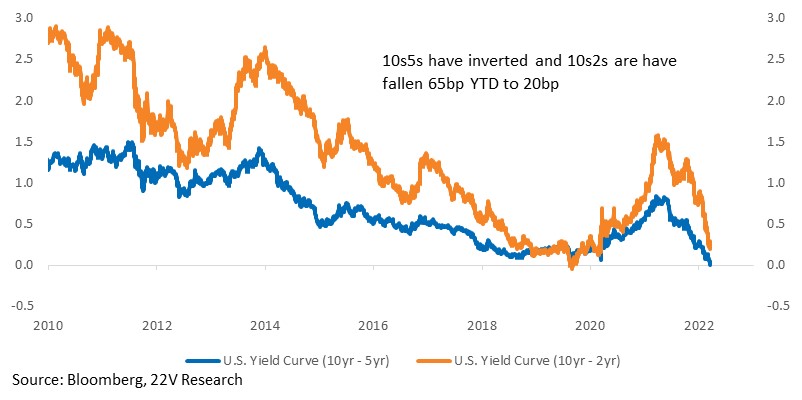
It is hard to separate what may be transitory/flight to safety impacts on Treasury yields tied to the war/sanctions, from what may be broader concerns about the outlook for growth. For now, the near-term flattening of 10s2s and the modest inversion of 10s5s is another signal that growth has become more constrained. Markets have priced in a good deal of tightening. If that is enough to drive inflation lower given the Fed’s current indicated rate hike path, or if further tightening will be needed remains uncertain. Near-term, there should be some easing of the low vol/quality market internals that led returns since the war broke out.