We are hosting the firmwide 22-minute weekly webinar again today at 10:30 AM ET. For those that haven’t registered but would like to, the registration link is HERE. If you’ve joined one of our weekly webinars before, you don’t need to register.
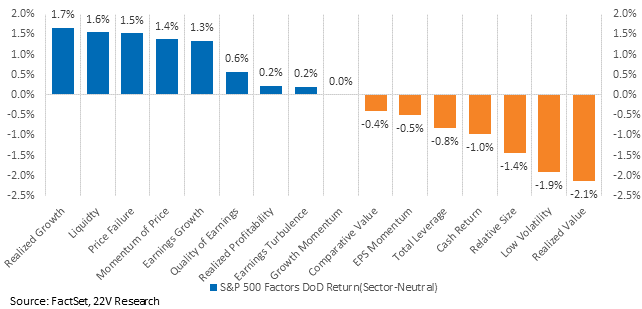
SUMMARY: Yesterday it became clear 1) the harshest sanctions would be avoided (didn’t target Putin or cut Russia off from SWIFT) and 2) that Russia is too big to sanction given its influence on everything from bread, to gas, to supply chains, to European banks. That realization, along with investors discounting high odds Kiev would fall soon and a new Russian government inserted, led to a significant reversal in risk assets. It was a 1st percentile DoD underperformance of Value relative to Growth (back to 2005) and Cyclicals broadly outperformed Defensives. We expect that to continue near term.
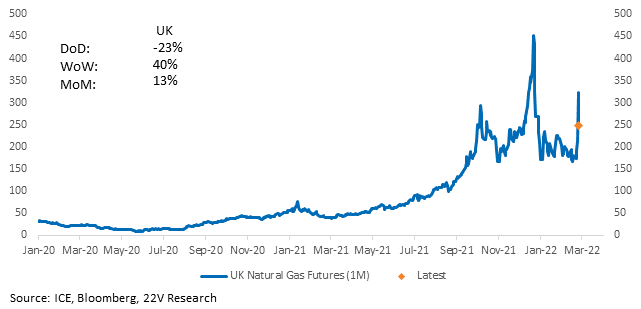
Gerard thinks some tightening of financial conditions is still required, just less so than before as “the effects on demand of the soon-to-resume re-opening of the US economy, post-Omicron, should easily dominate the trade shock from Europe, especially if the benchmark is whether US growth will slow to trend and thus prevent a further tightening of the labor market. (If the benchmark were above or below, say, 3% GDP growth, we might get a different answer.)” If gas prices in Europe DON’T help cause a recession (a big if of course), global economic momentum remains firm and China is continuing to add stimulus. This morning, news is focused on Premier XI’s support for Ukraine negotiations (pro Russia govt inserted), helping push UK natural gas prices well off their highs.
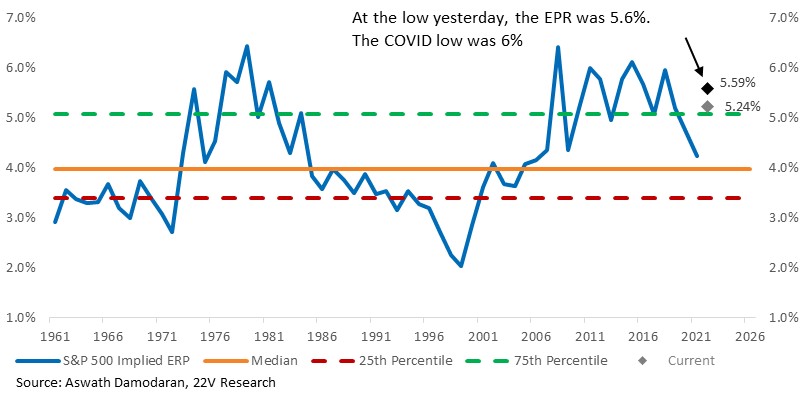
Bottom line, the implied equity risk premium (which takes into account future expected cash return yields relative to risk free rates), reached 5.6% at the market low yesterday. That is near historic highs and means being short the market, from around these levels, is going to be difficult if financial conditions DON’T need to tighten as aggressively and earnings don’t collapse. Much negativity has been discounted. Being long makes more sense and internals matter much more than the overall market call. We would stay long Cyclicals (Tech is a cyclical) relative to Defensives near-term.

FYI…We are assuming the near-term focus will be on the deeply oversold condition and the market backdrop becoming less uncertain. And Financial conditions have tightened some, so the Fed has more room to wait and see how geopolitical risk impacts the economy. If the labor market continues to tighten and growth remains firm (still seems likely) much more tightening could be required. That is a risk to being aggressively long equities. Along with an oil price spike.
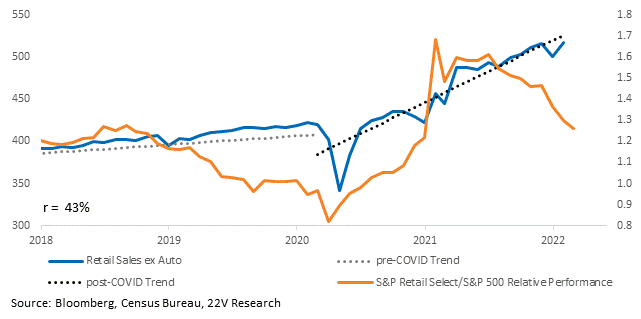
Quickly on Retail stocks. The outlook for the consumer is better than the outlook for consumer stocks. Given the divergence between retail sales trends and XRT, look for a sharp rebound in XRT (retail ETF, retail is the second performing industry YTD) if investors assume a less aggressive Fed near term. Short-term options trades on XRT might be interesting.
Full report below…
MARKET VIEWS: Yesterday we discussed how severe the sanctions on Russia would be and how that would determine the short-term path of risk assts. When it became clear that 1) the most harsh sanctions would be avoided (didn’t target Putin or cut Russia off from SWIFT) and 2) That Russia is too big to sanction given its influence on everything from bread, to gas, to supply chains, to European banks, risk assets rebounded. That realization, along with the high odds that Kiev will fall and a new Russian government inserted, led to a significant reversal in risk assets. It was a 1st percentile DoD underperformance of Value relative to Growth (back to 2005) as recent winners, Energy/Financials, suffered on oil prices moving off their highs and the decline in UST yields. Fed rate hike expectations declined too, weighing on financials. Defensives significantly underperformed Cyclicals (Tech, Consumer and Industrials drove Cyclicals. Staples was the worst performing sector).
Fed rate hike expectations have moved somewhat lower, but the focus needs to be on financial conditions and if they have tightened enough to slow demand growth. Gerard thinks that some tightening of financial conditions is still required, just less so than before as “the effects on demand of the soon-to-resume re-opening of the US economy, post-Omicron, should easily dominate the trade shock from Europe, especially if the benchmark is whether US growth will slow to trend and thus prevent a further tightening of the labor market. (If the benchmark were above or below, say, 3% GDP growth, we might get a different answer.)“ If gas prices in Europe DON’T help cause a recession (this is a big if of course), economic momentum will still be firm globally and China is continuing to add stimulus. This morning the news is focused on Premier XI’s support for Ukraine negotiations, which has helped push natural UK natural gas prices well off their highs.
Bottom line, the implied equity risk premium (which takes into account future expected cash return yields relative to risk free rates), moved up to 5.6% at the low yesterday. That is near historic highs and means being short the market, from around these levels, is difficult if financial conditions DON’T need to tighten as aggressively and earnings don’t collapse. Much of the negativity is discounted. Being long makes more sense and internals matter much more than the overall market call. We would stay long Cyclicals (Tech is a cyclical) relative to Defensives near term.
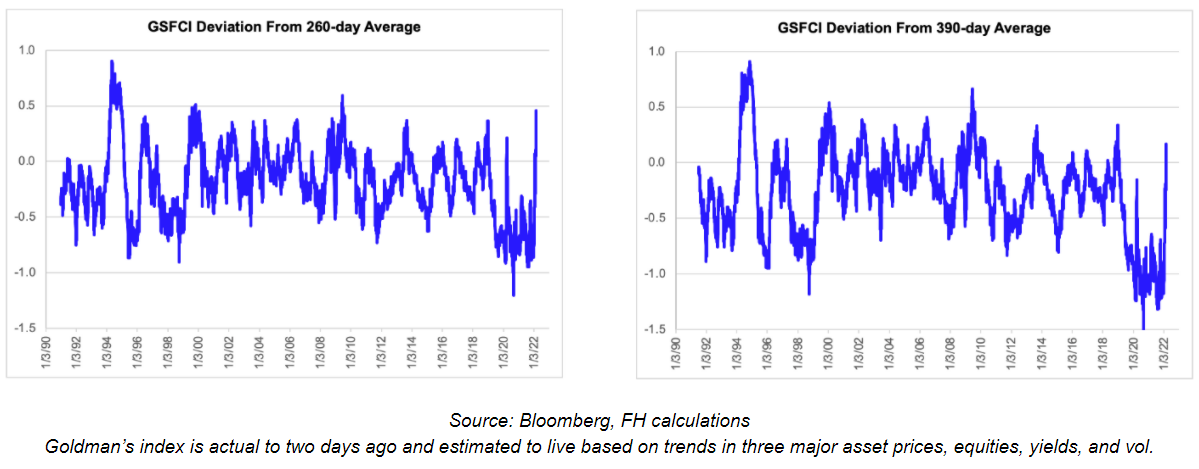
We should make it clear that we don’t know how much more financial conditions need to tighten. We are assuming near term the focus will be on the deeply oversold condition and moving to a potentially less uncertain backdrop as a market support. And Financial conditions have tightened some, so the Fed has some room to wait and see how geopolitical risk impacts the economy. That being said, as Per Gerard, the odds still favor the need for a further tightening of financial conditions because 1) the underlying demand trends in the U.S. economy should easily dominate the trade shock from Europe and 2) we don’t know what the recent deviation from trend in financial conditions means for economic growth. If the labor market continues to tighten and growth remains firm (still seems likely) much more tightening could be required. We just don’t know.
The post-pandemic trend of retail sales continues to outpace expectations and the pre-COVID trend. The trend will come down, but household financial balances are healthy, the labor market is tight, the wealth effect has been robust, and credit usage is low. Retail stocks, though, have been the second worst performing S&P industry as input costs (labor) spike while the Fed takes on inflation (pricing power). The outlook for the consumer is better than the outlook for consumer stocks. Given the divergence below, look for a sharp rebound in XRT (retail ETF) if investors assume a less aggressive Fed near term. Short term options trades on XRT might be interesting.