
Regulators’ financial stability concerns related to digital assets received new treatment yesterday in an updated risk assessment from the Financial Stability Board (FSB). It’s no surprise this study is more detailed than their 2018 report given the hyper growth of market products, providers, and purposes over the past 3.5 years.
As we all learn more about the possibilities and potential pitfalls of digital assets and the technology by which they travel, regulators increasingly are explicit about what they don’t know. These ‘data gaps’ are highlighted in FSB’s recent work. The nominal value of assets committed to decentralized finance shown in the accompanying graph illustrates a key risk: the rapid growth in valuation over the past few years. Furthermore, the market performance of crypto assets in the past year exemplifies another key risk: the correlation of digital asset valuations and equity markets, as shown in the second chart.

To protect against possible runs in the event of liquidity stress, regulators want more information about institutional participation, the share of transactions in unbacked crypto assets vs. stablecoins, leverage, reported fraud that stays private, and governance protocols of distributed ledger platforms.
Our macro conference guest, Tim Massad (former chairman of the CFTC), told us that central bank digital currency is a slow-moving concept in the US, unlike China where the PBOC’s coin was introduced this week. Tim also expects more activity at the SEC in decentralized finance. The hook he sees is the similarity between providing a protocol that does the same thing that is otherwise regulated by a financial institution. Tim noted growing international collaboration on stablecoin rules, particularly know-your-customer and anti-money laundering prescriptions. A reply link to the 22V 2/15/22 Macro Conference is found HERE. Our discussion on decentralized finance begins at 1:10:30.
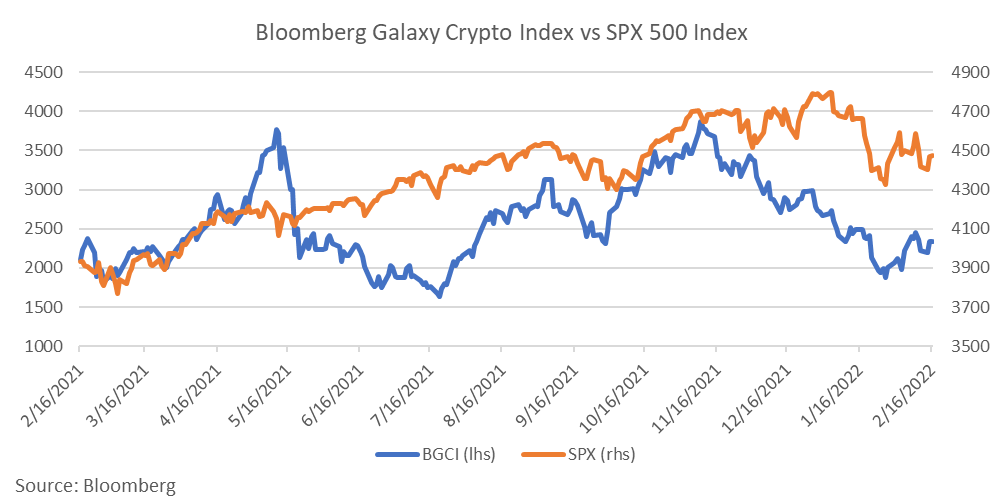
The Bloomberg Galaxy Crypto Index rates a 1 (weak) in John Roque’s technical scoring system, so the picture above is no surprise. After a good ride between Summer and Fall of last year, the Index (much like the SPX) had a difficult start to 2022 but registered a little life since the start of the year. Shakeout in this sector is on-going, owed in part to M&A among strong players and the dissolution of weaker ones. We continue to believe an eventual rulebook will further separate the weak from the strong as bank-like financial stability regulations come forward later this year.

