SUMMARY: Market action was intense yesterday with a massive intra-day reversal that saw the S&P closed higher than it opened for the first time since 1/14. Despite that, our thesis is unchanged. Financial conditions need to tighten before risk assets bottom. Futures are sharply lower this morning, reflecting ongoing concerns about the outlook for stocks as financial conditions OTHER than equities remain too easy to achieve the Fed’s goal of slowing inflation.
Global growth remains firm and Germany’s Ifo measure of business expectations for January rose more than expected, which is a both good and bad. Strong growth provides fundamental ongoing support for risk assets, which is being reflected in yet another strong earnings reporting season (80% beat rate S&P, 8.4% beat %). But that same strength makes the Fed’s job of slowing growth more difficult.
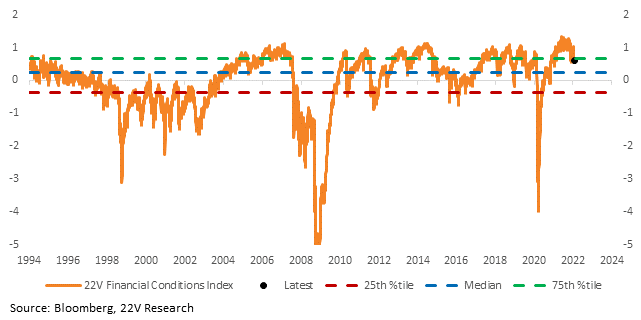
To track financial conditions with more granularity, we create our own index which is in its 71st percentile after reaching an all-time high (easy conditions) in June 2021. Almost all the tightening since is due to increased volatility – the VIX and MOVE have contributed 85% of the decline. Money markets, bonds, and equities (yields instead of prices) are comparatively benign.
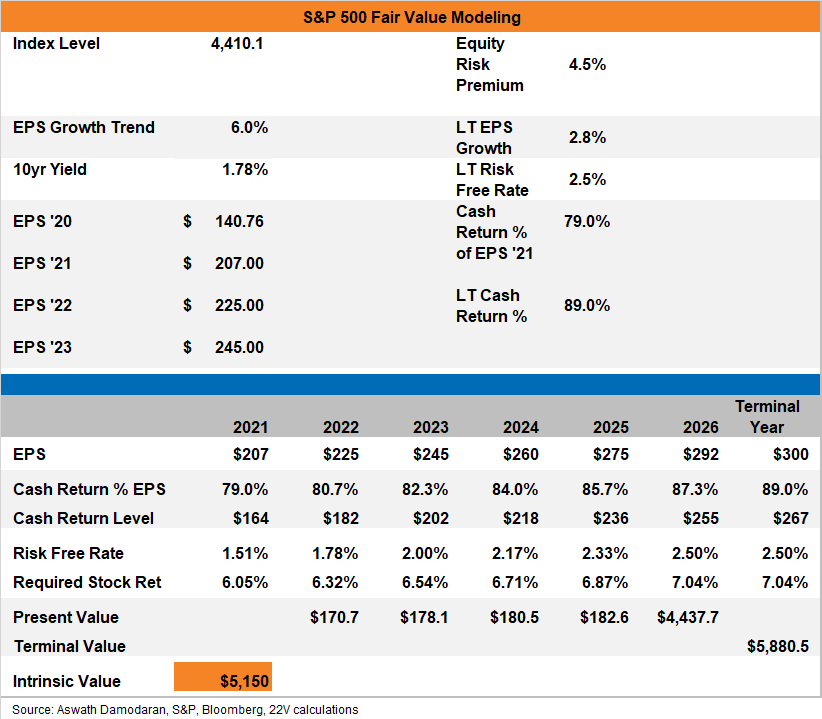
Macro uncertainty tied to inflation and fed policy remains high, helping push asset price volatility up as well. Determining fair value in that backdrop is very tricky and a handful of assumptions can significantly alter one’s perception of market skew. Our preferred valuation metric is Aswath Damodarn’s equity risk premium, which is essentially a discounted earnings + cash return yield adjusted for the level of bond yields and corporate payout. Earnings and payouts contribute to fair value, but the level of the equity risk premium is the single largest determinant.

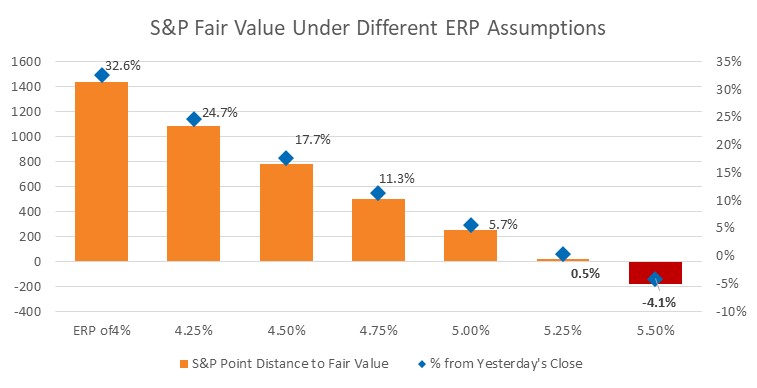
Under a 4.5% EPR, which remains our target for the end of 2022, S&P fair value, due to stronger earnings, is now around 5150, about 17% above yesterday’s close. The path from here to there is dependent on investor risk appetites improving over the course of the year. If the required risk premium remains elevated (~5%) there is still upside to the S&P, but only in the mid-single digits
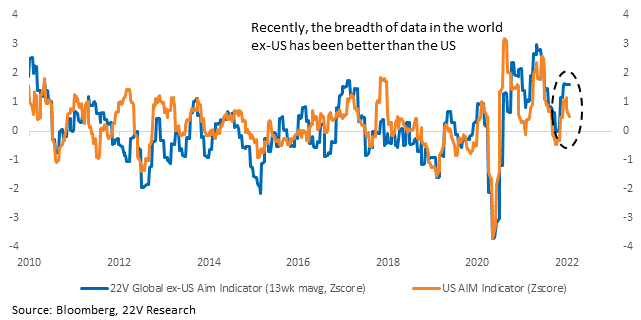
MARKET VIEWS: Germany’s Ifo measure of business expectations for January rose more than expected. European businesses are looking through the temporary disruptions from Omicron and face a different backdrop of inflation and central bank responses than that of the US. Last week, Lagarde said the ECB does not need to act as quickly as the Fed. The breadth of global economic data ex-US has been better than the breadth of data in the US lately. As the US economy slows, which the Fed wants (the question is HOW MUCH), international equities, which have underperformed US markets over the past year, look more attractive on a relative basis.
Finding a Bottom: Market action was intense yesterday – the NASDAQ traveled 5.6% intraday and the S&P 4.4%. It was the first day since 1/14 that the S&P closed higher than it opened. Despite that, our thesis is unchanged. We need to check in on financial conditions, inflation expectations, and credit before calling for a bottom. Futures are sharply lower this morning, reflecting ongoing concerns about the outlook for risk assets as financial conditions OTHER than equities remain too easy to achieve the Fed’s goal of slowing inflation.
To track financial conditions with more granularity, we create our own index comprised of money market, bond, equity and volatility measures. The index is in its 71st percentile after reaching an all-time high (representing easy conditions) in June 2021. Almost all the tightening of our index from its peak (and YTD) is due to increased volatility – the VIX and MOVE have contributed 85% of the decline. Money markets, bonds, and equities (yields instead of prices) are comparatively benign. All the components and their contributions are pasted in the table below the chart.
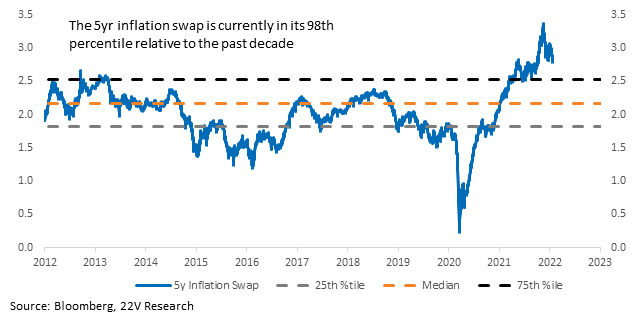
We are using medium-term inflation expectations as a proxy for demand growth. Proxies for the demand outlook rolling over will signal the Fed is succeeding in slowing demand. Today, inflation expectations are still in their 98th percentile…
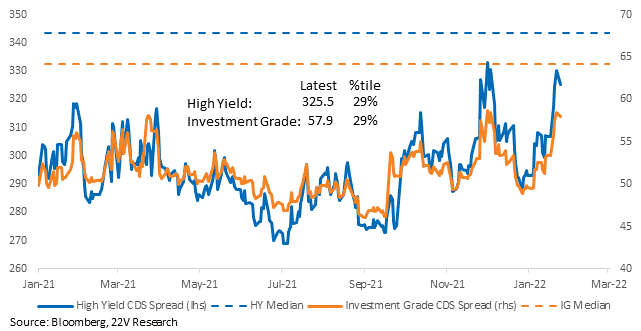
…And credit spreads are still below their 30th percentile. The Fed will tighten financial conditions to the point they affect the economy. We are not comfortable calling for a bottom in equities while the Fed has work left to do to tighten financial conditions. The Fed likely doesn’t want a market crash, but it also doesn’t like inflation being too high. So, if risk assets rally, stock and bond volatility normalize, and financial conditions ease again, the Fed will push back. Keep that in mind even if the Fed mentions market risks this week.
Fair Value Update: Macro uncertainty tied to inflation and fed policy remains high, helping push asset price volatility up as well. The MOVE index (Treasury vol) is near its highest point of the year the VIX is at 33 this morning, indicating daily average S&P volatility of over 2%. Determining fair value in that backdrop is very tricky and a handful of assumptions can significantly alter one’s perception of market skew. Our preferred valuation metric is Aswath Damodarn’s equity risk premium, which is essentially a discounted earnings + cash return yield adjusted for the level of bond yields and corporate payout. 4Q earnings growth is coming in stronger than expected with about 80% of companies beating estimates by ~8.4%, so fundamentals remain a support for equities. But the level of the equity risk premium is the single largest determinant of fair value.
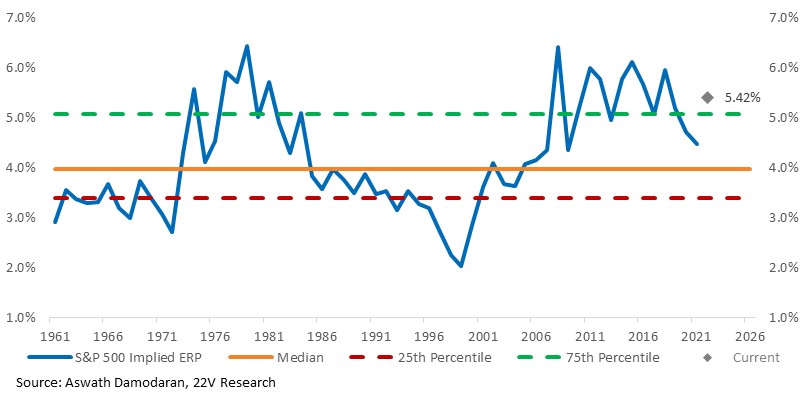
Apologies if the following is a bit confusing. It is meant to illustrate how important the assumptions that go into calculating the ERP are. As of yesterday’s close, using the Damodaran fair value framework as a starting point, applying Bloomberg consensus earnings estimates for the next two years, and assuming the 10yr yield remains steady, the S&P equity risk premium is 5.4%. At the start of the year the ERP, calculated under the same approach, would have been closer to 5%. Damodaran’s official ERP, which uses top-down earnings estimates and assumes a steady state cash return, was closer to 4.7%. At 5.4%, the ERP would be well above its long-term 75th %tile. At 4.7%, it would be elevated, but still within its normal range.
We have updated our fair value target using updated yields, adjusting the long-term target for the 10yr to 2.5% and a lower long-term earnings growth rate (as a result of rolling off depressed 2020 EPS). Under a 4.5% EPR, which remains our target for the end of 2022, S&P fair value is now around 5150, or about 17% above yesterday’s close. The path from here to there is dependent on investor risk appetites improving over the course of the year. If the required risk premium remains elevated (~5%) there is still upside to the S&P, but only in the mid-single digits.