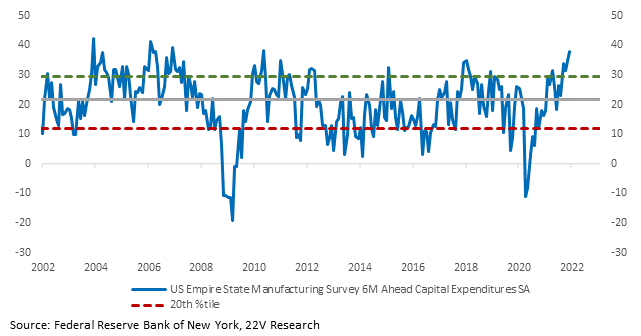
SUMMARY: The important positive part of yesterday first: The Fed penciled in 3 hikes for 2021 with a 2.7% core PCE rate. They also said rates will only rise to 2.1% by 2024 (below neutral). Investors quickly realized the Fed was NOT going to drive demand growth lower to achieve a much lower Core PCE goal (2.7% Core PCE is high for only 3 hikes). That is why the Fed funds futures curve didn’t react to the announcement. Near term this means financial conditions should be flat or ease if Omicron risk starts to fade (assuming Omicron tail risk doesn’t happen). That will keep S&P PE stable near term. Put simply, 3 hikes in this type of demand boom backdrop is nothing (see the charts at the end of the report that highlight blistering retail sales trends, high capex intentions and very strong PCE growth that the Fed is not clearly trying to offset yet).
That’s the dovish part…now the counter. Economist/Fed watchers like our economist Gerard noted his “base case for the economy is unambiguously hawkish. But in my view, he is not committed and ultimately the data will dominate. But he sounded hawkish.” Powell is not committed to being hawkish yet, but every chance he got to talk about inflation risk, the employment backdrop in general and participation rate in particular was tilted to the hawkish side in the press conference. Interesting divergence: Equity folks took his “squishiness” on full employment as dovish. Macro folks took that as pretty hawkish. Macro folks believe he is setting for a potential more aggressive rate hike path (macro folks think it is all upside risk to the rate hike path) when he indicated that 1) they could raise rates before full employment, 2) the economy is making rapid employment gains, and 3) basically gave up on participation increasing near term (doves think participation will increase keeping the rate path from shifting higher).
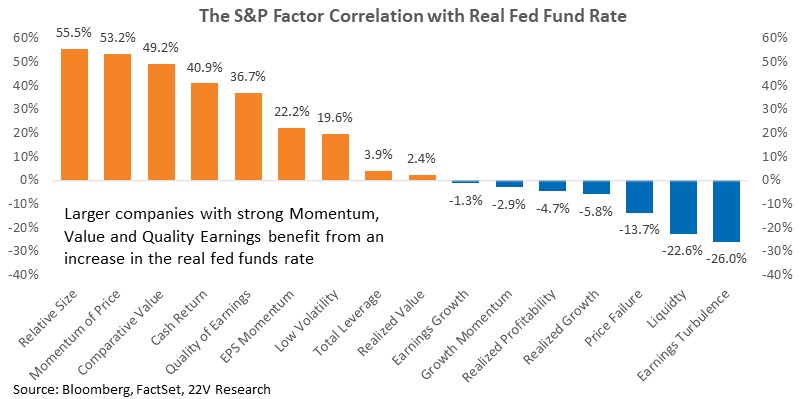
The employment reports going forward will be super important given Powell’s focus at the press conference. Our call remains the same, we don’t see a need for markets to price in a faster pace of tightening near term, but the skew is still to the right on rates given the employment (wages)/ rent outlook, which suggests upside risk to the Fed’s Core PCE forecast. Relative Size, Value and Cash Return tend to perform best when real fed funds are moving higher due to rate hikes and Momentum of Price and Quality of Earnings do best in environments where the funds rate is stable but inflation expectations are falling. How this plays out will be critical for risk assets. For now, expect some bounce back in price failure, earnings turbulence and low liquidity (they bounced back, but underperformed).
We need a few days to access what internals are discounting, so we are not putting too much emphasis on yesterday, but the same things worked yesterday in a up market that been working in sell-offs. That suggest less Fed risk with lingering Omicron uncertainty as apposed to hawkish fed and Omicron. If Omicron risk starts to fade and the Fed funds futures curve remains stable, expect risk-on factors to do better and the Defensives, which are overbought on any measure, to fade. We remain long the average stock relative to index (small caps), companies that benefit from improving supply chains, housing and Cyclicals in general.
Thanks for reading…summary was on the longer side, but complicated backdrop. Full report below.
MARKET VIEWS: As we noted yesterday, the Fed meeting was more about setting up the future than something that would change the trajectory of the rate hike path on the day. We got that part correct. Unfortunately, we were non-committal on the market impact of the rate path not moving, so we got that part wrong (the important part). Here is what is important to know, the Fed penciled in 3 hikes for 2021 with a 2.7% core PCE rate. They also said rates will only rise to 2.1% by 2024 (below neutral). The equity markets gravitated toward this view which implicitly implies the fed is NOT going to drive demand growth lower to achieve a much lower Core PCE goal. At least near term. Hence the Fed funds futures curve didn’t react.

The above is the dovish part. Economist/Fed watchers like our economist Gerard noted his “base case for the economy is unambiguously hawkish. But in my view, he is not committed and ultimately the data will dominate. But he sounded hawkish.” So Powell is not committed to being hawkish yet, but every chance he got to talk about inflation risk, the employment backdrop in general and participation in particular was tilted to the hawkish side. Interesting divergence: Equity folks took his “squishiness” on what full employment was as dovish. Macro folks took that as pretty hawkish. Macro folks believe he is setting up the potential for a more aggressive rate hike path (then is currently priced…macro folks think it is all upside risk to the rate hike path), when he indicated that 1) they could raise rates before full employment, 2) the economy is making rapid employment gains, and 3) basically giving up on participation increasing near term (doves think participation will increase , keeping the rate path wont shift higher).
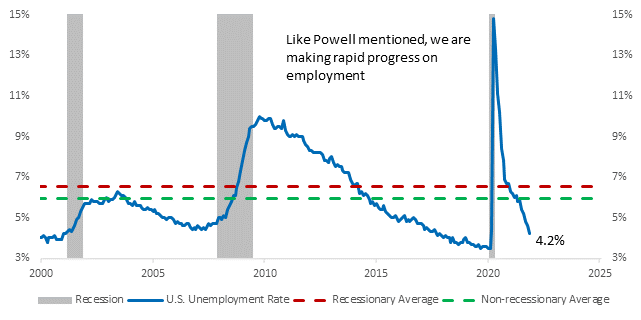
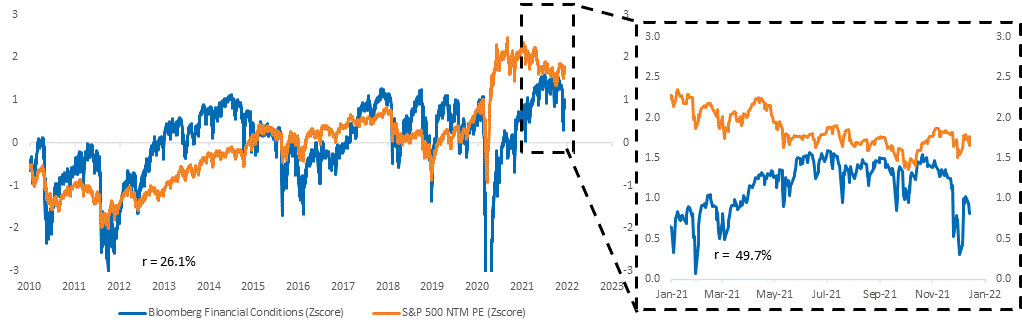
The net net of the above, financial conditions shouldn’t tighten much from here and could actually ease if Omicron risk starts to fade. That will keep S&P PE stable near term. Put simply, 3 hikes in the type of demand boom we are having is nothing. If Powell commits to a more forceful tightening (many macro folks think he will need to), that is how you get a much tighter financial conditions backdrop and lower PEs as equities would do much of the heavy lifting in tightening financial conditions.
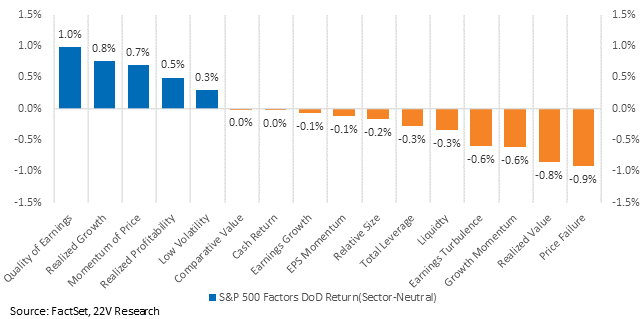
The employment reports going forward will be important given his comments at the press conference. Our call remains the same, we don’t see a need for the markets to price in a faster pace of tightening, but the skew is still to the right on rates given the employment (wages)/rent outlook. That right skew likely helps explain market internals yesterday. Price Failure, Earnings Turbulence and Liquidity fell while Quality of Earnings and Realized Growth were the best performers. Those trends are a continuation of the internals we have seen over the past few weeks, though with lower Low Vol gains, which makes sense given the FOMC delivered the meeting investors were expecting. The big difference is the market went up instead of down. The Fed not being clearly hawkish into Omicron vs being hawkish into Omicron is likely the swing factor on markets.
As noted in a quant report yesterday, we ran the correlations of changes in the implied real fed funds rate with factor returns. Larger cap, Value and Momentum names with large cash return and high quality earnings tend to perform best during periods of rising short rates. Importantly, Relative Size, Value and Cash Return tend to perform best when real fed funds are moving higher due to rate hikes and Momentum of Price and Quality of Earnings do best in environments where the funds rate is stable but inflation expectations are falling. A credible Fed with a firm, stable economic backdrop should lead to easing of inflation expectations but relatively little increase in the expected funds rate.
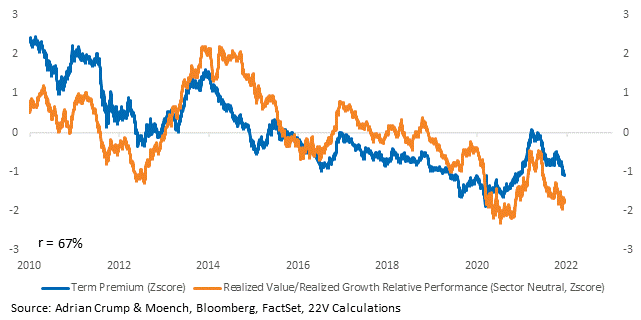
If Value is going to re-rate higher it will need to come with higher term premium. Term premiums are anchored and Omicron is likely having a significant impact on uncertainty risk in 10yr bonds. If the Fed is not going to slow growth AND Omicron risk fades, expect a rerating higher in term premium next year. Likely a mid to late 1Q issue if its going to happen.
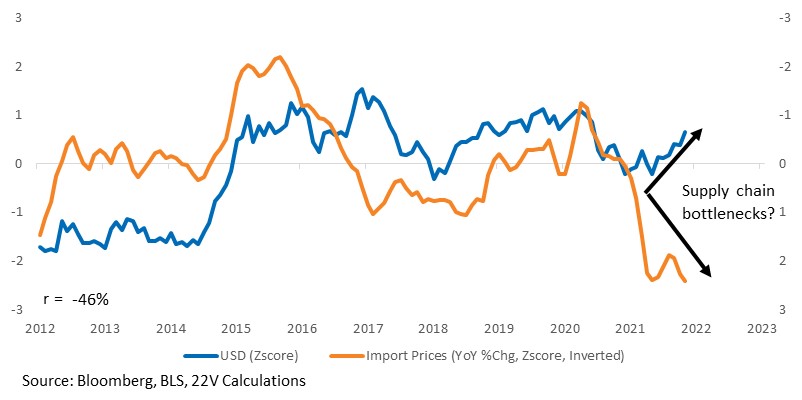
Odds and ends…import prices remained high yesterday, but if supply chains start to ease, expect a reversal lower in import prices given USD strength.
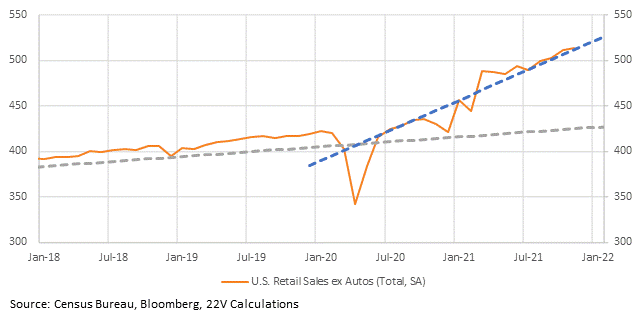
Retail sales are still booming. Yes the number missed yesterday, but the trend is the trend. The Fed did not signal they would offset this strength. Not yet at least.
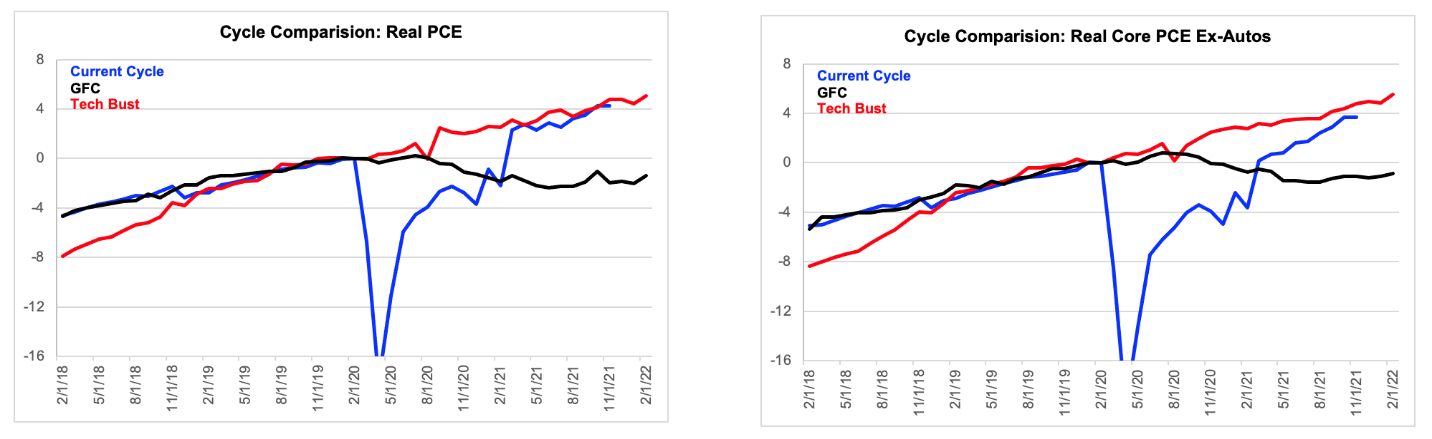
Given what we know on retail sales growth, the trend of PCE will remain firm (benchmark to the pre-GFC trends, not the post GFC trends). The Fed did not signal they would offset this strength. Not yet at least.
Empire mfg came in much stronger than expected and capex expectations increased again. The Fed did not signal they would offset this strength. Not yet at least.