
Internationally active companies cannot avoid nationalism and often expend nervous energy managing this persistent factor influencing their business environment(s). The Securities and Exchange Commission last week finalized a foreign company disclosure rule pursuant to law enacted about a year ago with strong legislative support. The immediate impact was a 9.1% selloff of the Nasdaq Golden Dragon China Index, taking it down to a level last seen approximately two years ago. The index is off 43% year to date.
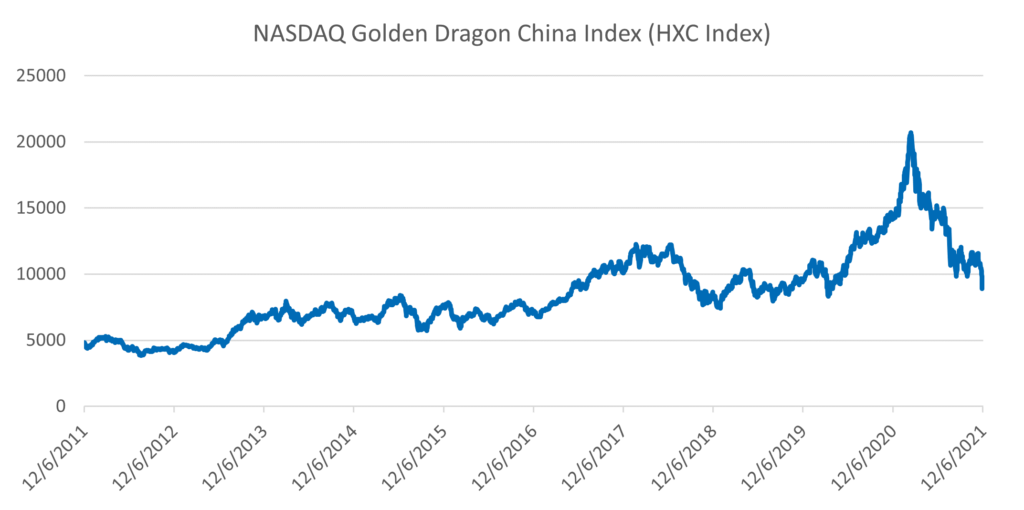
News since then highlights additional structural tensions of the US-China relationship. The White House and the House of Representatives yesterday announced plans sure to put further stress on the same. US diplomats will not attend the Olympic 2022 Winter Games, and Speaker Nancy Pelosi later said the House this week will consider the Senate-passed “Uyghur Forced Labor Prevention Act.” The actions were coordinated thematically if not chronologically.
Even if President Xi was not surprised by either move, it comes on the same day he asked 160 million Chinese children to become warriors in the fight against Covid-19. In accordance with his design, nationalism is running high in China to summon common sacrifice as he implements “common prosperity.” This is something of a full circle as Alibaba was the first Chinese multinational to be caught offsides by the common prosperity pivot. Didi’s move to delist, and the subsequent selloff of its American depository shares shows the bite of President Xi’s bared teeth.
Harvard professor Joseph Nye offered timely thoughts about the current phase and likely outlook for the US-China relationship. He focuses on the bilateral tech competition begun last decade when “Chinese leaders increasingly came to believe that America was in decline.” He advises Washington to focus on and master the three layers of interdependence he sees (and we agree) as unlikely to be damaged by decoupling flirtation: economic, transnational, and military distributions of power.
Industrial policy carries different presumptions for different people. The transition this century from multilateral to regional and bilateral trade deals expresses sovereigns’ desire to exert more predictable control over risks and opportunities of financial and commercial cross-border flows. A successful US policy toward China acknowledges the reality of the G2 competition. It also realizes the US benefits from partners, especially the EU/UK friendship. Lastly, it requires heavier US domestic investment in R&D (and STEM education) and immigration (intellect and skills importation). President Biden’s understanding of these priorities is reflected in his commitment to the Build Back Better economic plan.

