
Current macroeconomic outlooks cover the spectrum of the imaginable, some seemingly more far-fetched than others. Our personal bias is toward the more-growthy-than-not school for the coming four to six quarters. Listing the risks to this or any projection of the unknowable would bore you and us, so we will save that time. Likewise, individual prognostications on fiscal outyear consequences of current year policies leave room for lots of assumptions and beliefs most of which reflect one’s economic training or political bent.
In this swamp of uncertainty, it bears remembering that President Biden (per budget estimating rules) provided more offsets than needed, both for the newly enacted infrastructure law and the pending investments/spending programs. The social and fiscal effects of each component of Democrats’ reconciliation bill cannot be known but neither bill is likely to add to household or national debt.
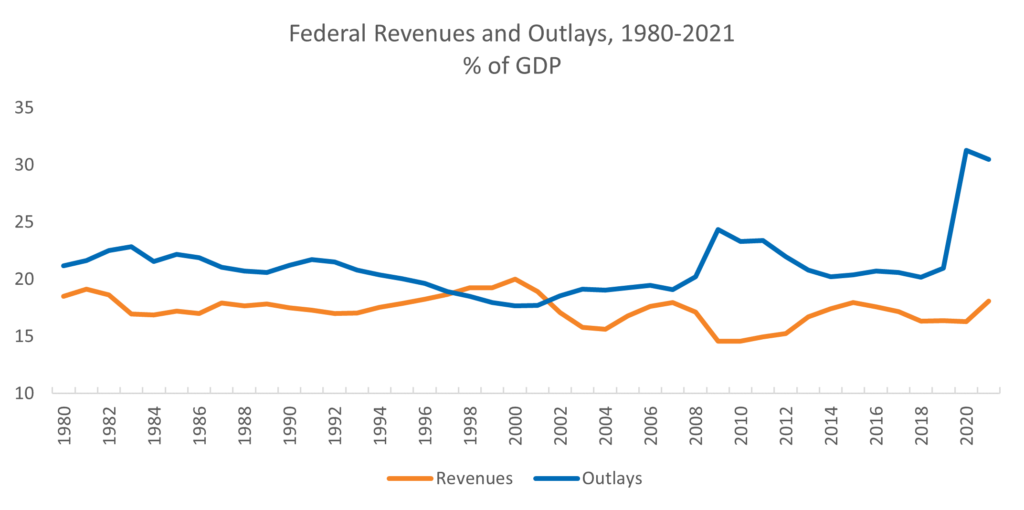
Tuesday morning delivered news that the economy continues to repair. So too, does the fiscal balance, albeit slowly. Presuming the US is not due another economic shock similar in scale to 2007 – 2009 or the pandemic-induced 2020 contraction, fiscal expansion this decade likely ended with the March 2021 American Rescue Plan. Spending has plateaued and revenues are recovering as a share of the economy as shown below.
Part of the uncertainty swirling around the final cog in the president’s economic policy wheel attaches to whether it would exacerbate inflation. Another is whether the fundamental policies can be achieved or if this is an advisable way to do it. Present now are concerns whether it falls short of being fully offset by provisions within the bill. The latter is a welcome turn from the debt created by every large fiscal stimulus package of this century.
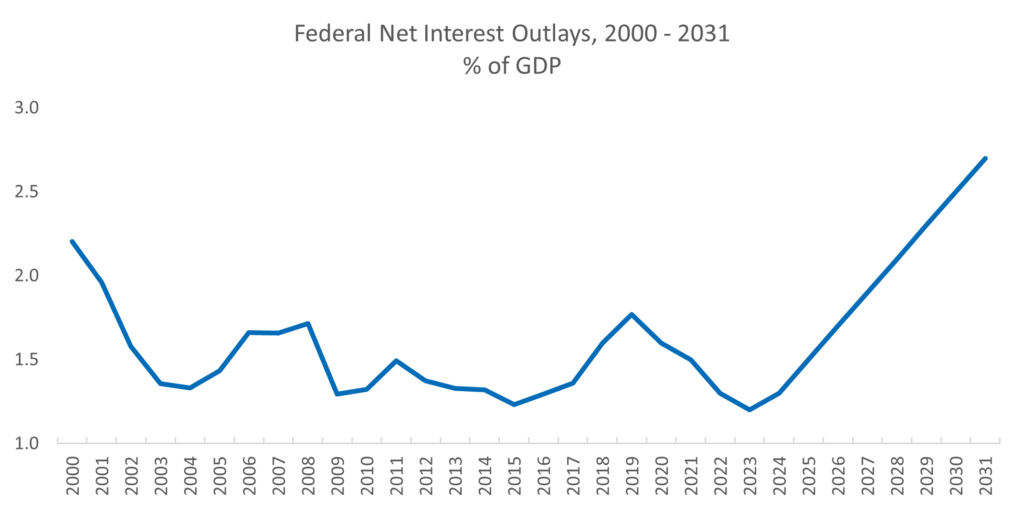
We are fortunate to spend time each day speaking with clients and colleagues about these topics. We are persuaded by the notion that continual debt accumulation even at low interest rates is not prudent. But we also believe that paying for programs that have a good chance of boosting longer run productivity without adding debt should be good for the US economy. The programs and offsets chosen deserve debate, but federal policies meant to grow our productive capacity and enhance quality of lives that do not worsen our net interest costs (shown below) also seem prudent.
We have three standard scenarios that appear relevant to the pending reconciliation package. Our core view remains that a $1.5 – $1.9 trillion ten-year social safety net bill is sent to the president next month, a day or three before Christmas. Our second scenario centers on the same amount with a slip of timing into January. The final and currently least likely scenario just acknowledges reality: Democrats could fail to agree on a bill.
We doubt scoring of the bill (which the Congressional Budget Office expects to complete by Friday) will be the reason for delay or collapse. A vote on the pending House bill could happen as soon as Friday but will likely slip into the weekend after which it will be sent to the Senate for consideration. The House bill uses fewer offsets than the legislation passed by the House Ways and Means Committee, which used less than $1.2 trillion of ‘payfors’ identified by the Biden administration. We could see Democrats having a hard time agreeing on a number at the low end of our range, and not agreeing to use available offsets. But that would be choosing to fail which still strikes us as unlikely, if even possible.

