SUMMARY: News this morning reinforces that the demand backdrop remains strong. Home Depot beat earnings estimates and Walmart brushed aside concerns about supply chain constraints and raised its annual sales and profit forecasts because of strong demand. Yesterday’s Empire manufacturing survey was also much stronger than expected as well.
Senate Banking Char Sherrod Brown reported Biden’s announcement of his pick for Fed Chair is “imminent.” Kim Wallace, 22V’s Washington analyst, leans against an announcement this week. Look for next week instead. Betting markets give the nod to Powell by a healthy margin, though Brainard is gaining in popularity. Kim believes Powell’s nomination is a done deal.
Looking deeper into JOLTS data shows employees are quitting small companies at a much faster rate than larger companies. Quits as a % of all separations are rising across firms, but the mass of employment at larger firms remains more stable. 91% of the American workforce is employed by companies with less than a thousand employees. These are the companies facing the worst of the ‘Great Resignation’ and, presumably, upward pressure on wages.

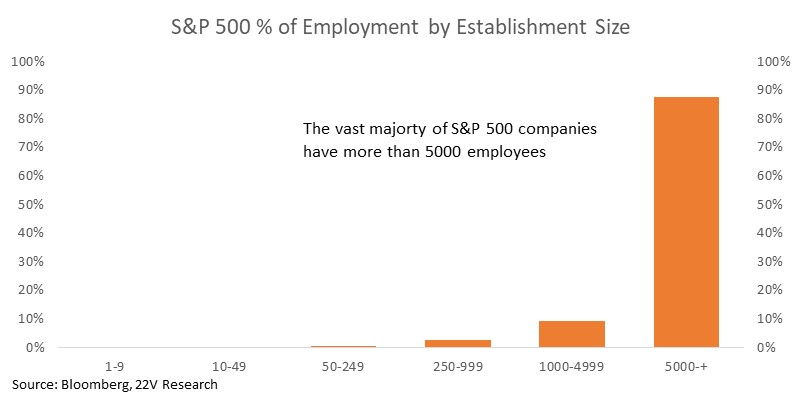
The S&P is almost entirely companies with over 5,000 employees, while only 3% of the American workforce is employed by establishments with 5,000+ employees. Turnover-induced wage inflation may put upward pressure on smaller employer costs, particularly within certain industries. But there is scant evidence it is yet a problem for large caps.
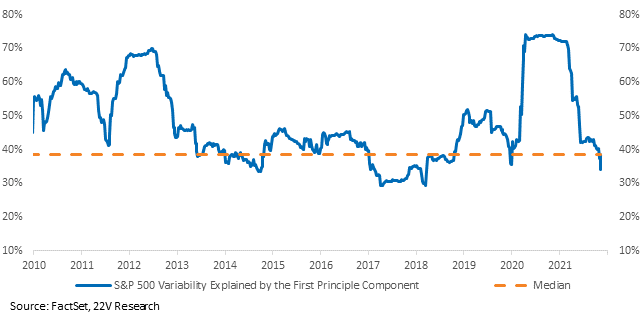
Divergence quits are another example of why it is important to keep in mind that micro themes are and will be increasingly important over the coming quarters. Total macro influence over the S&P has collapsed in 2021, as evidence by the decline of the market volatility explained by the first principle component (more on that below). Micro themes will be a key driver of equity return spreads through 2022 as stock picking continues to replace market and sector trends.
Sentiment readings have been weak and falling, even as hiring and wage growth have remained robust. The Chicago Fed CARTS model forecasts another solid retail sales number for October. Their reading is consistent with the still high level of job openings and hiring expectations.
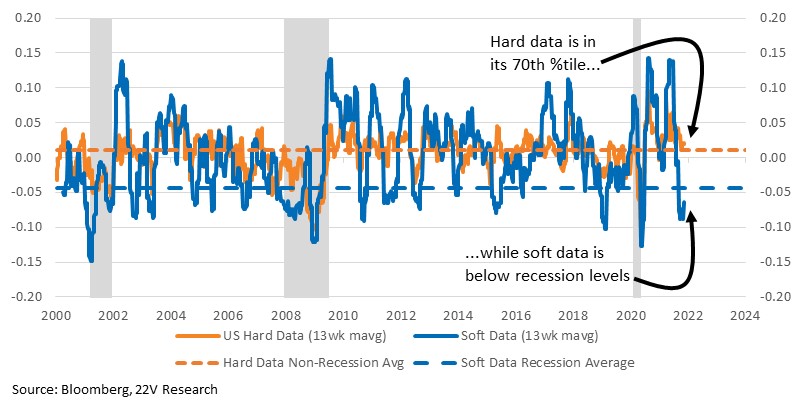
Retail sales have continued to expand at a solid pace even as sentiment has fallen in yet another example of sentiment readings diverging from actual data. Over the past several months, soft economic data (surveys) have collapsed to recession like levels while hard data (actual numbers) have remained at the high end of their typical range. Negative supply chain and inflation headlines remain a drag on sentiment, but as long as hard data remains strong, expect sentiment to rebound as production increases and inflationary pressures ease.
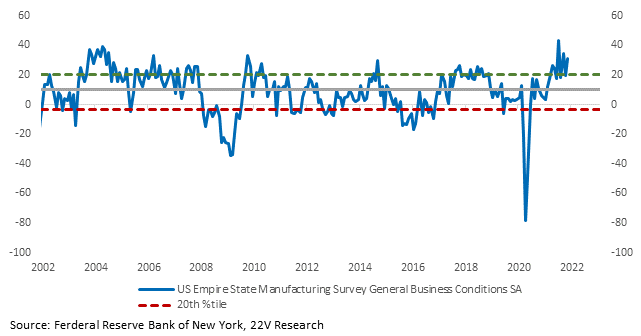
MARKET VIEWS: News this morning reinforces our views of the strong demand backdrop. Home Depot beat earnings estimates by 16% on modestly higher same store sales and stronger than expected margins. Walmart brushed aside concerns about supply chain constraints and raised its annual sales and profit forecasts because of strong demand. Yesterday’s Empire manufacturing survey was much stronger than expected as well, rising nine points. General business conditions, new orders, employment, and capex expectations all increased and are all above their 75th percentiles. We get retail sales data, which will provide another insight into consumer health, today (more on that at the end of the report).
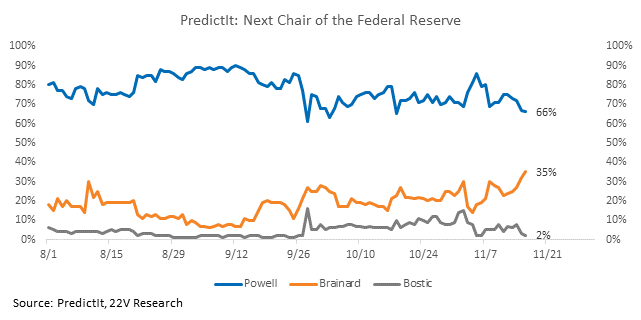
Senate Banking Char Sherrod Brown reported Biden’s announcement of his pick for Fed Chair is “imminent.” Kim Wallace, 22V’s Washington analyst, leans against an announcement this week. Per Kim, if the White House believes an announcement helps address the inflation messaging problem, they’ll do it this week. If they want the deadest air to dominate, whether inflation is a decision factor or not, wait for Nov 26. Betting markets give the nod to Powell by a healthy margin, though Brainard is gaining in popularity. Kim believes Powell’s nomination is a done deal.
QUITS & MICRO TRENDS: As the latest JOLTS data showed, total job openings remain exceptionally high and the “quits rate”, which tracks voluntary job separations, reached a new all-time high. Looking deeper into the data shows employees are quitting small companies at a much faster rate than larger companies. Most of the increase in separations have been from companies with fewer than 1000 employees though they have also been rising at companies with 1,000-5,000 employees. At companies with greater than 5,000 employees, the quits rate has been stable. Quits as a % of all separations are rising across firms, but the mass of employment at larger firms remains more stable.
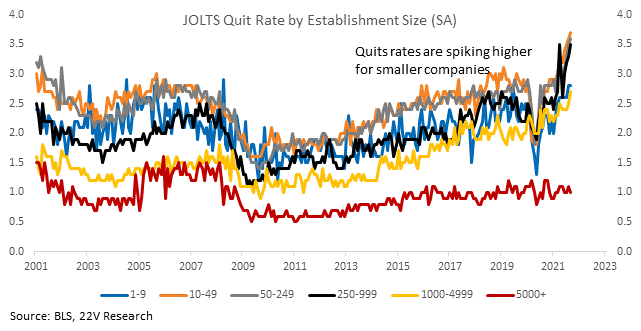
91% of the American workforce is employed by companies with less than a thousand employees. These are the companies facing the worst of the ‘Great Resignation’ and, presumably, upward pressure on wages.
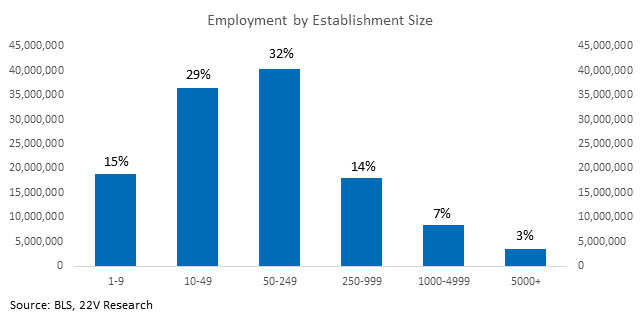
The S&P is almost entirely companies with over 5,000 employees, while only 3% of the American workforce is employed by establishments with 5,000+ employees. Turnover-induced wage inflation may put upward pressure on smaller employer costs, particularly within certain industries (Restaurants come to mind give wage and food cost pressures). But there is scant evidence it is yet a problem for large caps. A persistent wage price spiral would lead to longer term headwinds to growth and could cause a shift toward restrictive central bank policy, but over the next few quarters, large cap earnings look relatively insulated from labor pressures.
The percentage of S&P variability attributable to the first principle component is a proxy for total macro influence. COVID shifting from an existential threat to a reoccurring modest economic Divergence quits are another example of why it is important to keep in mind that micro themes are and will be increasingly important over the coming quarters. Total macro influence over the S&P has collapsed in 2021, as evidence by the decline of the market volatility explained by the first principle component.
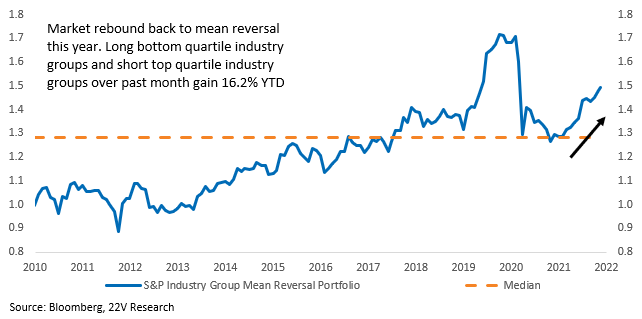
Our mean reversion portfolio, which is long the prior month’s worst 6 performers and short the best 6, is outperforming again as macro influence decreases. Micro themes will be a key driver of equity return spreads through 2022 as stock picking continues to replace market and sector trends.
Retail sales data will be out later this morning and provide another insight into the state of the consumer. Sentiment readings have been weak and falling, even as hiring and wage growth have remained robust. One more example of sentiment readings and actual data diverging. Earnings have been robust as well; Home Depot beat comparable sales decidedly and Walmart brushed aside concerns about supply chain constraints and raised its annual sales and profit forecasts because of strong demand.
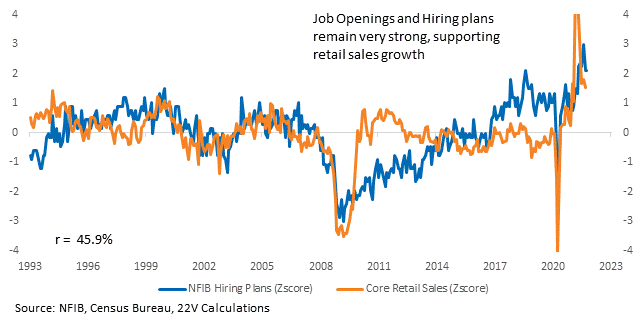
Retail sales have continued to expand at a solid pace even as sentiment has fallen. The Chicago Fed CARTS model forecasts another solid retail sales number for October (released at 8:30am ET). Their reading is consistent with the still high level of job openings and hiring expectations.
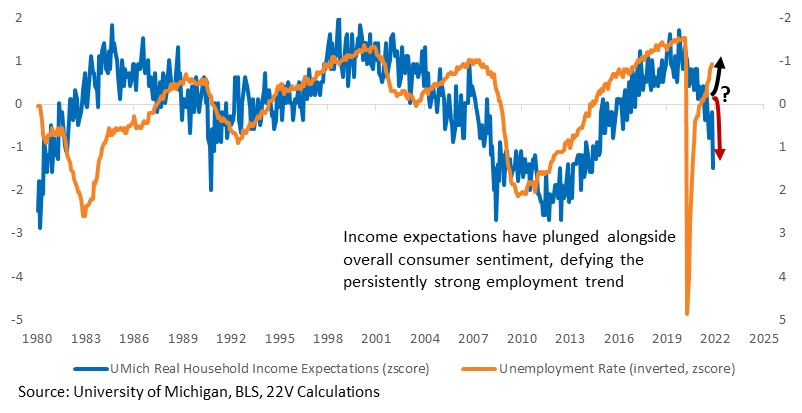
Consumer sentiment and income expectations falling while retail sales and payrolls move higher is part of a larger trend in data. Over the past several months, soft economic data (surveys) have collapsed to recession like levels while hard data (actual numbers) have remained at the high end of their typical range. Negative supply chain and inflation headlines remain a drag on sentiment, but as long as hard data remains strong, expect sentiment to rebound as production increases and inflationary pressures ease.