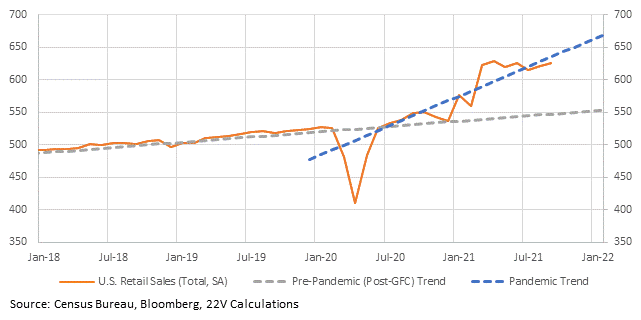
SUMMARY: The reason Fed rate hike expectations have increased is not because of stagflation, but due to consumer demand remaining extremely strong while supply chain bottlenecks persist (some are calling it kaboomflation). That became more obvious last week after JOLTS data pointed to stronger wage growth (quits rate accelerated) and retail sales remained at an extremely high.
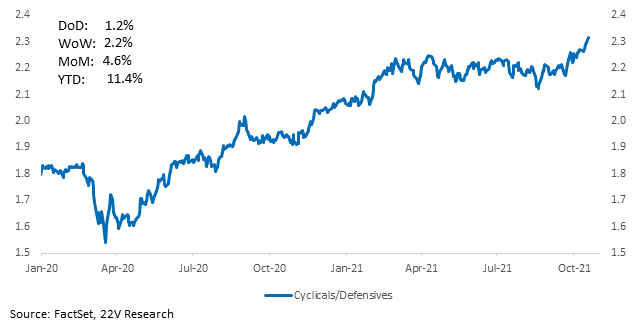
Persistently strong demand, which was NOT expected by investors in the late summer and post Labor Day, is why Cyclicals have significantly outperformed Defensives. The Value vs Growth mix has gone back and forth and we like Tech through earnings season, but Cyclicals have been a consistent winner. The move in yields reflects the change in the US demand backdrop. Two rate hikes are firmly priced in for 2022 and odds of a rate hike in June of 2022 are ~50%.
Odds are low that Powell will be as aggressive on rate hikes as the market is currently discounting. Credit spreads have figured this out and remain narrow. Narrow credit spreads reinforce the Fed’s pro-growth bias, which is bullish for stocks and the economy LONGER TERM. Short term, we would point out that 1) retail sales should move lower over the coming months 2) COVID could continue to linger. We are not making a call on the new Delta sub-variant, but it appears to be impacting UK case growth. At the same time, 10yr UST yield have consolidated along with reopening stocks. The new Delta sub-variant doesn’t have to be a problem to impact 10yr yields. Recall, 10yr yield are used as a hedge against bad outcomes.
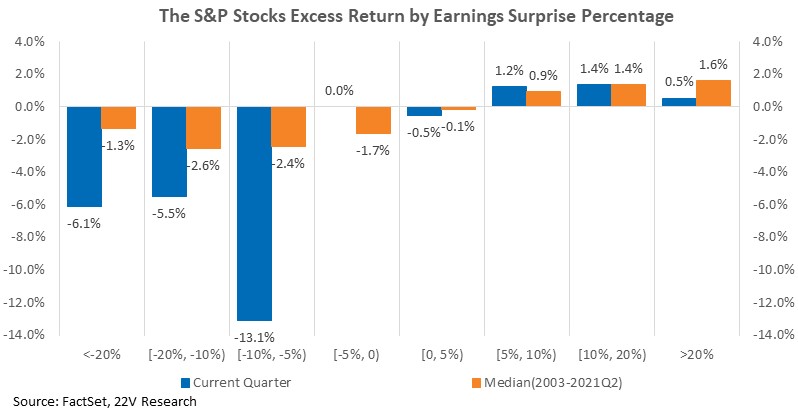
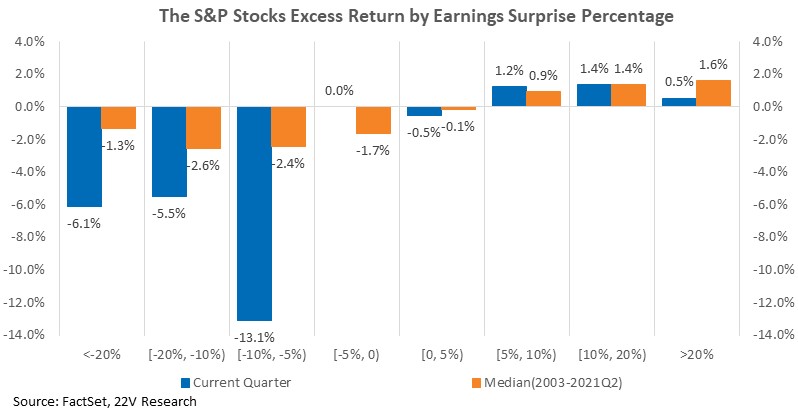
Earnings reporting season is still young, but there are two developments that are incrementally important. The first is that there has not been a feared collapse in sales growth or corporate margins due to supply shocks. Underlying earnings support for equities remains strong. Second, companies that do miss earnings, even by relatively small amounts (-5 to -10%) have been harshly punished. Fewer companies than normal are missing estimates (only ~7% of companies through Friday’s close), but those that do are seeing sharp declines. That data reinforces the argument that stock picking is an increasingly important component of alpha generation this earnings season. Correlations will continue to decline through earnings season.
Full report below and thanks so much for reading…
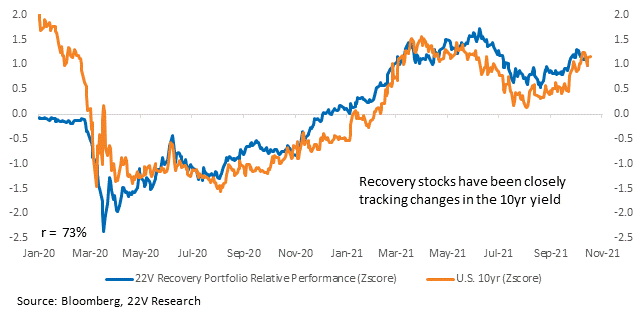
MARKET VIEWS: It was a relatively quiet night on the news front and 10yr yields continue to consolidate. All the action over the past few days has been in the short end of the curve and is related to a sharp increase in Fed rate hike expectations. As we have noted, rate hike expectations have increased is not because of stagflation, but as a result of extremely strong consumer demand while supply chains struggled to keep up (some are calling it kaboomflation). This became more obvious last week after JOLTS data pointed to stronger wage growth (quits rate accelerated) and retail sales remained at unusually high levels.
Persistently strong demand, which was NOT expected by investors in the late summer and post Labor Day, is why Cyclicals have significantly outperformed Defensives. The Value vs Growth mix has gone back and forth and we like Tech through earnings season, but Cyclicals have been a consistent winner. The strength of the economy is why even left of center twitter is upset about how the last stimulus was dolled out.
The realization that demand is persistently strong and supply constraints remain (strong demand ran right into COVID-zero countries reducing production) is why Fed rate hike expectations have shot higher. Two rate hikes are now firmly priced in for 2022 and the odds of a rate hike in June 0f 2022 are basically 50%. We think that is way too aggressive.
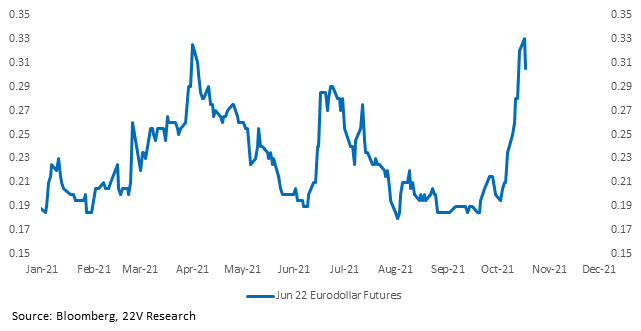
Odds are low that Powell will be as aggressive on rate hikes as the market is currently discounting. Credit spreads have figured this out and remain narrow. Narrow credit spreads reinforce the Fed’s pro-growth bias and that is bullish for stocks and the economy LONGER TERM. Shorter term, we would point out that 1) retail sales should move lower over the coming months (don’t worry about this, demand growth will still be above trend) and 2) COVID could continue to linger. We are not making a call on the new Delta sub-variant, but it appears to be impacting UK case growth. At the same time UST yield have consolidated at reopening stocks have consolidated. The new Delta sub-variant doesn’t have to be a problem to impact 10yr yields. Recall, 10yr yield are a hedge against bad outcomes.
HARSHER EPS SEASON: 3Q earnings reporting accelerates this week with more than 100 S&P companies releasing their results. So far, companies are defying bearish views with over 87% of companies beating analyst EPS estimates by 1% or greater and 95% posting absolute beats. Overall, the earnings surprise distribution has been very positively skewed with nearly half of reported companies posting earnings growth that were 10pp or better than consensus forecasts.
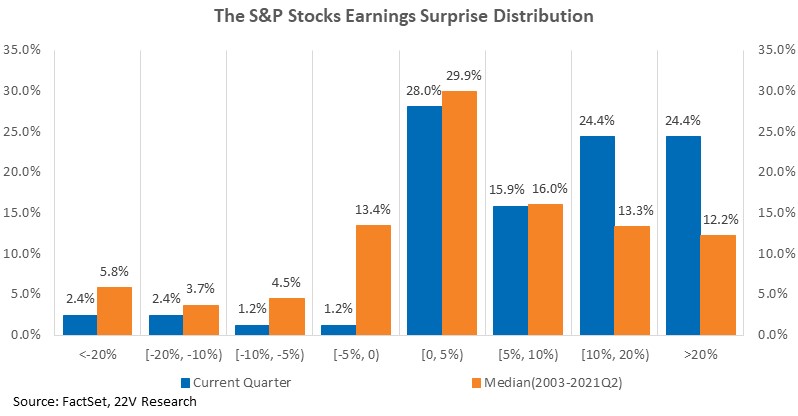
Since 3Q20, the scope and degree of earnings beats has been exceptionally high as corporate earnings fell less and rebounded faster than analysts expected. Growth rates are coming down now, in part because the global economy has largely reopened and in part because the easy comps from the acute pandemic period are waning. There are two developments that are incrementally important. The first is that there has not been a feared collapse in sales growth or corporate margins due to supply shocks. Underlying earnings support for equities remains strong. Second, companies that do miss earnings, even by relatively small amounts (5-10%) have been harshly punished. Again, fewer companies than normal are missing estimates (only ~7% of companies through Friday’s close), but those that do are seeing sharp declines. That data reinforces the argument that stock picking is an increasingly important component of alpha generation.