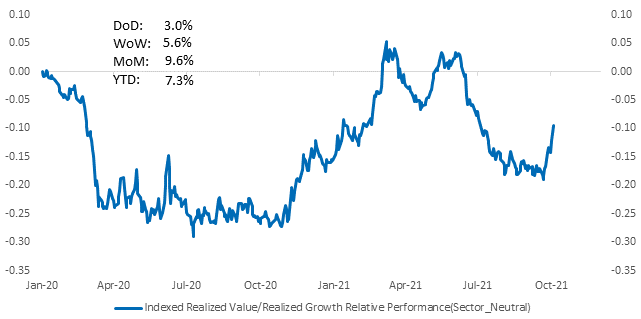
SUMMARY: Uncertainty about stagflation and the U.S. debt ceiling continue to dominate trading and we don’t have much to add other than aggregate supply chain news appears to be getting less bad. We are focused on demand, oversold conditions, and thinking about S&P fair value, which are all tied together. The delta wave was a clear headwind for Cyclicals and as the variant fades, there is upside to UST yields and Cyclicals. As our economist Gerard MacDonell noted yesterday, “nominal demand outside autos (the supply epicenter) has remained quite strong and the 5-month rate of growth of real ex-auto PCE since March has been 5%.” The bottom line from Gerard, “consumer demand growth has remained solid, although clearly less boomy, and underlying inflation appears to have picked up somewhat. That is worth knowing when thinking about the bond market.” Internals seem to reflect what Gerard has noted.
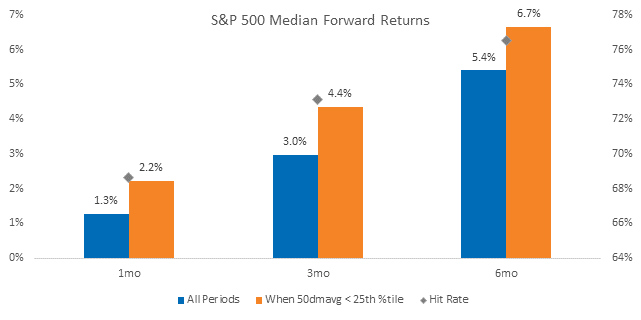
Currently 16% of Nasdaq stocks and 28% of the S&P are trading above their 50-day moving average. Both are well below their 25th %tile. Forward returns tend to be stronger than normal for the S&P on a 1/3/6 month basis when this is the case.
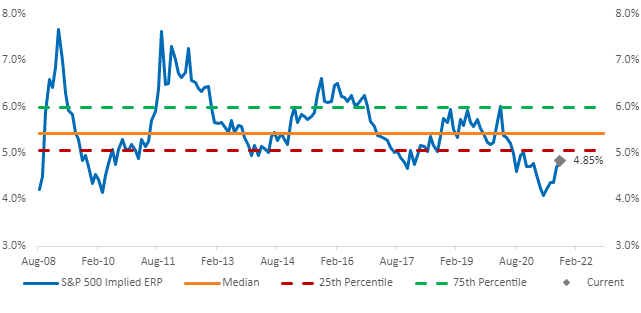
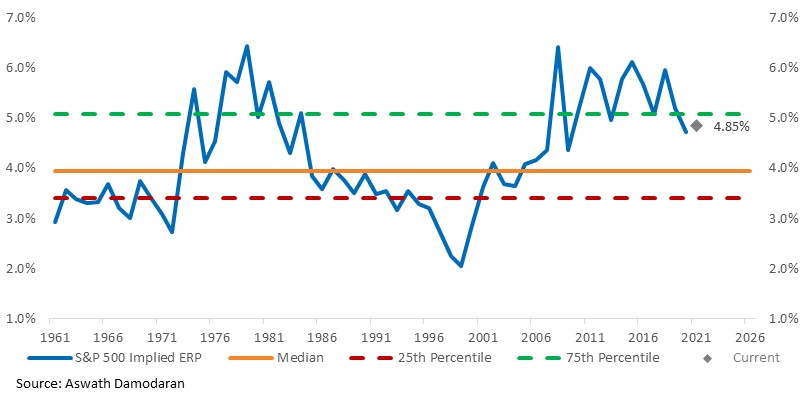
If the market was extremely overvalued stepping into an oversold condition would be risky. Yes, bond yields have rebounded, putting pressure on PEs, but bond yields are not the only or primary driver of fair value What matters is how the equity risk premium (ERP) moves in relation to bond yields. Currently, the equity risk premium is high relative to its long-term history, but low relative to the post-GFC period.
Bears argue persistent supply shocks, long term growth issues in China, and global growth continuing to follow its post-GFC trend will keep the ERP in its post-GFC range. With that backdrop, equities would move lower. If the risks mentioned above fade, investors will focus on the pro-inflation monetary policy regime and sea change in the consensus approach to fiscal policy, which should help drive equity risk premiums lower as zero lower bound risk fades. Bottom line, a longer term view based on the idea of a fundamentally different regime going forward relative to the post-GFC period argues for taking advantage of oversold conditions to buy stocks. Sell if you think stagflation is persistent.
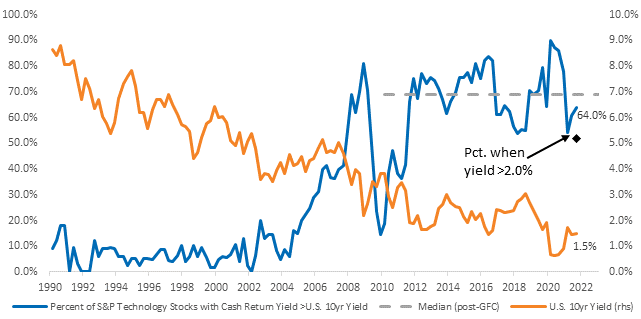
SIDE NOTE ON TECH: 64% of S&P 500 Tech stocks have a cash return yield greater than the 10yr. And earnings season should reinforce the sector’s strong cash flow and solid earnings trajectory. Earnings season could be a catalyst for Tech to rebound from its oversold conditions.
MARKET VIEWS: S&P futures are higher, but UST yields and oil prices up too, which will likely weigh on sentiment short term. People are getting bombarded with stagflationary articles, which will continue to have an impact until investors are more comfortable that supply chain pressures are easing. We will continue to focus on the demand side, which is firm, and how that translates into sector, factor and overall market calls. Yesterday we discussed our factor tilts (long US focused cyclicals, long reopening, long small caps, short defensives short spec tech, long profitable tech vs unprofitable tech) and today will we focus on oversold conditions and how to think about S&P fair value. The bottom line, the recent outperformance of Value is consistent with relatively strong US demand and a bias higher in UST yields. The Delta wave was a clear problem for Value.
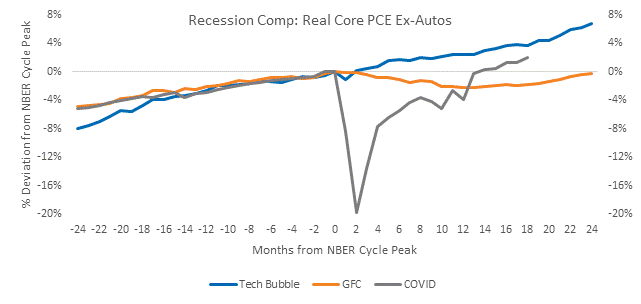
On demand, our economist Gerard MacDonell made an important point on personal consumption expenditures (PCE): if you net out of your analysis the “epicenter of the supply bottlenecks, which is the auto sector. (In order to facilitate a comparison of quantity and nominal with price, I will also net out food and energy here.) Nominal demand outside autos has remained quite strong and has been coincident with continued strong growth in the real or quantity component there as well. The chart (below) shows levels, rather than growth rates directly, but the 5-month rate of growth of real ex-auto PCE since March has been 5%.” The bottom line from Gerard, “consumer demand growth has remained solid, although clearly less boomy, and underlying inflation appears to have picked up somewhat. That is worth knowing when thinking about the bond market.” Internals seem to reflect what Gerard has noted.
The market is dealing with a number of concerns, but demand doesn’t seem to be one of them. Death by a thousand China cuts, debt ceiling, rest of Asia supply constraints, gas prices in Europe surging, oil likely headed to 100 (so we are told) etc.,. That has led to a sharp selloff and oversold conditions. Currently 16% of Nasdaq stocks and 28% of the S&P are trading above their 50-day moving average. Which is well below the 25th%tile. Forward returns tend to be stronger than normal on a 1/3/6 month basis when this is the case. We like looking at the percent of names trading above the 50 day because it has a long history and high hit rate in oversold conditions (65%+ depending on the index).
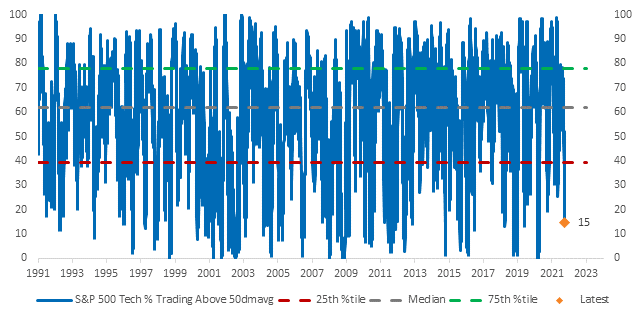
Tech dramatically underperformed the S&P yesterday, contributing -0.61pp to the -1.3pp decline in the index. Now only 14% of Tech is trading above their 50dmavg. That’s the lowest since the pandemic market crash.
64% of S&P 500 Tech stocks have a cash return yield greater than the 10yr. And earnings season should reinforce the strong cash flows and solid earnings trajectory for most large cap tech stocks. Earnings season might be a catalyst that helps Tech rebound from the oversold conditions
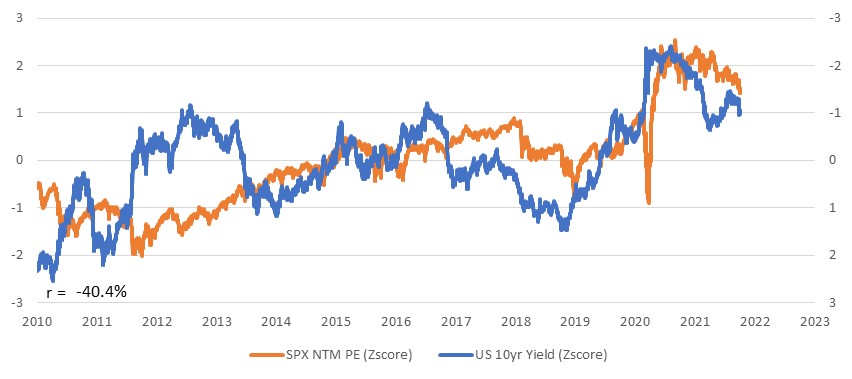
FAIR VALUE STILL HIGHER: Oversold conditions are meaningless if the market is extremely overvalued and a shock or recession is likely. Bond yields have moved significantly off the lows, which has pushed PEs lower, but that does not mean the S&P should be headed lower. What matters is how the equity risk premium moves in relation to bond yields.
Falling equity prices, strong earnings and cash return have left equities relatively attractive when compared to bond yields. The implied equity risk premium (ERP), as calculated by NYU professor Aswath Damodaran, remains at the high end of its long-term range (low relative to post GFC period and we cover why that is important below). As growth normalizes and tail risk is further reduced (COVID ceases to be an existential threat, the debt ceiling is raised, supply chain issues ease), the equity risk premium should fall further. Monetary and fiscal policy that is more inflationary, relative to the last cycle, is why we believe equity risk premiums should move toward the long term median. We are assuming the persistent risk of the zero lower bound starts to fade.
Computing S&P fair value using Damodaran’s framework, which accounts for earnings, cash return, the ERP and the level of bond yields (And has proven very useful in the post-GFC era) is dependent on a handful of decisions. The first is forecasting earnings and cash return. To keep our fair value exercise tied to broad market expectations, we use Bloomberg consensus estimates and the post-GFC trend level of EPS growth.
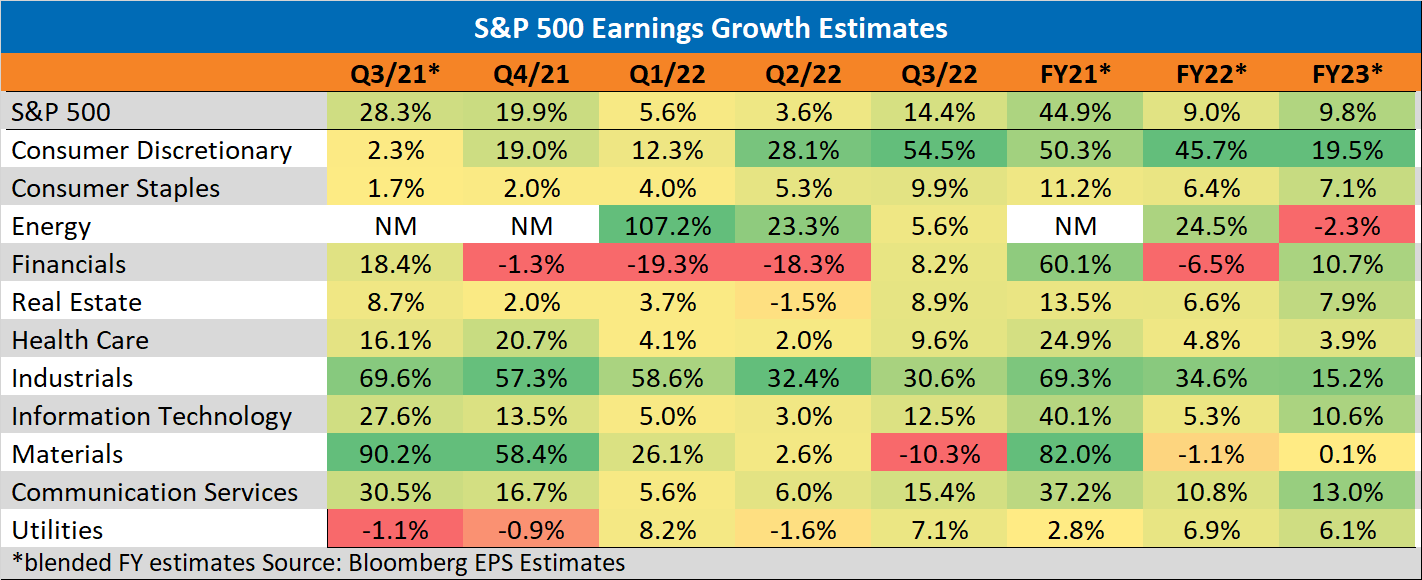
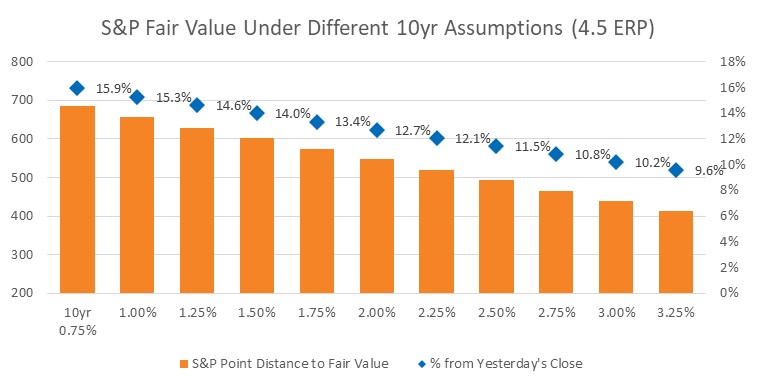
The other key questions is what will earnings growth, with particular respect to bond yields, look like over the coming years. We are using a long term EPS growth rate greater than the long term level of Treasury yields because historically S&P earnings have expanded at a faster pace than broad economic growth (you can tie this into R* being persistently below G as well). Below we layout the math behind of fair value calculation, which leaves us with an S&P fair value of 4,900. The fair value assumes that 10yr yields stay around current levels and the equity risk premium falls to 4.5%. Our call is not 4900 S&P as bond yields are likely to increase.
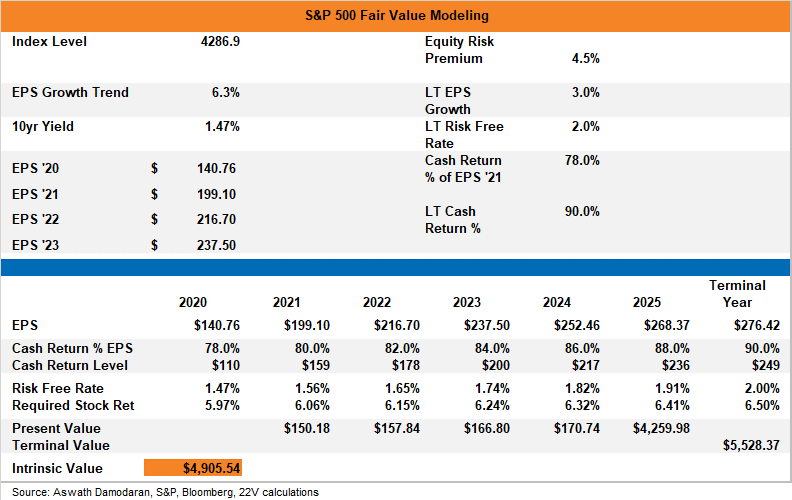
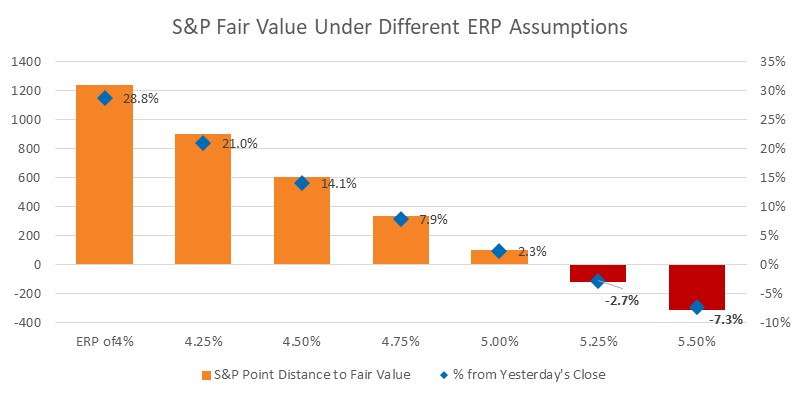
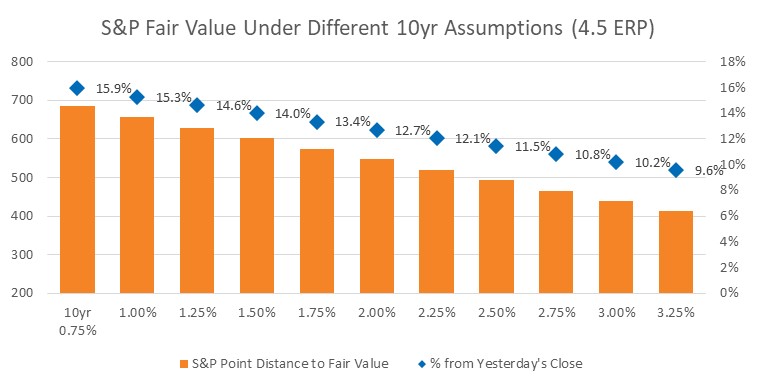
To demonstrate the sensitivity of this analysis to changes in bond yields and the ERP, in the chart below we show fair value under different assumptions. If the U.S. fails to raise the debt ceiling or supply chain issues do lead to demand destruction the ERP will rise and the S&P will struggle. If the ERP stays around the current levels and bond yields don’t change, the S&P has 8% upside.
Fair value is insensitive to temporary shocks to earnings. A 20% decline in a single quarter’s earnings growth puts the market close to fair value. A persistently lower level of earnings would have a significant negative impact on equities even if the ERP held steady. Changes in the outlook for the 10yr yield, independent of change in the ERP, also have relatively little impact on fair value. The important point from the chart below, even if the equity risk premium stays around its current level (which is on the high side) and 10yr yields move up to 2% to 2.5%, the S&P would still have some upside to fair value.

FYI… below are the fair value assumptions using a 4.5% ERP (which we think is more likely) and different 10yr yield assumptions.
A shift higher in equity risk premiums, to a range that is more consistent with the post GFC period (when disinflation was a significant risk) would be a problem for equities. Especially if 10yr yields moved higher at the same time. As shown above, a 5.2% implied equity risk premium suggest the S&P is currently overvalued by 2.7%. The bears would argue persistent supply shocks, long term China issues and similar economic growth to the post GFC period will keep ERP in the post GFC range. If the risk just mentioned start to fade, investors will focus on the pro-inflation monetary policy regime and sea change in the consensus approach to fiscal policy, which should help drive equity risk premiums lower. 10yr yields will rise at the same time, which will ultimately limit market gains, but the market will be biased higher. Bottom line, if you have a long-term view and believe we are in a different regime relative to the post GFC period, take advantage of oversold conditions to buy stocks.