
Federal Reserve System decision makers set the crisis policy response model in March-May 2020, after distinguishing themselves during the 4Q08-2009 Great Recession. By no means a perfect institution or history, the Fed nonetheless demonstrated the advantages of policy preparations. Its leaders and senior staff thankfully engage a rolling informal ‘beige book’ conversation with businesses, markets, and workers that comprise the US economy. This finger-pulse feedback loop enabled most stakeholders to avert worst case scenarios, even if the top-down policy approach originated in 1913 did not address all economic policy shortcomings including those imposing inequities on many communities, essential workers, and their households.
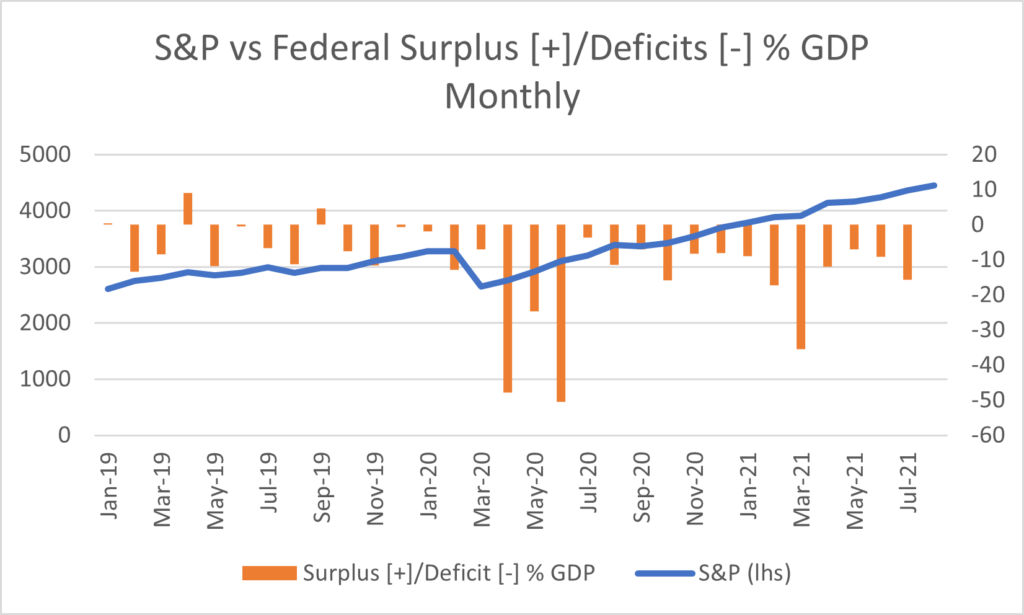
But then that’s why we have fiscal authorities. In fact, it’s entirely fair to ask if the fiscal policy response was as professional and targeted as the monetary authorities’ thinking and action (clear PPP facility excesses aside). And if not, why not. The accompanying chart cannot tell the whole story, but we know markets are in better shape now than many households. This dichotomy will persist as a discussion and possible action topic throughout the year.
From a sentiment and then valuation basis, the S&P 500 recovered in three relatively quick weeks from what undeniably looked and felt like an abyss. Dramatic deficits are all we have to show from the fiscal response thus far, although August numbers revealed a hopeful sign of a slight narrowing of the current fiscal year deficit. Employment and wage data show improvements since the March 2020 super shock but with roughly 5 million more jobs to create or fill to breakeven, and wage increases being ravaged by pandemic-induced inflation.
As Democrats debate whether and how to continue loose fiscal policy after markets and the economy have recovered, one enduring central banking lesson is to not prematurely pull support. The pending reconciliation and infrastructure packages present a turn toward multiyear stimulus to address some of the failures of public and private policies in place for decades. These include regressive redistribution and corporate decisions favoring capital holders over labor providers.
Fed and Treasury officials get to share their opinions about successes and near-misses with the Senate Banking and Urban Affairs Committee today and the House Financial Services Committee on Thursday. Both Treasury Secretary Janet Yellen and Fed Chairman Jerome Powell are set to testify before the two committee chairs most vocal about the short shrift workers and people of color experience as takers of economic policy. While on balance the institutions they lead deserve praise for steering through a difficult recovery, Chairman Sherrod Brown and Chairwoman Maxine Waters likely will focus on these policy shortcomings.
The US is fortunate to have a dual intermediation system of generally separated capital and financial markets often providing discernible choices for credit and banking customers and clients. Both Congress and the Fed have market oversight responsibilities, but their methods for executing those jobs are constitutionally different. However, one created the other which points to not only occupational contrasts but also significant gaps in comprehensive power. This relationship allows Congress to focus on mistakes whenever it wants.
Congress nonetheless could learn plenty from the Fed’s preparations-enabled crises responses of this century, should it seek that knowledge. Proponents of Bidenomics would tell Congress to avoid seeking political perfection in its response(s) to the detriment of wise, potentially important fiscal growth plans.
The Fed once again saved capital and financial markets from stresses the economy will never know because it came in with a massive and sustained response until the fire was out. Fiscal authorities, or at least those in the majority, have an opportunity to do similar work. That said, for Democrats set on publicly bemoaning the Fed’s inability or unwillingness to address all economic disparities, structural or transitory, votes in the coming quarter could allow Congress to express that viewpoint and help redress imperfections not within the remit of the central bank originated by their body.
Over the past six quarters, bipartisan fiscal managers stabilized pieces of the bottom-up economy out of direct reach of monetary policy. Congress now and likely through December will have a few opportunities to invest in people and their productivity to counteract decades of economic burden imbalances demonstrated by the consequences of the novel coronavirus.
While not seen in over half a century as the motivating national economic policy theory, Democrats believe Bidenomics offers fiscal policy a chance to shine despite partisan shade being thrown on its proponents. Senate Republicans’ rejection yesterday of an easy, early end to the latest round of debt ceiling madness ensures pressures will increase on Democrats to enact pro-growth fiscal policies this year designed to help workers and businesses thrive in the hoped-for post-pandemic environment

