
Both President Biden’s and President Xi’s UN speeches yesterday focused on the crucial US/China relationship. These bookends fit many of the headlines and realities of geopolitics but also fit the globally-focus macroeconomics of the G2 countries – both policy inputs and actual results. Biden is arguably the most experienced international affairs president in US history, but his party’s midterm elections and his 2024 re-election very likely will rise or fall on voters’ perceptions of his economic agenda – and him.
Ongoing fiscal negotiations are complex and fraught thanks mostly to an unusually thin voting majority and the deep partisanship it reflects. The ‘Senate man’ from Delaware by way of Scranton, PA, and his team have engaged an ambitious fiscal policy agenda that remains generally popular, even if pandemic numbers are slightly better. The most recent Fox News poll shows 55% of respondents approve of Biden’s handling of the pandemic, down from 64% in late June. His economic job approval rating was an even 50% in this poll, interestingly, down only a point from late June.
Democrats remain strongly supportive of Bidenomics, which should give proponents at the White House and congressional leaders some leverage in bringing the package to fruition. The latest Navigator polling shows nine out of ten self-identified Democrats in support. It must be noted the same poll reports two-thirds of respondents in favor of the plan. Democrats’ national party commissioned the poll. We don’t know if the Fox or Navigator poll survey carry implicit or explicit bias; the overall economic support reading would suggest at minimum the two organizations did not speak to the same people at the same time. At least.
All in, the public spotlight will shine brightly on economic policy and consequences in the upcoming quarter. As we write, two deadlines are important and will drive other temporary or contrived deadlines throughout the quarter. September 30 is the end of the current fiscal year. Congress must decide whether, how, and for how long routine government operations should be funded in the coming fiscal year. October 31 is the latest deadline Secretary Janet Yellen implied Congress had to avoid defaulting on paying bills incurred largely before Biden’s inauguration. We see no reason yet to change our posture of fading fiscalamity headlines. That time could come, but for now buy the fade.
In life and especially in politics it is a common trait to confuse or morph uncertainty with risk. It is wholly unsurprising that headline writers do not see “progress” or a “path to success” among “squabbling” Democrats. This is the stuff of governance. While it is too soon to know outcomes because we haven’t yet bumped against a hard deadline, any progress being made today is in private by design.
However, the House schedule was set last week for a continuing resolution and debt limit action. The Rules Committee yesterday completed that schedule, and the full House passed the bill 220-211 last night. The continuing resolution will now be sent to the Senate for consideration. GOP statements this month put odds against the Senate leaving the debt limit provision in the CR. Regardless, Republicans likely will vote to extend FY21 government funding even if that outcome takes another week. Going back to our major fiscal policy legislation table updated on Monday, disaster money and routine government funding carry little risk. The path forward on infrastructure is set even if House scheduling presents a smidge of risk. Those are the easy three pieces. The other two, long-term debt limit accommodation and reconciliation (carrying the President’s stimulus program) are much less certain from a timing standpoint. More than the debt limit outcome, barring an unlikely default, Biden is the compelling factor in stimulus endgames.
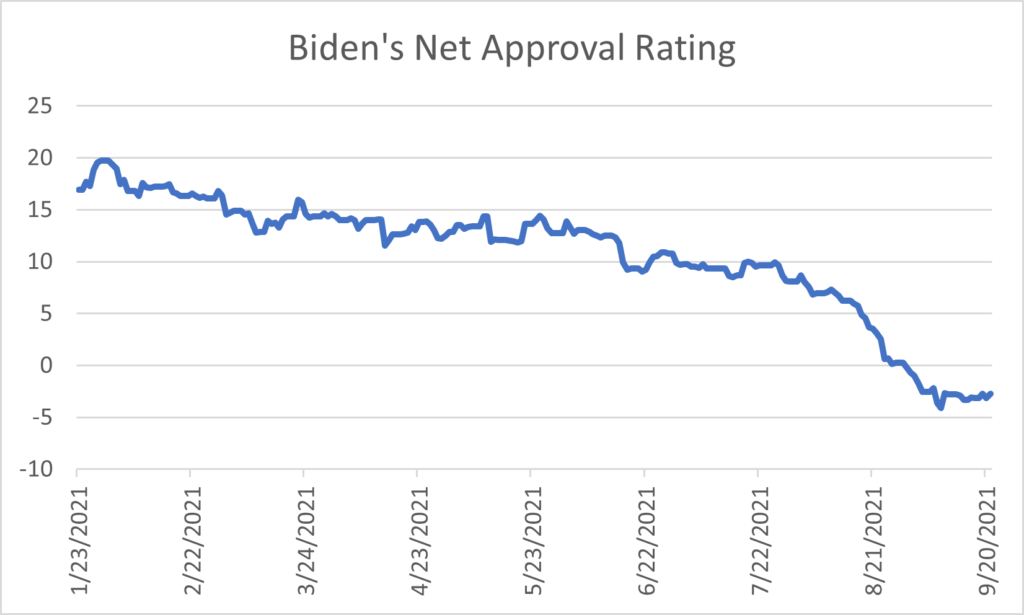
That the pandemic and related economics would drive the 46th US president’s policy agenda was and remains a given. Geopolitics clearly has affected President Biden’s approval rating, presenting him with the first full-on crisis to manage in real time with most of the Afghanistan decision implementation phase playing out very publicly. Fairly or not, that is how it usually goes for presidents. Nonetheless, he, his advisors and his Capitol Hill partisans know it is economic policy that most makes administrations look smart or otherwise. Biden is scheduled to meet with Democrats’ leaders today. It’s fair to say Biden is Democrats’ hope and risk but that’s akin to observing the horns section made the Tower of Power.
President Biden’s economic agenda aligns with the beliefs of most congressional Democrats. We will know before the year is out whether the messenger is as motivational as the message. US presidents overall fare poorly in their first midterm election achieving at best mixed results but mostly losing records. Since the Depression two notables stand away from this history and likely because their economic programs rallied the nation to some degree but certainly energized their bases. Franklin D. Roosevelt in 1934 added nine seats each in the House and Senate, and George W. Bush added eight seats in the House and two in the Senate. At present, Biden’s political risks and opportunities seem certain

