
Friday angst ballooned over the weekend into full bore debt contagion worries. Stepping away, momentarily, from your favorite metaphorical cliff reveals an embrace of something most of us have long known: economies, markets, and headlines are overly reliant on policy for sustenance. Both understandable and sub-optimal, the world is long overdue for downside glimpses into dominant macroeconomic policy thinking. Our overall view is that Congress will act on the debt ceiling. That said, the volatility in the market this morning is still justifiable on the basis that the inherit risks in fiscal policy have been known and have not been sufficiently considered by the market yet.
The pandemic recovery here and globally certainly wasn’t available without massive stabilization and stimulus inputs from central banks and fiscal authorities. The mistake was that too many economic actors have relied on loose policy since March 2009. Equity markets reacted favorably to US measures of banks’ well-being in the shadow of the 2007 global credit market freeze, 2008 Lehman bankruptcy, and subsequent global equity market selloff, the following financial recession, and the ill-advised 2010-2014 dance with fiscal austerity despite loose monetary policy.
For much of the past 12 years markets have relied on financial engineering, policy accommodation, and a concentration of benefits to the top of the economic pyramid. In the US, this trend topped many decades of underinvestment in human and physical infrastructure that has limited organic growth. There is no counterfactual to the pandemic’s exposure of economic cleavages that exacerbated the 2020 recession. Most of all, the lack of a ready system to support essential workers required to address the health and economic disaster from Covid-19 left the US and many countries vulnerable to protracted risk. We were never going to have a V recovery because we lacked sufficient preparations for it.
Counter-cyclical policies preformed the necessary stabilization, but it also added to debt loads that began accelerating after 2017 tax cuts that weren’t financed by adjustments to the budget or by growth. President Biden’s economic program leads with worker, family, innovation, and climate investments. Debt from his policies hasn’t hit the books yet. More importantly, many of those proposals are designed to grow the economy which holds out hope of reducing debt over time.
Media outlets compete for eyeballs and sometimes mind share. During times of crisis, the former gets more space than the latter. We are living through such times. It’s true that every day until Washington solves this debt limit impasse and Beijing escalates actions to contain Evergrande fallout, headlines will increasingly darken. On this side of the Pacific, we would note that observations of a lack of progress on the fiscal front are to be expected and usually don’t reflect an accurate picture. The tough discussions that could avert worst case outcomes on all pending fiscal legislation aren’t and won’t become known to outsiders until deadlines inform us of success or failure. The following table updates that legislation.
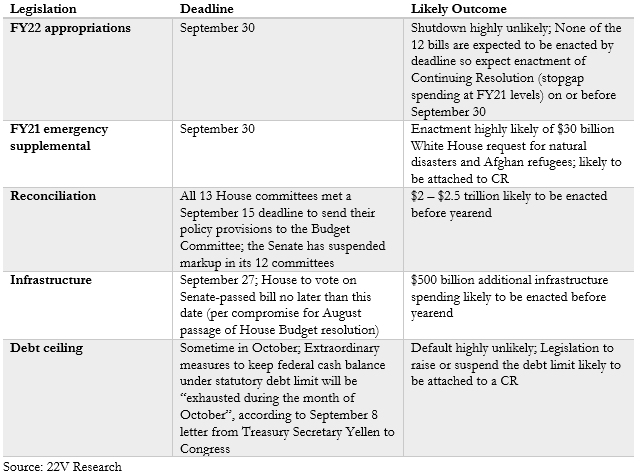
Trading headline volatility caused by politicians isn’t a new game. Keep in mind that schedule slippage, mis- and dis-information, and even temporary setbacks are all part of the game. Congress very likely will work through a series of risk flares this month and next. The record nonetheless shows that worst-case outcomes rarely develop. This is especially true of debt ceiling dramas.
If there ever is a moral to a policy story, we are living through one now. Macroeconomic policy (monetary, fiscal and trade) that doesn’t use resources wisely in the present while sticking to a longer run discipline risks accumulating imbalances that complicate future policy making. The western hemispheric austerity of last decade wasn’t a plan, it was a reaction. Procyclical tax cuts, for example, wasn’t aimed at sparking growth; the intent was to reward winners, many of whom benefitted most from periods of loose monetary and fiscal policies. Trade liberalizations of the past four decades ignored the stakes of workers, resulting in populism that jeopardizes even trade policies with clear geopolitical and worker upsides.
Bidenomics may not represent an answer to these problems but the people and physical investments at its core are politically and practically acceptable attempts at engendering sustainable, fairer growth. So, on this Monday morning, we’re treated to volatility focused on different kinds of debt in the two largest global economies. Markets’ attention is warranted, but arguably that’s a long overdue condition as we have been living on borrowed time (and money) for over a decade. Policy helped get us here and, unfortunately, in the nearest of terms for lots of reasons it likely is the only bulwark against very ugly developments.
Secretary Janet Yellen’s op-ed published today by the Wall Street Journal warning of some of the risks attendant with US government default makes all the right points in the right tone. Both her tone and the risks will rise from here until this accounting chore concludes. Then we can focus more on the range of possible risks from large global private and public debt and how best policy might contribute to enduring growth.


