

In this note, I argue that (probably) rising term premia* mean that the yield curve will be inclined to steepen over time. However, there is little reason to believe that rising term premia will have much effect on overall financial conditions, which – to a first approximation – will continue to be set by the Fed.
Before getting into that, though, I need to offer the usual two caveats about arguments involving term premia. First, when I refer to term premia, I mean the premia found in the text book, which is the excess return that investors require to take default-free duration risk. These premia have nothing to do with concerns about fiscal sustainability or associated fears of default, either implicitly or in the form of inflation. If you follow the popular convention and think of “the” term premium as badness in the bond market, you will miss this argument.
Second, we may be fairly confident that term premia exist. But we can have little confidence that our measures of them are accurate. I work with what are probably the most widely accepted measures of term premia as a partial reality check. But I am aware that these measures are estimates. In some ways, the argument I offer here is a bit hypothetical. If we take it as given that term premia will continue rising, then what might we expect of broader macro trends in response to that?
Why higher?
With that in mind, let’s quickly refresh on why term premia are probably headed higher. The main reason is that the large fiscal deficit is dumping a lot of (still-presumably-default-free) pure rates duration into the market. And if the demand for rates duration slopes downward, then the yield concession required to have this duration taken down, i.e., the term premium, will have to rise. Separately, but in a way that reinforces, duration risk should now be more difficult to take down because the stock-bond correlation has switched from “ice” to something closer to normal, with perhaps a slight nod toward “fire.” So, duration risk is no longer diversifying within the representative portfolio. And this points to further upward pressure on term premia – and I would guess increased sensitivity to duration supply itself. In other words, both the constant and the coefficient on supply have increased, I think.
The main cause of the stock-bond correlation shift is the escape from liquidity trap, which – admittedly – fiscal expansion helped bring about. But that is separate from saying this reflects a fiscal problem. Secondarily, perceived inflation risks have probably become more rightward skewed, in response to the development mentioned above and because of the recent experience of high inflation and perhaps also the leadership change at the Fed. But the main driver here would seem for now to be the escape from liquidity trap. And that is not badness in the bond market.
Estimated ten-year premium and 2s10s slope
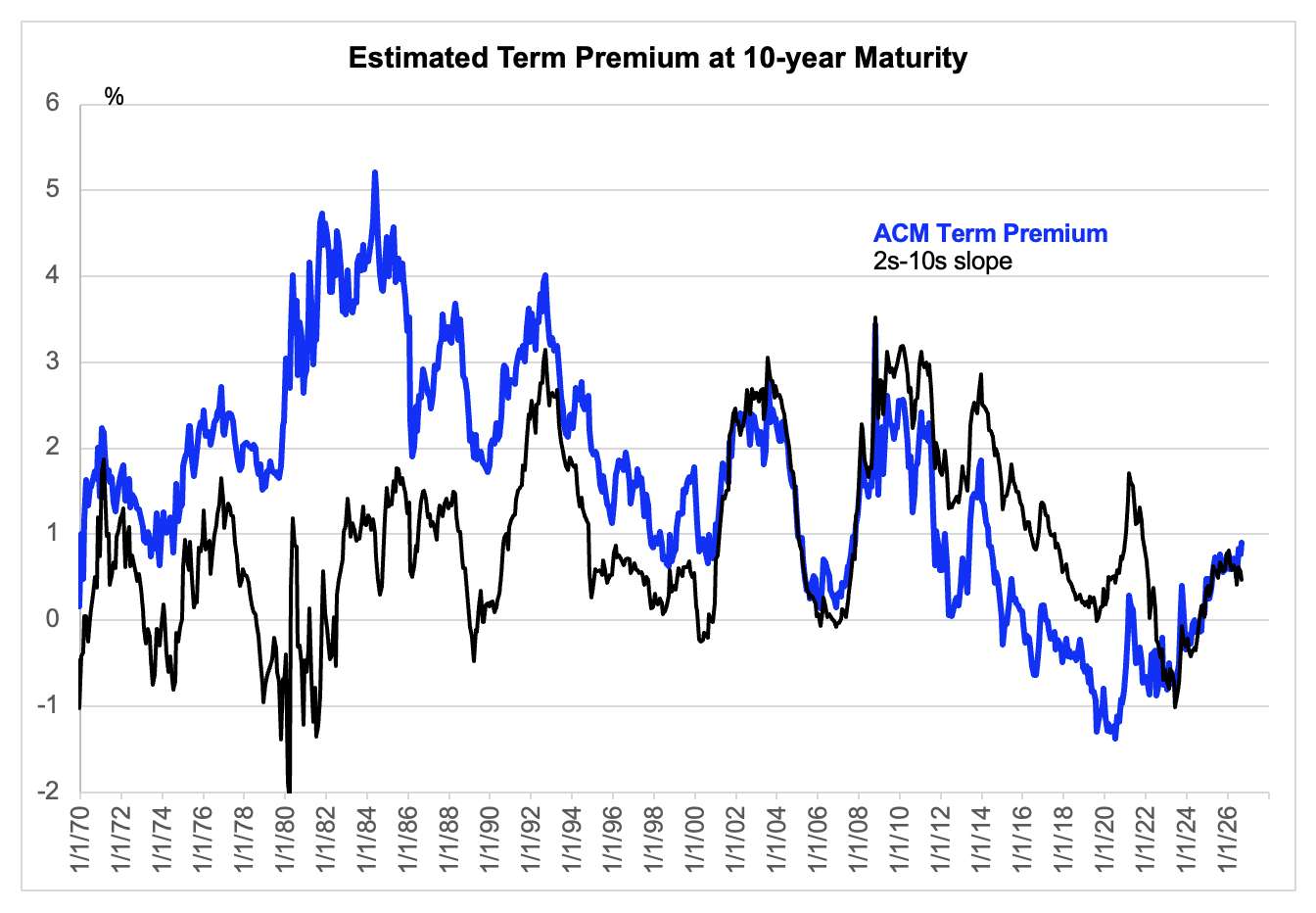
Data are monthly, although the last observations are daily values as of October 1. There can be a bit of a reporting lag in these data.
Steeper curve
One obvious effect of a higher term premium should be a steeper Treasury yield curve. The reason is that the slope of term premia across the maturity spectrum tends to steepen when the representative term premium is rising. So, for example, if we figure the term premium at the 5-year maturity is going to rise 25 basis points, then we might expect a 10 basis point rise at the 2-year maturity and a 40 basis points rise at the 10-year maturity. Higher means steeper, in principle (so far as I can tell) and as measured, especially when the term premium is meaningfully positive.
But term premia are not the only or even main influence on the slope of the yield curve. Especially at short horizons, the slope of the curve is dominated by changes in the expected path of interest rates. If policy is believed to be tight, then short rates will tend to be expected to fall in the future, as the tightness has had its effect, which will impose a strong flattening influence on the curve, even if the term premia are grinding higher. The chart above provides a picture of that. But keep in mind that the 2s10s slope is known while the 10-year term premium itself is only estimated.
Measurement issues aside, this explains my claim that rising term premia favor a tendency for the curve to steepen over time. A good guess of the average expected change of rates over time is zero, because monetary policy will on average be neither tight nor easy. And under that assumption, the trend in the slope of the yield curve will be dominated by the term premium, at least if it is moving a lot.
Before leaving this issue, I want to address something you may have noticed in the chart. I assert here that the term premium influences the slope over time. And yet the chart shows a very tight correlation between the estimated 10-year premium and the slope at short horizons. Isn’t that the opposite of my claim? That correlation is probably an artifact of imperfections in how the term premium is estimated. But, yes, it is a fly in the ointment. As mentioned, the term premium is not observable and my argument here is largely speculative.
No systematic effect on overall financial conditions
The point mentioned above probably go down fairly easily among most readers. But the second point I want to raise here may strike you as more controversial. Even if term premia rise steeply in response to rapid duration supply hitting an increasingly inelastic market, we should expect no systematic effect on overall financial conditions. The reason is that the Fed retains last mover advantage here, by virtue of having plenty room to cut (or avoiding raising) short-term interest rates if conditions suggest that is appropriate. To the extent that rising term premia imply tighter financial conditions for any given level of the funds rate, they will also imply a lower fund rate (than otherwise).
This may seem like a rather theoretical point given our recent experience, which has been one rising term premia and the need for less expansionary financial conditions. In recent months, the funds rate, its expected path, and the term premium have all been moving to deliver restraint, although incidentally in the third case. But if inflation pressures were to ease and / or demand conditions were to soften, then this would change, and a tendency of the term premium to rise would be offset by a lower funds rate. Again, this is easiest to internalize if you think of the term premium in its text book sense rather than as badness in the bond market.
We can see that lower short and near intermediate rates might offset the economic drag from higher long and far intermediate rates. But how this relates to the equity market is much tougher for me. We know that higher 10-year rates make the conventional measure of the equity premium (EY less real yield) fall, absent a compensating decline in equity prices. But I keep an open mind on this, even though I am not currently enthusiastic about equities.
If a higher term premium related specifically to duration supply lowers the path of short rates, all else equal, without affecting the likely pace of GDP growth, does that really mean downward pressure on equity prices? It would if the true equity premium and term premium were equal, but that is very unlikely to be the case. Arguments involving the term premium are tough. But unfortunately, that does not give us the right to just ignore this issue.
* I usually refer to the term premium, in the singular. But it is helpful to use the plural in this case, for reasons that I hope are obvious.

