Back Quantitative

Quant Market in Numbers: Macro Risk from Rising 10yr Yield Remains Limited

Published on October 1, 2026

∙ Download the PDF Report

By

Dennis DeBusschere

Sophia Wang

Kevin Brocks

Frodo Gu

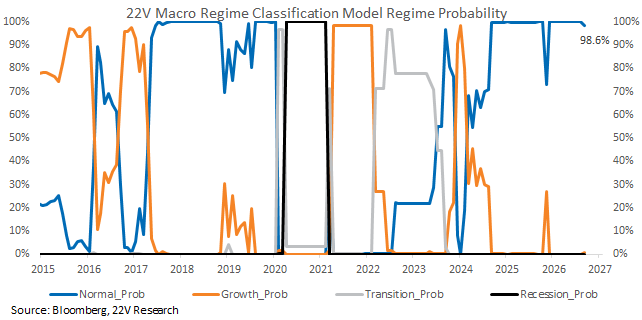
Rising Treasury yields and tighter financial conditions have pressured risk assets, but our Macro Regime Classification (MRC) model continues to indicate a stable Normal expansion. This regime has persisted for more than 2.5 years, with its probability changing only marginally despite the surge in yields and recent market volatility.

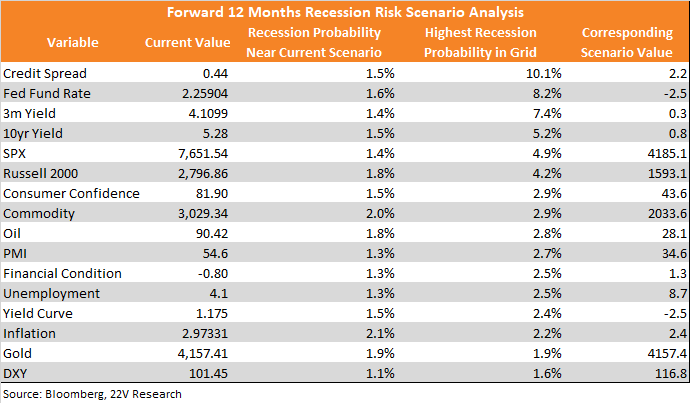
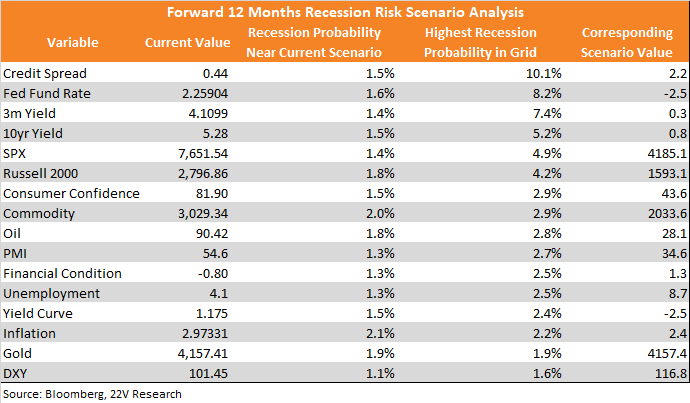
To assess whether further macro shifts could alter that backdrop, we combine a Bayesian vector autoregression (BVAR) with our MRC framework. The BVAR projects macroeconomic variables jointly, capturing their historical relationships rather than assuming they move independently. We then translate these conditional forecasts into regime probabilities over a 12-month horizon. For now, a recession happening in one year is very low, with the highest probability only 10.1% if credit spreads widen sharply.
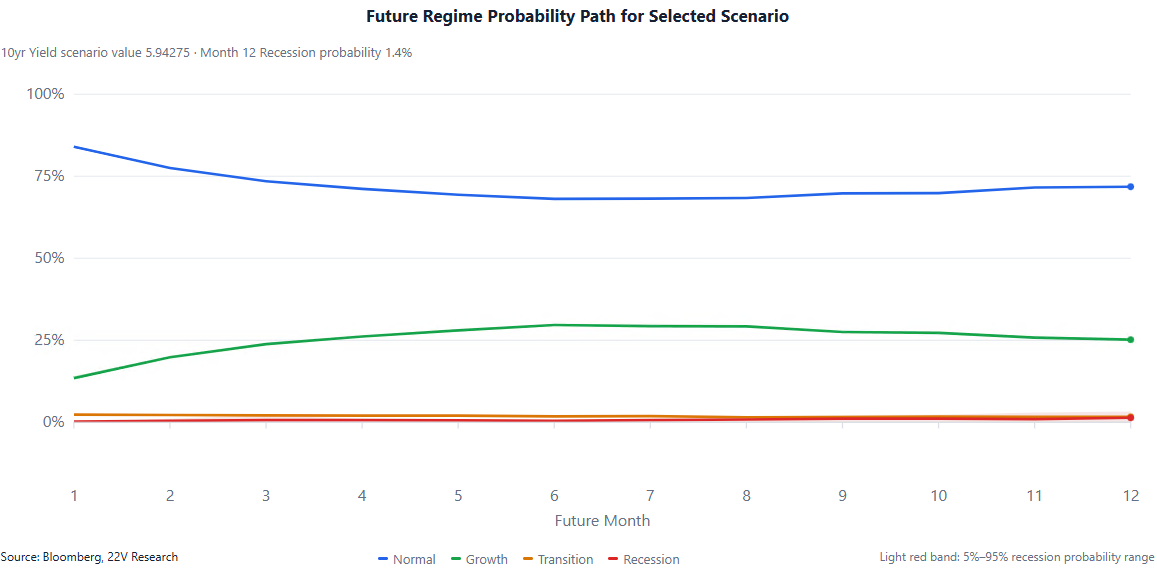
U.S. 10-year rising 53bps in September to 5.28% has been a major macro concern. Nevertheless, other macro data is stable to better over the same period, leaving the odds of being in a Normal economic expansion the dominant projected regime over the next six months (probability is around 70%). Even under scenarios where yields approach 6% leave the one-year regime outlook relatively stable. The results suggest higher yields alone are unlikely to derail the expansion.

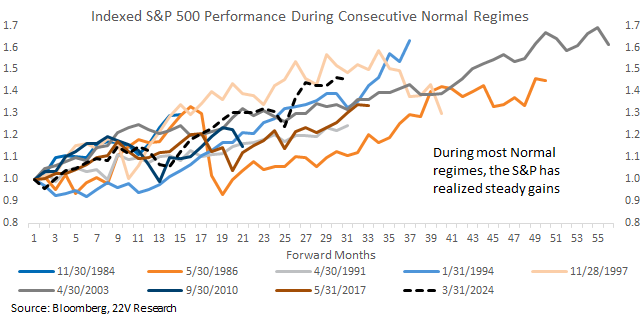
For equities, these findings suggest the downward pressure on equities should be a short-term phenomenon rather than a long-term turning point. Historically, stable Normal expansion backdrops have supported an upward trend in S&P returns, making continued regime stability an important counterweight to concerns surrounding the Fed rate hiking cycle.

Macro Risk from Rising 10yr Yield Remains Limited: Rising 10-year yields and tightening financial conditions have put pressure on risk assets recently. Other macro data have been stable, however, and based on our Macro Regime Classification (MRC) model, the macro backdrop continues to be best classified as one of a Normal expansion regime. That has been the dominate regime for more than 2.5 years.
It is important to understand how forward macro readings may impact the regime classification. Macroeconomic variables rarely move in isolation. Changes in interest rates, inflation, employment, financial conditions and market prices occur together and influence one another over time. So, we have added a Bayesian vector autoregression (BVAR) to model these relationships and to generate joint monthly forecasts.

This forecast framework also allows us to ask conditional questions, such as how other macro readings may evolve if 10yr yields or credit spreads reach a specified value next month. The model adjusts the other variables according to their historical relationships and carries the resulting paths forward over a 12-month horizon. So, scenarios describe conditional outcomes rather than causal effects.

We then feed each projected macro path forward 12 months to our Macro Regime model to get the probability of being in each regime a year from now. This enables us to turn macro scenarios into a view of how the economic regime may evolve. For now, a recession happening in one year is still a very low risk, with the highest probability only at 10.1% if credit spread (measured as Moody Corporate BAA – AAA spread) rise sharply from current 0.44% to 2.2%.
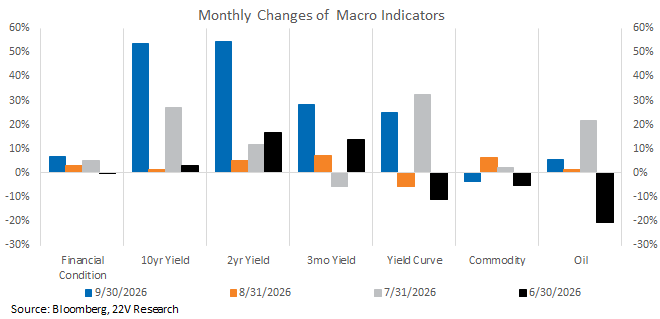
Over the past few months, yields and financial conditions have tightened alongside a backup in oil prices, driven by geopolitical uncertainty. Those have been the macro swing factors with the greatest impact on equities. Yield changes have been especially dramatic with the 10yr yield climbing 53bps in September to 5.28%, the highest level in two decades.
Based on our scenario analysis model, the impact of 10yr yield changes on the forward 6 month macro regime is limited. The odds of being in a Growth regime increase as 10yr yield rise, but the probability of the Normal regime continuing remains at ~70%. This means that taking the co-movement of other macros variables with 10yr yield moves into consideration, the regime is still likely to be at normal expansion.
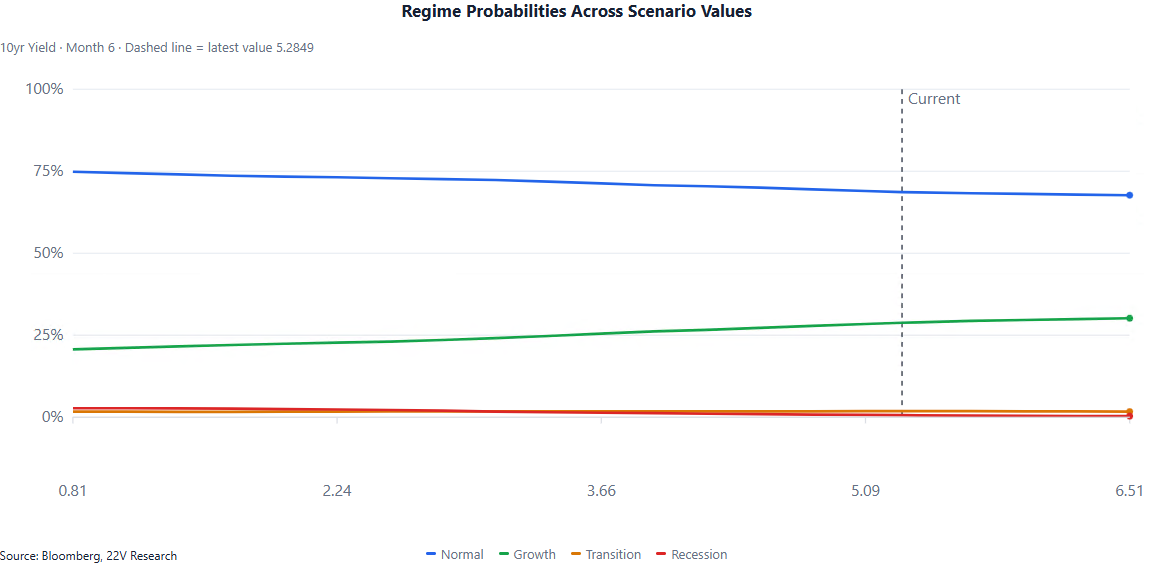
Even if 10-year yield climb near 6%, the forward one-year regime path is still relatively stable. Growth regime probability rises while recession risk remains low. The impact from rising yield is more near-term than long-term.
The stable forward macro regime is important for risk assets. Investors are concerned about tightening financial conditions and a growth slowdown as the Fed starts a hiking cycle, and S&P return has slowed recently as well. If macro backdrop stays one of a Normal expansion, the recent headwinds should be a near-term pressure than long-term turning point, as the S&P performance have been trending higher in historical stable Normal expansion backdrops.
DISCLOSURES AND DISCLAIMERS

Analyst Certification

The analyst, 22V Research Group, primarily responsible for the preparation of this research report attests to the following: (1) that the views and opinions rendered in this research report reflect his or her personal views about the subject companies or issuers; and (2) that no part of the research analyst’s compensation was, is, or will be directly related to the specific recommendations or views in this research report.

Analyst Certifications and Independence of Research.

Each of the 22V Research analysts whose names appear on the front page of this report hereby certify that all the views expressed in this Report accurately reflect our personal views about any and all of the subject securities or issuers and that no part of our compensation was, is, or will be, directly or indirectly, related to the specific recommendations or views of in this Report.

22V Research (the “Company”) is an independent research provider. The Company is not a member of the FINRA or the SIPC and is not a registered broker dealer or investment adviser. 22V Research has no other regulated or unregulated business activities which conflict with its provision of independent research.

22V Research, LLC is a professional services and independent publication organization. 22V Research, LLC is not a securities broker-dealer, not a member of the Financial Industry Regulatory Authority (FINRA), not a registered investment advisor (RIA) and not a member of SIPC.

Securities transactions, when offered, are offered by 22V Securities, LLC through LPS Capital, LLC. Certain employees of 22V Securities, LLC are dually registered as securities representatives of LPS Capital, LLC or Analyst Hub Securities, LLC. 22V Securities, LPS Capital and Analyst Hub Securities are members FINRA, SIPC.

https://brokercheck.finra.org/

Current Ratings Definition.

SECTOR OUTPERFORM: An “outperform” rating anticipates the company will outperform the S&P Regional Banking Index (peer group).

SECTOR PERFORM: A “market perform” rating anticipates the company will perform in line with the S&P Regional Banking Index (peer group).

SECTOR UNDERPERFORM: An “underperform” rating anticipates the company will underperform the S&P Regional Banking Index (peer group).

Limitation Of Research And Information.

This Report has been prepared for distribution to only qualified institutional or professional clients of 22V Research Group. The contents of this Report represent the views, opinions, and analyses of its authors. The information contained herein does not constitute financial, legal, tax or any other advice. All third-party data presented herein were obtained from publicly available sources which are believed to be reliable; however, the Company makes no warranty, express or implied, concerning the accuracy or completeness of such information. In no event shall the Company be responsible or liable for the correctness of, or update to, any such material or for any damage or lost opportunities resulting from use of this data. Nothing contained in this Report or any distribution by the Company should be construed as any offer to sell, or any solicitation of an offer to buy, any security or investment. Any research or other material received should not be construed as individualized investment advice. Investment decisions should be made as part of an overall portfolio strategy and you should consult with a professional financial advisor, legal and tax advisor prior to making any investment decision. 22V Research Group shall not be liable for any direct or indirect, incidental or consequential loss or damage (including loss of profits, revenue or goodwill) arising from any investment decisions based on information or research obtained from 22V Research Group.

Reproduction And Distribution Strictly Prohibited.

No user of this Report may reproduce, modify, copy, distribute, sell, resell, transmit, transfer, license, assign or publish the Report itself or any information contained therein. Notwithstanding the foregoing, clients with access to working models are permitted to alter or modify the information contained therein, provided that it is solely for such client’s own use. This Report is not intended to be available or distributed for any purpose that would be deemed unlawful or otherwise prohibited by any local, state, national or international laws or regulations or would otherwise subject the Company to registration or regulation of any kind within such jurisdiction.

Copyrights, Trademarks, Intellectual Property.

22V Research Group, and any logos or marks included in this Report are proprietary materials. The use of such terms and logos and marks without the express written consent of 22V Research Group is strictly prohibited. The copyright in the pages or in the screens of the Report, and in the information and material therein, is proprietary material owned by 22V Research Group unless otherwise indicated. The unauthorized use of any material on this Report may violate numerous statutes, regulations and laws, including, but not limited to, copyright, trademark, trade secret or patent laws.
