Back Washington Policy

3Q26 Fiscal Policy Uncertainty Tolerable Another Six Weeks

Published on August 5, 2026

∙ Download the PDF Report

By

Kim Wallace

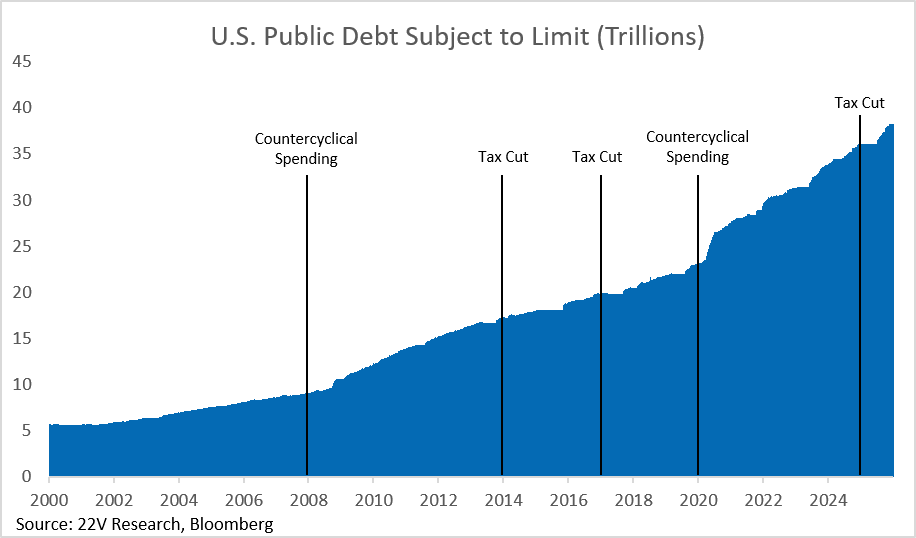
Fiscal policy suffers more than most DC substantive debates as narrow voting margins the past decade or so empower those in the tails of the political spectrum. Approaching $40 trillion (120% of GDP), US debt subject to limit nearly doubled in the period. Unfinanced countercyclical spending and tax cuts are major contributors shown in our accompanying graph. Demography-fueled entitlement spending, policy rates, and the self-feeding base of debts in the absence of remedial policy complete the picture. Washington seems unlikely to significantly worsen or improve the picture this year, but fiscal folly (our term is fiscalamity, coined 15 years ago) seems destined to inflate volatility in markets and on the floors of Congress before the October 1 start of FY27.
A graph of a blue graph with white text

AI-generated content may be incorrect.

Workable estimates delay until about this time next year the more worrisome, routine fiscal drudgery of debt ceiling adjustments. That is good news for now. In this quarter, Washington’s mild fiscal challenge includes a concise list:

  • Averting or accepting an Oct 1 shutdown of nonessential government operations.
  • Funding defense spending (entire FY27 Pentagon budget or just war FY26 supplemental)
  • Deciding by which method to fulfill the second objective.

The following 3Q26 fiscal scenarios attempt to frame risks not predict outcomes. At present neither Congress nor the White House offer guidance or even durable clues about resolving lingering fiscal uncertainties. One can glean from the past two weeks that Congress hopes to avoid shutdown fiscalamity one month out from midterm elections.

Likely Scenario (55-60%)

FY26 defense/nondefense spending supplemental (60-70%) or reconciliation (30-40%) by third full week of September ($50-100b).

  • Preclude shutdown through Nov 15/20.
  • Oct 1 shutdown odds today feel <20%. Grandstanding on both sides will become headline vol by Sept 17 or so and sentiment risk rises steadily if a deal does not materialize by Sept 25.

Plausible Scenario (25-30%)

Prior to election risk aversion motivating compromise, midterms friction forces the tails of each dominant party to pretend to possess or exert demonstrable leverage for terms favorable to partisan positioning.

  • FY27 begins under six-week continuing resolution through Nov 10 to maintain government operations.
  • $50b Defense replenishment funds, and a similar amount for emergency disaster relief.

Unlikely Scenario (10-20%)

Electoral risk aversion produces an October 26-November 6 very short-term agreement to reopen the shuttered parts of government.

  • Limited Pentagon replenishment funds with no bump to domestic spending.
  • Election intrigue fuels fiscal partisanship leading to another shutdown.

Important dates

April-July 2027 – next debt ceiling deadline window

Jan 3 – 120th Congress sworn in (date per the Constitution; the 4th more likely)

Dec 21 – target adjournment of the 119th Congress

Dec 2 – Congress returns from Thanksgiving break

Nov 20 – Congress breaks for Thanksgiving

Nov 10 – Congress begins lame duck session

Nov 3 – Election Day

Oct 6 – Congress recesses for elections (subject to uncertainty)

Oct 1 – FY27 begins

Sept 21-23 – Yom Kippur recess

Sept 14/1 – Senate and House conclude summer break, respectively (subject to uncertainty)

Aug 8/9 – Senate begins summer recess (House left two weeks ago)

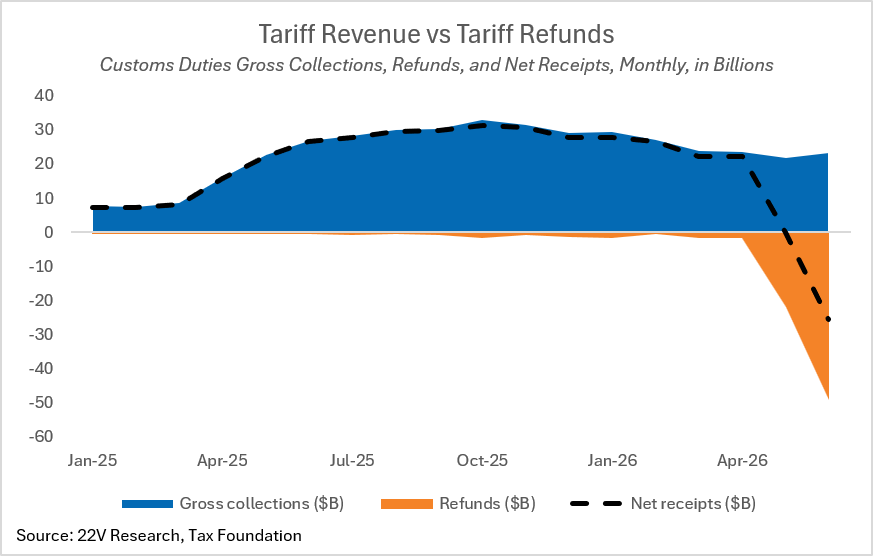
This calendar of potentially important dates and, in italics, those that could affect risk sentiment in the next five months with debt ceiling added for context. My sense remains that appropriations rather than reconciliation legislation is a more likely funding path for defense money this year. The latter requires explicit heavy lifts in the Senate. The following graph shows IEEPA tariff refunds weakening the 2H26 fiscal balance. Higher deficits and inflation headlines will not ease voters’ economic conditions concerns.
A graph of a blue line

The Senate Finance Committee today listened to testimony exploring ways to enhance Social Security solvency. Dr Alan Greenspan more than 40 years ago led the last successful effort to prolong solvency, well before the front end of baby boomers began drawing down benefits. Republicans embraced pursuit of another commission to insulate the effort from predictable zero-sum politics. Democrats favored Congress doing the job, recognizing politics as just one of many difficult elements of approving necessary policy.

22V Research summer intern, Alexis Curisaca meaningfully contributed to the note and conducted useful research of issues including trade, data centers,and cybersecurity. Thanks Alexis and have a great fall semester.


DISCLOSURES AND DISCLAIMERS

Analyst Certification

The analyst, 22V Research Group, primarily responsible for the preparation of this research report attests to the following: (1) that the views and opinions rendered in this research report reflect his or her personal views about the subject companies or issuers; and (2) that no part of the research analyst’s compensation was, is, or will be directly related to the specific recommendations or views in this research report.

Analyst Certifications and Independence of Research.

Each of the 22V Research analysts whose names appear on the front page of this report hereby certify that all the views expressed in this Report accurately reflect our personal views about any and all of the subject securities or issuers and that no part of our compensation was, is, or will be, directly or indirectly, related to the specific recommendations or views of in this Report.

22V Research (the “Company”) is an independent research provider. The Company is not a member of the FINRA or the SIPC and is not a registered broker dealer or investment adviser. 22V Research has no other regulated or unregulated business activities which conflict with its provision of independent research.

22V Research, LLC is a professional services and independent publication organization. 22V Research, LLC is not a securities broker-dealer, not a member of the Financial Industry Regulatory Authority (FINRA), not a registered investment advisor (RIA) and not a member of SIPC.

Securities transactions, when offered, are offered by 22V Securities, LLC through LPS Capital, LLC. Certain employees of 22V Securities, LLC are dually registered as securities representatives of LPS Capital, LLC or Analyst Hub Securities, LLC. 22V Securities, LPS Capital and Analyst Hub Securities are members FINRA, SIPC.

https://brokercheck.finra.org/

Current Ratings Definition.

SECTOR OUTPERFORM: An “outperform” rating anticipates the company will outperform the S&P Regional Banking Index (peer group).

SECTOR PERFORM: A “market perform” rating anticipates the company will perform in line with the S&P Regional Banking Index (peer group).

SECTOR UNDERPERFORM: An “underperform” rating anticipates the company will underperform the S&P Regional Banking Index (peer group).

Limitation Of Research And Information.

This Report has been prepared for distribution to only qualified institutional or professional clients of 22V Research Group. The contents of this Report represent the views, opinions, and analyses of its authors. The information contained herein does not constitute financial, legal, tax or any other advice. All third-party data presented herein were obtained from publicly available sources which are believed to be reliable; however, the Company makes no warranty, express or implied, concerning the accuracy or completeness of such information. In no event shall the Company be responsible or liable for the correctness of, or update to, any such material or for any damage or lost opportunities resulting from use of this data. Nothing contained in this Report or any distribution by the Company should be construed as any offer to sell, or any solicitation of an offer to buy, any security or investment. Any research or other material received should not be construed as individualized investment advice. Investment decisions should be made as part of an overall portfolio strategy and you should consult with a professional financial advisor, legal and tax advisor prior to making any investment decision. 22V Research Group shall not be liable for any direct or indirect, incidental or consequential loss or damage (including loss of profits, revenue or goodwill) arising from any investment decisions based on information or research obtained from 22V Research Group.

Reproduction And Distribution Strictly Prohibited.

No user of this Report may reproduce, modify, copy, distribute, sell, resell, transmit, transfer, license, assign or publish the Report itself or any information contained therein. Notwithstanding the foregoing, clients with access to working models are permitted to alter or modify the information contained therein, provided that it is solely for such client’s own use. This Report is not intended to be available or distributed for any purpose that would be deemed unlawful or otherwise prohibited by any local, state, national or international laws or regulations or would otherwise subject the Company to registration or regulation of any kind within such jurisdiction.

Copyrights, Trademarks, Intellectual Property.

22V Research Group, and any logos or marks included in this Report are proprietary materials. The use of such terms and logos and marks without the express written consent of 22V Research Group is strictly prohibited. The copyright in the pages or in the screens of the Report, and in the information and material therein, is proprietary material owned by 22V Research Group unless otherwise indicated. The unauthorized use of any material on this Report may violate numerous statutes, regulations and laws, including, but not limited to, copyright, trademark, trade secret or patent laws.